

Equipment installation is only as effective as the space and wiring behind it. Ford Explorer police interceptor upfitting can use the column shifter to free up room in the center console, while an available rear console plate provides a wiring channel from the front console toward the rear of the vehicle. These factory provisions offer a practical starting point for equipment layout.
Fitting radios, controls, and emergency lighting is only part of the job. Equipment placement, wiring routes, and power demands all affect how the vehicle performs in service. A planned installation makes effective use of available console space and factory connections while keeping equipment accessible.
This article explains how console design, factory wiring, emergency-lighting packages, and radio or siren pre-wiring support police equipment installation. It also covers the factors that shape an upfit, including equipment layout, electrical loads, and safe integration with vehicle components. You’ll learn what the Ford Police Interceptor Utility provides from the factory and how those provisions can guide a purpose-built installation.
Key Takeaways
- Use the column shifter’s freed console space to plan accessible equipment placement; the available rear console plate can provide a route for wiring toward the rear.
- Factory lighting packages differ by patrol configuration, so match the selected setup to the vehicle’s intended role and equipment layout.
- Factory siren, speaker and radio pre-wiring can simplify integration by providing prepared wiring paths for key communications equipment.
- Plan electrical loads as a complete system, including radios, light bars and other installed equipment, rather than treating each component separately.
- Route and install equipment with attention to vehicle components and officer safety, especially around airbags and other protected areas.
Column shifter and console space for equipment
The Ford Police Interceptor Utility’s column shifter leaves more center-console space available for police equipment. The Ford F-150 Police Responder also uses a column shifter. That open area can accommodate controls, communications equipment, and mounting hardware without competing with a floor-mounted gear selector. For Ford Explorer police interceptor upfitting, map each device’s position before fixing the console layout.
Start with the equipment operators need to reach while seated. Place radio and siren controls where they can be operated without obstructing essential vehicle controls. Group related switches, and leave enough room behind the console face for connectors and wiring. Even a compact layout should allow clear access to service individual components.
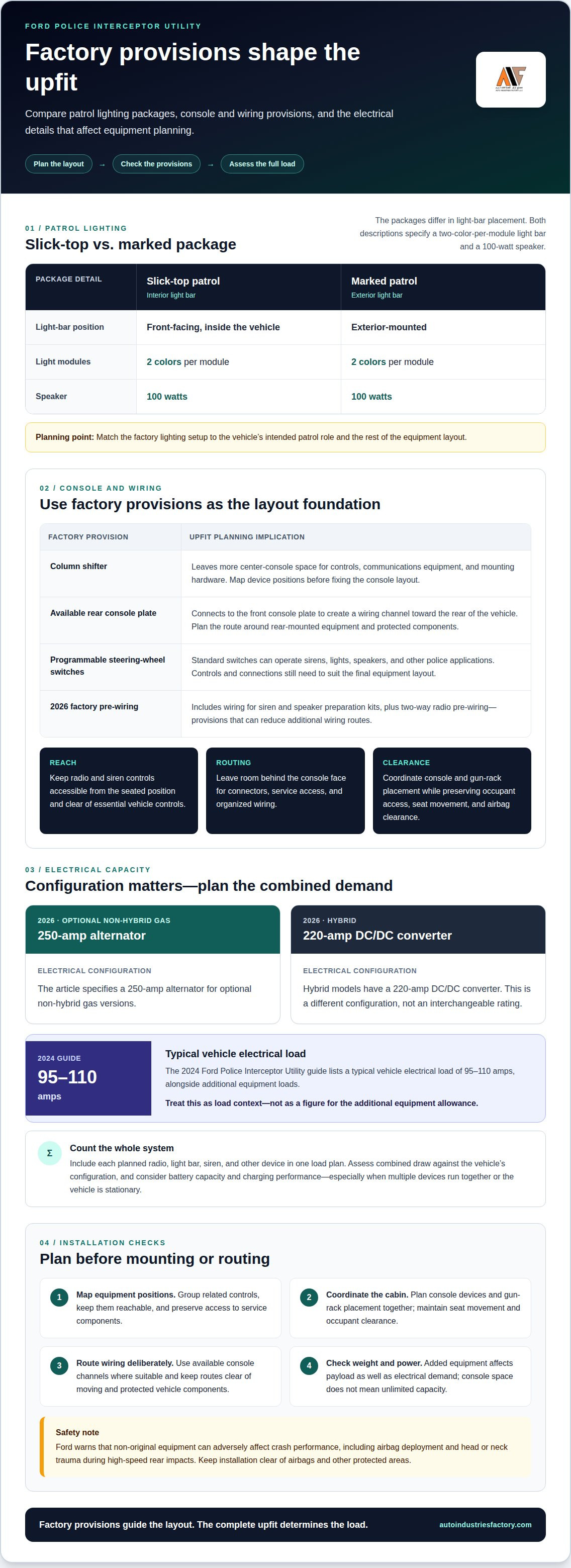
The available rear console plate connects to the front console plate, creating a wiring channel from the front console area toward the vehicle’s rear. This can help organize electronics wiring instead of leaving loose cables across the cabin. Plan the channel around the equipment’s actual locations, including rear-mounted devices, and keep it clear of moving parts and protected vehicle components.
Console equipment and a gun rack need coordinated placement. A rack may occupy space behind or beside the front seats, while console devices need accessible controls and practical cable routes. Map both before installation. Preserve occupant access and seat movement, and maintain clearance around airbags. Ford warns that non-original equipment can adversely affect crash performance, including airbag deployment and head or neck trauma during high-speed rear impacts.
Payload, alternator, battery, and power limits work together. Added equipment contributes weight, while radios, lights, and sirens draw current; the available capacity depends on vehicle configuration and the combined load. Optional non-hybrid gas versions of the 2026 Ford Police Interceptor Utility have a 250-amp alternator, while 2026 hybrid models have a 220-amp DC/DC converter. These are different electrical configurations, not interchangeable ratings.
Use a load plan before selecting equipment. The 2024 Ford Police Interceptor Utility guide lists a typical vehicle electrical load of 95-110 amps, alongside additional equipment loads. Include each planned device and its operating demand, then assess the combined draw against the relevant vehicle configuration. Battery capacity and charging performance also matter, particularly when multiple devices operate together or while the vehicle is stationary. Don’t assume unused console space means unlimited electrical or payload capacity.
- Locate controls for seated reach and unobstructed operation.
- Route wiring through the console plates toward rear equipment.
- Coordinate console devices, gun-rack placement, and occupant clearances.
- Assess total equipment weight and electrical demand against the vehicle configuration.
Factory-installed lighting and wiring packages
Ford Police Interceptor Utility packages vary in lighting placement, wiring preparation, and intended patrol configuration. Compare the factory equipment with the vehicle’s operational role before planning additional components.
Compatible Equipment and Installation Kits
Compatible equipment includes lighting, sirens, speakers, radios, and console components designed for police vehicles. Choose vehicle-specific installation kits that match the Police Interceptor Utility’s model year and configuration, since package features and wiring provisions vary. Check how each proposed component connects to factory wiring and fits its intended mounting location. For a UAE fleet, plan the layout around its duties and equipment needs.
In the United States, requirements for emergency lights, sirens, radios, and vehicle modifications depend on applicable federal, state, and local rules. Permitted use and installation conditions vary by jurisdiction, so a single national package description cannot establish every local requirement.
State and local procurement, installation, and certification requirements also vary. Agencies set purchasing and deployment requirements for their jurisdictions, and the relevant rules depend on where the vehicle will operate.
Factory Wiring and Common Patrol Upfits
The Ford Police Interceptor Utility has standard programmable steering-wheel switches that can operate sirens, lights, speakers, and other police applications. The 2026 model also has factory-installed wiring for siren and speaker preparation kits, plus two-way radio pre-wiring. These provisions can reduce extra wiring routes, while the final equipment layout still determines connections and controls.
Common patrol equipment includes light bars, sirens, radios, speakers, and console controls. Match the selected package to the vehicle’s required components, then coordinate their mounting positions and wiring routes. Factory switches offer a control point, but each device still needs a planned electrical connection.
The slick-top patrol package includes a front-facing interior light bar with two colors per module and a 100-watt speaker. It suits a configuration using an interior light bar rather than the marked package’s exterior light bar. The marked patrol package includes an exterior light bar with two colors per module and a 100-watt speaker.
The administrative package takes a different approach. It includes a passenger-side, front-facing dual-head visor light with two colors per module and a 100-watt speaker. Compare that visor-mounted configuration with the slick-top interior bar and marked exterior bar before deciding which factory package aligns with the vehicle’s role.
Upfit safety and reliability depend on installation details. Ford warns that non-original equipment can affect crash performance, including airbag deployment and head or neck trauma in high-speed rear impacts. Ford also does not test aftermarket equipment for functionality with its components. Warranty effects depend on the circumstances and applicable terms, so don’t assume every modification has the same effect.
Emergency lighting configurations
Emergency lighting design starts with the patrol vehicle’s operating role. A Ford Police Interceptor Utility can use different factory lighting configurations, including interior, exterior, and visor-mounted locations. Each placement changes how light is presented around the vehicle. Define the intended coverage first, then coordinate mounting positions, controls, wiring routes, and equipment access.
An interior light bar places emergency lighting behind the windshield, while an exterior bar sits on the roof. A visor-mounted light occupies a more localized position near the front cabin. These arrangements are not interchangeable: the location affects installation planning and how lighting components fit with other vehicle equipment.
Electrical demand is another key design factor. The 2024 Ford Police Interceptor Utility guide lists a light bar load of 28.0-43.0 amps and an LED light bar load of 6.0 amps. Treat these as distinct listed loads, not as a promise that every lighting system draws the same current. Include the actual planned equipment in the complete vehicle load assessment.
Plan the installation around visibility and component integration. Map each lighting unit’s position, connection route, and control point before mounting. For example, a roof-mounted bar and a front-facing interior unit require different physical routes. Coordinate the layout with radios, consoles, and other equipment instead of adding lights wherever space remains.
The Police Interceptor Utility’s programmable steering-wheel switches can operate lights and other police applications. Assign controls deliberately so operators can identify each function without confusing it with another switch. Document the function assigned to each switch and match it to the installed lighting configuration.
Configuration also affects future servicing. A documented layout can identify each unit, its wiring route, and its control assignment, helping technicians trace a lighting circuit during inspection or replacement. Keep wiring organized and avoid routes that could interfere with vehicle components or occupant protection systems.
- Define coverage: Select interior, exterior, or visor-mounted placement for the patrol role.
- Plan electrical demand: Use the 2024 listed light-bar loads when assessing the full equipment system.
- Map controls: Assign lighting functions to programmable switches and document each assignment.
- Coordinate installation: Plan mounting and wiring with radios, consoles, and safety components.
A disciplined lighting plan accounts for placement, electrical demand, and controls before installation. This gives the Ford Police Interceptor Utility a coordinated emergency-lighting layout instead of a collection of separate components.
Package choice can make the selected placement more specific. The slick-top patrol package includes a front-facing interior light bar with 2 colors per module. The marked patrol package includes an exterior light bar with 2 colors per module. The administrative package includes a passenger-side front-facing dual-head visor light with 2 colors per module.
Use the package description to keep the placement plan consistent with the intended configuration. Document each unit’s location and control assignment alongside its wiring route, connecting the selected arrangement to the wider installation plan.
Factory siren, speaker and radio pre-wiring
The 2026 Ford Police Interceptor Utility includes factory-installed wiring for siren and speaker preparation kits, plus two-way radio pre-wiring. These provisions avoid pulling wire through the firewall. That gives an upfit a prepared starting point, but each device still needs correct connections, mounting, controls, and electrical planning.
Start by matching each pre-wired connection to the planned equipment. Map the siren, speaker, and radio positions, then trace the wiring routes to each location. Coordinate these routes with the console layout and other installed components. This makes it easier to identify which factory provisions serve each device during installation and later servicing.
The 2024 Ford Police Interceptor Utility guide lists a siren load of 15.0-30.0 amps. That range makes the selected siren and its electrical demand important parts of the system plan. Account for the siren alongside radio, lighting, and vehicle loads. Don’t treat factory pre-wiring as evidence that every combination of equipment has unlimited electrical capacity.
A speaker’s location also affects how its wiring and siren connection fit into the installation. For example, the 2026 vehicle’s speaker preparation wiring should be considered with the selected speaker position and the siren control location. Keep those components coordinated with operator access and nearby equipment. A layout drawing can show mounting locations, connections, and cable paths before installation begins.
- Identify: Match siren, speaker, and radio equipment to the prepared wiring.
- Map: Record device locations, cable routes, and control positions.
- Assess: Include the siren’s 15.0-30.0-amp load in the electrical plan.
- Integrate: Coordinate connections with console equipment and other vehicle systems.
Two-way radio pre-wiring can reduce the need to route its cable through the firewall. Plan the radio’s mounting position and connection path together rather than treating pre-wiring as a complete installation. Radios, sirens, and speakers serve different functions, so keep their controls and wiring identifiable during operation and maintenance.
For a complete installation, document the final connections and assigned controls. This record helps technicians trace a radio or siren circuit without guesswork. For Ford Explorer police interceptor upfitting, use the model-year-specific wiring provisions and equipment layout as the basis for the installation plan. Factory preparation supports integration, while the chosen equipment and its electrical demands shape the final setup.
Police-vehicle wiring and LED lighting
Plan police-vehicle wiring as one electrical system, not separate accessory jobs. The 2024 Ford Police Interceptor Utility guide lists a typical vehicle electrical load of 95-110 amps. It also lists communications radios at 5.0-20.0 amps and light bars at 28.0-43.0 amps. These figures help show why the equipment schedule must include factory and added loads.
LED lighting has its own listed demand. The 2024 guide gives an LED light bar load of 6.0 amps, compared with 28.0-43.0 amps for a listed light bar. Other vehicle loads also count: the low-beam headlamps draw 9.1 amps, heated rear window and mirrors draw 18.0 amps, and the cooling fan’s high-speed variable load is 27.0 amps. Account for simultaneous operation when reviewing the complete electrical plan.
Connection details matter. The 2024 guide specifies a maximum 15 A fuse for the referenced B+ feed. It limits solder splicing to 16 AWG and smaller-diameter wire. Crimp splicing is specified for 10 - 22 AWG wire matched to like wire diameter. These instructions apply to the identified connections, not every circuit in the vehicle.
Use the correct installation method for each connection. The 2024 guide specifies 93 lb.in (10.5 Nm) torque for one referenced electrical component and 40 lb.in (4.5 Nm) for another. Don’t transfer either value to unrelated fasteners. Follow the component-specific instructions and keep wiring separated from protected vehicle systems.
The Ford Police Interceptor Modifier’s Guide provides wiring diagrams and component separation clearances for upfitters. Use the diagrams to plan cable routes, identify connection points, and maintain specified clearances. The Ford Police Interceptor Utility also has programmable steering-wheel switches for lights, sirens, speakers, and other police applications. Assign each switch a clear function and document it for operation and servicing.
For LED bars, radios, and other equipment, record each device’s expected operating load, fuse protection, wire type, and route. This creates a useful reference for diagnosing faults or replacing components later. It also helps show how an added accessory affects the combined demand of the vehicle’s existing systems.
- Include factory loads and planned equipment in one load assessment.
- Apply splice and fuse specifications only to their identified circuits.
- Use Ford’s wiring diagrams and separation clearances for routing decisions.
- Document switch assignments and installed connections for future service.
For a purpose-built police vehicle wiring and lighting installation, discuss police vehicle modifications tailored to the equipment layout.
Mobile communication equipment installed in a vehicle should comply with FCC or CRTC regulations and should be installed only by a qualified service technician. Include this requirement in the equipment plan alongside the device’s expected operating load, fuse protection, wire type, and route, so installation responsibilities are clear.
When adding non-original equipment, law-enforcement agencies should balance equipment functionality with other officer-safety concerns. Consider this balance when planning the complete setup, rather than treating each accessory as an isolated addition. The equipment plan should account for how added functions fit with the vehicle’s other needs and documented installation details.
Auto Industries Factory: Police & Military Vehicle Modifications
Auto Industries Factory provides Police & Military Vehicle Modifications for fleets that need purpose-built equipment integration. For a Ford Explorer police interceptor requiring coordinated fabrication alongside its console, wiring, and lighting plan, this service provides a practical next step. Modifications can be tailored to the vehicle and its operational equipment requirements.
Auto Industries Factory’s in-house capabilities include laser cutting, CNC machining, welding, and painting. These fabrication processes support modifications that require accurately made components and integrated vehicle work. Share the vehicle platform, intended use, and planned equipment to define the modification around the installation needs.
For police vehicle modifications in the UAE, contact Auto Industries Factory to discuss your project requirements.
Move Your Vehicle Plan Into the Build Stage
A Ford Explorer police interceptor upfitting project works best when the equipment plan becomes a clear fabrication brief. Define the vehicle’s role, the components it must carry, and the layout priorities that matter to operators. This gives the modification work practical direction from the outset.
Auto Industries Factory LLC handles Police & Military Vehicle Modifications, as well as Ambulance Conversions and Safari Vehicle Conversions. For a police vehicle project, modifications are shaped around the intended application and equipment requirements. Share the vehicle details and operational priorities to start a focused discussion about the build.
Contact Auto Industries Factory LLC to discuss your police vehicle modification requirements. A well-defined brief is the first step toward a vehicle configured for its mission.
Frequently Asked Questions
What Ford Explorer Police Interceptor Utility model years and trims are available for upfitting?
Upfitting examples here cover the 2024 and 2026 Ford Police Interceptor Utility, plus a turnkey package for the 2025 Ford Police Interceptor Utility Hybrid AWD. Factory configurations include slick-top patrol, marked patrol, and administrative packages. Equipment fit depends on model year, powertrain, and package, so installations should be planned around the exact vehicle rather than assuming parts or wiring provisions transfer between versions.
How does the Ford Police Interceptor Utility compare with the standard Explorer for fleet upfitting?
The Police Interceptor Utility has police-focused provisions, including programmable steering-wheel switches and factory wiring for siren, speaker, and two-way radio preparation on the 2026 model. Its available patrol packages also include specific emergency-lighting and speaker equipment. These details can give fleet planners a more direct basis for police equipment integration than a general-purpose configuration, while the final layout still depends on the vehicle’s model year and operational needs.


