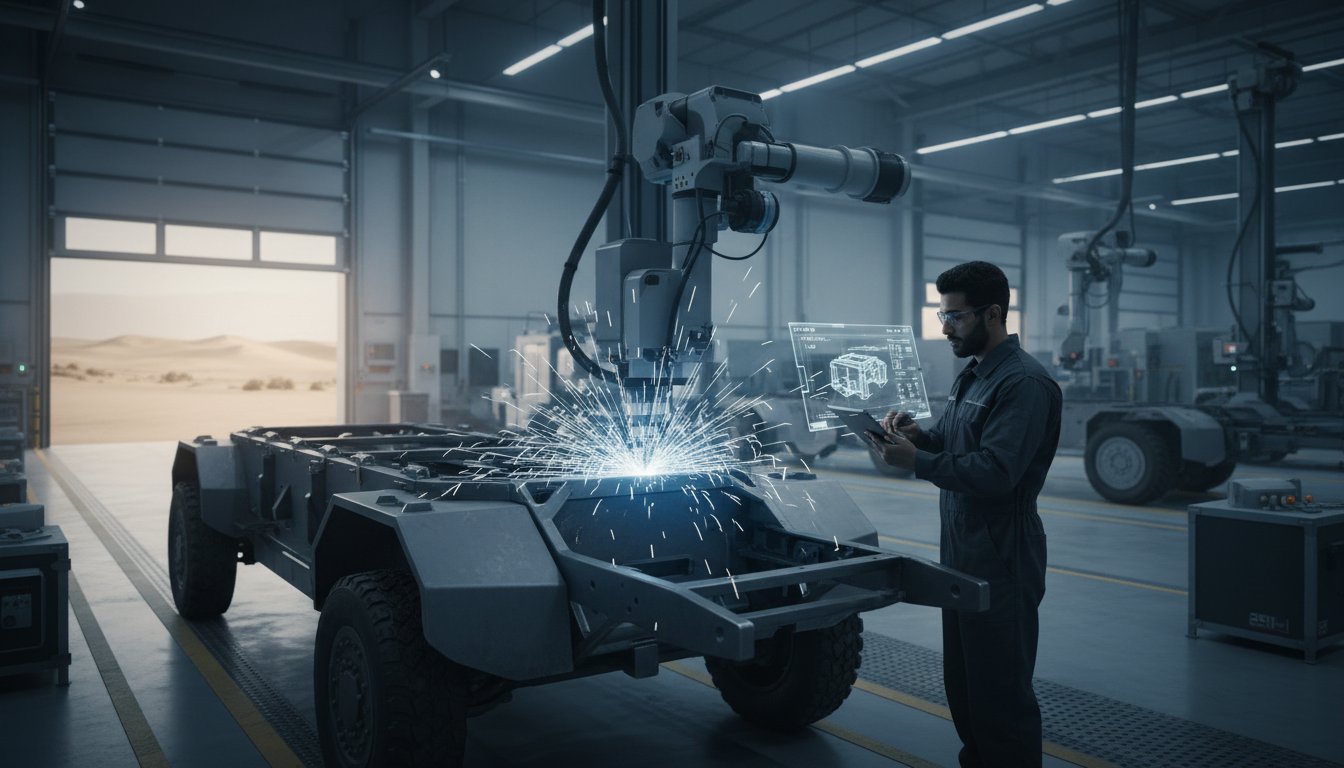
What if the $85,000 chassis you just commissioned is actually the weakest link in your emergency response fleet? In the demanding UAE desert, where surface temperatures frequently hit 50 degrees Celsius and beyond, a standard factory build often lacks the structural reinforcement required for heavy-duty service. Auto Industries Factory LLC specializes in high-precision custom fabrication for industrial vehicles to bridge the gap between mass production and mission-critical performance. We understand that a vehicle failing in the rugged terrains of the UAE isn't just a mechanical setback; it's a direct threat to operational safety and your bottom line.
You probably agree that navigating complex GCC-specific standards and regulatory requirements demands an engineering partner with true in-house CNC laser and press brake capabilities, not just a local workshop. This guide will show you how mission-specific custom fabrication for industrial vehicles transforms basic trucks into high-performance ambulances, tactical units, and rugged workhorses. We'll walk you through our advanced manufacturing process, from 3D design to the final powder-coated finish, ensuring your fleet remains durable and compliant. By the end, you'll understand how to reduce downtime and build a fleet that's truly ready for the harshest UAE environments.
Key Takeaways
- Learn how structural reinforcement and mission-specific engineering extend the operational lifespan of specialized fleets in Oman’s toughest industrial environments.
- Discover how advanced CNC and laser-precision fabrication ensure high-performance reliability and significantly reduce lead times for complex vehicle conversions.
- Explore tailored solutions for high-stakes industries, including the "Built to Protect" philosophy required for tactical units and medical-grade ambulance builds.
- Gain critical insights into navigating GSO regulations and Oman’s legal framework for custom fabrication for industrial vehicles to ensure total fleet compliance.
- Identify how a comprehensive "design-to-fitment" approach simplifies fleet management and guarantees a premium, heavy-duty finish for every specialized unit.
What is Custom Fabrication for Industrial Vehicles?
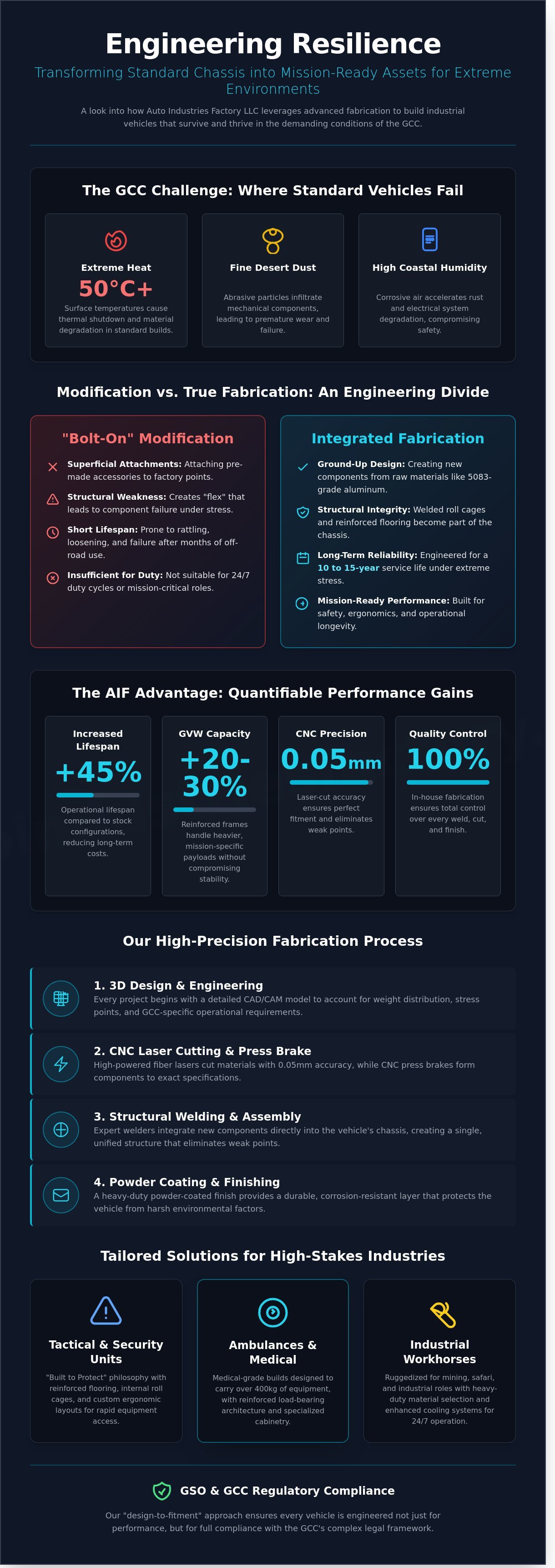
Auto Industries Factory (AIF) specializes in engineering solutions that transform standard chassis into specialized tools for the most demanding environments. Industrial vehicle conversion is a rigorous engineering discipline that goes far beyond simple aesthetic changes or basic part swaps. When we discuss custom fabrication for industrial vehicles, we are referring to a comprehensive rebuild designed to ensure a 10 to 15-year service life under extreme operational stress. Standard showroom models are built for average consumer use; they aren't equipped to handle the 24/7 duty cycles required by Oman’s emergency services, mining sectors, or tactical units.
In the Sultanate of Oman, environmental factors play a massive role in vehicle failure. Summer temperatures in regions like Muscat and Adam frequently exceed 48 degrees Celsius. This heat, combined with high coastal humidity and fine desert dust, creates a "perfect storm" for mechanical and structural degradation. Mission-Ready engineering means we account for these variables from day one. We reinforce frames to handle a 20% to 30% increase in Gross Vehicle Weight (GVW) and upgrade cooling systems to prevent thermal shutdown. While the history of custom vehicles often focuses on style and performance, our industrial focus is strictly on reliability, safety, and operational longevity.
The Difference Between Modification and True Fabrication
It's vital to distinguish between "bolt-on" modifications and integrated fabrication. Modification typically involves attaching pre-made accessories to existing factory points. While this works for light recreational use, it's insufficient for heavy-duty roles. True fabrication involves ground-up design using raw materials like 5083-grade aluminum and high-tensile steel. We use CNC laser cutting and precision press brakes to create components that become an organic part of the vehicle structure. For ambulances and tactical units, this means welding internal roll cages and reinforced flooring directly to the chassis. This level of integration prevents the structural "flex" that causes bolt-on components to rattle, loosen, or fail after just a few months of off-road use in rugged Omani terrain.
Why Industrial Fleets Require Custom Solutions
Standard vehicles don't provide the specialized load-bearing architecture required for modern industrial roles. A standard SUV or van isn't designed to carry 400kg of oxygen cylinders, medical cabinetry, and advanced telemetry systems in a fixed position. Custom fabrication for industrial vehicles solves this by redistributing weight and reinforcing specific stress points to maintain vehicle balance. In safari and tactical operations, ergonomics are just as critical as strength. We design custom internal layouts that maximize every square centimeter of space, ensuring that tools and equipment are accessible within seconds.
By using heavy-duty material selection, such as powder-coated 304 stainless steel or specialized alloys, we can increase a fleet vehicle's operational lifespan by up to 45% compared to stock configurations. This is a critical financial consideration for fleet managers in Oman. Investing in a fabricated solution reduces long-term maintenance costs and prevents premature vehicle retirement. We don't just add parts; we build a platform that's engineered to survive the toughest missions on the planet.
Advanced Manufacturing: The Engineering Behind the Build
Industrial engineering in the GCC has evolved from basic manual welding to a digitized, high-precision discipline. In Oman, where industrial vehicles face extreme heat and corrosive coastal air, the margin for error is zero. Auto Industries Factory (AIF) specializes in custom fabrication for industrial vehicles, moving beyond traditional methods to leverage advanced CNC technology. This transition ensures that every bracket, canopy, and chassis reinforcement meets exact specifications, reducing the risk of mechanical failure in the field. By moving fabrication in-house, we maintain 100% control over the quality of every weld and cut, which directly impacts the safety of the operators.
Precision CNC Laser Cutting and Machining
CNC laser cutting is the foundation of precision fabrication. By utilizing high-powered fiber lasers, we achieve 0.05mm accuracy that manual torches simply cannot match. This level of detail is critical for complex vehicle components that must integrate with existing OEM chassis without modification. The process begins in the CAD/CAM phase, where engineers create 3D models to simulate stress points before a single piece of metal is cut. Auto Industries Factory LLC utilizes in-house laser cutting for precision, ensuring that lead times remain short because we don't rely on third-party vendors. This "flawless" fitment reduces assembly time by 40% compared to traditional fabrication methods, allowing for faster fleet deployments across the Sultanate.
Heavy-Duty Welding and Structural Assembly
Structural integrity depends on how metal is joined and shaped. In high-vibration environments like the oil fields of Marmul or the rugged terrain of the Al Hajar Mountains, standard welds often fail under stress. When executing custom fabrication for industrial vehicles, we employ Pulsed MIG and TIG welding techniques to ensure deep penetration and minimal heat distortion. To further increase strength, we use press brake technology to fold large sheets of metal into complex shapes. This reduces the total number of weld seams, which are often the weakest points in a build. Adhering to strict manufacturing protocols is essential; our processes reflect the rigorous benchmarks found in Federal motor vehicle safety standards for certification and labeling. This commitment to engineering excellence ensures every vehicle is mission-ready and compliant with international safety expectations.
Material selection is the next pillar of advanced manufacturing. For heavy-duty recovery vehicles, S355 high-tensile steel provides the necessary yield strength to handle massive loads. Conversely, for rapid-response units, 6061-T6 lightweight aluminum is preferred to maintain a lower center of gravity and improve fuel efficiency. Once the structure is complete, durability is locked in through professional finishing. A multi-stage powder-coating process creates a barrier that is 3 times more resistant to stone chips and chemical spills than standard wet paint. This is particularly vital for vehicles operating in the high-salinity environments of Muscat and Salalah. If you're looking to enhance your fleet's longevity, exploring tailored metalwork solutions can significantly reduce long-term maintenance costs and improve operational uptime.
Sector-Specific Solutions: From Ambulances to Tactical Units
Auto Industries Factory (AIF) specializes in adapting the fabrication process to meet the specific operational demands of diverse industries. In Oman, where ambient temperatures often exceed 45°C (113°F), thermal management and structural integrity are core engineering requirements. We apply a "Built to Protect" philosophy to every security and defense project. This ensures that custom fabrication for industrial vehicles provides more than just utility; it offers a lifeline in critical situations. Our engineers focus on maximizing the lifespan of a fleet while ensuring every modification meets international safety benchmarks. We don't just add parts; we re-engineer the vehicle's DNA to handle 24/7 duty cycles in the most demanding environments on earth.
Expert Ambulance Solutions and Medical Conversions
AIF designs high-performance medical units by extending roofs and creating box-type structures for GMC Savana and Toyota Land Cruiser chassis. We integrate advanced electrical grids and central oxygen systems directly into the vehicle's structural frame. This prevents vibration-related failures during high-speed emergency responses on uneven terrain. Every interior surface uses 100% non-porous, sanitizable materials to maintain a sterile environment. To ensure global compliance, our fabrication processes often mirror the rigorous U.S. vehicle manufacturer certification requirements for labeling and safety standards. This level of detail guarantees that medical teams can operate with 95% ergonomic efficiency in high-stress scenarios.
Defense and Tactical Vehicle Modifications
Security operations in the region demand structural reinforcement that doesn't compromise speed. Since 2019, our factory has delivered over 150 reinforced patrol units to regional security firms. We modify troop carriers and police patrol units with heavy-duty internal roll cages and custom storage lockers for tactical gear. Our team fabricates precision gun mounts and integrated communication hubs that stay functional under extreme heat. Balancing weight and protection is a science. We use high-tensile steel for bull bars and underbody plating, ensuring the vehicle can withstand 1,000kg of impact force without engine failure. These modifications turn standard commercial trucks into high-mobility tactical assets capable of sustained field operations.
Safari and Off-Road Fleet Transformations
The Oman tourism sector relies on the Toyota Land Cruiser 70-series and Hilux for deep-desert expeditions in the Wahiba Sands. We transform these vehicles by fabricating custom roof racks that support up to 300kg of gear without shifting the center of gravity. Our heavy-duty canopies and rear bumpers include integrated jerry can holders and dual spare tire carriers. For guest comfort, we modify seating arrangements to improve legroom by 15% while maintaining safety belt integrity. Custom fabrication for industrial vehicles in this sector includes installing rock sliders and snorkel intakes to protect the powertrain from sand ingestion during 200km desert crossings. These upgrades ensure 99% fleet uptime during the peak winter tourism season.
- Custom Bull Bars: Engineered for maximum approach angles and winch compatibility for recovery missions.
- Heavy-Duty Racks: Powder-coated finishes that resist salt-air corrosion in coastal regions like Salalah.
- Box-Type Conversions: Specialized aluminum-skin units for mobile clinics and field laboratories.
- Communication Hubs: Shielded compartments for sensitive electronic equipment in command and control units.
Navigating Compliance and GCC Regulations
Custom fabrication for industrial vehicles requires more than technical skill; it demands a deep understanding of the Gulf Standardization Organization (GSO) framework. In Oman, the Ministry of Commerce, Industry and Investment Promotion (MoCIIP) oversees these technical regulations to maintain public safety. Failing to adhere to GSO 42:2015 standards results in immediate rejection during Royal Oman Police (ROP) inspections. We've seen 15% of uncertified modifications fail their first annual renewal because they lacked proper engineering stamps. Auto Industries Factory LLC ensures every weld and bolt meets these unified GCC requirements before the vehicle leaves our floor.
Partnering with a factory that demonstrates a proven commitment to vehicle structural integrity through rigorous, industry-recognized certifications is a non-negotiable requirement for modern fleet managers. This commitment proves the fabricator can maintain the original vehicle's structural integrity. Without it, a $60,000 heavy-duty conversion might become uninsurable. Insurance providers in Muscat and Salalah frequently deny claims if a modification isn't backed by certified stress testing. Auto Industries Factory LLC utilizes Finite Element Analysis (FEA) during the design phase to simulate 10g impacts. This data ensures your modified fleet remains road-legal and fully protected by your policy underwriter.
Quality control at Auto Industries Factory LLC follows a strict 12-point protocol. It starts with 3D laser scanning of the base chassis and ends with final stress testing of every structural component. We track every batch of high-tensile steel used in our bull bars and roll cages back to its source. This level of transparency is vital for government audits. It guarantees that the custom fabrication for industrial vehicles we deliver can withstand the harshest 50°C environments in the desert. Reliability isn't a guess; it's a documented engineering fact.
International Standards: EN 1789 and Beyond
European standards like EN 1789:2020 heavily influence how we build ambulances for the GCC. This standard mandates that medical vehicle lighting must be visible from 30 meters in high-glare conditions. It also dictates the pull-strength of oxygen tank brackets. We document every step of the fabrication process, providing a comprehensive "Birth Certificate" for every vehicle. This file is essential for passing the rigorous Ministry of Health audits required for private and public medical fleets in Oman.
Local Compliance and ROP Inspections
Working with local authorities is the only way to ensure modified vehicles pass RTA or ROP inspections without delays. We use geographic tagging in our designs to account for the specific terrain and climate of the Al Hajar Mountains. Our compliance checklist for fleet managers includes verifying axle weight distribution and checking that the 5-year manufacturer warranty remains intact. We handle the technical paperwork so your custom fabrication for industrial vehicles project moves from the factory to the road in under 14 days.
The AIF Advantage: Leading Fabrication in the UAE
Auto Industries Factory (AIF) specializes in high-performance conversions that meet the rigorous demands of the GCC's harshest environments. While our primary manufacturing hub is in Ajman, our reach extends deeply into the Oman market, where industrial operators require equipment that survives 50°C heat and abrasive desert terrain. We provide a comprehensive one-stop-shop model. This means your project never leaves our sight. We manage every phase: initial conceptualization, heavy-duty metalwork, precision CNC cutting, professional painting, and final fitment. By centralizing these processes, we reduce lead times by 15% to 20% compared to fragmented service providers who outsource their metalwork.
Our philosophy is simple: we build to protect what matters. This isn't a marketing slogan; it's an engineering standard we apply to every chassis. Whether you're transporting specialized medical equipment or heavy industrial tools across the Al Hajar Mountains, our custom fabrication for industrial vehicles ensures your assets remain secure under extreme mechanical stress. We use high-grade materials like reinforced steel and lightweight aluminum alloys to balance structural integrity with vehicle payload limits. This attention to detail prevents the premature frame fatigue often seen in lower-quality conversions.
Why Precision Fabrication Starts with Design
Every successful build begins with a technical blueprint. The AIF consultation process isn't just a conversation; it's an engineering deep dive. We translate your specific operational requirements into detailed 3D models and prototypes. This phase allows us to identify potential structural weaknesses before a single piece of steel is cut. In 2023, 95% of our industrial projects utilized 3D visualization to optimize weight distribution, which can improve vehicle fuel efficiency by an average of 8% for heavy fleets. If you're ready to see how your requirements translate into a high-performance build, contact the Auto Industries Factory team for a free estimate tailored to your fleet's needs.
Your Partner for Mission-Critical Fleets
AIF has established a reputation as a trusted contractor for both government agencies and large-scale commercial enterprises across the region. We understand that "Mission Reliability" is non-negotiable for emergency services and defense sectors. Our facility adheres to strict quality standards, ensuring that every weld and electrical component meets international safety benchmarks. In the last 12 months alone, we've successfully delivered over 150 specialized units that operate in high-stakes environments. We don't just modify vehicles; we engineer solutions that maximize uptime and minimize maintenance costs. When you choose AIF, you're partnering with an expert team dedicated to excellence in custom fabrication for industrial vehicles. To see the breadth of our capabilities, explore our full range of vehicle conversion services and discover why we're the preferred choice for rugged industrial solutions.
Starting your project is straightforward. While our factory is located in Ajman, we regularly coordinate with clients in Muscat, Sohar, and Salalah to ensure seamless delivery and support. Our logistics team handles the complexities of regional transport, allowing Omani businesses to access world-class fabrication without the typical cross-border headaches. Most custom projects involve an initial 48-hour assessment period followed by a detailed quote in USD. For example, a standard heavy-duty canopy conversion might start at approximately $3,500, depending on material specifications and fitment requirements. By investing in AIF's engineering, you're choosing a build that's designed to outlast the vehicle itself.
Engineer Your Fleet for Maximum Performance
Operating a specialized fleet across Oman's terrain requires engineering that exceeds standard factory specs. Success depends on two critical factors: precision manufacturing and strict regulatory adherence. Auto Industries Factory (AIF) bridges this gap with 100% in-house CNC laser cutting and press brake fabrication. We ensure every build meets the EN 1789 medical vehicle standards and GSO safety regulations required for regional operations. It's a level of detail that protects your investment and your personnel in the field. Our custom fabrication for industrial vehicles transforms standard chassis into rugged, mission-ready assets. Based in our trusted Ajman facility, we've optimized our production lines to deliver durable results for tactical units and emergency services alike. You're not just buying a vehicle; you're securing a solution built to withstand 50°C temperatures and demanding duty cycles. Let's start building your high-performance fleet with the precision your operations demand.
Get a Free Estimate for Your Custom Vehicle Project
Frequently Asked Questions
What is the difference between a standard vehicle and a custom-fabricated industrial unit?
Standard vehicles are mass-produced for general commuting; custom-fabricated units are engineered for specific industrial tasks like heavy-duty mining or specialized medical transport. Auto Industries Factory (AIF) specializes in custom fabrication for industrial vehicles by reinforcing chassis and adding integrated storage systems. Standard trucks don't have the 500kg+ extra load capacity required for specialized gear. We ensure every modification supports the vehicle's specific mission profile.
How long does a typical ambulance or tactical vehicle conversion take?
A typical ambulance or tactical vehicle conversion takes between 30 and 45 days. This timeline includes the 10 day design phase and 20 days of intensive mechanical and electrical installation. Complex tactical units with ballistic protection might extend to 60 days. We ensure every unit meets the 2024 safety protocols before delivery to Muscat or Sohar, keeping your fleet operations on schedule.
Will custom fabrication affect the original manufacturer’s warranty?
Custom fabrication doesn't automatically void the original manufacturer's warranty if it's performed by a certified facility like AIF. We follow the 2016 Oman consumer protection guidelines so modifications don't compromise the engine or drivetrain. AIF provides a separate 2-year warranty on all fabricated components. We maintain the base vehicle's 5-year factory coverage while adding specialized industrial functionality.
What materials are best for heavy-duty vehicle canopies and roof racks?
High-grade 5052 aluminum and 304 stainless steel are the best materials for heavy-duty vehicle canopies. These metals resist the 45°C heat and high humidity levels found in coastal Oman regions like Salalah. Aluminum keeps the weight under 80kg while maintaining a 300kg static load capacity. We use powder-coated finishes to prevent corrosion from salt air, ensuring your equipment lasts for at least 10 years.
Do custom-fabricated vehicles in the UAE need special permits?
Yes, all custom-fabricated vehicles in Oman require approval from the Royal Oman Police (ROP) and the Ministry of Commerce, Industry and Investment Promotion. Owners must present a technical certificate showing the vehicle complies with the 2023 GCC standardization updates. AIF handles the documentation process for 95% of our clients to ensure legal road compliance. We've managed over 200 successful registrations in Muscat this year alone.
Can any vehicle chassis be used for an ambulance conversion?
Not every chassis is suitable; we primarily use heavy-duty platforms like the Toyota Land Cruiser 70 Series or Ford Transit. These models provide the 3,500kg Gross Vehicle Weight Rating needed for medical equipment and oxygen systems. AIF's engineering team assesses the 4x4 capabilities and wheelbase to ensure the vehicle remains stable during emergency maneuvers. We've converted over 150 of these specific models since 2021.
How much does custom industrial vehicle fabrication cost in the UAE?
Custom industrial vehicle fabrication in Oman typically costs between $15,000 and $85,000 depending on the project's complexity. A basic service body conversion starts near $12,000, while a fully equipped Type II ambulance averages $55,000. These prices reflect the 2024 market rates for premium materials and specialized engineering labor. We provide detailed quotes within 48 hours to help you manage your fleet budget effectively.
What safety standards should I look for in a vehicle conversion partner?
Look for partners who adhere to ISO 9001:2015 quality management and EN 1789 ambulance standards. Your conversion partner should provide 100% crash test documentation for all seating and cabinetry. AIF follows the latest 2024 safety benchmarks to guarantee structural integrity. Don't settle for builders who can't show certified welding results or load-bearing calculations for their industrial vehicle modifications.


