

A spare wheel carrier must suit the vehicle, wheel and mounting position, while supporting the load securely. Custom spare wheel carrier fabrication adapts the carrier to those requirements through suitable metalwork, a protective finish and reliable retention for travel.
A bracket that looks universal can still cause problems if the wheel does not fit, the mounting point is unsuitable or the carrier interferes with vehicle use. Secure support and correct fit must work together.
This guide covers the key decisions before fabrication: vehicle requirements, load capacity, wheel compatibility, fabrication methods, corrosion-resistant finishes and secure retention during travel. It also explains how testing and final verification help assess durability and reliability, and what information to prepare for a practical vehicle-specific solution.
Key Takeaways
- Start with the vehicle’s mounting location and operating requirements so the carrier’s design fits its intended use.
- Match carrying capacity and bracket adjustment to the spare wheel’s size, type and weight.
- Understand how inspection, precision forming, fabrication, finishing and verification shape the finished carrier.
- Choose a stable tray or carrier arrangement suited to the vehicle and the demands of transporting a spare wheel.
- Consider corrosion-resistant finishing and secure locking to help protect the carrier and keep the wheel in place during transit.
Custom fabrication for vehicle-specific requirements
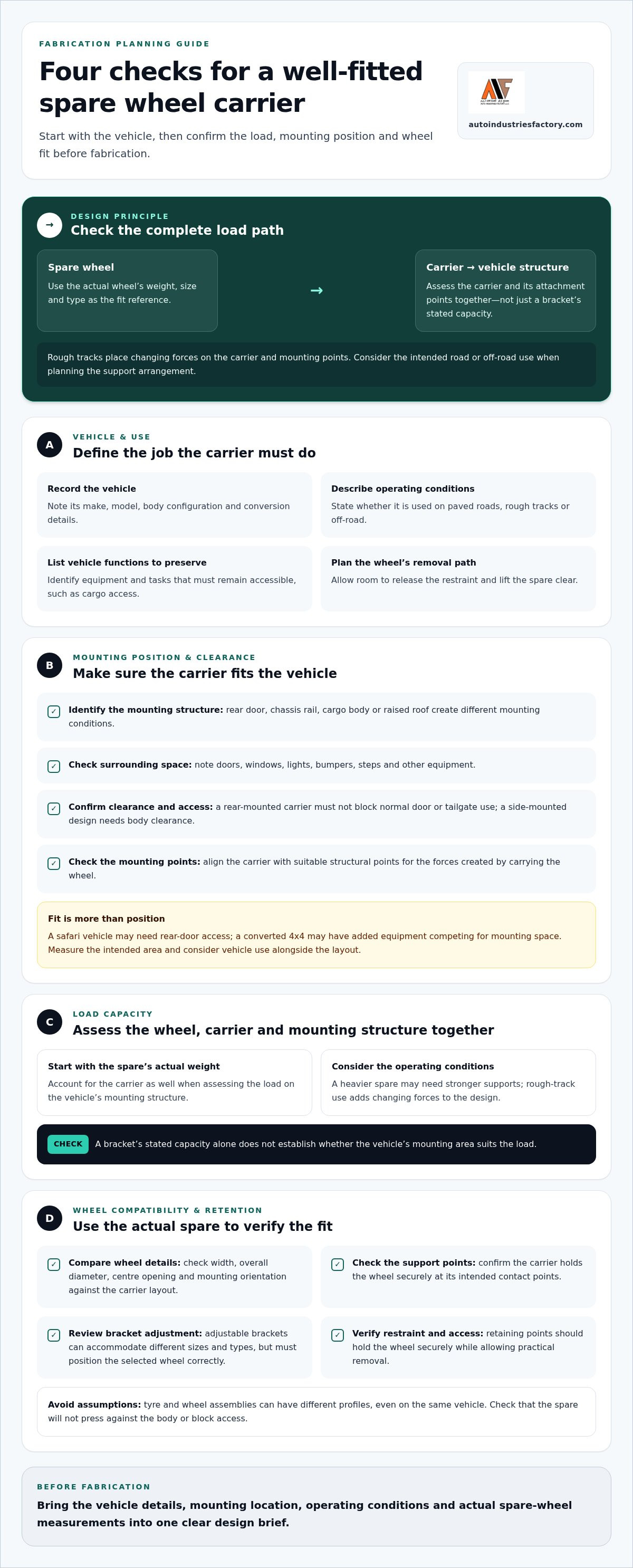
Custom spare wheel carrier fabrication starts with the vehicle, not a standard bracket. A rear door, chassis rail, cargo body or raised roof creates different mounting conditions. Record the vehicle’s make, model, body configuration and intended use, then identify where the spare wheel needs to sit. A safari vehicle may need clear access to its rear doors. A police or military vehicle may have other equipment competing for the same mounting space.
Inspect the mounting structure and surrounding space. Note nearby doors, windows, lights, bumpers and equipment. A wheel mounted on a rear door must not block its normal opening path. A chassis-mounted carrier needs to align with suitable structural points. These observations inform the carrier’s position, shape and support arrangement, helping avoid a design that holds the wheel but restricts vehicle use.
Define the operating conditions before choosing a layout. Consider whether the vehicle travels on paved roads, rough tracks or both. A safari vehicle used on uneven terrain has different demands from one carrying a spare for occasional road use. Include the wheel’s removal path in the design. The person changing a wheel needs room to release the restraint and lift the spare clear. A practical layout accounts for access as well as storage.
- Vehicle identity: Record the make, model, body type, and conversion details.
- Mounting position: Mark the chosen point and nearby components, such as rear doors or lights.
- Wheel access: Map how the spare will be removed and replaced.
- Vehicle function: List equipment and tasks that must remain accessible.
- Operating environment: Describe road, track, and off-road use in the UAE.
These details guide the carrier’s geometry. A high-mounted wheel may need a different support arrangement from a low-mounted one. A side-mounted design must allow for body clearance and access. The vehicle’s structure also matters: mounting locations should suit the forces created by carrying a wheel. Custom design can adapt the carrier to these constraints instead of forcing the vehicle to accommodate a generic shape.
Include the finish in the specification. A corrosion-resistant finish helps prevent rust and should suit the fabricated metal and its exposure. Testing then assesses the carrier’s strength, durability and reliability. Record the inspection results and verify the finished carrier against the vehicle, wheel, mounting points and access path. These steps turn vehicle-specific requirements into a clear fabrication brief.
When selecting a carrier, weigh vehicle type, load capacity, mounting position, durability and spare-wheel compatibility. The right combination keeps the carrier suited to the vehicle and its intended use.
Load capacity, fit and wheel compatibility
For a 4x4 or off-road vehicle, choose a carrier around the vehicle’s mounting point, spare-wheel load, and operating conditions. Match those factors before selecting a bracket or tray.
Carrier Load Capacity
Load capacity affects how the carrier supports the spare wheel and movement during travel. Start with the wheel’s actual weight, then account for the carrier when assessing the load on its mounting structure. A heavier spare may require stronger supports and a different mounting arrangement. Intended use matters, too: rough tracks place changing forces on the carrier and its attachment points.
Look at the complete load path, from wheel contact points through the carrier to the vehicle structure. A bracket’s stated capacity alone doesn’t describe whether the vehicle’s mounting area suits that load. For a 4x4 regularly used off-road, account for the carrier, attachment points, and wheel together. This gives the design process a clear basis, instead of selecting a carrier by appearance alone.
Vehicle Fit
Vehicle fit includes the carrier’s position, mounting arrangement and clearance from nearby components. A rear-mounted carrier must leave the tailgate or rear doors usable. A side-mounted design needs clearance from the body, steps and equipment. Check the proposed position against the vehicle’s structure, then consider how the wheel will move during removal and replacement.
For example, a safari vehicle may need its spare accessible without blocking cargo access. A converted 4x4 may also have added equipment that changes available mounting space. Measure the intended area and note the vehicle’s body configuration before choosing a design. Safari vehicle conversions can involve changes to vehicle use and equipment layout, so fit should be considered alongside those requirements.
Wheel Compatibility
Wheel compatibility means the carrier can hold the spare securely at its intended contact points. Compare the spare’s size and type with the support and retention arrangement. Adjustable mounting brackets can accommodate different wheel sizes and types, but their adjustment range must still position the selected wheel correctly without pressing it against the body or blocking access.
Check the wheel’s width, overall diameter, centre opening and mounting orientation against the carrier layout. Confirm that the retaining points hold it securely and allow practical removal. Tyre and wheel assemblies can have different profiles, even on the same vehicle. Use the actual spare as the fit reference rather than assuming a standard size.
Use this sequence to narrow the design:
- Identify the vehicle type and intended road or off-road use.
- Assess the spare wheel and carrier load against the mounting structure.
- Choose a mounting position with usable clearance and access.
- Match the bracket or tray to the wheel’s size and type.
These checks help define a suitable carrier layout before fabrication. For a vehicle being adapted for safari use, Safari Vehicle Conversions provide relevant context for planning its equipment and configuration.
Metal fabrication and forming processes
Fabrication and installation follow a sequence: inspect the material, form components, build the structure, finish surfaces, test the assembly and verify the fit. Each stage affects how the finished carrier meets the vehicle’s mounting and wheel requirements.
Begin by inspecting the raw material. Look for visible damage, inconsistent surfaces or defects that could affect cutting and joining. Confirm that the material suits the carrier’s intended structure and finish. This establishes a sound starting point before cutting. For example, damaged edges on a support plate can make accurate forming and assembly more difficult.
Precision metal forming creates the carrier’s plates, brackets and supporting shapes. Measurements of the vehicle and spare wheel guide component dimensions. Forming must produce parts that align at their joining points. A support bent out of position can complicate fitting and shift the wheel from its intended position. Check each formed part against the fabrication layout before joining.
Structural fabrication brings the components together through planned joints and supports. Align the parts before welding or other joining work, then inspect the completed structure for consistent fit. A tray-style carrier needs a stable platform and supports suited to the vehicle’s mounting arrangement. The fabrication sequence should preserve access to the wheel and allow the finished carrier to sit correctly at its mounting points.
Apply the surface finish after structural work. Prepare the metal so the coating covers it evenly, including edges and joined areas. A corrosion-resistant finish helps prevent rust on a spare wheel carrier. Specify and apply the coating as part of fabrication, not as a cosmetic afterthought. This is relevant for vehicles exposed to dust, moisture and changing outdoor conditions.
Testing assesses the finished carrier’s strength, durability and reliability. Final verification compares the assembly with the vehicle, wheel and mounting layout. In custom spare wheel carrier fabrication, these are separate checks: testing assesses the built structure, while verification confirms that the completed part matches its intended configuration.
- Inspect raw metal and confirm parts suit the fabrication layout.
- Cut and form components to the required shapes and dimensions.
- Align and join the structure, then inspect its assembly.
- Prepare the surface, apply a suitable coating, and finish exposed areas.
- Test the assembly, then verify fit against the vehicle and spare wheel.
- Trial-fit the carrier, align its mounting points, and secure it to the vehicle.
- Check wheel seating, retention, access, and surrounding clearance.
During installation, trial fitting can reveal alignment issues before final fastening. Confirm that the wheel sits squarely, the retaining points engage and nearby doors or equipment remain accessible. Inspect the complete assembly again once it is secured. This final check confirms the carrier’s actual fit on the vehicle, rather than relying on measurements alone.
Spare wheel carrier purpose and function
A spare wheel carrier holds and transports a spare wheel on trucks and heavy-duty vehicles. Its job is to keep the wheel supported, accessible and secure in its chosen position. A tray provides a stable platform for heavy-duty and off-road vehicles, while a bracket or frame can suit other mounting layouts.
For a 4x4, a fixed carrier keeps the wheel attached in one position. It has a straightforward layout, but the wheel can block access to a rear door or cargo area. A swing-away carrier moves aside with its mounted wheel, opening the rear for loading. It adds a moving joint and requires room to swing clear. Choose by weighing access against mechanical simplicity.
Start with the vehicle’s daily role. A work truck carrying tools may need an unobstructed rear door, while a safari vehicle may need quick access to stored equipment. A fixed carrier suits a layout where the wheel does not obstruct routine access. A swing-away arrangement may work when the spare would otherwise cover a door. In either case, check the wheel’s removal path before choosing the mechanism.
For use in the UAE, include applicable vehicle modification and inspection requirements in the installation plan. Document the mounting arrangement and confirm the carrier preserves the vehicle’s intended functions, with clear access to lights, the number plate and doors.
Custom fabrication can address a vehicle’s specific mounting layout through metal cutting, bending, joining, finishing and fit verification. Auto Industries Factory LLC provides in-house metal fabrication, including CNC laser cutting, bending, welding and machining, to support customized vehicle solutions. The process should include a final fit check on the vehicle.
Let the carrier’s purpose guide its form. A heavy-duty vehicle carrying a large spare may need a tray that distributes support across its structure and provides a stable resting surface. A frame-style carrier can hold the wheel at defined contact points instead. In either case, the mounting arrangement connects the spare to the vehicle rather than leaving it loose in the cargo area.
Function also depends on practical handling. The spare should be reachable without moving unrelated equipment, and its restraint should release in a controlled way. For a swing-away design, assess the open position and ensure it does not obstruct the operator’s route. For a fixed design, check that the wheel does not prevent routine door or cargo access. These operating details distinguish a useful carrier from a mount that merely holds the wheel.
Before installation, check the finished assembly against three functions: support the spare, preserve vehicle access and retain the wheel during travel. A stable tray, a suitable opening path and secure retention each serve a different purpose. Testing and final verification assess whether the fabricated carrier performs as intended on its vehicle.
Spare wheel security during transit
A spare wheel must remain seated and restrained as the vehicle moves. Secure locking mechanisms help hold it in place during travel. The carrier’s contact points, retention method and mounting arrangement all contribute. A latch cannot compensate for a wheel that shifts on its support, so assess the complete assembly.
To help prevent rust and vibration, specify a corrosion-resistant finish and seat the wheel firmly against its supports. Corrosion-resistant finishes help prevent rust on spare wheel carriers. Correctly aligned contact points and secure retention reduce unwanted movement. Check for looseness during installation and after use, especially following travel over rough tracks.
Build security into the carrier layout. The wheel should sit squarely on its tray or bracket, not lean against an unrelated vehicle panel. Retaining points should hold it in the intended position, while a secure locking mechanism helps prevent movement during travel. Check that the lock engages fully and releases in a controlled way when the spare is needed.
- Wheel seating: Confirm the spare rests evenly against the designed supports.
- Retention: Check that the restraint engages the wheel securely.
- Locking: Test the mechanism for full engagement and deliberate release.
- Mounting: Inspect carrier joints and attachment points for looseness.
- Finish: Look for coating damage, exposed edges, and early rust.
Vibration can reveal a poor fit before visible damage appears. Listen for rattling on rough surfaces, then inspect the wheel’s contact points and retaining hardware. If the spare moves against the tray, adjust its seating or retention arrangement. If the carrier itself shifts, inspect its joints and vehicle attachments. These are separate checks: tightening the wheel restraint will not correct a loose carrier mount.
Inspect the surface protection, too. A scratch or chipped coating can expose metal and create a starting point for rust. Clean the affected area and restore its protective finish during maintenance. Pay particular attention to edges, joints and contact areas, where repeated wheel removal can wear the coating. Dust and outdoor exposure make these checks useful as part of routine vehicle care.
Before a trip, check the lock, wheel seating and carrier mounts. After rough off-road travel, repeat the inspection and look for fresh movement marks. Testing during fabrication assesses strength, durability and reliability; final verification checks the installed assembly and its retention. Together, these checks support a clear handover from fabrication to regular use.
For a vehicle-specific metalwork project, discuss vehicle fabrication requirements with the workshop and explain the spare-wheel mounting location and operating conditions.
Auto Industries Factory: Ambulance Conversions
Auto Industries Factory LLC supports specialized vehicle projects through Ambulance Conversions, Police & Military Vehicle Modifications, Safari Vehicle Conversions, and Metal Canopies and Roof Racks. These services are relevant when spare-wheel planning forms part of a wider vehicle conversion or equipment layout, rather than a standalone carrier project.
For example, a safari vehicle conversion may need to position the spare wheel without compromising cargo access or other fitted equipment. A metal canopy or roof rack also affects how available space and mounting arrangements are planned. Define the vehicle’s intended use, spare-wheel position and access requirements before discussing the wider build.
Contact Auto Industries Factory LLC to discuss the requirements for a specialized vehicle conversion or equipment project.
Move From Requirements to a Vehicle Plan
Let the vehicle’s intended role guide your next decision. A clear project brief brings equipment layout, access needs and operating conditions together before fabrication begins. For custom spare wheel carrier fabrication, make the discussion practical by describing the vehicle, where the spare needs to sit and what must remain accessible.
For a wider vehicle conversion project, Auto Industries Factory LLC offers Ambulance Conversions, Police & Military Vehicle Modifications, and Safari Vehicle Conversions. These services address specialized vehicle requirements where equipment and vehicle configuration need to work together. Define the vehicle’s purpose and the changes needed to support it as the next step.
Bring your project requirements together and start the conversation with Auto Industries Factory LLC. Contact Auto Industries Factory today to discuss your vehicle project. A focused plan puts the next fabrication decision on solid ground.
Frequently Asked Questions
What materials and steel thickness suit a durable spare wheel carrier?
Steel is a common choice for a rigid carrier, but the design, not a generic gauge, should determine its thickness. The wheel’s mass, support spacing, bracket shape, mounting points and forming method all affect the required section. For example, a long unsupported tray places different demands on its material than a compact bracket. Specify the vehicle and wheel together, then assess the finished structure and protective coating.
How do I measure a spare wheel and vehicle for a custom carrier?
Measure the complete spare, including the tyre, rather than the bare rim. Record its overall diameter, width, centre opening and bolt pattern if the design uses wheel studs. On the vehicle, map the proposed mounting area and measure clearance from doors, lights, body panels and fitted equipment. Also note how the wheel must be lifted or released. These details help prevent fit conflicts during installation.
What safety risks and load limits should I consider?
The main risks are wheel movement, carrier or mounting failure, and blocked access to vehicle components. There is no single load limit for every carrier: the design must account for the assembled wheel, carrier structure, attachment points and intended travel conditions. A practical review checks the complete load path, secure retention and installation condition. Testing the finished assembly helps assess strength and durability before regular use.


