
A standard chassis is simply a shell until it's re-engineered for the high stakes of emergency response. Many fleet managers find that basic conversions fail under the stress of harsh climates or lack the structural integrity required for heavy medical equipment. It's frustrating when a vehicle doesn't meet international EN 1789 standards or suffers from frequent downtime due to poor third-party workmanship. You need a fleet that's as reliable as the paramedics operating it. Building high-performance customized ambulances requires more than just installing lights and sirens. It demands precision metalwork and a deep understanding of vehicle dynamics.
This engineering guide explores how mission-specific fabrication transforms platforms like GMC and Toyota into rugged, life-saving units. We'll show you how in-house laser cutting and CNC machining ensure every reinforcement meets exact tolerances for maximum safety. You'll learn the technical requirements for specialized medical fleets, from box-type configurations to extended roof models. By focusing on rugged engineering from the design phase to the final paint, you can ensure your fleet delivers maximum uptime and protects both patients and crew in the field.
Key Takeaways
- Learn how in-house laser cutting and CNC machining achieve millimeter-perfect fitment for medical cabinetry and heavy equipment.
- Compare the structural advantages of Box Type units versus Extended Roof conversions to determine the best fit for your specific mission requirements.
- Discover the essential electrical and medical gas specifications required to transform standard chassis into high-performance customized ambulances.
- Understand the value of a complete design-to-paint service cycle in ensuring maximum vehicle uptime and long-term structural reliability.
- Identify the critical engineering standards used to reinforce GMC and Toyota platforms for the most demanding medical environments.
Defining the Role of Customized Ambulances in Modern Healthcare
A standard delivery van is not built to save lives at high speeds. Modern healthcare demands a mobile trauma room, not just a transport vehicle. This shift toward mission-specific engineering is reshaping how national healthcare fleets are built across the globe. Unlike basic transport units, customized ambulances are engineered from the ground up to handle the physiological and technical stresses of emergency medicine. Understanding the history and types of ambulances reveals that as medical technology advances, the vehicle must evolve from a simple carrier into a sophisticated, high-performance medical platform.
Off-the-shelf vehicles often fail because they weren't designed for the weight and power requirements of Advanced Life Support (ALS) equipment. When a fleet relies on standard configurations, it risks mechanical failure and decreased safety for both the patient and the crew. True customization involves a complete re-evaluation of the chassis to ensure it can withstand the rigors of 24/7 emergency response. It's about turning a standard GMC or Toyota platform into a rugged, reliable extension of the hospital.
The Limitations of Standard Medical Vehicles
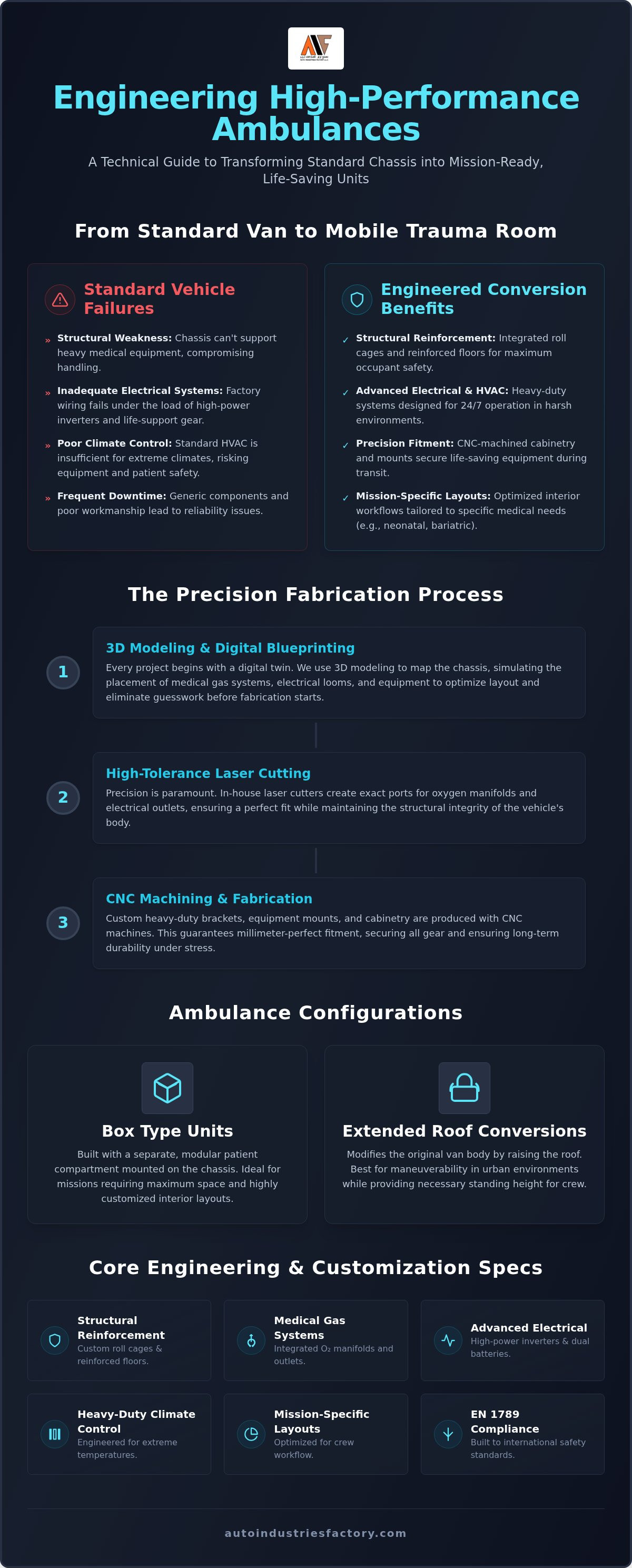
Standard commercial vans often suffer from structural weaknesses when loaded with heavy life-support systems. A non-reinforced chassis can't support the weight of oxygen manifolds, specialized seating, and diagnostic tools without compromising vehicle handling. Most factory-standard vehicles also lack the electrical capacity required for modern medical gear. When you add high-power inverters and dual-battery setups, original wiring often fails. In extreme climates, standard insulation and HVAC systems are inadequate. This leads to equipment overheating and patient discomfort during critical transit times.
Benefits of a Purpose-Built Conversion
Purpose-built units prioritize the ergonomics of the medical crew. When every second counts, the placement of a suction unit or oxygen port must be intuitive. Specialized conversions allow for optimized interior workflows that reduce paramedic fatigue and improve patient stability. Using high-strength materials and precision fabrication ensures long-term durability that standard builds simply can't match. At Auto Industries Factory LLC, we provide specialized vehicle conversion solutions that address these specific operational challenges.
Key advantages of these engineered units include:
- Structural Reinforcement: Integration of custom roll cages and reinforced floors to protect occupants.
- Advanced Climate Control: Heavy-duty HVAC systems designed to maintain stable temperatures in desert environments.
- Precision Fitment: CNC-machined cabinetry that keeps life-saving equipment secure during high-speed maneuvers.
- Mission-Specific Layouts: Interior designs tailored to neonatal, bariatric, or standard emergency response needs.
By moving away from "one-size-fits-all" models, healthcare providers can ensure their customized ambulances are ready for any mission. This engineering-first approach maximizes vehicle uptime and provides a safer environment for life-saving interventions.
The Technical Fabrication Process: Engineering Precision
Engineering a high-stakes vehicle requires a master craftsman's touch and industrial-grade technology. We don't rely on generic kits. Instead, we use in-house 3D modeling to map every inch of the chassis before a single piece of metal is cut. This digital blueprint allows us to optimize the layout of customized ambulances for maximum efficiency. By simulating the placement of medical gas systems and electrical looms, we eliminate the guesswork that often leads to structural failure in the field. Every weld and every cut is planned to ensure the final product is a robust, life-saving machine.
Advanced Cutting and Machining Technologies
Precision is the foundation of a reliable medical unit. We utilize high-tolerance laser cutting to create exact ports for oxygen manifolds and electrical outlets. This level of accuracy is critical for maintaining the structural integrity of the vehicle's skin. CNC machining allows us to produce custom heavy-duty brackets and equipment mounts that are tailored to the specific dimensions of the medical gear they hold. Precision cutting ensures millimeter-perfect fitment, preventing interior rattling and component failure over time. These technical steps ensure that every unit meets rigorous Ambulance safety standards, providing a secure environment for life-saving interventions.
Structural Reinforcement and Painting
The result is a vehicle that functions as a cohesive tool rather than a collection of parts. If you're looking for a partner to build your next fleet, you can learn more about our fabrication services to see how our engineering expertise translates into mission-critical reliability. Our commitment to a complete design-to-paint cycle means your customized ambulances are built to last under the most demanding operational cycles. We take pride in delivering rugged solutions that paramedics can trust when seconds matter most.
Comparing Ambulance Configurations: Box Type vs. Extended Roof
Selecting the right configuration is a strategic decision based on the specific mission profile and operational environment. A rural desert rescue requires a different engineering approach than an urban patient transport unit. While both are customized ambulances, the choice between a Box Type and an Extended Roof model dictates the volume of medical equipment you can carry and how the vehicle handles at high speeds. These designs must adhere to strict Ambulance Safety and Design Standards to ensure occupant protection during high-impact scenarios. Our goal is to provide a vehicle that isn't just a transport tool, but a reinforced medical environment built for survival.
Box Type Ambulance Features
The Box Type configuration is the gold standard for Advanced Life Support (ALS) and intensive care missions. Its square-body design provides the maximum possible workspace for paramedics, allowing for full 360-degree patient access. This model uses a separate medical module mounted onto a heavy-duty chassis, typically a GMC or Toyota platform. The structural benefit of this mounting system is twofold: it provides superior crash protection and allows the medical box to be remounted on a new chassis once the original engine reaches its end-of-life. It's the ultimate solution for fleets requiring heavy diagnostic gear and multiple oxygen cylinders.
Extended Roof and Van Conversions
For urban environments where speed and agility are paramount, the Extended Roof conversion is the preferred choice. These units maintain the original van's aerodynamic profile, which improves fuel efficiency and response times in heavy traffic. We use custom roof extensions to create enough standing room for medical staff to work comfortably while adding overhead storage for trauma kits. This configuration is exceptionally versatile for non-emergency transport or rapid-response units. If you want to explore our ambulance conversion expertise, you'll see how we optimize these platforms for tight city streets without sacrificing medical capability.
Choosing between these configurations depends heavily on your terrain and the level of care required during transit. A Box Type unit offers the stability and space needed for long-distance rural transfers or complex mobile ICUs. In contrast, an Extended Roof model provides the accessibility required for multi-story hospital bays and narrow city alleys. Our engineering team works with you to determine the best platform, ensuring your customized ambulances are built for the specific challenges of your region. By matching the configuration to the mission, you maximize both patient safety and vehicle longevity.
Essential Customization Specs for Emergency and Transport
Precision fabrication is only the first step. The true utility of customized ambulances lies in the integration of specialized life-support systems and redundant power grids. We treat the interior of each vehicle as a high-tech clinical environment where every component must perform under extreme pressure. From the placement of oxygen manifolds to the routing of electrical looms, every specification is chosen to enhance the speed and accuracy of medical care. These units aren't just vehicles; they are mobile trauma centers designed to function flawlessly when every second determines a patient's outcome.
Life-Support and Medical Systems
Auxiliary Power and Communication
Electrical failure is not an option in a mission-critical environment. Our builds feature dual-battery setups with split-charging systems to ensure the engine always has starting power, regardless of the medical load. We install shore power inlets to keep on-board equipment charged and internal temperatures regulated while the vehicle is stationed. A pure sine wave inverter is essential for customized ambulances because it provides clean, stable power that prevents interference or damage to sensitive medical electronics like ventilators and monitors. For fleet management, we integrate mobile command systems and multi-band radios that allow for real-time data sharing with hospital trauma teams.
Interior hygiene is equally vital for long-term operational success. We use medical-grade, anti-bacterial surfaces and non-porous, easy-clean flooring to prevent the buildup of biohazards. Lighting systems include high-intensity LED medical lights for procedures and dimmable ambient lighting for patient comfort. If you are ready to upgrade your fleet with these advanced specifications, request a quote for our ambulance conversion services to see how our engineering team can meet your specific mission requirements. By focusing on these essential technical specs, you ensure your fleet remains reliable, sterile, and fully equipped for any emergency.
Engineering Reliability: Why Partner with a Conversion Specialist
Building a fleet of customized ambulances is a high-stakes investment that demands a partner with proven technical capability. A complete in-house conversion cycle, from initial 3D design to final painting, ensures that every structural reinforcement and medical system is integrated seamlessly. When you work with a specialist, you aren't just buying a vehicle; you're securing a life-saving tool built to meet rigorous national safety and quality standards. Our facility in Ajman utilizes advanced laser cutting and CNC machining to deliver units that exceed the durability of generic, mass-produced alternatives. This engineering-first approach guarantees that every component, from the oxygen manifold to the reinforced floor, is designed for long-term performance under pressure.
The Specialist Advantage
Generic vehicle modifications often fail because they don't account for the extreme stress of emergency missions. We apply the same rugged engineering principles used in our safari and military vehicle modifications to every medical unit we build. This background in high-performance fabrication ensures that our customized ambulances can handle the most punishing terrains and operational cycles. You can learn more About Auto Industries Factory and our commitment to engineering excellence. By choosing a specialist, you gain the benefit of custom-fabricated parts that are designed for maximum vehicle uptime and paramedic safety.
Getting Started with Your Custom Build
The process begins with a detailed consultation to define your mission-specific requirements. Whether you require an extended roof on a Toyota platform or a box-type GMC unit, our engineers guide you through chassis selection and layout optimization. We use a detailed 3D design phase to prototype your vehicle before fabrication begins, ensuring every medical port and equipment mount is perfectly placed. This precision-first approach eliminates costly errors and ensures your fleet is ready for deployment on day one. Contact our engineering team for a custom ambulance estimate to begin the specification process for your specialized medical fleet.
Partnering with a specialist means you receive a complete solution, not just a product. Our after-sales support and the durability of our custom-fabricated parts ensure your fleet remains operational for years to come. By prioritizing engineering precision and mission-specific fabrication, you provide your medical teams with the most reliable tools available for saving lives in the field.
Building the Future of Emergency Response
Precision engineering is the only way to ensure your fleet survives the rigors of modern emergency medicine. We've explored how in-house CNC and laser cutting technology transform standard chassis into high-performance customized ambulances. By prioritizing mission-specific fabrication on proven GMC and Toyota platforms, you eliminate the structural weaknesses and electrical failures common in generic conversions. Our comprehensive national fabrication and painting services provide a complete solution from initial 3D design to final delivery.
When you partner with a specialist, you gain the advantage of rugged engineering derived from military and safari vehicle expertise. This ensures every reinforcement and medical gas system is built for extreme reliability. It's time to move beyond off-the-shelf limitations and invest in a fleet that protects your patients and paramedics in any environment. Our master craftsmen are ready to translate your technical requirements into a robust, life-saving reality.
Ready to specify your next unit? Request a Technical Consultation for Your Ambulance Fleet today. Let's build a mobile medical solution that never fails when it matters most.
Frequently Asked Questions
What is the difference between a Type 1 and a Type 2 customized ambulance?
A Type 1 ambulance features a modular medical box mounted on a heavy-duty truck chassis, while a Type 2 is a van-based conversion where the medical compartment is integrated into the original vehicle shell. Type 1 units offer more interior space and can be remounted onto a new chassis later in their service life. Type 2 units are more agile and fuel-efficient, making them ideal for urban patient transport where maneuverability is prioritized over total equipment volume.
Which vehicle chassis are best for ambulance conversions in 2026?
The GMC Savana and Toyota Hiace or Land Cruiser platforms remain the most reliable choices for ambulance conversions in 2026. These chassis are preferred for their global parts availability and proven ability to handle the weight of Advanced Life Support systems. Toyota models are especially valued in harsh climates for their cooling efficiency, while GMC platforms provide the high-torque performance needed for heavy modular box-type configurations used in rural or intensive care missions.
How long does the typical customization process take for a fleet unit?
The typical fabrication timeline for a single customized ambulance ranges from 4 to 12 weeks depending on the complexity of the medical specifications. A standard van conversion with an extended roof is generally faster to complete than a full modular build. This timeframe includes the complete design-to-paint cycle, ensuring every structural reinforcement and electrical system is tested for mission readiness before the vehicle is delivered to the client for active service.
Are customized ambulances compliant with international EN 1789 standards?
Yes, customized ambulances can be engineered to meet or exceed international EN 1789 standards for medical vehicles and their equipment. Compliance requires rigorous testing of the patient compartment's structural integrity and the securement of all medical devices during high-impact scenarios. Our engineering process incorporates these safety requirements from the initial 3D modeling phase to ensure every unit provides maximum protection for both paramedics and patients during high-speed emergency transit.
Can an existing van be converted into a customized ambulance?
An existing van can be converted into a medical unit if the chassis is in sound structural condition and meets the weight-bearing requirements for the intended mission. We evaluate the vehicle's payload capacity to ensure it can support the added weight of medical gas systems, cabinetry, and specialized electrical grids. If the van meets these technical criteria, we apply our in-house fabrication process to transform it into a fully functional and reliable emergency vehicle.
What specialized electrical systems are required for Advanced Life Support (ALS) units?
Advanced Life Support units require redundant electrical systems, including pure sine wave inverters and dual-battery setups with split-charging capabilities. These systems are essential for providing stable, interference-free power to sensitive diagnostic electronics like cardiac monitors and ventilators. We also integrate shore power inlets to maintain equipment charge and climate control while the vehicle is stationary, preventing mission failure due to power depletion during long shifts or standby periods.
How does in-house laser cutting improve the quality of an ambulance build?
In-house laser cutting ensures millimeter-perfect accuracy for every medical port, equipment mount, and cabinet fitment. This high-tolerance fabrication prevents interior rattling and component failure caused by the constant vibrations of high-speed emergency response. By maintaining total control over the cutting process, we ensure that every modification to the vehicle's skin preserves its structural integrity while providing a seamless, professional finish that is easy to disinfect and maintain over years of use.
What are the benefits of a box-type ambulance over a standard van conversion?
A box-type ambulance offers significantly more interior workspace and storage capacity than a standard van conversion. The square-body design allows for 360-degree patient access, which is critical for intensive care and complex trauma missions. Additionally, the separate medical module can be remounted onto a new chassis in the future. This provides a longer service life for the medical equipment and cabin compared to integrated van models that must be retired once the engine reaches its end-of-life.


