

What if the heavy armor meant to protect your team actually compromises their safety by destroying the vehicle's off-road mobility? It's a legitimate concern for mission commanders and security professionals who can't afford a mechanical failure in the field. Adding heavy ballistic plating to a standard chassis requires more than just welding; it demands precision engineering and a deep understanding of weight distribution. You likely already know that poorly executed 4x4armored vehicles often suffer from suspension fatigue, brake failure, or sluggish handling when they are needed most.
This guide ensures you master the technical requirements and conversion possibilities of high-performance 4x4 armored vehicles for mission-critical operations. We'll explore how to balance high-level protection with the agility needed for rugged terrain, ensuring your fleet complies with international ballistic standards. You'll gain a clear understanding of the engineering behind specialized conversions, from box-type ambulances to troop carriers on Toyota and GMC platforms. We'll also cover the essential role of in-house fabrication, including laser cutting and custom bull bars, in creating a durable, mission-ready asset that performs under pressure.
Key Takeaways
- Understand why modern security operations are shifting from heavy armor to agile 4x4 platforms for better tactical response and mobility.
- Identify the specific ballistic protection levels, such as CEN B6 and B7, required to withstand high-powered rifle fire in high-threat environments.
- Learn how to select a durable chassis, like the Toyota Land Cruiser, that can manage the extreme payload requirements of heavy ballistic plating.
- Explore the technical engineering involved in converting 4x4armored vehicles for specialized roles, including box-type ambulances and tactical police units.
- Discover how in-house laser cutting and 3D modeling ensure a precise, zero-gap fit for maximum structural integrity and occupant safety.
What are 4x4 Armored Vehicles and Why are They Essential?
A 4x4 armored vehicle is a high-performance platform engineered to provide life-saving protection against ballistic projectiles and explosive blasts. Unlike standard civilian SUVs, these units undergo extensive structural modification to carry heavy protective materials while maintaining off-road mobility. The evolution of modern security has seen a significant transition from heavy, slow-moving tanks toward the versatile military armored car and its civilian-based 4x4 counterparts. This shift prioritizes speed and urban maneuverability without sacrificing the safety of the crew inside.
Security landscapes are changing, and the demand for specialized 4x4armored vehicles spans across multiple critical sectors. Law enforcement agencies, emergency medical services, and private security firms require assets that can operate in high-risk environments where a standard vehicle would fail. Choosing a custom conversion over an off-the-shelf model is often the superior strategy. It allows for mission-specific configurations, such as specialized medical bays or prisoner transport cells, ensuring the vehicle meets exact operational demands rather than offering a generic solution.
The Core Components of an Armored 4x4
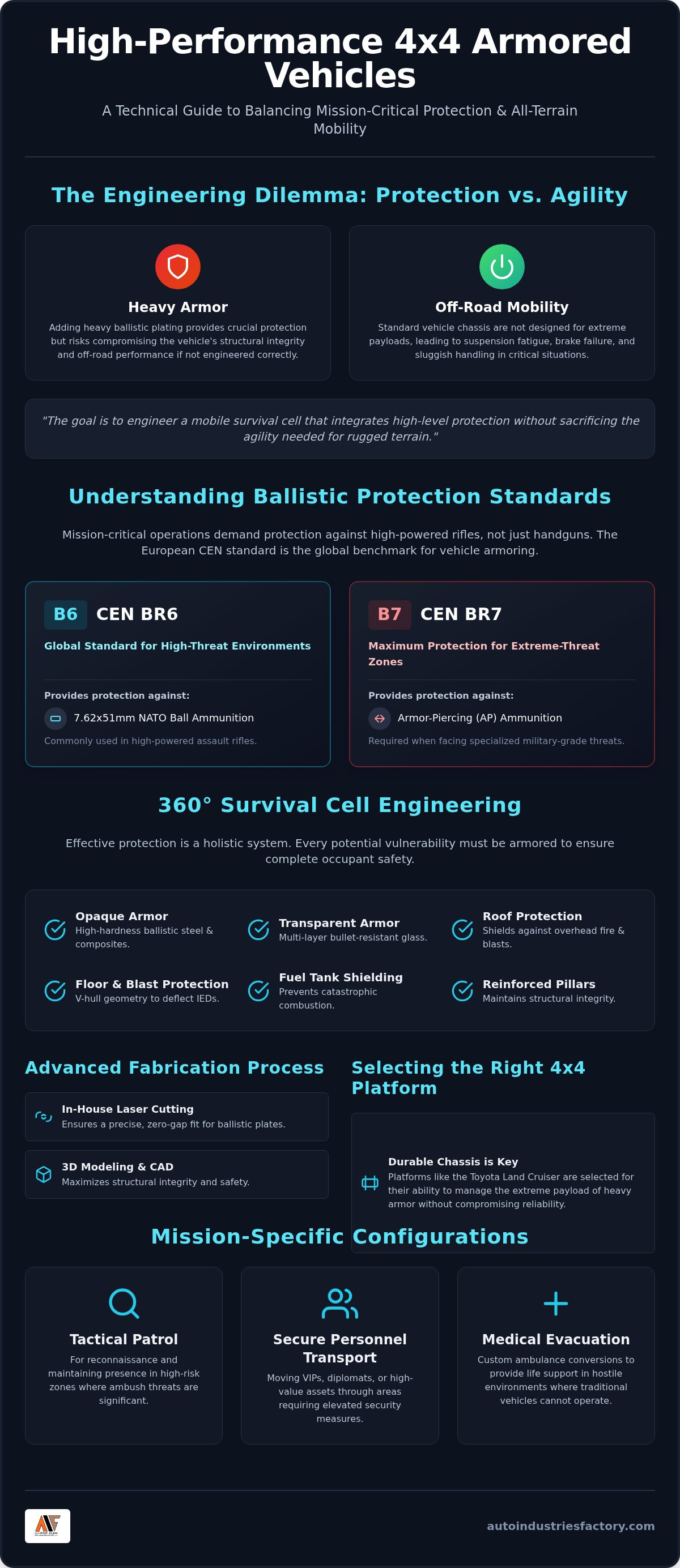
The engineering of high-performance 4x4armored vehicles relies on material science and structural integrity. High-hardness ballistic steel plating remains the industry standard, often paired with advanced composite materials to keep the vehicle's center of gravity low. Transparent armor, or bullet-resistant glass, uses a multi-layer polycarbonate and glass sandwich construction to stop high-velocity rounds while providing clear visibility. Because of the added weight, we reinforce the structural pillars and chassis to prevent frame fatigue over long-term use.
Primary Roles for Armored 4x4 Platforms
Versatility is the greatest strength of the 4x4 platform. These vehicles aren't limited to combat; they're essential tools for maintaining order and saving lives in volatile regions. Common roles include:
- Tactical Patrol: Conducting reconnaissance and maintaining a presence in high-risk zones where ambush threats are high.
- Secure Personnel Transport: Moving VIPs, diplomats, or high-value assets through areas where standard security measures aren't enough.
- Medical Evacuation: Utilizing specialized ambulance conversions to provide life support in hostile environments where traditional ambulances can't reach.
Understanding Ballistic Protection Levels and Standards
Selecting the right protection level for 4x4armored vehicles is a critical engineering decision that dictates the vehicle's weight, performance, and survival capability. Industry professionals rely on two primary standards: the European CEN (VPAM/BR) and the American NIJ (National Institute of Justice). While both are respected, CEN is the global benchmark for vehicle armoring. B4 protection is designed to stop handgun threats, making it suitable for low-threat urban environments. However, mission-critical operations usually demand B6 or B7 levels, which are engineered to stop high-powered rifle fire and specialized ammunition.
Effective protection requires a 360-degree approach that leaves no vulnerability. It isn't enough to armor the doors and windows. The roof must withstand overhead blasts or fire from elevated positions, and the fuel tank needs specialized shielding to prevent catastrophic combustion. Blast protection is equally vital; we incorporate floor reinforcement and V-hull geometry to deflect the energy from IEDs away from the occupants. This holistic view of modern armored vehicle design ensures that the chassis remains a survival cell even under extreme duress.
CEN BR6 vs. BR7: Which Level Do You Need?
CEN BR6 is the global standard for most security details and tactical units. It provides protection against 7.62x51mm NATO ball ammunition, which is common in high-risk zones. For environments where armor-piercing (AP) rounds are a threat, BR7 is required. The choice involves a significant trade-off. BR7 armor is considerably heavier, which can impact the vehicle's top speed and off-road agility. It's essential to balance the threat level with the need for maneuverability to ensure the team can escape a kill zone quickly. If you're unsure which rating fits your mission, you can consult with our experts on vehicle modification solutions to find the right balance.
Critical Protection Zones Beyond the Cabin
A vehicle that can't move is a target. We prioritize engine bay armoring to protect the radiator and engine block from disabling fire. Run-flat tire systems are non-negotiable; they allow the vehicle to travel up to 50km at 50km/h even after the tires are completely shredded. We also shield the battery and Electronic Control Unit (ECU) to prevent a total system shutdown during an engagement. Our fabrication process ensures these components are protected without interfering with the vehicle's cooling or electronic performance.
- Engine Shielding: Protects the radiator, battery, and ECU from ballistic fragments.
- Fuel Tank Protection: Specialized coating or plating to prevent leaks or explosions.
- Run-Flat Inserts: Maintains mobility for escape after tire damage.
- Overlap Protection: Zero-gap armor at door seams and window edges.
Selecting the Right 4x4 Platform for Armored Conversion
The foundation of any mission-ready asset begins with the chassis. You can't simply bolt armor onto a light-duty frame and expect it to survive a tactical deployment. Selecting high-performance 4x4armored vehicles requires a platform with a high Gross Vehicle Weight Rating (GVWR) to accommodate the massive payload of ballistic materials. A typical B6 conversion adds between 1,000kg and 1,500kg of weight. If the base vehicle isn't engineered for this load, you'll face catastrophic failure of the frame, drivetrain, and suspension within months of operation.
While purpose-built tactical units are effective, as seen in Forecast International's analysis of the M1117 Armored Security Vehicle, the industry gold standard remains the conversion of proven commercial platforms like the Toyota Land Cruiser and Hilux. These vehicles are preferred because their parts are available globally, and their high-torque diesel engines provide the low-end power needed to move a heavy armored shell through deep sand or mud. Our engineering team applies the same principles of off-road durability found in our Safari Vehicle Conversions to ensure armored units can handle extreme terrain without mechanical fatigue.
Chassis and Suspension Reinforcement
Standard suspension systems are designed for passenger comfort, not ballistic steel. To manage the added weight, we replace factory components with heavy-duty springs and high-pressure nitrogen shock absorbers. Braking systems also require a complete overhaul. Kinetic energy doesn't lie; a vehicle carrying an extra ton of armor requires high-performance rotors and multi-piston calipers to maintain safe stopping distances. We also reinforce axles and drivetrain joints to prevent snapping under the increased stress of high-torque maneuvers.
Common Base Vehicles for Professional Fleets
Choosing the right base vehicle depends on the mission profile. We specialize in the following platforms for professional security and emergency roles:
- Toyota Land Cruiser 70 Series: Known as the 'indestructible' choice, its simple mechanical design makes it perfect for military and remote humanitarian use.
- GMC and Chevrolet Platforms: These heavy-duty American chassis are the preferred choice for large-scale command centers and box-type ambulance conversions.
- Toyota Hilux: A versatile, cost-effective platform for rapid response teams and light tactical patrol in urban environments.
By starting with a robust platform and applying precision engineering, we ensure your 4x4armored vehicles remain agile, reliable, and capable of completing the mission under any conditions.
Mission-Specific Configurations for Armored 4x4s
Armored Medical Evacuation (MedEvac) Units
Balancing medical capacity with ballistic safety is a complex engineering task. Our armored ambulances feature integrated oxygen systems and heavy-duty stretchers secured within a reinforced survival cell. The interior utilizes medical-grade, easy-clean surfaces that maintain hygiene in harsh environments. Since life-support equipment is power-hungry, we install secondary electrical systems and high-capacity battery banks. This ensures critical machines stay on even if the primary engine fails. It's a system designed for zero downtime. Learn more about our technical approach in our guide to Ambulance Conversion.
Troop Carriers and APC Modifications
Moving personnel through high-risk zones requires specialized seating and defensive capabilities. We can reconfigure the interior of 4x4armored vehicles to carry 8-10 personnel while maintaining a low profile. Tactical upgrades often include armored roof hatches and gun ports that allow the crew to respond to threats without exiting the vehicle. These APC-style modifications turn a standard 4x4 into a mobile fortress. We also reinforce the door hinges and latches to handle the extreme weight of the armored doors during rapid troop deployment. For more details on these roles, read our post on Armoured Personnel Carriers.
Our UAE-based factory provides the precision fabrication needed for these mission-critical roles. If you're looking for a partner to build your next fleet, request a quote for our vehicle modification solutions today.
The Fabrication Process: How We Build Reliability
Reliability isn't an accident; it's the result of a controlled fabrication environment. At our UAE-based facility, we oversee every stage of the build to ensure that 4x4armored vehicles meet the highest safety standards. We don't rely on third-party fabricators. By keeping the design, cutting, and welding in-house, we maintain absolute control over the structural integrity of the ballistic shell. This process begins with a complete teardown of the base vehicle, followed by the integration of the armor capsule into the existing chassis to create a seamless survival cell.
In-House Engineering Excellence
Precision starts in the digital space. Our engineering team uses advanced 3D modeling to map the interior of the vehicle, ensuring that every piece of ballistic steel fits perfectly against the frame. We use high-precision laser cutting and CNC machining to create armor plates with complex geometries. This technology allows us to achieve seamless overlapping at critical points like door pillars and window frames. Without this level of accuracy, ballistic gaps can occur, creating lethal vulnerabilities. You can visit our About Us page to learn more about our factory's specialized equipment and technical expertise.
Welding ballistic steel requires a master craftsman's touch. Standard welding techniques can overheat the metal, compromising its hardness and ballistic resistance. We use specialized pulse welding and heat-management protocols to join the armor plates while maintaining their protective properties. Once the shell is complete, we subject every unit to a rigorous quality assurance protocol:
- Water Ingress Testing: High-pressure spray tests ensure the cabin remains sealed against the elements.
- Road Testing: We conduct extensive trials on varied terrain to verify that the upgraded suspension and brakes perform under the full armored load.
- Ballistic Verification: We ensure all materials used are certified to the required standards through documented batch testing and certification.
Finishing and Protective Coatings
A mission-ready vehicle must look the part and withstand environmental decay. We provide professional vehicle painting and color changes to match your fleet's branding or provide low-visibility matte finishes for tactical use. Because many of our clients operate in coastal or desert environments, we apply advanced anti-corrosion treatments to the chassis and underbody. Finally, we integrate essential exterior hardware. This includes fitting Custom Bull Bars and heavy-duty roof racks to expand the vehicle's utility in the field. This comprehensive approach ensures your 4x4armored vehicles are as durable as they are protective.
Secure Your Mission with Precision Engineering
Deploying high-performance 4x4armored vehicles requires a deep understanding of the intersection between ballistic science and automotive engineering. True protection goes beyond merely adding steel; it demands a reinforced chassis, specialized suspension, and zero-gap fabrication to ensure the vehicle remains a mobile asset rather than a mechanical liability. Whether your mission involves tactical patrol or emergency medical evacuation, the reliability of your conversion depends entirely on the precision of the manufacturing process.
Auto Industries Factory LLC provides specialized in-house fabrication for military and medical conversions, delivering rugged solutions for national security needs. We don't settle for generic builds. Our team utilizes advanced laser cutting and CNC machining to transform standard platforms into mission-ready fortresses that perform in the harshest environments. You can trust our engineering to keep your team safe in the field.
Ready to upgrade your operational capabilities? Request a Technical Consultation for Your Armored Fleet today and partner with a leader in vehicle modification excellence.
Frequently Asked Questions
What is the most common ballistic protection level for 4x4 armored vehicles?
CEN B6 is the most common protection level for professional 4x4armored vehicles. This rating ensures the cabin can stop 7.62x51mm NATO ball ammunition, which is the standard threat in high-risk zones. While B4 protects against handguns, security professionals prefer B6 for its ability to withstand high-powered rifle fire. It provides a reliable balance between extreme protection and the weight limits of the vehicle's chassis, ensuring the platform stays mobile and responsive.
How does armoring a 4x4 vehicle affect its off-road performance?
Armoring significantly increases a vehicle's weight, which can affect acceleration and handling if the suspension isn't properly upgraded. However, professional conversions utilize heavy-duty springs and nitrogen shocks to maintain ground clearance and off-road agility. High-torque diesel engines are essential to ensure the vehicle has the power to navigate deep sand or mud despite the added ballistic plating. This engineering ensures that the vehicle's original off-road capabilities are preserved for mission-critical operations.
Can any standard 4x4 vehicle be converted into an armored unit?
No, only vehicles with high Gross Vehicle Weight Ratings (GVWR) are suitable for armored conversion. The frame must be strong. It must support at least 1,000kg of additional weight without buckling. We focus on Toyota and GMC platforms because their frames are engineered for extreme durability. Light-duty passenger SUVs lack the structural integrity required for ballistic reinforcement. They simply won't survive the load.
What are run-flat tires and why are they necessary for armored cars?
Run-flat tires are specialized wheel inserts designed to maintain mobility even after the tire has been completely deflated. Mobility saves lives. A stationary armored vehicle is an easy target. These systems allow the driver to maintain control and travel at speeds up to 50km/h for a limited distance. This capability ensures the crew can escape a danger zone and reach a secure location even under heavy fire.
How much weight does ballistic armor add to a typical SUV?
A typical B6 armored conversion adds approximately 1,000kg to 1,500kg of total weight to the base SUV. Weight distribution is critical. This mass includes ballistic steel plates, multi-layer glass, and reinforced structural pillars. Because this weight is permanent, it's vital to choose a platform with a high payload capacity. Our engineering team calculates the balance to ensure the vehicle remains stable during high-speed maneuvers and avoids excessive body roll.
What is the maintenance schedule for an armored 4x4 compared to a standard vehicle?
Maintenance intervals for 4x4armored vehicles are significantly shorter than those for standard civilian models. The constant heavy load puts extreme stress on the braking system, suspension bushings, and tire sidewalls. We recommend inspecting the high-performance brake pads and rotors every 5,000km to ensure stopping power isn't compromised. Regular drivetrain lubrication is also critical to prevent premature wear on the axles and joints under the increased weight of the armor.
How long does the armored vehicle conversion process usually take?
The conversion process generally takes between 6 and 12 weeks from the initial teardown to the final quality testing. This timeline accounts for the precision laser cutting of the armor plates, the specialized welding process, and the installation of mission-specific hardware like medical systems or tactical communication arrays. Complex builds, such as box-type ambulances, may require additional time for custom interior fabrication and electrical integration to ensure total reliability.
Are armored 4x4 vehicles street-legal for private use?
Street legality for armored 4x4s varies by country and regional jurisdiction. In many markets, private individuals can own armored vehicles, but they often require specific security permits or government licensing. It's also important to check local weight restrictions, as some armored units may exceed the limits for standard driver's licenses. We recommend consulting with local transport authorities to ensure full compliance with regional safety and security laws before starting a project.


