

A standard 4x4 with a siren isn't a rescue vehicle; it's a liability waiting to happen in the world's most unforgiving environments. You've likely seen standard emergency vehicles fail when the pavement ends, getting stuck in deep sand or suffering structural damage from relentless vibration. When a life is on the line, an off-road ambulance must be more than just a modified van. It needs to be a ruggedized medical sanctuary built with the precision of a master craftsman to ensure that neither the terrain nor the heat compromises patient care.
You're looking for a solution that balances heavy-duty agility with strict medical compliance. In this guide, you'll discover how specialized 4x4 engineering and precision medical fabrication create life-saving vehicles capable of conquering the toughest terrains. We'll break down the 2026 standards for remote rescue, from chassis reinforcement on platforms like the Toyota Land Cruiser to advanced anti-vibration systems that protect sensitive equipment. You'll learn exactly what it takes to maintain long-term reliability when the nearest workshop is hundreds of miles away.
Key Takeaways
- Identify why conventional van platforms suffer catastrophic chassis stress in desert and mountain environments.
- Compare the mechanical advantages of the Toyota Land Cruiser 78 and the Toyota Hilux box-type configurations for remote rescue.
- Discover how precision metal fabrication and CNC machining create a durable off-road ambulance that prevents equipment failure during transit.
- Learn the necessity of custom-fabricated bull bars and structural reinforcements to protect critical engine components in wildlife areas.
- Review the specialized 7-step conversion process used to build high-performance medical vehicles that meet 2026 compliance standards.
Understanding the Off-Road Ambulance: Why Standard Units Fail in Remote Terrain
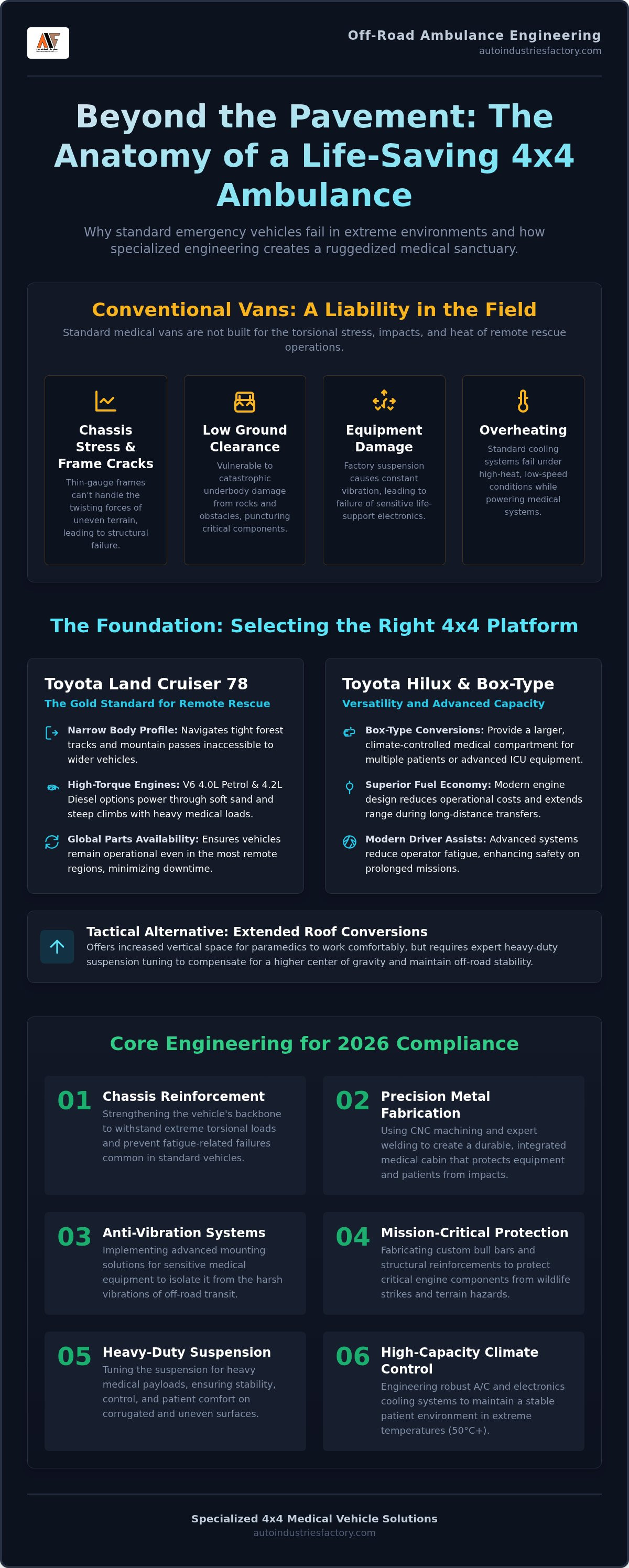
An off-road ambulance isn't just a vehicle; it's a high-clearance, 4x4 engineered platform designed for patient stabilization in unpaved environments. While standard ambulance types excel on tarmac, they quickly become liabilities in the desert or mountains. These conventional units fall into the "Standard Van" trap. Their thin-gauge chassis aren't built for the torsional stress of uneven tracks, leading to frame cracks and door misalignment. In critical mission profiles like mining operations, deep-forest logging, or disaster relief, a vehicle that gets stuck isn't just a logistical failure; it's a life-threatening delay. By utilizing 4x4 capability, rescue teams significantly reduce "time to treatment" by navigating directly to the incident site rather than waiting for a secondary transport team to bridge the gap.
The Limitations of Conventional Medical Vehicles
Standard vans suffer from low ground clearance that invites catastrophic underbody damage. A single hidden rock can puncture an oil pan or sever a hydraulic line. Beyond that, their factory suspension isn't tuned for heavy medical payloads on corrugated roads. Constant vibration leads to structural fatigue and potential damage to delicate life-support equipment. In extreme heat, standard cooling systems often fail. They simply aren't designed to idle for hours in 50-degree Celsius temperatures while powering high-draw medical electronics and high-capacity air conditioning for the patient compartment.
Defining the 4x4 Emergency Response Vehicle
A true off-road ambulance requires specific mechanical DNA. This includes low-range gearing for steep climbs, locking differentials for traction in soft sand, and high-torque engines that don't bog down under load. Approach and departure angles are equally vital. Without sufficient clearance, a vehicle will bottom out or lose its bumper during ravine crossings or steep transitions. Every component must be reinforced to handle the lateral G-forces of off-road driving. The 4x4 ambulance is the essential bridge between rugged expedition vehicles and sterile medical clinics, ensuring the patient remains stable even when the road disappears.
Selecting the Right Platform: Toyota Land Cruiser 78 vs. Heavy-Duty Trucks
Choosing the right chassis is the most critical engineering decision for an off-road ambulance. It dictates the vehicle's survival in harsh environments and the level of care possible inside the patient compartment. While many platforms exist, professional fleet managers in 2026 prioritize a balance between mechanical simplicity and structural payload capacity. You need a vehicle that can carry a full Advanced Life Support (ALS) kit without bottoming out on the first sand dune it encounters.
The Toyota Land Cruiser 78: The Gold Standard
The Land Cruiser 78 remains unrivaled for high-heat, high-dust environments. Its narrow body profile allows it to navigate tight forest tracks or mountain passes where wider vehicles would be forced to turn back. With V6 4.0L petrol and 4.2L diesel options, it provides the raw torque needed to move heavy medical loads through soft terrain. Global parts availability ensures that even in remote regions, maintenance doesn't ground the vehicle for weeks. It's the master craftsman's choice for missions where reliability is the only metric that matters.
Heavy-Duty Alternatives: Hilux and Box-Type Conversions
The Toyota Hilux is gaining ground as a versatile 4x4 platform. For 2026, it offers superior fuel economy and modern driver assistance systems that reduce operator fatigue during long transfers. When medical missions require more than basic stabilization, the Hilux Box-Type C conversion provides the necessary square footage for multiple patients or advanced ICU equipment. These larger builds must adhere to rigorous safety benchmarks, such as the Ground Vehicle Standard for Ambulances, to ensure structural integrity during a rollover or high-impact scenario.
For agencies requiring maximum vertical space without the footprint of a full box, the extended roof ambulance on GMC and Toyota platforms offers a tactical middle ground. This modification allows paramedics to stand more comfortably, reducing physical strain during life-saving procedures. However, adding height shifts the center of gravity. Expert fabricators must compensate with heavy-duty suspension tuning to maintain off-road stability. If you're unsure which platform fits your specific geographic challenges, exploring professional ambulance conversion services can help align your medical requirements with the right mechanical capabilities.
Payload capacity always competes with off-road agility. A GMC heavy-duty truck can carry an entire mobile clinic's worth of gear, but it lacks the nimbleness of an LC 78 in dense vegetation. You must evaluate the "last mile" of your rescue mission. If the terrain involves steep ravine crossings, agility wins. If the mission is a long-distance transport from a remote mine to a city hospital, the payload and comfort of a larger truck platform are superior.
The Engineering Behind Off-Road Medical Conversions
Engineering an off-road ambulance requires a master craftsman's approach to metalwork. It isn't enough to bolt medical cabinets into a 4x4. The constant torque and vibration of remote trails will shake standard fasteners loose within weeks. Precision is the only solution. By utilizing in-house CNC machining and laser cutting, fabricators ensure every bracket and structural support fits the chassis with zero tolerance for play, a standard we uphold as a national specialist in the UAE. This level of detail prevents the dreaded "cabinet rattle" and ensures life-saving equipment doesn't detach during aggressive maneuvers. For a deeper look at the fundamentals of these builds, you can explore our professional ambulance conversion services.
Suspension and Chassis Upgrades
A fully equipped medical interior adds significant permanent weight. Heavy-duty batteries, oxygen cylinders, and reinforced cabinetry quickly push a factory chassis to its limits. We reinforce the frame at key stress points to prevent sagging or cracking under load. Upgrading to heavy-duty shocks and multi-leaf springs is mandatory for stability. This isn't just about comfort; it's about safety. Keeping the center of gravity low is a primary engineering challenge, especially with high-roof or box-type conversions. Every kilogram placed above the beltline is countered by strategic placement of heavy components like water tanks and battery banks beneath the floor level. These modifications align with modern Ambulance Safety and Design Standards to ensure the vehicle remains stable during high-speed evasive maneuvers or steep side-slopes in a specialized off-road ambulance.
Interior Ergonomics for High-Vibration Environments
Inside the patient compartment, material choice is everything. We move away from traditional wood or heavy plastics, favoring aircraft-grade aluminum for cabinetry. Aluminum offers the perfect strength-to-weight ratio and doesn't splinter in a collision. Every drawer and medical kit must feature positive-locking mechanisms. Friction-fit latches fail on corrugated roads; mechanical bolts are the only way to prevent supplies from becoming projectiles. To maintain 2026 hygiene standards, we implement several critical features:
- Lightweight Aluminum Cabinetry: Maximizes payload while resisting structural fatigue from constant vibration.
- Mechanical Locking Latches: Prevents medical supplies from becoming airborne during rough transit.
- Anti-microbial Seamless Surfaces: Ensures easy decontamination in dusty, remote environments.
- Shock-Isolated Equipment Mounts: Protects sensitive heart monitors and ventilators from high-frequency shocks.
Vibration dampening is the final layer of protection. Sensitive heart monitors and ventilators are mounted on specialized isolators that absorb the high-frequency shocks of gravel tracks. This protecting the electronics ensures accurate readings for the medical team when they matter most. By combining robust metalwork with precision medical engineering, we create a vehicle that protects both the patient and the provider in the world's most difficult terrain.
Mission-Critical Accessories: Protecting the Vehicle and the Patient
A mission-ready off-road ambulance is only as reliable as its weakest component. In remote rescue, a punctured radiator from a minor brush strike or a dead starter battery in the middle of a desert is a catastrophic failure. Protecting the vehicle's mechanical vitals is just as important as protecting the patient inside. We view accessories not as optional add-ons but as integrated armor designed to withstand the harshest environmental variables. Every piece of hardware we install serves a functional purpose in ensuring the vehicle reaches the hospital without mechanical interruption.
Custom Bull Bars and External Protection
Front-end protection is the first line of defense against the unpredictable. Standard plastic bumpers offer zero protection against wildlife strikes or heavy debris in unmapped areas. Our in-house fabricated bull bars are engineered using laser cutting and CNC bending to provide a precise fit that integrates seamlessly with the chassis. These bars protect the radiator and engine while providing a structural mounting point for heavy-duty winches. You can explore our custom bull bars and bumpers designed for specialized fleets to see how we reinforce front-end integrity. We also install rock sliders to protect the sills and rear bumpers with integrated spare tire carriers, ensuring that even a double puncture doesn't ground your mission.
Visibility and logistical autonomy are critical for search and rescue operations. High-intensity LED bars provide the daylight-like illumination necessary for navigating technical terrain at night. To support long-range operations, we manufacture heavy-duty roof racks capable of carrying extra fuel, recovery gear, and a second spare tire. These racks are built to handle the dynamic loads of off-roading without compromising the structural integrity of the roof conversion, a specialty of our master craftsmen.
Climate Control and Power Management
Maintaining a sterile, cool environment is a non-negotiable requirement for an off-road ambulance. In regions where ambient temperatures exceed 50°C, standard automotive AC systems often fail to keep up. We install high-capacity, independent air conditioning units designed to maintain a stable internal climate regardless of external heat. Powering these systems requires a sophisticated dual-battery setup. This ensures that medical equipment and interior lighting draw from a dedicated deep-cycle bank, leaving the starter battery fully charged for engine ignition. It's a fail-safe approach that prioritizes mission continuity.
For long-term readiness, we integrate external 220V shore power inlets. This allows the vehicle to maintain battery levels and climate control while stationed at a depot, ensuring it's ready for immediate deployment. Every accessory is a calculated solution to a specific remote-rescue challenge. If you need to upgrade your fleet with mission-specific armor, you can request a quote for our specialized vehicle modification services today.
Custom Fabrication Solutions by Auto Industries Factory
Every off-road ambulance we build is the result of a rigorous, vertically integrated engineering cycle. We control the entire lifecycle of the conversion in-house, from the initial 3D design to the final coat of paint. This master craftsman approach eliminates the delays common with third-party suppliers and ensures that every structural component meets our strict durability standards. By managing everything on-site at our Ajman facility, we maintain a level of quality control that "plug-and-play" converters simply cannot match. You can view our full range of specialized vehicle services to see how we apply this precision to diverse fleet requirements.
Our 7-step conversion process ensures mission-readiness for every unit:
- Technical Consultation & 3D Design: Mapping medical requirements to the vehicle chassis.
- Precision Laser Cutting & CNC Bending: Creating exact metal components for cabinets and brackets.
- Structural Chassis Reinforcement: Strengthening the frame for heavy payloads.
- Interior Cabinetry Fabrication: Building lightweight, durable aluminum storage.
- Electrical & Climate Integration: Installing dual-battery systems and high-capacity AC.
- Performance Testing: Rigorous quality assurance for off-road stability.
- Final Painting & Finishing: Applying fleet branding and protective coatings.
Precision Engineering and Laser-Cut Accuracy
We utilize advanced laser cutting technology to ensure perfect fitment in every 2026 model, including the latest Land Cruiser and Hilux platforms. This precision is vital for creating customized interiors that align with specific NGO or government medical protocols. Our engineers tailor every layout to the exact equipment list provided by the client, ensuring ergonomic efficiency during high-stress rescue missions. The durability of our welding and metalwork remains unchallenged in extreme environments, providing a structural cage that protects both the crew and the patient even during high-impact scenarios.
Partnering for National Fleet Success
Securing the Future of Remote Medical Response
Deploying a mission-ready off-road ambulance requires more than just 4x4 capability. It demands a synergy between heavy-duty vehicle platforms like the 2026 Toyota Land Cruiser 78 and precision engineering. You've seen how standard units fail under the stress of unpaved terrain. The solution lies in rugged, field-tested fabrication that prioritizes structural integrity and patient safety above all else. By utilizing in-house CNC machining and laser-cutting precision, we ensure that every internal cabinet and external bull bar is built to withstand the most punishing environments on earth.
Reliability in the field is a direct result of master craftsmanship. Whether you're managing a national emergency response fleet or a remote mining operation, your vehicles must perform when the pavement ends. We specialize in transforming the Hilux and Land Cruiser platforms into durable medical sanctuaries that meet 2026 standards. Don't leave your rescue missions to chance with unreinforced conversions. Take the next step in protecting your crew and patients by partnering with an expert engineer who understands the stakes of remote rescue.
This commitment to precision and performance is a hallmark of specialized services in the Emirates, whether for life-saving vehicles or the high-performance gear maintained by Yalla Jump.
Request a Quote for Your Off-Road Ambulance Fleet and ensure your team is equipped for any challenge the terrain presents.
Frequently Asked Questions
What is the best vehicle for an off-road ambulance conversion in 2026?
The Toyota Land Cruiser 78 remains the industry gold standard for 2026 due to its mechanical simplicity and narrow body profile. For missions requiring expanded patient care capacity, the Toyota Hilux with a box-type conversion is the preferred choice. Both platforms offer the necessary torque and global parts availability required for long-term reliability in remote areas.
Can a standard 4x4 SUV be converted into a fully functional ambulance?
Yes, but it requires extensive structural reinforcement to handle the permanent weight of medical systems and oxygen cylinders. We utilize in-house laser cutting and CNC machining to create precise internal frames that prevent chassis fatigue. Without these reinforcements, a standard SUV will suffer from frame stress and door misalignment when driven over corrugated terrain.
What medical equipment is essential for a remote rescue vehicle?
Beyond standard trauma kits, a remote vehicle must have high-capacity oxygen systems and shock-isolated medical monitors. It's critical to use stretchers with specialized mounting systems that absorb high-frequency vibrations. Every piece of equipment must be secured with mechanical locking latches to ensure it doesn't become a projectile during aggressive off-road maneuvers.
How does an off-road ambulance handle extreme temperatures?
An off-road ambulance manages extreme heat through high-capacity, independent air conditioning units and superior compartment insulation. We integrate dual-battery management systems to power these cooling units and medical electronics without draining the engine's starter battery. This ensures the vehicle remains a sterile, cool sanctuary even in ambient temperatures exceeding 50 degrees Celsius.
Is a 4x4 ambulance slower than a standard road ambulance?
On paved highways, a 4x4 ambulance typically has a lower top speed due to its heavy-duty suspension and all-terrain tires. However, in remote environments, it's significantly faster because it doesn't get stuck or damaged by obstacles. The primary metric is "time to treatment," and a specialized vehicle wins by navigating directly to the patient where standard vans cannot go.
What maintenance is required for a specialized vehicle conversion?
Maintenance involves regular technical audits of the reinforced chassis points and all fabricated accessories like bull bars and winches. You must also check the integrity of the secondary electrical systems and the medical compartment's structural fasteners. Standard automotive servicing should be supplemented with a specialized inspection every six months to ensure mission-readiness.
Do you provide national delivery for off-road ambulance fleets?
Yes, we provide comprehensive national support and delivery for fleet-ready modifications. Our facility is equipped to handle large-scale orders for government agencies and NGOs, ensuring every vehicle meets the same rigorous fabrication standards. We provide technical consultations and ongoing support for fleets deployed in the most challenging regional environments.
How much does an off-road ambulance conversion cost?
The total investment for an off-road ambulance varies based on the chosen vehicle platform and the level of medical equipment required. Factors such as custom armor, advanced climate control, and specific ALS or BLS configurations will influence the final technical specifications. We provide detailed, custom estimates tailored to your specific mission profile and budget requirements.


