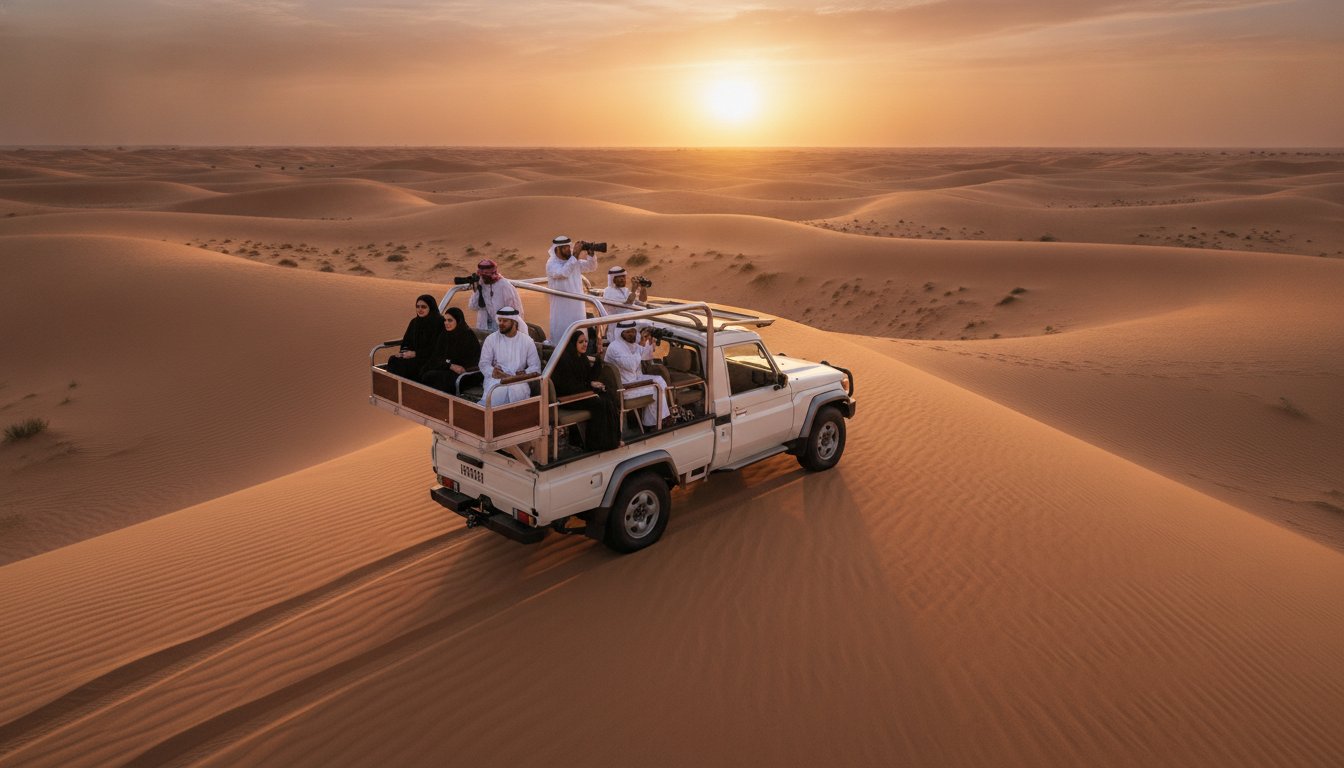
What if your back-row passengers spend more time looking at the headrest in front of them than the pride of lions five meters away? You already know that guest satisfaction hinges on that perfect, unobstructed shot, yet standard 4x4 layouts often fail to deliver the experience your clients expect. Professional elevated seating for safari viewing solves this by lifting the vantage point, but it isn't as simple as just adding height. It requires a master craftsman's approach to ensure the vehicle remains stable and safe on rugged terrain.
This guide explains how professional elevated seating conversions transform standard 4x4s into world-class safari viewing platforms through precision engineering. We'll examine the technical balance between achieving 360-degree visibility and maintaining a low center of gravity for safety. You'll learn how to build a fleet that withstands extreme desert heat, complies with regional safety regulations, and increases your booking value through premium VIP viewing options. Whether you're modifying a Toyota Land Cruiser 70-series or a Hilux, the right fabrication makes the difference between a standard drive and an elite expedition.
Key Takeaways
- Understand why custom tiered platforms are essential to eliminate visibility gaps and provide every passenger with a clear 360-degree view.
- Compare the Toyota Land Cruiser 70-series and the Toyota Hilux as the primary platforms for high-performance elevated seating for safari viewing.
- Evaluate the engineering trade-offs between internal stadium seating for passenger safety and rooftop platforms for professional photography.
- Learn how precision Center of Gravity calculations and integrated Roll-Over Protection Systems ensure vehicle stability on the most demanding terrain.
- Discover the professional fabrication workflow that transforms raw metal into a durable, mission-ready safari fleet through 3D design and expert welding.
Why Elevated Seating is Essential for Premium Safari Viewing
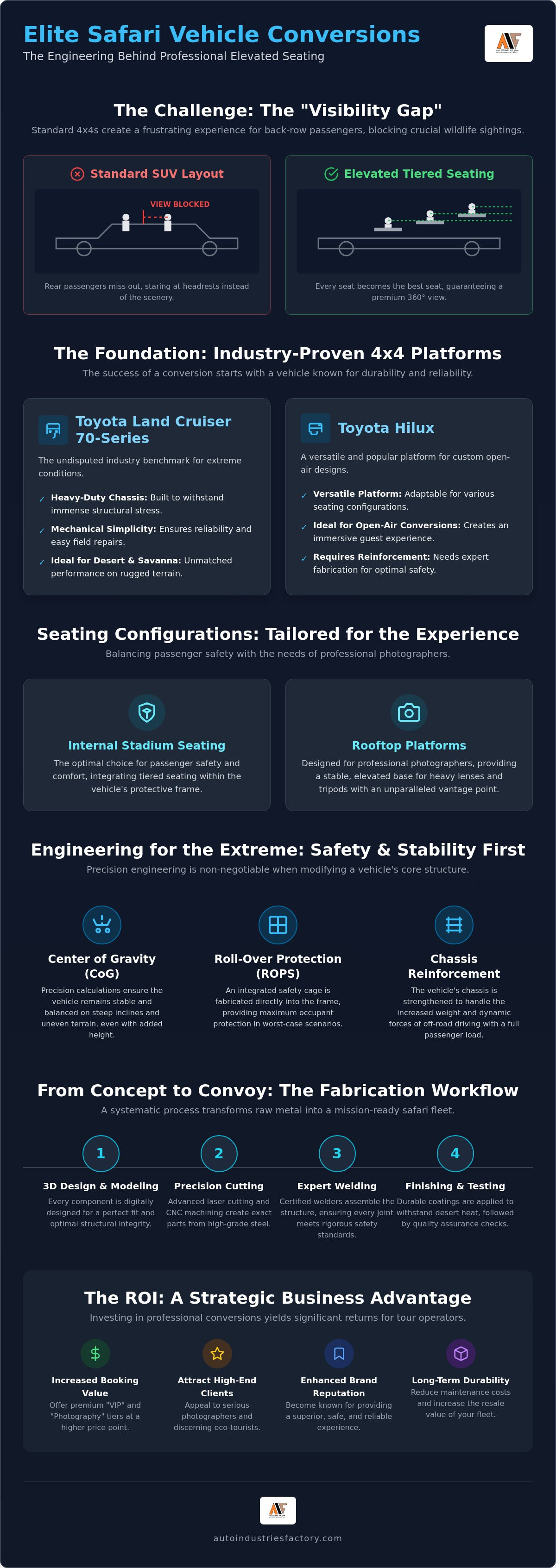
Elevated seating for safari viewing is more than just height; it's a precision-engineered solution for unobstructed 360-degree observation. We define this as custom-fabricated tiered or rooftop platforms designed to eliminate the "Visibility Gap." In a standard SUV, rear passengers are often trapped behind headrests or restricted by narrow window frames. This limitation ruins the experience during desert tours where wildlife or landscapes might be low on the horizon or hidden behind dunes.
By converting a standard 4x4 into a specialized Game viewer vehicle, operators provide guests with a vantage point that standard vehicles can't match. This elevation places tourists above the swirling dust and thick brush, creating a truly immersive wilderness experience. It's a psychological shift that makes the guest feel like an active explorer rather than a passive passenger, providing a sense of openness and security simultaneously.
To better understand how these platforms enhance the experience, watch this helpful video:
From a business perspective, the ROI is clear. Premium viewing platforms allow operators to market "VIP" or "Photography" tiers. Guests are willing to pay a premium for the guarantee of a clear shot. It's about selling the view, not just the transport. When every seat is the best seat in the house, your booking value increases along with your guest satisfaction scores.
The Evolution of the Safari Viewing Platform
The industry has moved far beyond simple roof hatches. We've seen a shift toward sophisticated stadium-style seating that provides every passenger an equal view. Current trends for 2026 in the UAE focus on sleek, integrated designs that handle the high-speed transit to the dunes while offering maximum visibility once on site. Guest satisfaction ratings are tied directly to the quality of the view, making modern, tiered layouts a requirement for high-end operators.
B2B Advantages for Tour Operators
Investing in professional safari vehicle conversions helps you stand out in a crowded market. You'll attract high-end eco-tourists and professional photographers who require stable, elevated seating for safari viewing to support heavy lenses and tripods. Choosing custom metal fabrication from Auto Industries Factory LLC over cheap, bolt-on aftermarket kits ensures your fleet survives the punishing desert heat without rattling, cracking, or structural failure. This level of engineering doesn't just improve the guest experience; it reduces long-term maintenance costs and increases the resale value of your vehicles. It's an investment in your brand's reputation for quality and reliability.
Vehicle Platforms: Converting the Toyota Land Cruiser and Hilux
The choice of vehicle platform determines the success of any conversion. While many 4x4s exist, the Toyota Land Cruiser 70-series remains the industry benchmark. To source these vehicles at a better value, you can discover Marhaba Auctions and browse their selection of used 4x4s. Its heavy-duty chassis and mechanical simplicity make it ideal for the extreme conditions of the savanna or the desert. We also see increasing demand for the Toyota Hilux. It serves as a versatile platform for open-air conversions. Both vehicles require significant structural reinforcement before we install elevated seating for safari viewing. Adding height shifts the center of gravity. Without prepping the chassis, you risk compromising the vehicle's handling and safety.
Precision is paramount in our fabrication process. We utilize advanced laser cutting and CNC machining to create exact mounting points. This ensures that every bracket and support beam fits perfectly without compromising the vehicle's original integrity. When following South African vehicle safety regulations, it's clear that material thickness and weld quality are non-negotiable. Our in-house team handles every step from metal bending to final assembly. If you're looking for expert safari vehicle conversion services, starting with a reinforced foundation is the only way to ensure long-term durability.
LC70 Safari Specialist Modifications
The LC70 demands specific upgrades to support overhead loads. We reinforce the pillars and roof frame to handle the dynamic stress of a fully loaded viewing platform. Custom bull bars and heavy-duty side steps are integrated into the design. These provide guests with stable, easy access to their high-vantage seats. For a deeper look at specific platform requirements, check our safari vehicle conversions guide. We don't just add parts; we re-engineer the vehicle for its new mission.
Hilux and Pickup Conversions
Pickup platforms like the Hilux offer unique opportunities for multi-tier viewing arenas. We transform the cargo bed into a stadium-style seating area. This process involves custom canopy integration where the seating mounts are welded directly to a reinforced sub-frame. Balancing the payload is critical. We calculate the weight distribution to ensure the vehicle maintains its off-road performance even when fully loaded. It's about maximizing visibility without sacrificing the agility needed to navigate deep sand or rocky trails. Professional elevated seating for safari viewing requires this level of detail to keep your guests safe and your vehicles on the road.
Seating Configurations: Stadium vs. Rooftop Platforms
Choosing the right configuration for elevated seating for safari viewing is a strategic decision that impacts both guest experience and operational safety. We categorize these modifications into two primary architectures: stadium seating and rooftop platforms. Each offers distinct advantages depending on whether your priority is high-speed transit stability or maximum stationary visibility. A master craftsman understands that the mission profile of the vehicle dictates the fabrication approach.
Stadium seating utilizes tiered rows integrated directly within the vehicle body. This layout maintains a lower center of gravity compared to roof-mounted options, providing maximum safety during off-road maneuvers. It's the preferred choice for family-oriented tours where comfort and protection from the elements are paramount. In contrast, rooftop platforms provide an unmatched 360-degree vantage point. These are the ultimate solutions for professional photography and stationary wildlife observation, allowing guests to see over tall grass and dense scrub that would otherwise block their line of sight.
Hybrid designs are becoming increasingly popular for high-end fleets. These combine the security of interior stadium seating with a secondary exterior viewing deck or a pop-up roof hatch. Accessibility remains a core engineering focus; we design custom-fabricated ladders and integrated handrails to ensure guests of all ages can navigate the vehicle safely. Every weld and mounting point is tested to withstand the vibrations of corrugated roads.
Comparing Layouts for Fleet Efficiency
Fleet managers must balance seating capacity with individual visibility. A "sweet spot" typically involves three tiered rows, ensuring no guest's view is obstructed by the person in front. Weather protection is another critical factor. We integrate custom metal canopies and retractable sunshades directly into the seating frame to combat the intense desert sun. Beyond the vehicle, those seeking similar high-quality shade solutions for their homes or offices often rely on Fabrico for custom window treatments. For operators concerned with resale, we engineer these systems to be semi-modular, allowing for a cleaner conversion back to standard specifications if the vehicle is retired from safari service.
Interior Comfort and Ergonomics
The desert environment demands high-durability upholstery. We use materials that resist UV degradation and are easy to clean after dusty excursions. Ergonomics play a vital role in passenger safety; we integrate reinforced grab handles and adjustable footrests to keep guests stable during sudden movements. To maximize space, we include storage solutions for guest gear, such as camera bags and binoculars, integrated directly beneath the elevated seat bases. If you need a fleet that balances these technical requirements, our custom safari vehicle solutions provide the durability your operations demand. This keeps the aisles clear and equipment secure during every expedition.
Engineering for the Desert: Stability, Safety, and Durability
Engineering a vehicle with elevated seating for safari viewing presents a significant challenge in physics. Adding weight and height to a 4x4 fundamentally alters its handling characteristics. We don't just bolt seats to a roof; we recalculate the vehicle's entire operational envelope. Precision engineering ensures that the platform remains stable whether navigating steep dunes or traversing rocky outcrops. It's about protecting the lives of your guests through rigorous technical standards.
Structural integrity is maintained through the integration of Roll-Over Protection Systems (ROPS). We fabricate both internal and external roll cages that tie directly into the reinforced chassis. These cages provide a survival cell for passengers in the unlikely event of a rollover. By using high-tensile steel and specialized bending techniques, we create a frame that is both lightweight and incredibly strong. This dual-layer protection is a hallmark of professional safari vehicle conversions.
Protecting the metalwork from the harsh desert environment is equally critical. We use professional-grade painting and protective coatings to prevent corrosion caused by sand abrasion and extreme heat. Beneath the body, we install heavy-duty suspension upgrades. Standard springs and shocks cannot handle the dynamic loads of an elevated payload. We specify high-performance components that provide a smooth ride for guests while maintaining the necessary stiffness to prevent excessive body roll.
The Science of Vehicle Stability
High-seated vehicles are susceptible to increased roll angles during aggressive dune maneuvers. To compensate for the added height, we often widen the vehicle's track or upgrade to wider, high-flotation tires. These modifications increase the footprint, providing a more stable base for the elevated platform. In safari engineering, the Center of Gravity (CoG) is the theoretical point where the entire weight of the modified vehicle is concentrated, determining the critical threshold at which the platform becomes unstable during lateral movement. Monitoring this point is the only way to guarantee safety on uneven terrain.
Safety Standards and Fabrication Quality
Mission-critical seating mounts require welding standards that exceed typical automotive repairs. We utilize laser-cut precision for all load-bearing brackets to ensure a perfect fit and maximum surface area for welds. This eliminates the structural weak points found in manual fabrication. Our process ensures that every seat and safety rail remains anchored, even under high-impact stress. For more information on how we integrate secondary safety features, read our guide on custom bull bars and bumpers. If you are ready to upgrade your fleet with engineered precision, contact us for a professional safari conversion estimate today.
Professional Fabrication: Building Your Safari Fleet
Transitioning from a technical blueprint to a mission-ready vehicle requires a master craftsman's touch. At Auto Industries Factory LLC, we don't just assemble parts; we execute a comprehensive engineering workflow. This process begins with precise 3D design and culminates in a high-performance finish that withstands the harshest environments. When you invest in elevated seating for safari viewing, you're investing in a system where every weld and bracket is part of a calculated safety solution. Our approach ensures that your fleet isn't just functional but is built to a standardized, professional grade.
Customization is the core of our fabrication philosophy. We understand that a tour operator in the UAE desert has different requirements than one in the Serengeti. We tailor seating heights, layouts, and access points to your specific tour routes and guest demographics. For fleet owners, scalability is vital. We maintain strict consistency across multiple vehicle builds, ensuring that every unit in your fleet offers the same "VIP" experience. This uniformity simplifies maintenance and reinforces your brand's reputation for quality.
Long-term support is what separates a professional conversion from a temporary modification. Specialized safari vehicles endure constant vibration and high-impact stress. We provide the technical guidance and maintenance schedules necessary to keep your elevated platforms secure for years of service. Our team remains a partner in your operation, offering support for everything from structural inspections to protective coating touch-ups. It's about ensuring your investment continues to deliver value long after it leaves our facility.
Our In-House Fabrication Process
Every component is manufactured within our facility to maintain total quality control. We utilize CNC machining and laser cutting for perfect fitment, ensuring that structural reinforcements align with the vehicle's original chassis points. Our team conducts rigorous testing on all seating mounts and safety frames to verify they meet our internal load-bearing standards. You can see our services for the full range of fabrication capabilities we bring to every project. We leave nothing to chance when it comes to the safety of your passengers.
Getting Started with Your Conversion
The first step is selecting the right platform for your specific terrain. Whether you choose the rugged Land Cruiser 70-series or the versatile Hilux, we provide expert consulting to ensure the vehicle matches your operational goals. We move from initial concept to prototyping and design approval, allowing you to visualize the custom seating layout before fabrication begins. Our goal is to deliver a solution that maximizes both visibility and safety. Contact us for a professional consultation on your fleet needs and let's build your next world-class viewing platform. We're ready to transform your vision into a durable, mission-ready reality.
Engineering the Future of Safari Expeditions
The transition from a standard 4x4 to a world-class viewing platform requires a perfect balance of visibility and structural integrity. We've explored how precision engineering, from Center of Gravity calculations to Roll-Over Protection Systems, ensures your guests remain safe on the most demanding terrain. By selecting the right platform and configuration, you don't just improve the view; you increase the operational value and lifespan of your fleet. Professional elevated seating for safari viewing is the definitive way to differentiate your brand in a competitive market.
As specialists in Toyota Land Cruiser and Hilux conversions, we utilize expert in-house CNC and laser fabrication to deliver mission-ready results. We're trusted by regional fleet and military operators to provide solutions that survive extreme desert conditions. Upgrade your fleet with professional safari conversions from Auto Industries Factory LLC today. Your guests deserve an unobstructed view of the wild, and we have the master craftsmanship to provide it. Let's build a fleet that sets the standard for excellence in every expedition.
Frequently Asked Questions
Is elevated seating safe for dune bashing in the desert?
Elevated seating is safe for dune bashing only when the vehicle's suspension and center of gravity are professionally recalibrated. We install heavy-duty components to manage the increased lateral forces experienced during high-angle maneuvers. Without these specific engineering adjustments, the risk of instability increases significantly. It's vital to use a conversion specialist who understands the physics of desert driving rather than relying on basic bolt-on kits that ignore structural dynamics.
What is the best vehicle for an elevated safari seating conversion?
The Toyota Land Cruiser 70-series is the industry standard due to its rigid ladder-frame chassis and high payload capacity. This platform provides the necessary structural foundation for heavy metal fabrications without warping under stress. While the Toyota Hilux is an excellent alternative for lighter, open-air setups, the LC70 remains the top choice for operators requiring maximum durability in remote areas. Its mechanical simplicity also ensures easier field repairs during long-distance expeditions.
Does adding high seats affect the vehicle warranty?
Modifying a vehicle with elevated seating for safari viewing typically voids the manufacturer's warranty on the affected structural and suspension components. Dealers often view custom fabrications as significant alterations to the original engineering. You should consult with your local dealership to understand the specific impact on your coverage. Most professional operators accept this trade-off because the specialized utility of the conversion is essential for their business model and guest experience.
Can elevated seating be removed if I want to sell the vehicle later?
Yes, we can design elevated seating platforms to be semi-modular for future removal. By utilizing precision-machined mounting brackets instead of permanent welds on the main body, the vehicle can be restored to a more standard configuration for resale. This approach protects your long-term investment. While some structural reinforcements remain, a modular design ensures the vehicle retains its appeal for buyers who may not require a dedicated safari layout.
How many passengers can an elevated seating platform safely hold?
Passenger capacity depends on the vehicle's Gross Vehicle Weight Rating (GVWR) and the specific design of the platform. For example, regulations in South Africa often limit converted vehicles to 10 passengers plus the driver to ensure stability. We calculate the total weight of the fabrication and the guests to stay within safe engineering limits. Exceeding these limits compromises braking performance and handling, so we never recommend over-crowding the viewing area.
What kind of maintenance do custom safari viewing platforms require?
Maintenance involves regular inspections of the mounting bolts, safety rails, and protective coatings. The vibrations from off-road travel can loosen hardware over time, so we recommend a torque check every 5,000 kilometers. You should also inspect the metalwork for any signs of coating wear or surface oxidation caused by sand abrasion. Keeping the upholstery clean and treated for UV protection will also extend the life of your interior components in the desert sun.
Are there specific regulations for elevated seating in the UAE?
Specific regulations for elevated seating for safari viewing in the UAE are managed by the RTA and Ministry of Interior. These authorities require that all vehicle modifications meet strict roadworthiness and safety standards before they're registered for commercial use. You'll need to provide technical drawings and proof of structural integrity for approval. We recommend working with a fabricator who is familiar with the local inspection process to ensure your fleet remains fully compliant.
How does elevated seating affect the fuel efficiency of a 4x4?
Fuel efficiency decreases because the added height increases aerodynamic drag and the metal fabrication adds total vehicle weight. You can expect a noticeable change in liters per hundred kilometers, especially during highway transit to the safari site. The engine works harder to overcome the wind resistance created by the elevated profile. Most operators find this an acceptable cost because the increased booking value of a premium viewing experience outweighs the higher fuel expenditure.


