

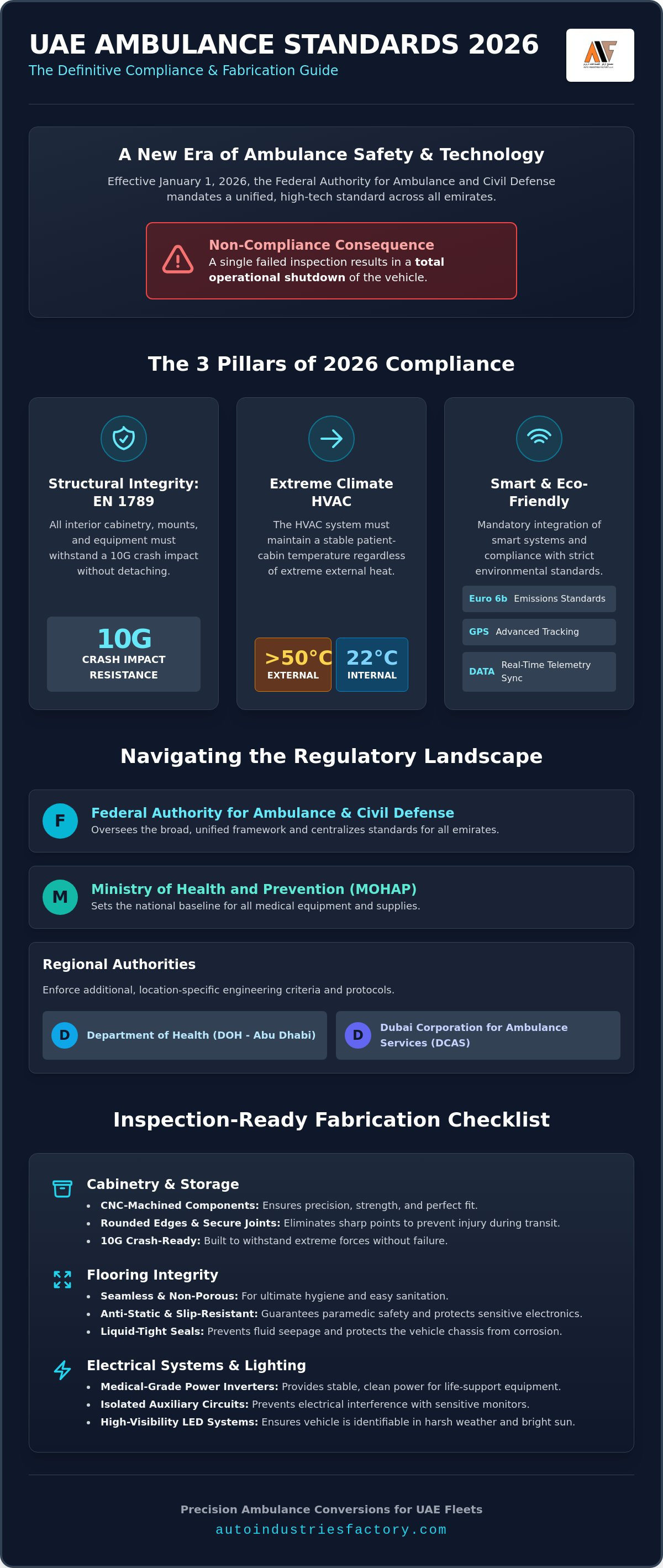
A single failed inspection under the new Federal Authority for Ambulance and Civil Defense isn't just a paperwork hurdle; it's a total operational shutdown that compromises public safety. You know that meeting ambulance conversion standards UAE requires more than a surface-level check. It demands rigorous engineering that survives the 10G crash impact mandated by EN 1789. With regulations that became effective on January 1, 2026, the margin for error has vanished, and the technical demands for specialized vehicle conversions have never been higher.
We agree that keeping pace with shifting MOHAP, DCAS, and DOH requirements is a complex challenge for any fleet manager. This article provides a professional 2026 inspection framework designed to secure your compliance and eliminate unexpected downtime. We'll preview the critical engineering benchmarks, from Euro 6b emission protocols to HVAC systems that must maintain 22°C even when external temperatures exceed 50°C. By the end of this guide, you'll have the actionable insights needed to ensure your fleet is mission-ready and fully certified.
Key Takeaways
- Understand the 2026 regulatory shift under the Federal Authority for Ambulance and Civil Defense to avoid costly fleet grounding.
- Implement ambulance conversion standards UAE by verifying 10G-rated structural integrity and CNC-machined interior cabinetry.
- Establish a rigorous inspection cadence using our daily rapid-check and weekly deep-dive frameworks for maximum vehicle uptime.
- Ensure medical readiness through precise calibration of oxygen systems and life-support equipment to meet DCAS and DOH mandates.
- Leverage high-precision fabrication techniques like laser cutting to guarantee hygienic, seamless surfaces that pass every sanitary audit.
Understanding UAE National Ambulance Standards in 2026
The UAE ambulance sector underwent a massive transformation on January 1, 2026, with the full activation of the Federal Authority for Ambulance and Civil Defense. This body now centralizes the ambulance conversion standards UAE across all seven emirates. It's no longer enough to meet local municipality guidelines; your fleet must integrate into a unified federal framework that prioritizes smart telemetry and real-time data synchronization. Failure to comply leads to immediate vehicle grounding and heavy operational penalties. In a region where external temperatures exceed 50°C, engineering precision isn't a luxury. It's a survival requirement for both the patient and the sensitive medical electronics on board. For vehicles that are grounded and no longer cost-effective to upgrade, SellAnyMotor.ae provides a straightforward way to sell used or scrap vehicles across the UAE.
To better understand the technical precision required for these modifications, watch this helpful video:
Modern 2026 regulations place a heavy emphasis on "smart" capabilities. This means your vehicle conversion must support advanced GPS tracking, integrated patient monitoring systems, and Euro 6b emission standards. If your fabrication partner doesn't master these technical integrations, the operational downtime during inspection will be significant. Every component, from the reinforced chassis to the oxygen delivery system, must be documented in a comprehensive technical file for the ECAS certification, which carries a standard process fee of AED 2,500. Just as technical documentation is vital, ensuring your business's financial compliance through VAT consultancy Dubai is a key part of maintaining a professional operation in the UAE.
MOHAP vs. DCAS vs. DOH: National and Regional Inspections
While the new Federal Authority oversees the broad landscape, specific regional mandates still apply. The Ministry of Health and Prevention (MOHAP) sets the national baseline for medical equipment. However, the Abu Dhabi Department of Health (DOH) and the Dubai Corporation for Ambulance Services (DCAS) enforce additional engineering criteria. For example, Type A units for basic transport have different structural loads than Type B or Type C Mobile Intensive Care Units. Coordinating a national fleet requires a conversion partner who understands how to bridge these regional gaps without duplicating fabrication costs.
The Role of EN 1789 in UAE Fleet Certification
The European standard EN 1789 serves as the primary safety benchmark for UAE ambulance conversions. A critical element of this standard is the 10G "Sledge Test." This mandates that every piece of interior cabinetry, medical mounting, and equipment must withstand a 10G crash impact without becoming a projectile. Electrical systems must also feature medical-grade power inverters and isolated auxiliary circuits to prevent interference with life-saving monitors. Don't settle for "standard" builds; ensure your fabrication utilizes CNC-machined components that meet these exact global safety metrics.
The Vehicle Fabrication and Structural Integrity Checklist
Most fleet managers focus heavily on medical supplies while overlooking the structural foundation of the vehicle. An ambulance is a high-stress environment where every weld and cabinet joint must withstand constant vibration and potential impact. Meeting ambulance conversion standards UAE requires a shift in perspective from simple "outfitting" to master-level engineering. If the fabrication isn't robust, the medical equipment it houses becomes a liability during high-speed emergency maneuvers. Your inspection should start with the core shell before moving to the life-saving tools inside.
Flooring integrity is a critical yet often neglected compliance point. The surface must be seamless, anti-static, and slip-resistant to ensure paramedic safety and patient hygiene. We utilize high-precision liquid-tight seals at every corner to prevent fluids from seeping into the chassis. Additionally, lighting and sirens must meet specific acoustic and luminosity levels. High-visibility LED systems are mandatory for 2026, ensuring the vehicle is identifiable from a distance under the harsh UAE sun without draining the primary battery system.
Cabinetry and Storage Precision
Interior cabinetry must be more than just functional; it must be crash-ready. We use CNC-machined components to ensure every edge is rounded and every joint is secure. This eliminates sharp points that could cause injury during sudden stops. Inspect every medical drawer for rattle-free, secure-lock mechanisms that won't fail under heavy loads. All high-touch surfaces must use antimicrobial and fire-retardant materials. This aligns with the latest Abu Dhabi DoH ambulance standards, which emphasize structural safety as much as clinical readiness. For heavy equipment like monitors and oxygen cylinders, verify that structural reinforcement exists behind the walls to prevent mounting failure.
Electrical and HVAC Performance
The UAE climate is unforgiving. Your HVAC system must be "desert-hardened" to maintain a stable internal temperature of 20-22°C, even when external temperatures soar to 50°C. This isn't just for comfort; it's vital for the shelf life of medications and the calibration of sensitive electronics. Electrical systems must feature an auxiliary battery and a dedicated shore-line power connection for when the vehicle is stationary. Ensure all wiring is automotive-grade, loomed, and colour-coded. This precision makes future maintenance straightforward and prevents the electrical fires often caused by substandard aftermarket modifications. If you're looking to upgrade your fleet, consider our specialized vehicle conversion services for engineering that meets these rigorous benchmarks.
A final check of the siren and acoustic levels ensures compliance with national noise regulations. The siren must be audible enough to clear traffic while remaining within the decibel limits set for urban areas. Precision fabrication ensures these components are integrated seamlessly into the vehicle’s bodywork, reducing wind resistance and preventing water ingress during high-pressure cleaning.
Medical Equipment and Life Support Readiness
Life-saving technology is only as reliable as its integration into the vehicle's electrical and structural framework. While standard inspections often focus on a simple inventory check, true compliance with ambulance conversion standards UAE requires verifying the operational readiness and secure mounting of every device. A defibrillator with a failing battery or a ventilator that hasn't been calibrated to MOHAP specifications is a liability that can ground your entire fleet. We prioritize engineering solutions that ensure these tools are always powered, accessible, and protected from the rigors of high-speed emergency response.
Diagnostic gear requires the same level of scrutiny as heavy machinery. Pulse oximeters and blood glucose monitors must be tested daily for functional accuracy and battery health. During a DCAS or DOH audit, inspectors will check the expiry dates on electrode pads and the calibration logs for advanced monitoring systems. Don't overlook the smaller essentials; immobilisation tools like scoop stretchers and spinal boards must be inspected for hairline fractures or strap wear. These components must be housed in custom-engineered brackets that prevent movement while allowing for rapid deployment.
Oxygen and Gas Management
The central oxygen piping system is the heart of the medical compartment. Inspectors will check for leaks and pressure drops across the entire line, from the cylinder manifold to the wall-mounted flow meters. Secure mounting is critical; cylinders must be locked into heavy-duty, crash-tested brackets to prevent them from becoming projectiles during a collision. We ensure that every humidifier and flow meter is positioned for immediate access, allowing paramedics to manage patient airways without reaching over unstable equipment. Testing the integrity of these gas lines is a mandatory step in every semi-annual audit to ensure patient safety and regulatory compliance.
Patient Handling Systems
Moving a patient requires a loading mechanism that operates with absolute smoothness. The main stretcher must lock into the floor-mounted rail system with a definitive, secure click, ensuring it remains stationary during transit. We also inspect the carry chair and its dedicated restraint system for any signs of mechanical fatigue or belt fraying. For professional advice on optimizing your internal space for these systems, you can refer to our guide on Ambulance Conversion: The Complete Guide for equipment layout tips. Efficient layout isn't just about ergonomics; it's about meeting the strict spatial requirements set by UAE health authorities for Type B and Type C units.
Reliability in patient handling also extends to the hydraulic or manual ramps used in specialized conversions. These systems must be lubricated and tested for load-bearing capacity to prevent failure at the point of care. By maintaining a rigorous check on these mechanical interfaces, you ensure your vehicle meets the highest standards of safety and operational efficiency required in the UAE market.
Operational Inspection Framework: Daily vs. Monthly
Operational readiness is built on a tiered inspection strategy. A static checklist designed for every scenario is a failure of management; it's either too shallow for a deep technical audit or too slow for a morning shift change. To maintain ambulance conversion standards UAE, you must distinguish between rapid operational readiness and long-term structural integrity. This framework ensures your vehicles remain in service while meeting every federal mandate from the Federal Authority for Ambulance and Civil Defense. A disciplined cadence prevents small mechanical issues from becoming fleet-wide failures that lead to grounding and heavy fines.
The Weekly Deep Dive expands this scope to include full equipment inventory and electrical system testing. This is the time to verify the auxiliary battery health and the integrity of the shore-line power connections. Every month, a comprehensive technical audit should review the vehicle's structural foundation and HVAC performance. This includes inspecting the high-ambient cooling capacity to ensure it still meets the 22°C requirement in extreme heat. Documentation is your primary defense during an authority audit. Whether you use digital logs or physical logbooks, you must show a clear trail of these tiered checks to satisfy DCAS and DOH inspectors.
The Daily Shift Change Routine
The 5-minute daily check focuses exclusively on critical life-saving items. Your crew should perform a visual check of all exterior warning lights and siren functionality to ensure visibility and acoustic compliance. Verify that primary oxygen supply levels are at capacity and that the AED indicates a healthy battery status. Finally, confirm that communication devices and GPS telemetry are connected. If the smart telemetry isn't broadcasting, the vehicle isn't mission-ready under 2026 standards. These rapid checks ensure the ambulance is safe for the immediate shift without bogging down the crew in technical minutiae.
Quarterly Fleet Manager Audit
The quarterly audit is a high-level review of the fleet's technical health. This involves reviewing calibration certificates for all integrated medical electronics, including ventilators and monitors. Inspect the vehicle conversion for any signs of wear, tear, or structural fatigue in the cabinetry and mounting brackets. It's also the time to update firmware for integrated fleet management and telemetry systems to ensure data security and accuracy. For vehicles that require specialized engineering to meet these rigorous demands, explore our expert ambulance conversion solutions to guarantee long-term compliance.
Don't wait for an official inspection to find a fault. By implementing this tiered framework, you catch issues before they compromise patient care or regulatory standing. High-performance fleets in the UAE rely on this level of precision to maintain maximum uptime in one of the world's most demanding operational environments.
Why Precision Fabrication is Key to Inspection Success
Compliance in the UAE isn't just about what you carry inside the vehicle; it's about how that vehicle was built from the ground up. A failed inspection often stems from a lack of precision during the initial fabrication stage. When you utilize in-house laser cutting and CNC machining, you eliminate the human error that leads to loose fittings and structural instability. These ambulance conversion standards UAE mandates require that every piece of medical equipment is anchored to a chassis that's been engineered to handle the load. Substandard builds using generic brackets won't survive the rigorous vibration testing or the 10G impact requirements enforced by federal authorities.
Hygiene is another area where fabrication quality determines success. Professional vehicle painting and the application of medical-grade protective coatings ensure that surfaces are non-porous and easy to disinfect. If an inspector finds gaps in the flooring or flaking paint on the cabinetry, the vehicle is grounded. Every custom-fabricated accessory, such as front bull bars or roof racks, must be authority-approved. These components can't interfere with the vehicle’s safety sensors or exceed weight limits, which would compromise braking performance during an emergency response.
Auto Industries Factory: Engineering for Compliance
We don't just assemble ambulances; we engineer them. Our facility in the UAE specializes in the complete lifecycle of specialized vehicle conversion, from initial metal bending to the final electrical integration. By maintaining total control over the fabrication process, we ensure every reinforced material used contributes to the long-term durability of your fleet. This approach minimizes the risk of structural fatigue, which is a common cause of failure in poorly converted units. To see how we apply these master-craftsman principles to every build, explore Our Services and discover our full range of conversion capabilities.
Custom Solutions for Specialized Fleets
Our expertise extends beyond the medical sector. We have a proven track record in Police Vehicle Modifications and other mission-critical emergency units. Whether it's a box-type ambulance or an extended roof conversion on a GMC or Toyota chassis, our goal is to deliver a vehicle that passes its first inspection without delay. We understand the high stakes of the industries we serve and the ruggedness required for the UAE environment. Don't leave your fleet compliance to chance. Contact us today for a professional consultation and ensure your next conversion is engineered to lead the way in safety and performance.
Securing Your Fleet’s Mission Readiness
Maintaining a compliant emergency fleet in the UAE requires a shift from reactive repairs to proactive engineering. We've established that meeting ambulance conversion standards UAE is a technical mandate that starts with structural integrity and ends with rigorous, tiered inspection cycles. By distinguishing between 5-minute daily checks and deep monthly technical audits, you ensure your vehicles remain mission-ready and fully aligned with the latest federal requirements. This disciplined approach protects your operational license and, more importantly, the lives of your patients.
Success in this regulatory landscape depends on the precision of your fabrication partner. We bring in-house CNC and laser cutting precision to every build, ensuring your fleet meets the demanding EN 1789 standards for crash safety and durability. With a proven track record of delivering vehicles that satisfy national UAE authorities, we provide the technical expertise needed to eliminate operational downtime. Don't leave your compliance to chance; invest in engineering that protects your team and your patients in the most demanding environments.
Request a Technical Quote for Your Ambulance Fleet today and build a future of uncompromising safety. Your fleet is the backbone of your emergency response; let's ensure it's built to lead.
Frequently Asked Questions
What are the three main types of ambulances recognised in the UAE?
The UAE classifies ambulances into three categories based on the EN 1789 standard: Type A for basic patient transport, Type B for emergency care, and Type C for Mobile Intensive Care Units (MICU). Each classification requires specific engineering benchmarks to ensure the vehicle handles its designated medical load. Our ambulance conversion standards UAE framework ensures every vehicle is built to the exact specifications required for its federal classification.
How often does a UAE ambulance need to undergo a full health authority inspection?
A full system audit and health authority inspection are required every six months or every 10,000 kilometers. This frequency ensures that both the vehicle fabrication and the integrated medical electronics remain in peak operational condition. Regular audits by DOH or DCAS verify that your fleet continues to meet the rigorous safety and performance mandates enforced across the Emirates, preventing costly operational downtime.
Is the EN 1789 standard mandatory for all ambulance conversions in the UAE?
Yes, the EN 1789 standard is the mandatory safety benchmark for all ambulance conversions within the UAE. This European standard governs everything from the medical compartment's structural integrity to the 10G crash-test requirements for interior cabinetry. Adhering to these global metrics is essential for obtaining federal certification and ensuring the vehicle can withstand extreme operational conditions without compromising patient or crew safety.
What specific air conditioning requirements are there for UAE ambulances?
UAE ambulances must be equipped with desert-hardened HVAC systems capable of maintaining an internal temperature between 22°C and 24°C. This performance must remain consistent even when external ambient temperatures exceed 50°C. Maintaining this stable environment is critical for protecting sensitive life-support electronics and ensuring that medications remain within their required storage temperature ranges during transit in the harsh regional climate.
Can I convert a standard van into an ambulance myself in the UAE?
No, you cannot legally perform a DIY ambulance conversion in the UAE. All modifications must be executed by a professional conversion partner who possesses the specialized engineering and fabrication capabilities required for ECAS certification. Authorities require documented proof of structural integrity and electrical safety that only an expert manufacturer can provide to ensure the vehicle is safe for high-speed emergency response.
What medical equipment is mandatory for a Type C Mobile Intensive Care Unit?
A Type C Mobile Intensive Care Unit must carry advanced life support equipment, including transport ventilators, multi-parameter monitors, and biphasic defibrillators. These units also require infusion pumps, advanced airway management kits, and specialized immobilization tools. Every piece of equipment must be securely mounted in crash-tested brackets to prevent movement or mounting failure during high-speed emergency maneuvers or sudden stops.
How do I ensure my ambulance cabinetry meets safety standards for crash protection?
Ensuring your cabinetry meets safety standards requires the use of high-precision CNC machining and rounded safety edges. This engineering approach ensures that all interior components can withstand a 10G impact as part of the mandatory "Sledge Test" requirement. By utilizing reinforced materials and secure-lock mechanisms, you prevent cabinetry from failing or becoming hazardous projectiles during a collision, maintaining a safe clinical environment.
What documentation is required for an ambulance to pass a DCAS or DOH audit?
To pass a DCAS or DOH audit, you must provide a comprehensive technical file including the ECAS certification and medical equipment calibration logs. You'll also need to present daily and weekly inspection records, maintenance logs, and proof of compliance with ambulance conversion standards UAE. Having these documents organized and digitally accessible is vital for demonstrating your fleet's continuous operational readiness and regulatory adherence to federal authorities.


