When lives are on the line, the reliability of your fleet is non-negotiable. The process of emergency vehicle conversion, however, is fraught with challenges-from navigating complex technical specifications and ensuring compliance with local Omani standards to the fear of equipment failure during a critical response. Finding a single, expert partner who understands these high stakes can feel like a mission in itself. A poorly executed conversion isn't just a mechanical issue; it's a direct risk to public safety and your operational integrity.
This definitive guide is engineered to eliminate that uncertainty. We will walk you through every critical stage of transforming a standard vehicle into a mission-ready, high-performance unit. You will gain a clear, authoritative understanding of the entire process, from selecting the right heavy-duty base vehicle and meeting regional compliance like EN 1789, to the precision fabrication and final deployment of a durable, fit-for-purpose fleet. Prepare to equip your team with the confidence and capability they deserve.
What is Emergency Vehicle Conversion? More Than Lights and Sirens
An emergency vehicle conversion is a comprehensive engineering discipline that transforms a standard commercial vehicle chassis into a specialized, mission-critical asset. This process goes far beyond simple 'upfitting' or the bolt-on installation of lights and sirens. It is a ground-up redesign focused on creating a durable, reliable, and highly functional tool for first responders, medical teams, or security personnel.
The core objective is to re-engineer a base vehicle to perform a specific, demanding task flawlessly under pressure. This involves deep modifications to the vehicle's structural integrity, a complete overhaul of its electrical systems to handle heavy power loads, and a meticulous focus on ergonomics to ensure operational efficiency and safety for the crew. In the high-stakes world of emergency services, a one-size-fits-all approach is not just inefficient-it can be dangerous. True conversion builds a vehicle for its purpose.
The Base Vehicle: Selecting the Right Foundation
The success of any conversion begins with the chassis. Selecting the right foundation is critical for performance and long-term reliability. Common choices include versatile vans, rugged SUVs, and heavy-duty trucks, each chosen for specific operational needs. Key factors in this decision include payload capacity to handle specialized equipment, drivetrain configuration (with 4x4 being essential for Oman's diverse terrain), and proven engine reliability in high-temperature climates. Platforms like the Toyota Land Cruiser and GMC Sierra are frequently selected in the region for their proven durability.
Why Custom Conversion is Mission-Critical
A generic vehicle cannot meet the unique demands of emergency operations. Professional custom conversion is essential for ensuring that every component is optimized for safety, efficiency, and durability. This tailored approach addresses several critical requirements:
- Operational Workflow: Custom layouts are designed around specific tasks, such as maximizing patient access in an ambulance or organizing tactical gear in a police vehicle. Understanding the nuances between different Ambulance Types and Classifications, for instance, is fundamental to creating a truly functional interior.
- Systems Integration: Safely integrating complex communication arrays, advanced medical equipment, and auxiliary power management systems requires expert electrical engineering to prevent system failures.
- Enhanced Durability: Vehicles are reinforced and outfitted with heavy-duty components to withstand the harsh conditions and constant, demanding usage inherent to emergency response in Oman's challenging environments.
- Regulatory Compliance: A professional conversion ensures the final vehicle meets all stringent local and international standards for safety, construction, and performance, guaranteeing it is fit for duty.
Core Types of Emergency Vehicle Conversions Explained
An effective emergency vehicle conversion is not a one-size-fits-all process. Each vehicle category is engineered to overcome unique challenges and execute a specific mission. Understanding these core types is the first step in building a fleet that is reliable, durable, and purpose-built for the demands of front-line duty in Oman. The focus is always on modifications that directly enhance crew efficiency and operational safety.
Ambulance and Medical Response Vehicles
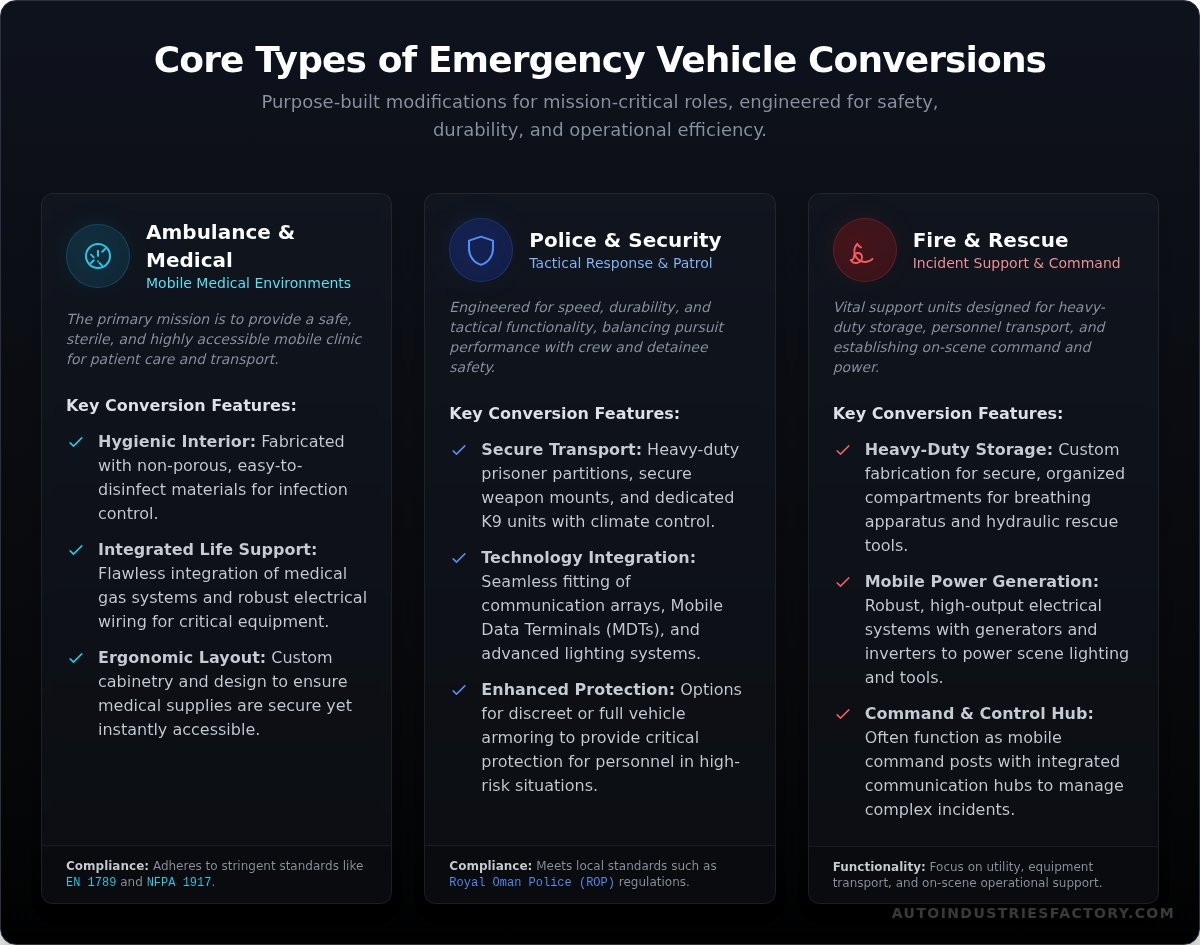
The primary mission of an ambulance is to serve as a mobile medical environment, demanding a conversion focused on patient safety, hygiene, and equipment accessibility. The interior must be fabricated with non-porous, easy-to-disinfect materials. The entire layout must adhere to stringent international guidelines, such as the NFPA 1917 Ambulance Design Standard, to ensure every component, from medical gas systems to electrical wiring for life support, is flawlessly integrated. Custom cabinetry ensures that all supplies are secure yet instantly accessible. Conversions range from van-based Type II models for patient transport to rugged, chassis-mounted Box-Type ambulances for demanding terrain.
Police, Security, and Tactical Vehicles
Law enforcement vehicles require a balance of speed, durability, and tactical functionality. Conversions are tailored for diverse roles, including patrol, prisoner transport, and special operations. Key modifications include:
- Crew & Detainee Safety: Installation of heavy-duty prisoner partitions, secure weapon mounts, and specialized K9 transport units with dedicated climate control.
- Technology Integration: Seamless fitting of advanced communication arrays, mobile data terminals (MDTs), and high-visibility emergency lighting systems compliant with Royal Oman Police (ROP) standards.
- Enhanced Protection: Options for discreet or full vehicle armoring provide critical protection for personnel during high-risk operations.
Fire and Rescue Support Vehicles
While distinct from primary fire engines, support vehicles are vital for transporting equipment, personnel, and establishing on-scene command. This emergency vehicle conversion prioritizes heavy-duty storage and power. Custom fabrication creates secure, organized compartments for breathing apparatus, hydraulic rescue tools, and specialized gear. These vehicles often function as mobile command posts or utility trucks, requiring robust, high-output electrical systems with generators and inverters to power intense scene lighting, communication hubs, and power tools essential for managing complex incidents.
The Conversion Process: From Chassis to Commissioning
Transforming a standard vehicle chassis into a mission-critical asset is a meticulous, multi-stage engineering project. A successful emergency vehicle conversion hinges on a transparent and collaborative workflow between your organization and the conversion specialist. We demystify this journey, breaking it down into four distinct phases, ensuring every operational requirement is met with precision and unwavering quality from initial design to final deployment.
Stage 1: Consultation, Design, and Engineering
This foundational stage translates your operational needs into a detailed engineering blueprint. It begins with an in-depth consultation to analyze mission parameters, crew requirements, and environmental challenges specific to Oman. Our engineers then develop precise 3D CAD models and schematics, allowing you to visualize the final layout. Material selection is critical; we specify heavy-duty, lightweight composites and metals to optimize durability and performance. Every design is engineered to meet or exceed rigorous benchmarks, referencing global best practices like the GSA Federal Vehicle Standards while ensuring full compliance with local Omani regulations before any fabrication begins.
Stage 2: Fabrication and Body Modification
With an approved design, the physical transformation starts. The base vehicle is stripped to its chassis for structural reinforcement, ensuring it can withstand the demands of emergency service. Using advanced CNC cutting and precision welding, our technicians fabricate and assemble custom components, from reinforced equipment compartments to modified rooflines. This phase includes expert bodywork and the application of multi-layer, corrosion-resistant paint and protective coatings designed for harsh climates.
Stage 3: Systems Integration and Final Assembly
Here, the vehicle becomes a fully integrated operational unit. This complex phase involves installing the core systems that define its function:
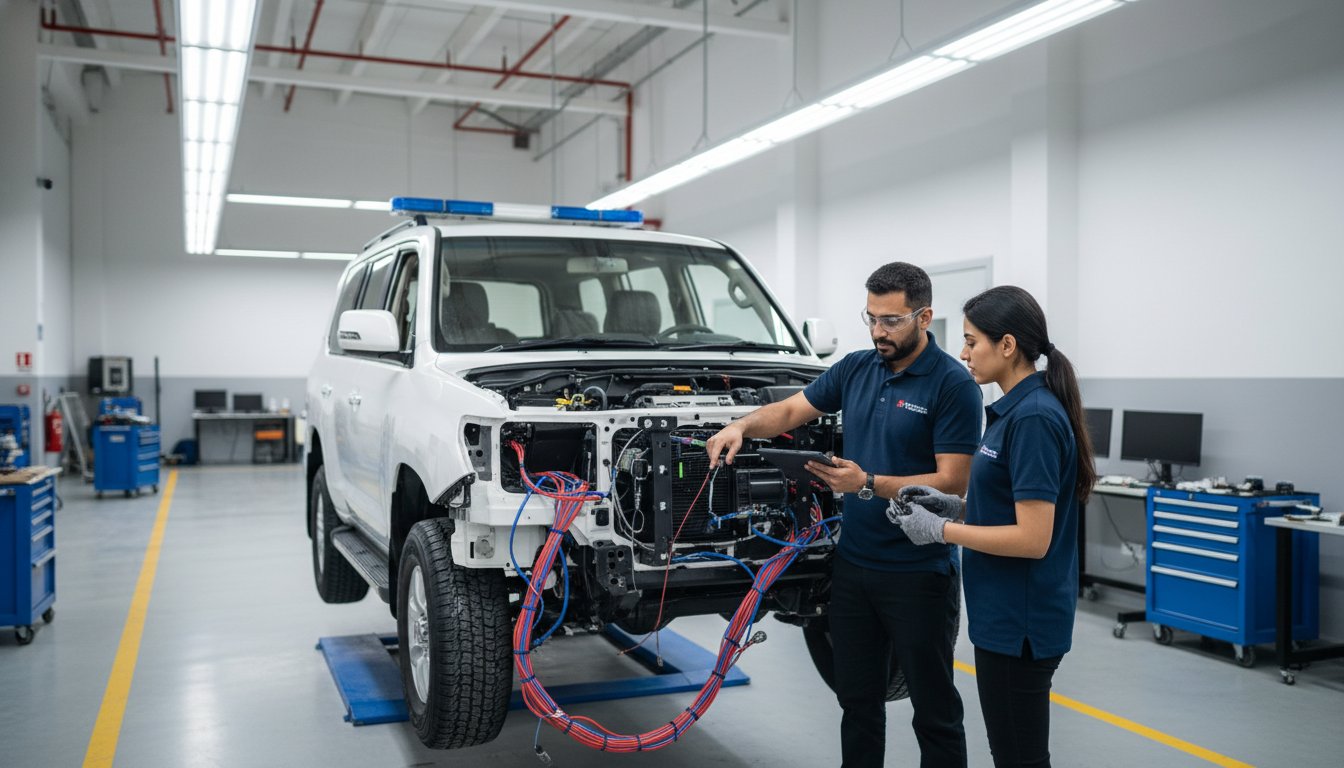
- Electrical Systems: A dedicated, heavy-duty wiring harness is installed to power emergency lighting, sirens, communication arrays, and onboard medical equipment.
- Specialized Equipment: We integrate mission-specific hardware, such as medical gas lines, advanced communication suites, and tactical gear mounts.
- Interior Finishing: The cabin and patient/personnel compartments are outfitted with durable flooring, custom cabinetry, secure seating, and medical-grade surfaces.
Finally, the vehicle receives its official livery, high-visibility decals, and emergency markings according to your organization's specifications and Royal Oman Police (ROP) standards.
Stage 4: Quality Assurance and Handover
Before commissioning, every vehicle undergoes a battery of rigorous tests. All electrical, mechanical, and specialized systems are tested under load to guarantee flawless performance and reliability. A comprehensive final inspection verifies build quality, finish, and adherence to the approved design and all relevant safety standards. The handover process includes complete documentation, maintenance schedules, and thorough operational training for your fleet operators, ensuring they are ready for deployment from day one.
Ready to build a fleet that meets the mission? Start your conversion project with an expert consultation.
Choosing Your Conversion Partner: A Checklist for Success
Selecting a partner for your emergency vehicle conversion is one of the most critical decisions you will make. This is not merely a transaction; it is the beginning of a long-term partnership that directly impacts your fleet's reliability, safety, and operational readiness. A superior conversion partner acts as an extension of your team, providing expert guidance and precision engineering. Use this checklist to rigorously evaluate potential partners and ensure you choose a company built for mission-critical excellence.
Engineering and In-House Capabilities
The true capability of a conversion specialist is revealed by what they control in-house. A heavy reliance on outsourcing critical fabrication introduces delays and quality control risks. A vertically integrated partner offers superior consistency, faster turnaround, and greater flexibility for custom solutions.
- Dedicated Engineering Team: Does the company employ qualified engineers and designers who can produce detailed schematics and 3D models before fabrication begins?
- In-House Fabrication: Verify they have advanced manufacturing capabilities on-site, including CNC laser cutting, press brake forming, certified welding, and professional paint booths.
- Proven Custom Solutions: Ask for a portfolio of complex, custom-built projects that demonstrate their problem-solving and engineering skills.
Compliance, Certifications, and Standards
Adherence to established standards is non-negotiable. It ensures crew safety, vehicle legality, and interoperability. A partner's commitment to compliance reflects their professionalism and attention to detail, which is vital for any emergency vehicle conversion project.
- Regional and International Standards: Confirm their experience with Gulf Standardisation Organization (GSO) regulations relevant to Oman, as well as international benchmarks like EN 1789 for ambulances.
- Quality Management System: Do they hold certifications like ISO 9001, proving a commitment to consistent quality, processes, and continuous improvement?
Material Quality and Durability
An emergency vehicle operates in demanding conditions. The materials used in its construction must be robust enough to withstand daily stress and harsh environments. Do not compromise on quality, as inferior components can lead to premature failure and costly downtime.
- Premium-Grade Materials: Inquire about the specific grades of aluminum, steel, and composite materials used for structural components and interior cabinetry.
- Electrical System Integrity: Ask about the quality of wiring, connectors, and control systems. High-quality electrical components are essential for reliability.
- Evidence of Durability: Review their past projects. Do their vehicles show a track record of long-term durability in the field?
Your due diligence in this stage is crucial. A partner who can confidently and transparently answer these questions is one you can trust with your mission-critical assets. Companies that demonstrate this level of expertise, like Auto Industries Factory, are equipped to deliver the durable, compliant, and high-performance vehicles your fleet demands.
Auto Industries Factory: Your Trusted Partner in the UAE
Choosing the right partner for your fleet's transformation is the most critical decision you will make. The challenges of durability, compliance, and operational readiness require more than just a workshop; they demand an engineering partner with proven mastery. At Auto Industries Factory (AIF), we provide comprehensive, in-house solutions that translate your mission-critical requirements into rugged, reliable assets ready for any challenge.
We eliminate the risks of outsourcing and supply chain delays by controlling every stage of the process under one roof. Our direct, hands-on approach ensures that every vehicle we deliver meets our uncompromising standards of quality and performance.
Complete In-House Control
Precision and quality are not optional in our line of work. That is why we manage every aspect of the build at our advanced facility in Ajman. From initial 3D design and engineering to final assembly, we guarantee excellence. Our capabilities include:
- Advanced Fabrication: Utilizing state-of-the-art CNC laser cutting, press brakes, and expert welding for flawless structural integrity.
- Precision Finishing: In-house paint and powder-coating shops provide durable, heavy-duty finishes that withstand the harshest conditions.
- Integrated Assembly: All electrical, interior, and equipment installations are handled by our specialized technicians.
This end-to-end control allows us to deliver superior quality with faster, more reliable turnaround times, getting your fleet into the field where it belongs.
Proven Expertise in Mission-Critical Builds
Auto Industries Factory specializes in high-stakes emergency vehicle conversion. Our extensive portfolio includes custom solutions for police forces, military units, and emergency medical services across the region. We possess deep institutional knowledge of the most trusted platforms, including the Toyota Land Cruiser, Nissan Patrol, and various GMC truck chassis. This expertise ensures that every modification enhances the vehicle's inherent strengths, resulting in a fleet that is dependable, capable, and built to protect what matters most.
Built for the Region, Ready for the World
Operating in the GCC presents unique environmental and regulatory challenges. Our vehicles are not just modified; they are re-engineered to perform flawlessly in extreme heat, sand, and humidity. We have an expert understanding of regional standards, ensuring every emergency vehicle conversion is fully compliant and road-ready from day one. When your mission cannot afford failure, trust the partner that builds for your environment. Take the next step in upgrading your fleet's capability and reliability.
Request a free estimate for your emergency vehicle fleet.
Your Mission-Critical Fleet Starts Here
Transforming a standard vehicle into a mission-ready asset is a complex process demanding precision engineering and uncompromising expertise. As this guide has shown, a successful Emergency vehicle conversion hinges on two critical factors: a deep understanding of operational demands and the selection of a capable, experienced partner who can deliver flawless execution from chassis to commissioning.
Auto Industries Factory is that trusted partner for organizations across Oman and the GCC. With comprehensive in-house design, fabrication, and integration, we maintain total control over quality and performance. Our specialization in advanced ambulance, police, and military conversions is backed by a proven track record of delivering durable, high-performance vehicles built to protect what matters most.
Ready to equip your fleet with the reliability and performance your mission demands? Discuss your emergency vehicle requirements with our specialists today. Let us build the robust, mission-critical solutions your team can depend on when every second counts.
Frequently Asked Questions
What is the average lead time for a custom emergency vehicle conversion?
The lead time for a custom conversion depends on project complexity and equipment availability. A standard police patrol vehicle or basic transport ambulance typically requires 4 to 6 weeks from final design approval. More complex projects, such as a mobile command unit or a highly specialized tactical vehicle, can take 8 to 12 weeks or more. We provide a precise timeline after the initial consultation and finalization of the technical specifications for your mission-critical fleet.
Can you convert a vehicle that I already own?
Yes, Auto Industries Factory (AIF) specializes in converting client-owned vehicles. We frequently work on rugged platforms popular in Oman, such as the Toyota Land Cruiser and Nissan Patrol. Before starting any project, our engineers conduct a thorough assessment of your vehicle to ensure its age, condition, and base specifications are suitable for the intended emergency application. This ensures the final converted vehicle is both reliable and safe for operational deployment.
What kind of warranty do you provide on your conversion work and installed equipment?
We stand behind our engineering with a comprehensive 12-month warranty on all fabrication and installation workmanship. This covers any defects related to our conversion process. For all installed third-party equipment, such as lightbars, sirens, and communication systems, we pass on the full manufacturer's warranty directly to you. Our team also facilitates any warranty claims on your behalf to ensure your fleet remains operational with minimal downtime.
How do you ensure the vehicle's electrical system can handle the added load of emergency equipment?
Our electrical engineering process is robust and safety-focused. We begin by calculating the total amperage draw of all new equipment. To manage this load, we install an isolated auxiliary battery system, heavy-duty wiring, and a dedicated power distribution module with integrated circuit protection. For high-demand builds, we may also recommend and install an upgraded, higher-output alternator to ensure the entire system remains stable and reliable during critical operations.
Do you assist with the vehicle registration process after modification in Oman?
While the final vehicle registration is the owner's responsibility, we provide comprehensive support to make the process seamless. Upon completion of the emergency vehicle conversion, we supply all the necessary technical documentation, modification certificates, and compliance reports. These documents are prepared to meet the specific standards required by the Royal Oman Police (ROP) and other relevant authorities in Oman, ensuring your vehicle is ready for official inspection and registration.
Can you integrate our organization's existing communication and IT hardware into the vehicle?
Absolutely. We understand the importance of system continuity for effective field operations. Our technicians are highly experienced in integrating existing client hardware, including specific radio systems, mobile data terminals (MDTs), GPS tracking units, and other proprietary IT equipment. We work directly with your technical team to ensure all systems are seamlessly installed, powered correctly, and function perfectly within the new vehicle layout for maximum operational efficiency.


