

A response vehicle must function as an integrated system, not as a collection of add-ons. Emergency vehicle upfitting in the UAE involves equipping and integrating mission equipment, warning lights and electrical systems for ambulance, police, fire and civil defense fleets. The configuration should reflect the vehicle’s operational role, with equipment positioned and connected for practical use in the field.
Reliable installations matter when vehicles face long operating hours, high temperatures and continuous equipment use. This guide covers what emergency fleet upfitting can involve, how warning lights and electrical systems fit together, and what to consider when planning a conversion. It also explains how ambulance conversions and police and military vehicle modifications can meet specialized fleet requirements, and where fabrication expertise contributes.
Key Takeaways
- Match the conversion plan to the vehicle’s response role, crew workflow and equipment needs before installation begins.
- Plan mounting and cable routes together so installed equipment stays accessible and the vehicle interior remains practical to use.
- Place warning lights to support visibility around the vehicle, with the arrangement suited to its operational purpose.
- Assess electrical integration as a complete system, including compatibility between vehicle electronics, controls and communications equipment.
- Compare conversion capabilities by vehicle type and fabrication scope to identify a suitable specialist for your fleet project.
Ambulance, police, fire and civil defense vehicles
UAE emergency fleets need vehicle conversions tailored to their response roles. An ambulance, police patrol vehicle, fire rescue unit and civil defense vehicle each require different equipment layouts and operating workflows.
For a closer look at a specialized police vehicle, watch The World's Most Futuristic Police Car by Supercar Blondie:
Emergency Vehicle Conversion Types
An ambulance conversion must suit its intended medical function, while a police patrol vehicle needs a layout that accommodates operational equipment and communications. Fire rescue and civil defense fleets may require arrangements for scene response, rapid intervention or utility tasks. Before choosing a configuration, define the vehicle’s role, crew workflow and equipment requirements.
UAE Approvals and Conversion Standards
Emergency vehicle upfits must comply with federal, state, and local regulations. Buyers should map the vehicle’s intended use and each modification to the applicable approval requirements before work starts. For ambulance conversions, assess the cabin layout and medical equipment installation against the requirements governing the vehicle’s role and equipment. Do not assume that a standard suitable for one vehicle type automatically covers another.
Approvals and standards for medical equipment depend on the conversion and equipment involved. Keep the vehicle configuration, equipment specifications and approval documentation aligned throughout the project, rather than treating approval as a final paperwork step.
When comparing UAE upfitters, assess their conversion scope, relevant certification evidence and documented project schedule. Compare like with like: ambulance conversions and police vehicle modifications involve different requirements, platforms and equipment integration.
When selecting an upfitter, buyers should assess:
- Experience with the fleet’s vehicle type and operational role.
- How equipment placement supports crew access and vehicle use.
- Electrical integration and compatibility with vehicle systems.
- Approval documentation and the project’s agreed delivery stages.
For example, a civil defense fleet should assess whether equipment is accessible for its response duties, rather than simply comparing the number of installed components. A clearly defined scope also helps coordinate vehicle preparation, installation and acceptance.
Warranty, maintenance and after-sales support depend on project scope. Compare written warranty coverage and exclusions, then define responsibilities for maintenance, troubleshooting, diagnostics, upgrades and replacement installations. For a fleet, document who handles each task and how vehicle downtime will be managed.
Emergency vehicle upfitting in the UAE works best when planning starts with the vehicle’s role, applicable approvals and equipment workflow. This gives fleet buyers a practical basis for comparing technical scope, certifications and delivery plans.
Emergency fleet equipment installation
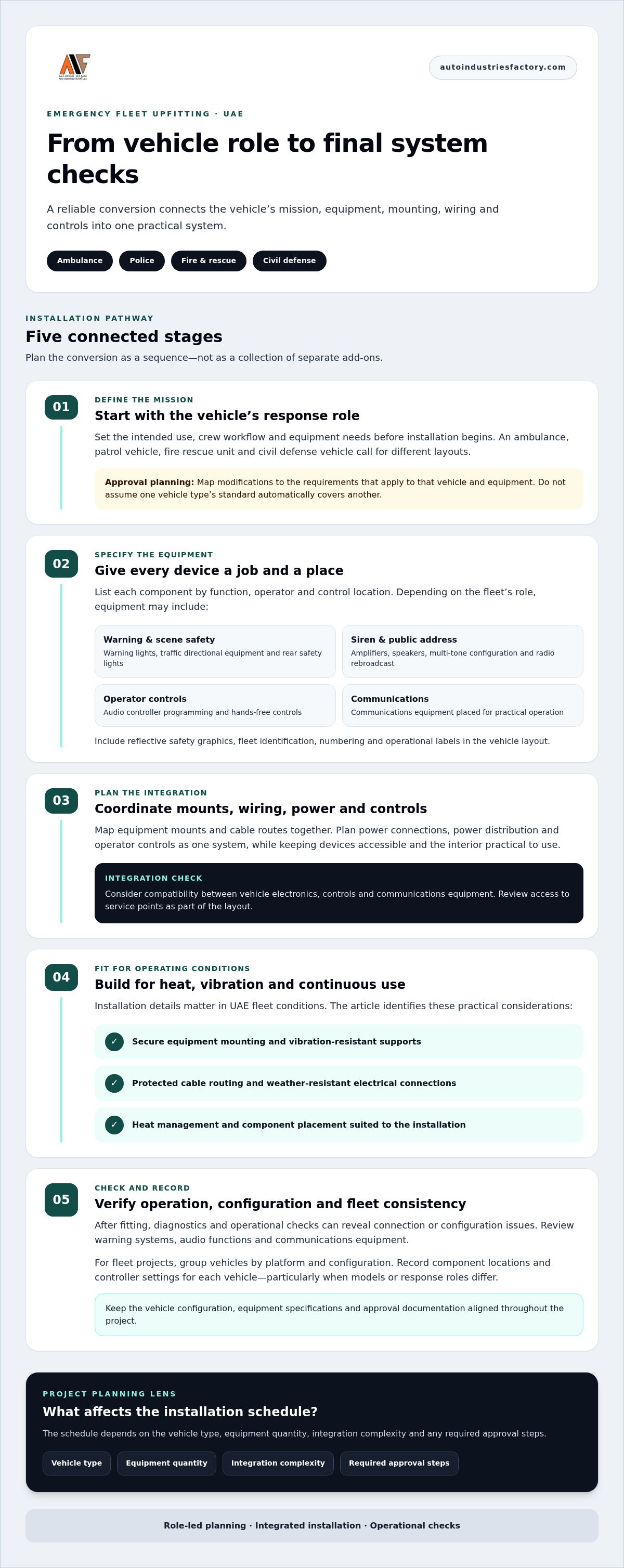
Installation planning links each device to its mounting location, power supply and operating controls. For UAE fleets, equipment choices and fitting methods should account for vehicle role, heat, vibration and continuous use.
Equipment Requirements
There is no single equipment package for every emergency vehicle. Depending on the fleet’s role, installations may include warning lights, siren amplifiers, speakers, public-address systems, hands-free controls and communications equipment. Before installation, map each device to a task, operator and control location.
A siren system may include multi-tone configuration, radio rebroadcast and audio controller programming. Warning systems can work alongside traffic directional equipment and rear safety lights. Choose a layout that supports the vehicle’s response function instead of assuming every component is required.
Installation details matter in UAE operating conditions. Secure mounting, protected cable routing, weather-resistant electrical connections, heat management and vibration-resistant supports contribute to a robust fitout. Reflective safety graphics, fleet identification markings, numbering and operational labels can also be included in the vehicle customization plan.
Before work starts, record the equipment and its intended position:
- List warning, siren and public-address components by function.
- Mark control locations for the driver and other operators.
- Map cable routes, power connections and equipment mounts.
- Include identification markings and operational labels in the layout.
This equipment schedule gives installers a clear reference for mounting and cable routing. It also helps fleet teams check whether the controls and devices suit the vehicle’s actual duties.
Installation Process and Timeline
The process starts by defining the vehicle and equipment scope. The installation team then plans mounting points, cable paths, power distribution and operator controls. After fitting, system diagnostics and operational checks can reveal connection or configuration issues. The project schedule depends on vehicle type, equipment quantity, integration complexity and any required approval steps.
For fleet projects, group vehicles by platform and configuration. A shared installation plan can highlight differences between units before work proceeds. Record component locations and controller settings for each vehicle, particularly when the fleet includes different models or response roles.
Review protected wiring and secure equipment mounts alongside access to service points. Heat and vibration also influence component placement. A final equipment review can cover warning systems, audio functions, communications connections and visible fleet markings.
Installation support can include troubleshooting, fleet upgrades, retrofits, controller reprogramming, electrical inspections, maintenance and replacement installations. These tasks help teams plan future changes around the original equipment layout. For projects requiring a wider vehicle conversion scope, review vehicle conversion services as part of the installation plan.
Warning light installation and placement
Warning light layouts should suit each emergency vehicle’s role and visibility needs. Options for emergency vehicle upfitting UAE include rooftop lightbars, visor lights, surface-mount lights, hideaway strobes, directional systems, rear safety lights and scene illumination.
A rooftop lightbar provides a prominent position for warning lights, while interior visor lights and surface-mount lights suit different vehicle layouts. Hideaway strobes offer another installation option. The right choice depends on the vehicle body, existing equipment and the visibility required around the vehicle.
Plan placement by viewing the vehicle from the front, sides and rear. Check that bodywork, roof accessories, glazing and open doors do not obstruct the intended light positions. For example, plan a rear directional system alongside rear safety lights so both fit the vehicle’s operating layout.
Warning light placement is intended to improve road visibility and public awareness during emergency response. Map each light to the area it serves. Front-facing lights address approaching traffic, while side and rear positions help make the vehicle visible from other directions. Scene illumination has a different purpose: lighting the work area rather than providing a directional warning.
Use a placement plan to coordinate positions and functions before installation:
- Mark proposed light locations on a vehicle outline.
- Identify the intended viewing direction for each unit.
- Note possible obstructions from doors, glazing or roof equipment.
- Separate warning-light positions from scene-lighting positions.
This plan helps installers and fleet teams review the arrangement before mounting begins. It also makes differences between vehicle models easier to identify when the fleet includes more than one body style.
Installation must account for demanding operating conditions. UAE emergency fleets can face high temperatures, long operating hours and continuous equipment use. Consider how mounting locations and cable routes relate to heat exposure, vehicle vibration and inspection access.
After installation, review each light from around the vehicle. Confirm that the selected components occupy their planned positions and that their functions are distinct. Directional systems, rear safety lights and scene illumination should each have a clear purpose in the overall layout.
For fleet consistency, document the selected positions and functions for each vehicle configuration. Use this record to plan later upgrades or replacement installations. A consistent layout helps fleet teams identify intended equipment locations while accounting for differences between vehicle types.
Careful equipment placement and electrical integration can support operator access, vehicle safety and emergency response efficiency. Consider equipment position together with electrical integration so access, safety and response needs inform the same decision. Emergency fleet installations in the UAE, provided by Auto Industries Factory LLC, can include secure equipment mounting, protected cable routing, weather-resistant electrical connections, heat management, vibration-resistant mounting and safety-focused installation procedures.
Keep the documented layout aligned with the vehicle’s operating needs, and review equipment mounting, cable routing and connections alongside warning-light positions. Drivers across the nation may maneuver to clear paths for emergency vehicles when responding to urgent calls. A placement review helps keep warning functions clear while accounting for safety-focused installation procedures.
Electrical and electronic integration
Emergency vehicle electronics must function as a coordinated system, not as isolated devices. Integration connects warning lights, sirens, communications, controls and power management to the vehicle platform.
A vehicle-specific plan starts with a list of each device and its function. Equipment may include LED warning lights, lightbars, siren and public-address systems, traffic advisors, communications equipment, control panels, CCTV and scene lighting. Grouping equipment by task helps map operator access, power supply and installation location before fitting.
Compatibility is essential. Vehicle electronics, warning systems and communications equipment must work together within the chosen vehicle configuration. CANbus integration, controller programming and vehicle-specific customization can form part of the electrical plan. For example, map how a control panel activates warning lights and audio functions, then account for the communications equipment in the same vehicle.
Power distribution needs equal attention. Integration approaches can include relay and fuse protection, smart power distribution, battery protection, low-voltage safety systems, battery management and load management. Identify each device’s power connection and protection, then assess the combined equipment load. This helps plan for simultaneous use of warning lights, communications and scene lighting during a response.
Equipment placement affects electrical routing and operator access. A control panel should suit the crew’s workflow, while cable paths should connect devices without obstructing vehicle use. Document planned locations, circuits, controls and programming for each vehicle configuration. This gives fleet teams a practical reference for diagnostics, upgrades and replacement installations.
Abu Dhabi offers a local example of connected emergency vehicle technology. Smart cameras have been installed in firefighting, ambulance and rescue vehicles, with systems linked directly to operations rooms. They track vehicle movements, identify traffic bottlenecks and coordinate alternative routes to incidents.
Fleet buyers can use a staged integration review:
- List electronic equipment and its operational purpose.
- Map device positions, controls and power connections.
- Plan CANbus, relay, fuse and battery protection needs.
- Review compatibility across vehicle electronics, warning systems and communications.
- Record controller programming and configuration differences across vehicles.
This review makes system dependencies visible before installation and gives technicians a clear basis for checking electronic functions and troubleshooting faults. For a vehicle with CCTV, communications equipment and warning systems, assess how the subsystems interact instead of testing each component in isolation.
UAE fleets may operate for long hours in high temperatures, with equipment in continuous use. Account for these conditions when planning power distribution, battery management and component locations. A complete integration scope brings the vehicle platform, equipment, controls and power plan together in a workable configuration.
Which UAE companies specialize in ambulance, police, fire, and rescue vehicle conversions?
Choose a UAE vehicle conversion and fabrication specialist whose work matches the fleet’s response role. A provider suited to ambulance conversions may not cover the operational needs of police patrol, fire rescue or civil defense vehicles. Compare the specialist’s conversion scope with the vehicle types and equipment your fleet needs.
Distinguish full vehicle conversions from equipment installation. A conversion can change the vehicle layout, while an installation project may focus on fitting warning systems, communications or controls. For example, a fleet requiring a specialized ambulance body needs different capabilities from one retrofitting warning lights across existing patrol vehicles.
Build a shortlist based on relevant work and production capabilities. Ask how the proposed configuration supports the vehicle’s intended use, how equipment is integrated and what project documentation is provided. Cutting, machining, welding and painting can be important when a conversion requires custom metalwork or changes to the vehicle body.
Compare each candidate against a consistent set of criteria:
- Experience with the required vehicle type and response role.
- Conversion scope, including fabrication and equipment installation.
- Evidence of relevant certifications and approval documentation.
- Project stages, delivery schedule and acceptance checks.
- Maintenance, diagnostics, retrofit and replacement support.
Compare certification claims carefully. Ask which certificates apply to the specific work, what they cover and how supporting documents relate to the proposed vehicle configuration. Quality-system credentials are distinct from vehicle approvals or equipment compliance, which address different parts of a project.
Lead times also depend on scope, vehicle platform, equipment requirements and fabrication work. Compare schedules only after defining the same project boundaries. A single-vehicle conversion and a fleet retrofit are not equivalent when one involves custom fabrication and the other follows an established installation plan.
Match the specialist’s capabilities to the fleet’s actual mix. Ambulance, police patrol, fire rescue, civil defense, rapid intervention, utility emergency and municipal response vehicles can have different conversion priorities. Check whether the proposed layout and equipment plan address each vehicle’s operational duties rather than relying on a general claim of emergency-vehicle experience.
Before selecting a UAE specialist, document your vehicle models, response roles, equipment scope and desired project stages. Use the brief to compare proposals consistently, including certification evidence, approvals, schedule and after-sales responsibilities. This helps identify a company equipped for the required conversion rather than one whose work covers only part of the project.
Clarify electrical integration as part of the conversion scope. Emergency fleet electrical integration in the UAE can include CANbus integration, relay and fuse protection, smart power distribution, battery protection, low-voltage safety systems, controller programming, vehicle-specific customization and load management. Ask providers to identify which elements are included in the proposed configuration and how they meet the fleet’s operational requirements.
Operational context also matters when planning response vehicles. Abu Dhabi's “Don’t Hesitate… Give Way Immediately” road safety campaign was launched in partnership with Abu Dhabi Police, Department of Health - Abu Dhabi and Integrated Transport Centre. Keep the intended response role and operating environment in view when comparing vehicle layouts, electrical systems and equipment integration. Request documentation that clearly describes the proposed configuration.
Auto Industries Factory: Ambulance Conversions
Auto Industries Factory LLC provides ambulance conversions for UAE fleet buyers planning specialized emergency vehicles. Options include box type ambulances and extended roof ambulances on GMC and Toyota platforms. These configurations offer a starting point for matching the vehicle body to its intended fleet role.
The company also offers police and military vehicle modifications, as well as safari vehicle conversions. Consider Auto Industries Factory LLC for a project involving one of these specialized vehicle conversions. Share the vehicle platform and operational requirements to define the scope.
Contact Auto Industries Factory LLC to discuss your ambulance conversion or specialized fleet vehicle requirements.
Build the Next Step Into Your Fleet Plan
Turn your operational priorities into a clear vehicle brief. Define the fleet role, vehicle platform, intended equipment and crew workflow before setting the conversion scope. This gives your team a practical basis for aligning vehicle specifications with response duties.
For emergency vehicle upfitting in the UAE, match the conversion scope to the vehicle’s intended work. Auto Industries Factory LLC offers Ambulance Conversions, Police & Military Vehicle Modifications and Safari Vehicle Conversions. Identify the vehicle type and intended use in your project brief.
Share your requirements with Auto Industries Factory LLC to discuss a suitable conversion path. A clear brief keeps the conversation focused on your fleet’s operational needs.
Contact Auto Industries Factory LLC to take the next step toward a purpose-built fleet vehicle.
Frequently Asked Questions
What emergency vehicle upfitting services are available in the UAE?
UAE fleet conversion services can include ambulance conversions, police and military vehicle modifications, and other role-specific vehicle work. Auto Industries Factory LLC also offers safari vehicle conversions, metal canopies and roof racks, and custom bull bars and bumpers. Structure your project brief by separating the vehicle conversion from required accessories, then define how each item supports the vehicle’s intended use.
What types of vehicles can be upfitted for emergency services in the UAE?
Emergency fleet vehicle types include ambulances, police patrol vehicles, fire rescue vehicles, civil defense fleets, security response vehicles, rapid intervention vehicles, utility emergency fleets and municipal response vehicles. The base vehicle should suit its assigned task and operating environment. For example, specify a dedicated ambulance separately from a utility response vehicle, then plan each conversion around its equipment and crew workflow.
What warranty, maintenance, and after-sales support do UAE upfitters offer?
Warranty, maintenance and after-sales support depend on project scope. Compare written warranty coverage and exclusions, and agree who handles maintenance, troubleshooting, diagnostics, upgrades and replacement installations, including how fleet downtime will be managed.


