
A certificate matters, but the conversion has to fit the vehicle’s mission. For an ISO certified vehicle converter in the UAE, the relevant standard depends on the organisation’s management systems: ISO 9001, ISO 14001, ISO 45001 and OHSAS 18001 are among the standards listed for the automotive sector. The certification label alone doesn’t explain what a custom build can do.
Choosing a specialist vehicle conversion involves more than selecting equipment or a base vehicle. The build must suit its intended use, whether for emergency response, security, field operations or utility work. Understanding the conversion process and what ISO certification does, and does not, establish can help you assess your options.
This guide explains specialist vehicle conversions in the UAE, how ISO management-system certification relates to a converter, and the practical factors that shape a suitable build. Learn what to consider when assessing conversion capabilities, how fabrication and modifications fit into the process, and when specialist support can help create a purpose-built unit. Clear requirements and functional design choices make it easier to assess the work against the demands of the job.
Key Takeaways
- Match the conversion to the vehicle’s intended role, operating environment and equipment needs before settling on a build specification.
- Compare emergency, security, safari and utility conversions by the functions each must support, not by appearance alone.
- Understand how ISO standards relate to an organisation’s quality, environmental and workplace safety management systems.
- Use the vehicle platform, fabrication requirements and intended use to identify the main factors shaping a conversion project.
- Explore specialist conversion options such as ambulance builds, police and military modifications, safari vehicles, and metal canopies or roof racks.
Custom special-purpose vehicle conversions
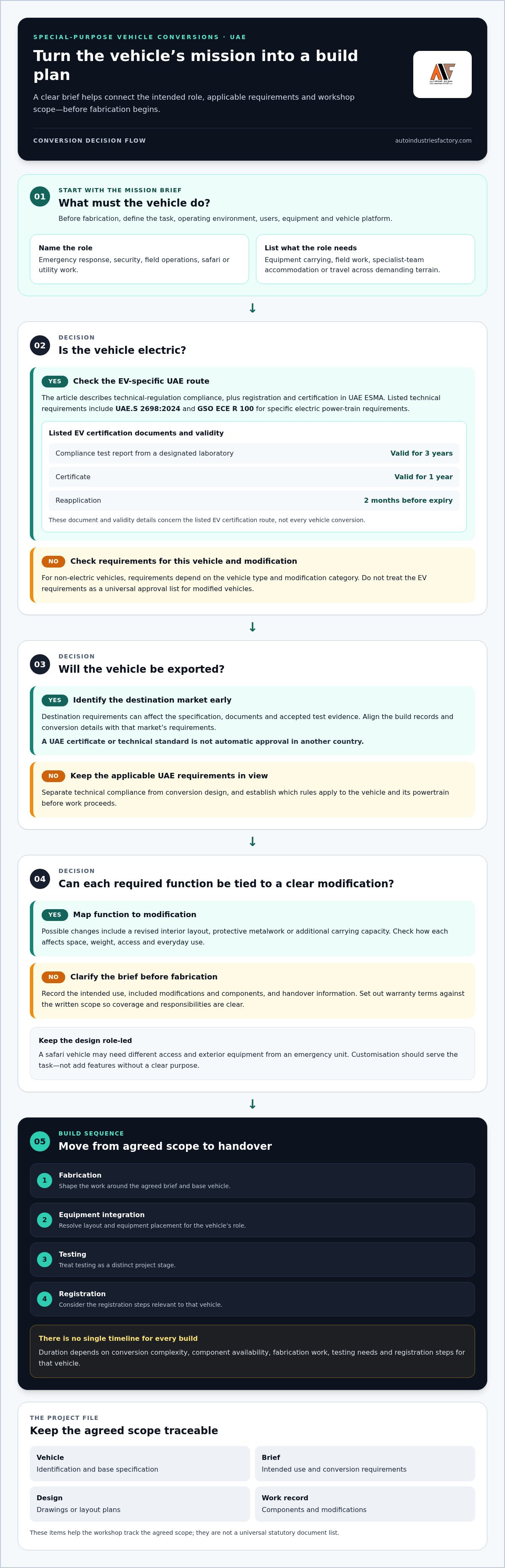
A special-purpose conversion adapts a vehicle’s layout or equipment for a defined operational role. Before fabrication begins, the brief should identify the task, operating environment, users and equipment.
For electric vehicles in the UAE, technical compliance is a separate consideration alongside fit, function and documentation.
To understand how ISO certification relates to quality and international business, watch this overview:
Special-Purpose Conversion Options
Conversion options include emergency response units, police and military vehicles, safari builds and utility platforms. Each starts with a specific task: carrying equipment, supporting field work, accommodating a specialist team or travelling across demanding terrain. Record the vehicle platform, operating conditions and required functions in the build brief. Then link each function to a modification, such as a revised interior layout, protective metalwork or additional carrying capacity.
A clear sequence makes the finished build easier to assess. A safari vehicle, for example, may need different access and exterior equipment from an emergency unit. List the operating priorities first, then consider how each change affects space, weight, access and everyday use. Customisation should serve the task, not add features without a clear purpose.
Vehicle Conversion Approvals
Which UAE authorities approve vehicle conversions and modified vehicles? For electric vehicles, UAE requirements call for compliance with related technical regulations and registration and certification in UAE ESMA. UAE.S 2698:2024 is among the technical requirements, while GSO ECE R 100 covers specific electric power-train requirements.
ESMA was established under UAE Federal Law (28), 2001. These electric-vehicle requirements do not, by themselves, describe approval for every type of modified vehicle. Separate the question of technical compliance from the conversion design, and identify which rules apply to the vehicle and its powertrain before work proceeds.
For exports, destination-market requirements can affect the specification, documents and accepted test evidence. Identify the intended market early, then align the build records and conversion details with its requirements. A certificate or technical standard relevant in the UAE should not be treated as automatic approval in another country.
A clear scope also makes customer expectations easier to manage. Before fabrication, document the intended use, included modifications and components, as well as the handover information. Set out warranty terms against that written scope so coverage and responsibilities are clear. This creates a traceable process: the customer can compare the finished build with the agreed requirements, and the conversion team has a defined reference for fabrication and inspection.
Vehicle conversion services in the UAE
Vehicle conversion projects combine an operational need with fabrication, equipment integration and applicable compliance steps. In the UAE, the process depends on the vehicle type and the modifications involved.
Electric vehicles have specific technical requirements, so their conversion and registration pathway needs separate consideration.
UAE Rules and Required Documents
For electric vehicles, UAE requirements call for compliance with related technical regulations, plus registration and certification in UAE ESMA. The technical requirements include UAE.S 2698:2024 and GSO ECE R 100 for specific electric power-train requirements.
The UAE certification documentation list requires a compliance test report from a designated laboratory, valid for 3 years. The certificate is valid for 1 year, and reapplication is required 2 months before it expires. These requirements concern the listed EV certification route, not every vehicle conversion.
For project control, organise a working file before fabrication. Include the vehicle identification and base specification, the conversion brief, drawings or layout plans, and a record of components and modifications. These items help the workshop track the agreed scope, but they are not a universal statutory document list. For a non-electric vehicle, requirements depend on its type and modification category.
Conversion and Registration Process
What is the process and timeline for converting and registering a vehicle in the UAE? First define the intended use and vehicle platform, then map each required modification and its effect on the vehicle. Fabrication, equipment integration, testing and registration are distinct project stages.
There is no single timeline for every build. Duration depends on the conversion’s complexity, component availability, fabrication work, testing needs and registration steps for that vehicle. A mobile workshop or service vehicle, for example, needs its working layout and equipment placement resolved before fabrication. This helps avoid late changes disrupting the build sequence.
Automotive and industrial conversion work can involve metal fabrication, equipment mounting, interior changes or vehicle colour changes. Identify the essential tasks, then sequence them around the base vehicle and its operating conditions. A written scope gives the workshop a practical reference for production and handover. An emergency vehicle and a mobile workshop, for example, require different layouts, equipment access and space planning.
Before the vehicle enters service, compare the completed work with the approved project scope and retain the relevant test and registration records. This creates a clear handover trail for operators and fleet managers. For examples of specialist vehicle conversion services, review the conversion categories and match them to the vehicle’s planned role.
Emergency and security vehicle conversions
Emergency and security conversions begin with the vehicle’s mission, not a standard equipment package. An ambulance, police vehicle and military transport platform each require a distinct layout, access plan and equipment arrangement.
Start by documenting the team’s duties, carried equipment and operating environment. Then match those needs to the vehicle platform, available cabin space and conversion scope. A clear brief helps prevent equipment placement from interfering with passenger access or daily operation.
Emergency Response Builds
An ambulance conversion must support the intended patient transport and crew workflow. Plan how personnel will enter, move through the cabin and reach each required work area. Position equipment according to the operating sequence, rather than simply filling available wall or floor space.
For example, list the equipment that must remain accessible during transport, then assign each item a secure location in the proposed layout. Consider doors, storage access and movement between the cabin and the vehicle exterior. These decisions shape the interior configuration and the fabrication work that follows.
Before production, review the build brief against the selected platform. Cabin dimensions, door openings and existing vehicle features affect what can be installed and where. Record any layout changes in the project scope so the completed unit can be assessed against the agreed requirements.
Police and Military Platforms
Police and military vehicle modifications support different operational needs. A police platform may require clear access to communications and carried equipment, while a military transport vehicle may prioritise crew arrangements and mission-specific storage. Define the task first, then choose the interior or exterior changes that support it.
Security-focused builds also require careful consideration of how added components affect access, visibility and routine use. Review entry points, storage locations, seating and exterior fittings together. This helps prevent one modification from undermining another part of the vehicle’s intended function.
Planning and Handover
Use a staged review to keep the conversion controlled:
- Define the mission: Record users, duties, equipment and operating conditions.
- Select the platform: Compare cabin space, access and existing vehicle features against those needs.
- Specify changes: Document proposed layouts, fittings and fabrication requirements.
- Review the finished build: Compare installed components and vehicle configuration with the agreed scope.
This process gives fleet managers a useful record of the build and helps identify scope changes before they affect fabrication or equipment placement. For an emergency unit, focus the review on crew movement and equipment access. For a police or military platform, assess the layout against its defined transport or operational role.
Conversion decisions should reflect the specific vehicle and its assigned task. A platform built for patient transport is not automatically suited to security duties, and a general-purpose vehicle may need substantial layout changes. A precise mission brief gives the conversion team a clear basis for engineering and workshop planning.
ISO certification for automotive organisations
Which vehicle converters in the UAE are ISO certified? The automotive-sector standards listed for the UAE include ISO 9001, ISO 14001, ISO 45001 and OHSAS 18001, but this list doesn’t identify individual certified converters. Certification applies to an organisation’s defined management system and scope. When assessing an ISO-certified vehicle converter in the UAE, focus on the certificate details, not the label alone.
ISO 9001 relates to quality management. In an automotive organisation, documented processes can support consistent work from initial requirements through fabrication and delivery. For example, defined review steps can track a build specification, record revisions and assess whether completed work matches the agreed scope. Implementing ISO standards can help organisations maintain service quality and improve performance across the organisation.
ISO 14001 concerns environmental management, while ISO 45001 concerns occupational health and safety. These systems can help an organisation structure its approach to environmental impacts and workplace risks. Implementing ISO standards can also help organisations reduce energy costs and support workplace health and safety. The practical value depends on how the organisation applies its system, rather than the certificate name by itself.
OHSAS 18001 is also listed among the standards for the UAE automotive sector. A reader comparing certificates should distinguish it from ISO 45001 instead of treating the identifiers as interchangeable. Check the standard named on the certificate, the certified organisation and the scope covered. A certificate for one business activity doesn’t automatically demonstrate coverage of every process that business performs.
ISO certification can also support confidence among clients and stakeholders. Implementing ISO standards can help organisations assure them that data is protected and comply with international regulations. For a global vehicle programme, management-system evidence may clarify how quality, safety or environmental processes are managed. It doesn’t, on its own, establish that a particular vehicle conversion meets every destination market’s technical requirements.
Use a practical review when assessing a converter’s certification:
- Identify the standard: Note whether the certificate names ISO 9001, ISO 14001, ISO 45001 or OHSAS 18001.
- Read the scope: Compare the activities covered with the conversion work required.
- Separate system from product: Treat organisational certification and vehicle-specific compliance as different questions.
- Connect it to delivery: Consider how documented processes support records, revisions and handover.
For example, a quality-management certificate relates to controlled organisational processes, while a safety-management scope addresses a different area. Neither replaces an assessment of the conversion’s requirements. When assessing an ISO certified vehicle converter in the UAE, review the certificate’s scope alongside the work being considered. This helps fleet teams understand how the certification relates to their project.
Specialty and utility vehicle conversions
Specialty and utility builds address tasks that standard vehicle layouts cannot handle efficiently. Start with a written duty profile: identify who uses the vehicle, what it carries, where it operates and how crews access equipment. This turns a broad modification request into practical decisions for trucks, field vehicles and mobile work units.
Consider a field-support truck carrying tools and materials. The conversion should keep frequently used items accessible without blocking entry, visibility or other equipment. A safari vehicle presents a different challenge: passengers need clear access and suitable seating, while the vehicle must retain space for its intended role. The same base platform can therefore require very different layouts.
Plan around the vehicle as a connected system. Added storage, metalwork and equipment can affect usable space, access routes and vehicle operation. Map each component to the task it supports. For example, place regularly used tools within easy reach and store less frequently needed items separately. A practical layout review can reveal clashes before fabrication begins.
A disciplined specification can cover these decisions:
- Operating role: Define the work, terrain and users the vehicle must support.
- Equipment: List tools, materials and equipment, then group them by access frequency.
- Vehicle layout: Mark seating, storage, entry points and working areas on a proposed plan.
- Modification scope: Record each change and its purpose before fabrication starts.
- Handover review: Compare the finished arrangement with the agreed task and layout.
For utility trucks, balance carrying capacity with convenient access. A storage arrangement that holds every item but blocks crews from essential tools can slow routine work. Likewise, an exterior modification should support the vehicle’s role without obstructing doors or existing access points. Review the complete layout, not each component in isolation.
Customisation also affects maintenance and future use. Keep project records identifying the modifications, equipment positions and agreed configuration. Fleet managers can use them when assigning vehicles, planning replacement equipment or comparing similar units. If a vehicle’s role changes, the documentation gives the next review a clear starting point.
The key takeaway is simple: specify the job before specifying the hardware. A precise operating brief helps engineers assess the platform, shape the modification and avoid additions that do not serve the work. To explore specialty vehicle conversion services, consider the vehicle’s role and required layout as the starting point for your project.
Auto Industries Factory: Ambulance Conversions
Auto Industries Factory LLC provides ambulance conversions for organisations planning a purpose-built emergency vehicle. Options include box-type ambulances and extended-roof ambulance conversions on GMC and Toyota platforms, allowing the vehicle configuration to match the intended operational brief.
The conversion range also includes police and military vehicle modifications, safari vehicle conversions, and metal canopies and roof racks. These specialist builds serve projects that need a defined vehicle layout or added utility equipment, rather than general passenger-car modifications.
Prepare a brief covering the vehicle platform, intended use and required conversion type. This gives the project a practical starting point for defining the build scope and relevant fabrication work.
To discuss an ambulance or specialty vehicle conversion, contact Auto Industries Factory LLC.
Set Your Conversion Project in Motion
Turn the vehicle’s intended role into a practical project brief. Define the platform, operating environment, required layout and essential equipment. Keep organisational certification separate from vehicle-specific requirements, and use the relevant ISO scope as one part of your assessment. Assess an ISO certified vehicle converter in the UAE in relation to the work and management-system scope involved, not the label alone.
Auto Industries Factory LLC converts ambulances and modifies police and military vehicles, as well as converting safari vehicles. These services provide a starting point for discussing a vehicle built around a defined operational use. A focused brief makes that discussion specific, from the vehicle platform to the required modifications.
Contact Auto Industries Factory LLC about your conversion and take the next step toward a build shaped around the demands of the job.
Frequently Asked Questions
What ISO certifications do UAE vehicle conversion companies hold, and are they current?
Standards listed for the UAE automotive sector include ISO 9001, ISO 14001, ISO 45001 and OHSAS 18001. That list doesn’t establish which converter holds a current certificate. Check the certificate’s named organisation, covered activities, standard, issuing body and validity dates. A management-system certificate and compliance documentation for a particular vehicle are separate things, so assess each against the project you’re planning.
What vehicle conversion services do ISO-certified UAE converters offer?
Certification alone does not define a converter’s services. Auto Industries Factory LLC converts ambulances, including box-type and extended-roof builds on GMC and Toyota platforms, and provides police and military vehicle modifications, safari conversions, and metal canopies and roof racks. Match the service to the vehicle’s intended role and required configuration. Assess organisational certification separately from the specific conversion work.
What risks, warranties, and insurance issues apply to converted vehicles in the UAE?
Changes to a vehicle’s layout, equipment or intended use can affect how its configuration is documented and assessed. Before work begins, record the agreed modifications and clarify the written warranty terms, including which components and workmanship they cover. Give your insurer accurate details of the conversion and intended use, and retain its response with the vehicle records. Keep handover documents and modification records together for future claims or fleet reviews.
How can I verify a UAE vehicle converter’s ISO certificate and accreditation?
Review the certificate for the organisation’s exact legal name, the ISO standard, the scope of covered activities, the issuing body and validity dates. Check its current status through the issuing body’s verification process, and confirm the issuer’s accreditation with the accreditation body named on the certificate. Make sure the scope relates to vehicle conversion activities relevant to your project. A certificate belonging to another entity or covering unrelated work does not demonstrate that scope.
Which UAE authorities approve vehicle conversions and modified vehicles?
Electric-vehicle approval requirements can depend on the vehicle and applicable technical regulations. Requirements for other modified vehicles depend on the vehicle and modification category.


