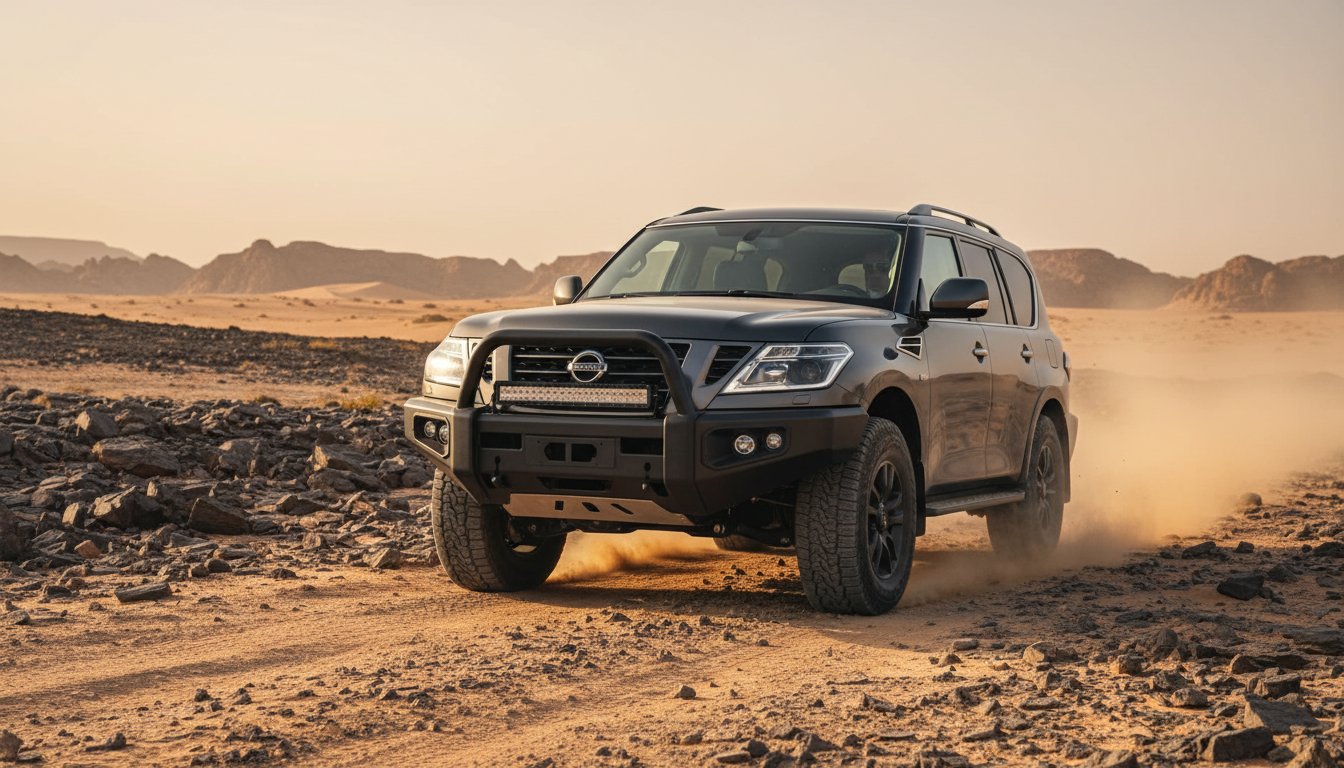
Choosing the right protection for your vehicle to navigate Oman's demanding terrain can be a complex decision. You're worried about airbag compatibility, sensor interference, and whether a heavy bar will compromise your vehicle's handling. Worse yet is the fear of investing in a low-quality product that fails when you need it most. This is where a properly engineered front bull bar becomes more than just an accessory-it's a critical component for safeguarding your investment against unexpected impacts, from urban mishaps to rugged off-road hazards.
This ultimate guide is engineered to eliminate that uncertainty. We provide a clear, no-nonsense breakdown of everything you need to know to make a heavy-duty choice with confidence. You will learn the critical differences between materials like steel and aluminum, explore various designs from nudge bars to full-coverage models, and understand the benefits of precision custom fabrication. By the end, you'll have the expert knowledge to select a durable, functional, and legally compliant bull bar that perfectly matches your vehicle and your mission.
What is a Front Bull Bar and Why Is It a Critical Upgrade?
Often misunderstood as a simple accessory, a professionally engineered front bull bar is a vital vehicle protection system. It is mission-critical equipment designed with one uncompromising purpose: to protect your vehicle's most vulnerable frontal components from catastrophic failure. In the demanding driving conditions of Oman-from rugged wadis to long desert highways-it is the definitive line of defense between a minor incident and a stranded vehicle. For a technical overview of its design and history, you can explore the question of What is a Bull Bar?, but its real-world value is measured in survivability and operational readiness.
A high-impact collision, whether with another vehicle or wildlife such as camels or goats, can instantly disable a standard vehicle by damaging the radiator, cooling system, or engine block. A heavy-duty bull bar is engineered to absorb and redirect these impact forces away from your vehicle's essential systems, ensuring you can continue your journey safely.
The Core Functions of a Heavy-Duty Bull Bar
A premium bull bar delivers a multi-faceted upgrade to your vehicle’s capability, providing far more than just a rugged appearance. Its primary functions are engineered for performance and protection:
- Frontal Impact Protection: This is its core purpose. A robust bull bar shields your vehicle from animal strikes, off-road debris, and low-speed collisions, safeguarding the radiator, headlights, and engine bay to prevent mission-critical failure.
- Secure Mounting Platform: It serves as a solid, chassis-mounted foundation for essential recovery and visibility gear. This includes heavy-duty winches, high-intensity driving lights or LED light bars, and communication antennas, keeping them secure in the most demanding terrain.
- Improved Approach Angles: Many advanced bull bar designs are tapered to increase the vehicle’s approach angle. This allows you to tackle steeper inclines and obstacles without damaging the front bumper, significantly enhancing off-road capability.
Bull Bar vs. Nudge Bar vs. Grille Guard: Clarifying the Terminology
Understanding the difference between frontal protection systems is crucial for making an informed decision. While they may seem similar, their construction and protective capabilities vary significantly.
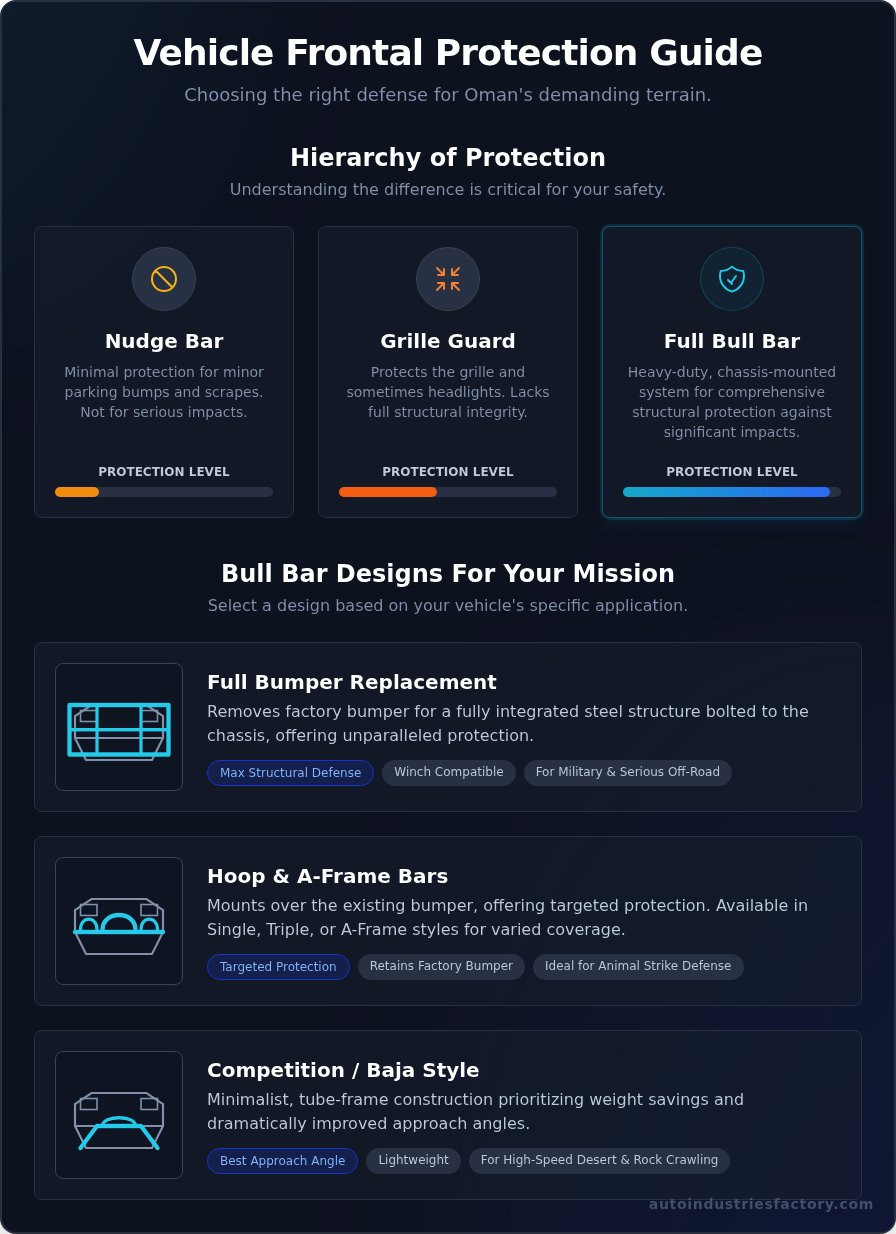
A true Bull Bar is a heavy-duty structure mounted directly to the vehicle's chassis. It offers comprehensive, structural protection for the entire front end, including the bumper, grille, and headlights, and is designed to withstand significant impacts.
In contrast, a Nudge Bar is a lighter, smaller-diameter tube that offers minimal protection against minor parking bumps and scrapes. It is not designed to handle animal strikes or serious collisions.
A Grille Guard focuses solely on protecting the vehicle's grille and sometimes the headlights with a thinner frame. It lacks the structural integrity and comprehensive coverage of a full bull bar.
Types of Bull Bars: Choosing the Right Design for Your Mission
Selecting the right front bull bar is not a matter of aesthetics; it is a critical decision based on your vehicle's specific mission. The ideal design provides robust protection without compromising vehicle dynamics or safety systems. In fact, professionally engineered bull bars are a world away from older, poorly fitted accessories that sparked debate about the dangers of bull bars due to their interference with crumple zones. A modern, purpose-built bar integrates with your vehicle, enhancing its durability and operational capability. Whether for a fleet of Nissan Patrols or a specialized Land Cruiser, the choice depends entirely on the intended application.
Full Bumper Replacement Bars
For maximum structural defense, a full bumper replacement is the ultimate solution. This heavy-duty design removes the vehicle's factory bumper entirely, replacing it with a fully integrated steel structure that bolts directly to the chassis. Engineered to seamlessly accommodate heavy-duty winches and recovery points, these bars offer unparalleled protection against high-impact collisions. They are the standard for military, remote-area fleet, and serious off-road vehicles that operate in the most demanding environments.
Hoop and A-Frame Bars
Hoop and A-Frame bars offer targeted protection while retaining more of the vehicle's original look. They mount over the existing bumper and are categorized by their coverage:
- Single Hoop: Provides essential protection for the radiator and central grille area, making it a popular choice for commercial fleets seeking a clean look with added resilience.
- Triple Hoop: Extends coverage to wrap around the headlights, offering the highest degree of defense against animal strikes-a crucial feature for vehicles traveling through remote parts of Oman at dawn or dusk.
- A-Frame: A classic and robust design that offers strong central protection, deflecting impacts away from the vehicle's core components.
Competition and Baja Style Bars
When agility and performance are paramount, competition or "Baja" style bars are the superior choice. Their minimalist, tube-frame construction prioritizes significant weight savings and dramatically improved approach angles for clearing steep obstacles. While offering less coverage than a full replacement bar, this design is purpose-built for high-speed desert driving and technical rock crawling, where every kilogram and degree of clearance counts. This style is frequently seen on recreational off-roaders built for tackling the dunes of the Wahiba Sands.
Material Matters: Steel vs. Aluminum for Ultimate Durability
When selecting a front bull bar, the choice of material is the foundation of its performance and longevity. This decision directly impacts your vehicle's protection level, handling dynamics, and resilience against the elements. In the demanding driving conditions of Oman, from rugged mountain tracks to corrosive coastal roads, understanding the differences between the two premium materials-steel and aluminum-is critical. Each offers a distinct set of advantages engineered for specific applications.
The Case for Steel: Unmatched Strength and Resilience
For maximum, heavy-duty protection, high-tensile steel is the undisputed champion. Its exceptional strength makes it the preferred material for commercial fleets, industrial vehicles, and tactical applications where the risk of heavy impact is high. A steel bull bar provides the ultimate defense against animal strikes and off-road obstacles. Furthermore, if a steel bar sustains damage in a remote area, it can often be welded and repaired with locally available equipment, ensuring mission reliability.
The Advantages of Aluminum: Lightweight Protection
Engineered aluminum alloys offer a modern, lightweight alternative without significant compromise on protection for most users. The primary benefit is the substantial weight reduction, which lessens the load on your vehicle's front suspension, preserving handling characteristics and potentially improving fuel efficiency. Aluminum's inherent corrosion resistance makes it an outstanding choice for Oman's coastal regions, like Salalah or Muscat, where salty air can quickly degrade lesser materials. It is the ideal solution for recreational 4x4s and daily drivers where balancing protection and performance is key.
Choosing the right material depends on your primary vehicle use:
- Steel is ideal for: Maximum impact protection, commercial and industrial use, and situations where field repairability is a priority.
- Aluminum is ideal for: Recreational off-roading, daily driving, reducing front-end weight, and superior performance in coastal or humid environments.
Protective Finishes: Powder Coating and Anodizing
The material itself is only part of the equation; the protective finish is what guarantees a long service life. A high-quality coating is essential to defend against intense sun, humidity, and abrasion. The two leading finishes are:
- Powder Coating: Typically applied to steel, this process creates a thick, durable, and uniform finish that is far tougher than conventional paint. It provides excellent resistance to chipping, scratching, and rust.
- Anodizing: Used exclusively for aluminum, this electrochemical process creates a hard, corrosion-resistant layer that is integrated into the metal itself, ensuring it won't peel or flake.
A premium finish ensures your investment not only protects your vehicle but also maintains its appearance for years to come.
Key Features to Demand in a Modern Bull Bar
In today’s market, a premium bull bar offers far more than just basic frontal protection. It is a fully integrated system engineered to enhance your vehicle's safety, utility, and off-road capability. A well-designed bar works in harmony with your vehicle's complex systems, rather than simply bolting on as a crude afterthought. For discerning vehicle owners in Oman, demanding these key features is non-negotiable for ensuring peak performance and safety, whether on the highway or deep in the wadis.
Airbag Compatibility and Sensor Integration
Modern vehicles are equipped with sophisticated SRS airbag systems that rely on precise crash sensor data and engineered crumple zones to deploy correctly. A non-compliant bull bar can alter this dynamic, potentially delaying or preventing airbag deployment in a collision. A professionally engineered front bull bar is rigorously tested to ensure it is fully compatible with these safety systems. Furthermore, it must include precise cutouts and mounts for parking sensors, front-view cameras, and adaptive cruise control radar to maintain full factory functionality.
Winch Compatibility and Rated Recovery Points
For serious off-road use, a winch is essential, and the bull bar is its foundation. A winch-compatible bar features an integrated, reinforced steel cradle designed to withstand the immense pulling forces a winch generates. Equally critical are the recovery points. Do not mistake simple tie-down loops for recovery points. True recovery points are:
- Engineered to handle extreme shock loads.
- Mounted directly to the vehicle's chassis for maximum strength.
- Stamped with a certified load rating (e.g., 8,000kg).
Using a non-rated point for vehicle recovery is extremely dangerous and can lead to catastrophic failure.
Accessory Mounting Provisions
A versatile bull bar serves as a centralized hub for essential accessories. Look for integrated provisions that eliminate the need for drilling, which can compromise the bar's structural integrity and protective coating. Key mounting points include welded tabs for driving lights or LED light bars, dedicated antenna mounts for communication equipment, and reinforced high-lift jacking points for safe and effective field recovery. These features ensure your gear is mounted securely and correctly. Investing in a feature-rich bar from a trusted fabricator like Auto Industries Factory ensures your vehicle is prepared for any challenge.
The Custom Fabrication Advantage: Why AIF is the Superior Choice
While mass-produced bull bars offer a basic level of protection, they are built on compromise. A one-size-fits-all approach often leads to imperfect fitment, reduced clearance, and features that don't align with your specific operational demands. For fleet managers, tour operators, and government agencies in Oman, "good enough" can be a liability. This is where Auto Industries Factory (AIF) delivers a decisive advantage. With our in-house engineering and advanced manufacturing facility, we move beyond generic solutions to create a custom front bull bar engineered exclusively for your vehicle and its mission.
Tailored Design for Your Exact Vehicle and Needs
A custom-fabricated bull bar from AIF guarantees a flawless fit that integrates perfectly with your vehicle's design, preserving aesthetic lines while maximizing crucial approach angles for off-road performance. We engineer solutions that account for your specific needs, whether that means integrating heavy-duty winch mounts for recovery vehicles, reinforced points for police equipment, or specialized brackets for communication antennas. Our design process also considers existing or planned vehicle modifications, such as suspension lifts and increased payload, ensuring the final product complements your entire vehicle system for optimal performance and safety.
Uncompromised Strength and Build Quality
Off-the-shelf products are often built to a price point, not a performance standard. At AIF, we control every aspect of production, from initial design to final finishing. This allows us to select premium-grade steel and enforce welding standards that far exceed mass-market norms. We strategically reinforce key impact zones and mounting points, creating a structure engineered for extreme durability. Every AIF bull bar is built to withstand the demanding operational conditions of the GCC region-from rugged mountain tracks to corrosive coastal environments. We don't just build accessories; we engineer mission-critical protection. Ready to equip your vehicles with protection that never compromises? Consult our engineers to design a bull bar for your fleet.
Secure Your Investment with a Mission-Ready Bull Bar
Choosing the right protection for your vehicle in Oman’s demanding environments is a critical decision. As we've covered, the right front bull bar is not just an aesthetic upgrade-it's an essential piece of armor that shields your investment from impacts. Understanding the differences between materials and selecting a design tailored to your mission ensures you get maximum performance and durability.
For those who demand uncompromising quality, off-the-shelf solutions fall short. At Auto Industries Factory (AIF), we leverage our in-house design, precision CNC laser cutting, and expert fabrication to engineer heavy-duty solutions built for extreme durability. It is this commitment to engineering excellence that has made us the trusted choice for military, police, and commercial fleet operators across the region.
Protect what matters and equip your vehicle for any challenge. Request a free estimate for your custom bull bar fabrication today and drive with confidence, no matter the terrain.
Frequently Asked Questions
Are front bull bars legal in Oman?
In Oman, the installation of front bull bars is generally permissible, particularly for off-road and commercial vehicles like the Toyota Land Cruiser or Nissan Patrol. However, they must adhere to Royal Oman Police (ROP) regulations. The key requirements are that the bar is securely mounted and free of sharp edges that could endanger pedestrians. It is always best practice to verify the latest ROP guidelines to ensure your vehicle remains fully compliant and passes inspection.
How much weight does a steel or aluminum bull bar add to a vehicle?
The weight added by a bull bar depends directly on its material and design. A heavy-duty steel bull bar, engineered for maximum impact resistance, typically adds between 50 to 85 kilograms to your vehicle's front end. In contrast, a high-strength aluminum model offers robust protection at a lower weight, usually ranging from 25 to 45 kilograms. This additional weight is a critical factor to consider for your vehicle's suspension and overall handling dynamics.
Will installing a bull bar void my vehicle's warranty?
Installing an aftermarket bull bar does not automatically void your entire vehicle warranty in Oman. A warranty claim can typically only be denied if the manufacturer proves the modification directly caused the specific failure. For instance, a poorly installed bar that damages the chassis could affect the warranty on related structural parts. To safeguard your warranty, ensure installation is performed by professional fabrication specialists who understand vehicle-specific mounting points and sensor integration.
How does a bull bar affect engine cooling and airflow?
A professionally engineered front bull bar is designed to work in harmony with your vehicle's systems. Our designs incorporate specific cutouts and vents that maintain optimal airflow to the radiator, ensuring engine cooling performance is not compromised, even in Oman's demanding climate. Conversely, a poorly designed or generic bar can obstruct critical airflow, potentially leading to overheating. Precision fabrication is essential to balancing superior protection with vehicle performance.
Can a bull bar be installed on a vehicle without a ladder frame chassis?
While bull bars are most commonly fitted to vehicles with a robust ladder frame chassis, they can be installed on unibody (monocoque) vehicles. The mounting system is fundamentally different and requires expert engineering to distribute impact forces correctly without damaging the vehicle's structure. These installations are typically designed for mounting accessories like lights or providing light protection rather than for heavy-duty recovery. Professional consultation is essential for unibody applications.
What is the typical cost for a custom-fabricated front bull bar in Oman?
The cost for a custom-fabricated bull bar in Oman varies based on material, design complexity, and vehicle model. A straightforward, durable steel bull bar for a popular 4x4 might range from 250 to 450 OMR. For more intricate designs, premium materials like aluminum, or integrated features such as winch mounts and sensor cutouts, the investment can range from 500 to 800 OMR or more, reflecting the advanced engineering and precision labor involved.


