

Connected emergency vehicles can share road and incident information with other vehicles and infrastructure, helping responders make better-informed decisions en route. The future of emergency vehicles in 2026 will be shaped by how effectively vehicle-to-vehicle and vehicle-to-infrastructure communication supports awareness, coordination and safer movement through traffic. Connectivity can strengthen a response, but it works alongside trained crews and reliable vehicle equipment.
Speed matters in an emergency, and so does having useful information before arrival. This article explains how connected vehicle technology can support dispatch and crews, what V2V and V2I communication may contribute, and where the practical limits lie. It also looks at how vehicle conversions fit into the picture: purpose-built emergency vehicles still need a robust platform and a layout designed around their operational role. The result is a grounded view of what connectivity can change for emergency response in the UAE, without treating emerging technology as a substitute for dependable engineering.
Key Takeaways
- Connected technology can help responders build a clearer picture of road conditions and incidents while travelling to a call.
- V2V and V2I communication serve different roles: one shares information between vehicles, while the other connects vehicles with road infrastructure.
- Compare electric and hybrid emergency vehicles by operational needs, including duty cycle, route demands, charging access and onboard equipment.
- Assess whole-life costs as well as purchase price, since energy use, maintenance and vehicle conversion requirements affect the comparison.
- Purpose-built ambulance conversions can help align a vehicle’s configuration with the demands of emergency response.
Connected vehicle technology
Connected vehicle technology links an emergency vehicle’s onboard systems with dispatch, nearby vehicles, and road infrastructure. It can help crews receive route updates, share vehicle status, and identify changing conditions before reaching an incident. The future of emergency vehicles in 2026 will depend on making these data exchanges useful under pressure, not simply adding screens or sensors.
No single manufacturer or model leads every emergency role in 2026. Ambulances, fire vehicles, and police fleets have different payload, duty-cycle, access, and conversion requirements. Fleet planners should compare a platform’s operational fit, connectivity compatibility, and ability to support required equipment, rather than treating one vehicle as a universal choice.
Connected features do not replace vehicle approval or emergency-equipment requirements under applicable UAE rules. NHTSA emergency response guides provide vehicle-specific information about fire, submersion, fluid leakage, towing, and storage. NHTSA describes a rescue sheet as a brief guide that quickly shows vehicle construction at a crash scene. These are examples of response information, not UAE regulations.
The main risks are interrupted communications, incompatible systems, and inaccurate or delayed information. Vehicle-to-infrastructure messages are useful only when receiving systems can interpret them correctly. Crews also need procedures for working safely when connectivity drops. Dispatchers and responders, for example, should retain established radio and navigation procedures as alternatives.
Fleet adaptation starts with the duty cycle. Managers can map each vehicle’s routes, operating hours, idle periods, onboard electrical loads, and return-to-base patterns. They can then assess whether charging access, fueling arrangements, and maintenance capacity meet those demands. Electric and hybrid platforms add battery and charging considerations, while diagnostic data can help maintenance teams identify issues that need attention—an operational principle mirrored by on-demand service providers such as Mobile Tyre Fitting Essex, where 24-hour mobile support ensures critical vehicles remain road-ready.
Regional priorities differ. In the UAE, fleet planning must account for local operating conditions, vehicle approval, infrastructure, and each response role. A system designed for one country may not transfer directly, especially when road infrastructure, communications networks, and fleet procedures differ. Planning the future of emergency vehicles in 2026 means assessing how these local factors affect real operations.
For a practical assessment, teams can follow three steps:
- Define the response mission, routes, payload, and equipment needs.
- Map how dispatch, vehicles, and infrastructure will exchange information.
- Test communications, fallback procedures, charging or fueling, and maintenance workflows together.
This approach keeps connectivity tied to operational outcomes. A camera, sensor, or data link matters when it gives crews timely information they can act on. For UAE fleets, testing a system against the vehicle, mission, and responder procedures is a practical way to shape the future of emergency vehicles in 2026.
Vehicle-to-vehicle and vehicle-to-infrastructure communication
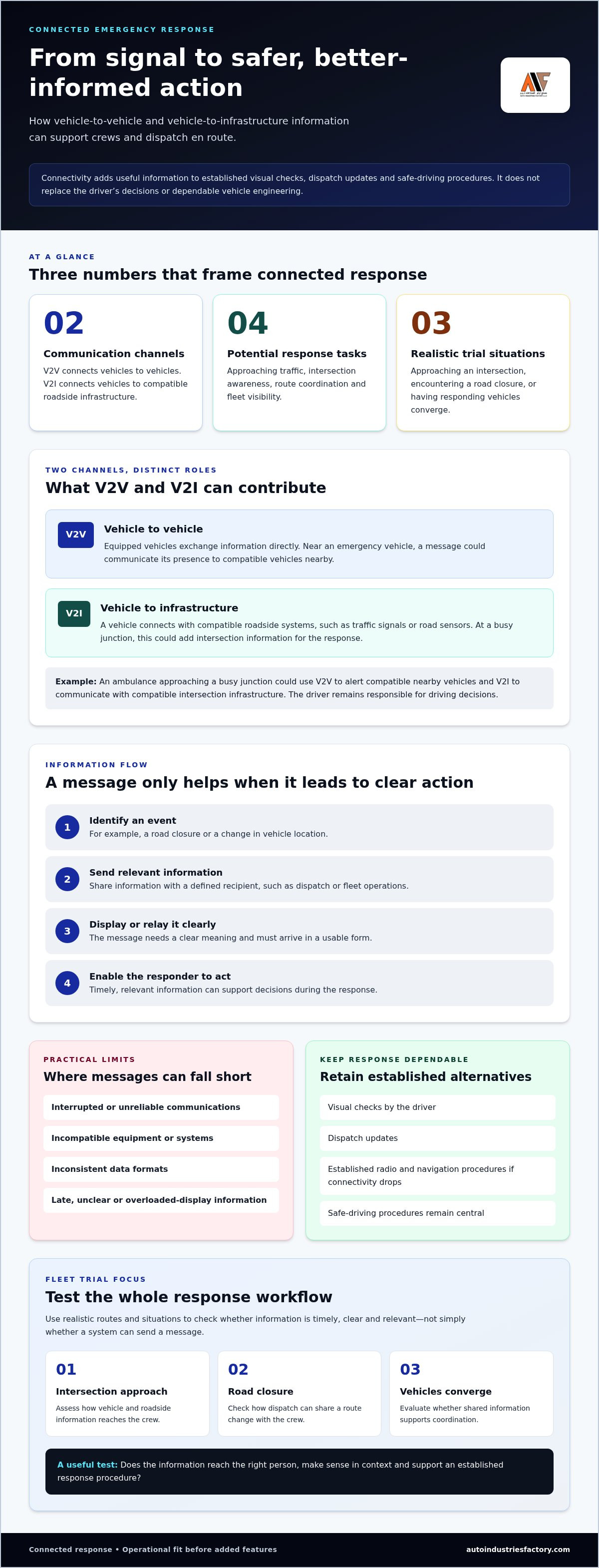
Vehicle-to-vehicle communication, or V2V, allows equipped vehicles to exchange information directly. Vehicle-to-infrastructure communication, or V2I, connects a vehicle with roadside systems, such as traffic signals or road sensors. For an emergency response, these channels could carry useful information about a responding vehicle’s position, movement, or nearby traffic conditions. Their purpose is practical: help drivers and dispatchers build a more current picture of the route.
Consider an ambulance approaching a busy junction. A V2V message could alert nearby connected vehicles to its approach, while a V2I message could communicate with compatible intersection infrastructure. The driver still makes the driving decisions. The benefit comes from adding information to established visual checks, dispatch updates, and safe-driving procedures, rather than assuming other road users or systems will always receive a warning.
For fleet planners, the key question is how information moves through the response workflow. A practical sequence is to identify an event, send relevant information, display or relay it clearly, and enable the responder to act. For example, dispatch could share a route change after a road closure, while a vehicle system relays its location to fleet operations. Each message needs a clear meaning and a defined recipient.
V2V and V2I can support different tasks:
- Approaching traffic: V2V can communicate a vehicle’s presence to compatible vehicles nearby.
- Intersection awareness: V2I can connect an emergency vehicle with compatible roadside equipment.
- Route coordination: Dispatch updates can help crews respond to road changes or revised incident locations.
- Fleet visibility: Shared vehicle status can help operations teams coordinate available units.
These exchanges depend on compatible equipment, reliable communications, and consistent data formats. A message that arrives late, lacks context, or appears on an overloaded display may not help the crew. Fleet trials should use realistic routes and situations, such as approaching an intersection, encountering a road closure, or having two responding vehicles converge. Teams can assess whether information is timely, clear, and relevant to the driver’s task.
Connectivity also needs a fallback plan. Radio communication, direct observation, and established dispatch procedures remain important when a data link is unavailable or a receiving system is incompatible. In the UAE, fleet managers should assess V2V and V2I against local routes, roadside infrastructure, and operating procedures. The same setup may perform differently across urban roads, highways, and remote routes, so trials should reflect the fleet’s actual work.
Emergency fleets that need purpose-built vehicle configurations can use police and military vehicle modifications to address the physical platform and operational requirements. Communication systems work best as part of a carefully considered vehicle setup, alongside clear procedures and trained users.
How are electric and hybrid ambulances, fire trucks, and police vehicles performing in 2026?
Performance depends on the mission, not the powertrain label. An ambulance may remain stationary for long periods while powering onboard equipment, while a fire truck carries substantial tools and must reach varied incident locations. A police vehicle may follow a different pattern, combining patrol work with rapid response. These roles create different demands for range, payload, charging, and vehicle configuration.
Many 2026 electric vehicles can travel more than 300 miles on a single charge. That figure describes electric vehicles generally, not a guaranteed range for a converted ambulance, fire truck, or police vehicle. Added equipment, vehicle weight, climate control, route conditions, and operating patterns can affect usable range. Fleet managers should assess the completed emergency vehicle against its real duty cycle.
Electric ambulances may suit routes with predictable return points and planned charging windows. Assessment should include the power needs of medical equipment while stationary, as well as travel between calls. Hybrid powertrains offer another approach: electric drive can support some operations, while a combustion engine remains available for other driving demands. The right comparison depends on route length, response readiness, and fleet charging access.
Fire and police roles need separate evaluations. A fire truck must account for mission equipment, crew requirements, and travel to incidents across its response area. A police fleet should consider patrol duration, equipment load, and access to charging or fueling. For each role, compare vehicles in their operational configuration rather than relying only on a base model’s published range.
A practical fleet assessment can compare these factors:
- Duty cycle: Record routes, operating periods, idle time, and return-to-base patterns.
- Vehicle load: Include crew, response equipment, and conversion components.
- Energy access: Map charging locations or fueling arrangements against shift routines.
- Maintenance: Plan service procedures around the selected vehicle and its emergency equipment.
For electric models, maintenance planning should account for the battery system and charging equipment. Hybrid models require teams to understand both electric and combustion components. In either case, fleet procedures should define how vehicles are inspected, assigned, and returned to service. Beyond routine servicing, operations must also establish clear recovery procedures for immobilised heavy units; industry specialists such as Allout Towing demonstrate how dedicated heavy machinery towing protocols protect substantial vehicles from further damage during transit. A trial using representative routes and equipment can reveal practical workflow issues before wider deployment.
In the UAE, route planning should reflect the fleet’s actual operating environment and charging access. A configuration designed for short urban routes may not suit long-distance coverage. Review heat management, cabin comfort, onboard electrical demand, and response geography together. These factors help distinguish a suitable platform from one that looks suitable only on paper.
For ambulance operations, the body and interior configuration matter as much as the powertrain. A box-type ambulance or an extended-roof ambulance on GMC and Toyota platforms offers different layouts to assess for crew movement, equipment placement, and the chosen base vehicle. Evaluate the conversion as part of the complete emergency unit, not as an isolated chassis decision.
What are the latest 2026 market forecasts and adoption figures for emergency vehicles?
Available 2026 indicators point to broader electric-vehicle availability and continued safety-technology adoption. They describe general vehicle markets, not emergency-vehicle sales or UAE fleet adoption. For fleet planners, the practical value is understanding the technologies and market conditions that may influence future procurement.
Many 2026 electric vehicles can travel more than 300 miles on a single charge. That range is a general-market indicator, not a guarantee for a converted ambulance, fire truck, or police vehicle. Added equipment, vehicle weight, route demands, and onboard power use affect operational suitability. Buyers should evaluate a complete emergency configuration rather than applying a passenger-vehicle figure directly.
Approximately 250,000 electric vehicles are expected to come off lease and return to the U.S. consumer market in 2026. This points to more used EVs entering that consumer market, not to a forecast of emergency-fleet purchases. Emergency operators still need to assess vehicle condition, mission equipment, support arrangements, and charging access before considering a used electric platform.
Safety adoption has a longer timeline. In the United States, 20 automakers pledged to equip virtually all new passenger vehicles with low-speed automatic emergency braking and forward collision warning by September 1, 2022. The Insurance Institute for Highway Safety estimated that this commitment would prevent 28,000 crashes and 12,000 injuries in the U.S. by 2025. These estimates concern passenger vehicles, not emergency vehicle adoption.
Regulatory developments also influence market direction. The U.S. Department of Transportation predicted that its proposed automatic emergency braking requirement would save 360 lives per year and reduce collisions by as many as 24,000. The proposal would set requirements for certain light vehicles and specify performance expectations for automatic emergency braking. These are U.S. figures, not UAE requirements.
For UAE fleet planning, separate market signals from local purchasing decisions. A useful review can track:
- Vehicle category: Distinguish passenger-vehicle adoption from emergency-fleet procurement.
- Operational fit: Compare range, equipment load, duty cycle, and charging access.
- Safety technology: Identify features relevant to the emergency vehicle’s role and operating environment.
- Local suitability: Assess the UAE vehicle approval process and available fleet support before selecting a platform.
The main takeaway for 2026 is measured adoption, not a single universal forecast. EV range and passenger-car safety commitments show where vehicle technology is moving, while emergency fleets must judge each platform against mission demands. In the UAE, those decisions depend on local operating conditions and the intended use of each vehicle.
The 20 automakers participating in the U.S. AEB commitment represented more than 99 percent of the U.S. automobile market. Automakers reported AEB status for U.S.-market vehicles manufactured from Sept. 1, 2016, through Aug. 31, 2017, providing a historical view of implementation.
How much do new electric emergency vehicles cost compared with conventional models?
There is no single useful price for every electric emergency vehicle. An electric ambulance and a conventional ambulance may differ in their base vehicle, conversion work, onboard equipment, and energy systems. A fair comparison starts by matching the mission and completed specification, not comparing bare chassis.
For an emergency vehicle in the UAE, the price depends on the project and is provided after a quote request. Key factors include the base platform, powertrain, conversion scope, equipment, and charging requirements. The same approach applies when comparing an electric police vehicle with a conventional one. Define the duty cycle first, then compare vehicles configured for that role.
Break the purchase into clear cost areas. The base platform establishes the starting specification. The conversion adds the body, interior arrangement, and mission equipment. For an electric vehicle, charging equipment and site preparation may also affect the total project. A conventional vehicle has different fueling and maintenance needs, so comparing purchase prices alone overlooks important operating costs.
A practical UAE comparison should include these items:
- Vehicle platform: Compare equivalent payload, cabin capacity, and intended service role.
- Conversion scope: List required bodywork, interior fittings, and emergency equipment.
- Energy provision: Include charging access for electric models or fueling arrangements for conventional vehicles.
- Operating demands: Consider routes, idle periods, onboard electrical loads, and return-to-base routines.
- Maintenance planning: Include service needs for the vehicle, conversion, and powertrain.
For example, an ambulance assigned to predictable routes with regular returns to base may have different energy needs from one covering longer routes. A fire vehicle carrying heavy equipment requires a separate payload and duty-cycle assessment. Neither example produces a universal price. Each affects the platform, equipment, and operational requirements included in the quote.
Ask procurement teams to compare like-for-like specifications in AED. The comparison should identify what each quoted configuration includes, such as the base vehicle, conversion work, equipment, and charging provision. Then consider how route patterns and maintenance requirements may affect the fleet’s operating budget. This gives a clearer basis for deciding than treating the initial purchase figure as the total cost.
Electric and conventional models cannot be ranked by price alone without matching their mission requirements. Before requesting comparable quotes, document the role, route pattern, equipment load, and energy access. That specification helps show whether differences reflect the powertrain, the conversion, or additional operational requirements.
Auto Industries Factory LLC: Ambulance Conversions
Auto Industries Factory LLC provides ambulance conversions for teams preparing vehicles for emergency response. If your fleet has selected a base vehicle and needs an ambulance configuration, options include box-type ambulances and extended-roof ambulances on GMC and Toyota platforms. These formats give fleet planners a starting point for matching the vehicle to crew and equipment needs.
When planning a conversion, discuss the intended role, base platform, and operational requirements. This keeps the configuration focused on how the ambulance will be used, rather than treating it as a standard transport unit. Auto Industries Factory LLC also handles police and military vehicle modifications, safari vehicle conversions, and metal canopies and roof racks.
Contact Auto Industries Factory LLC to discuss an ambulance conversion for your fleet.
Turn Fleet Priorities Into a Mission-Ready Plan
The future of emergency vehicles in 2026 will be shaped by decisions made before a vehicle enters service. For UAE fleet planners, the next step is to translate connectivity and powertrain priorities into practical requirements for each vehicle’s role. Define the operating environment, crew needs, equipment layout, and vehicle platform first. This gives procurement and conversion teams a clear basis for planning.
Technology works best when the vehicle configuration supports the mission. Dispatch systems, onboard equipment, and the platform itself need to function as one operational unit. Review how each vehicle will be used, rather than relying on a technology checklist disconnected from daily work.
Auto Industries Factory LLC provides Ambulance Conversions, Police & Military Vehicle Modifications, and Safari Vehicle Conversions. These services support fleets seeking specialized vehicles configured for distinct operational roles.
If you’re planning a conversion, bring your platform and mission requirements together at the start. Contact Auto Industries Factory LLC to discuss your vehicle requirements and move toward a configuration built around its intended work. Clear planning is a strong foundation for a capable response fleet.
Frequently Asked Questions
What emergency vehicle technologies are expected to be introduced in 2026?
In 2026, emergency fleet planning is increasingly shaped by connected systems, driver-assistance features, and vehicle-specific response information. Some 2026 models offer 360-degree surround-view cameras, while a standard rearview camera is a practical baseline. Adaptive cruise control with stop-and-go can maintain a set following distance. For UAE operators, the useful next step is to assess each feature against the vehicle’s role, crew workflow, and local operating conditions.
How are AI, connected-vehicle systems, and autonomous driving changing emergency response?
AI can help organize incoming information, while connected systems relay vehicle and road data to crews or dispatch. For example, software could display a route change alongside the incident location, leaving responders to assess the information and act. Autonomous driving is a separate capability and should not be treated as a substitute for trained emergency drivers. Fleet teams can evaluate these tools through controlled trials, checking message clarity, system compatibility, and fallback procedures.
Which emergency vehicle manufacturers and models are leading in 2026?
No single manufacturer or model leads every emergency role in 2026. Fleets should compare vehicles by operational fit, connectivity compatibility, payload, duty cycle and conversion requirements.


