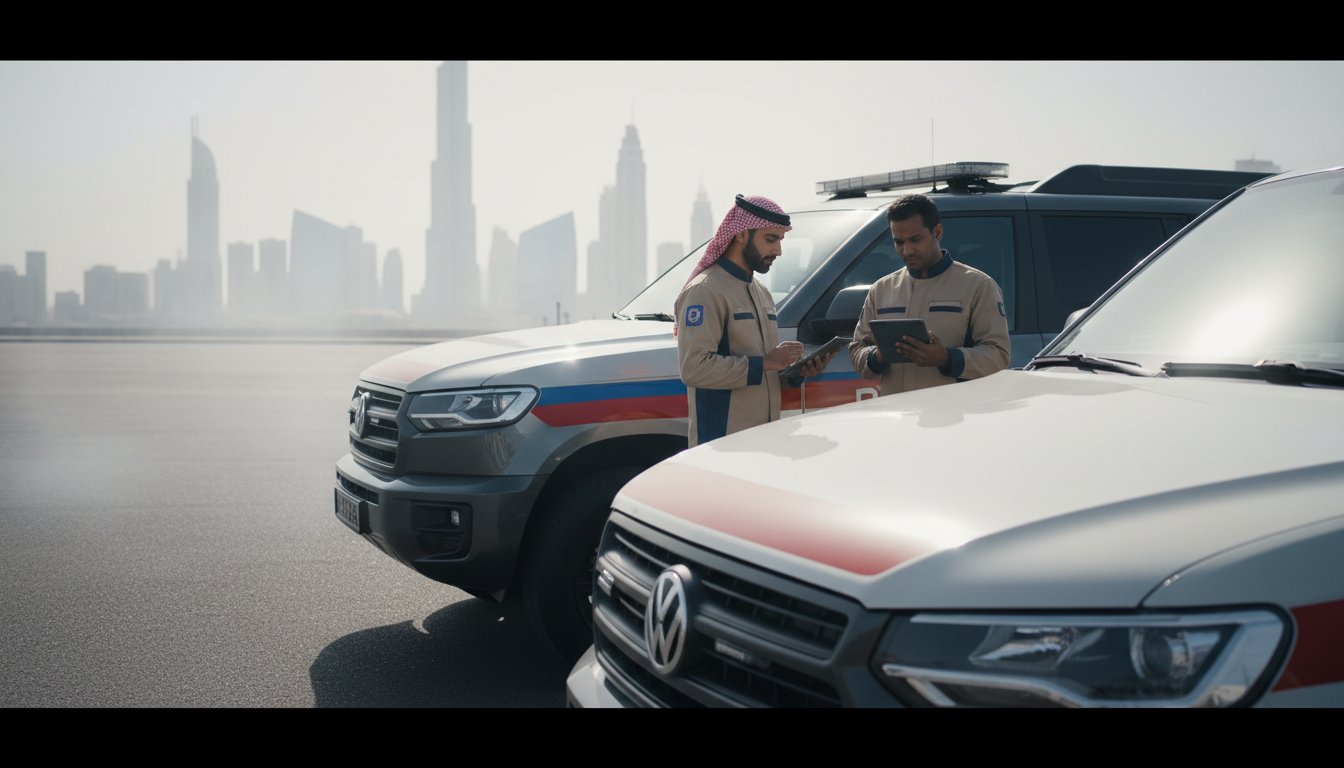
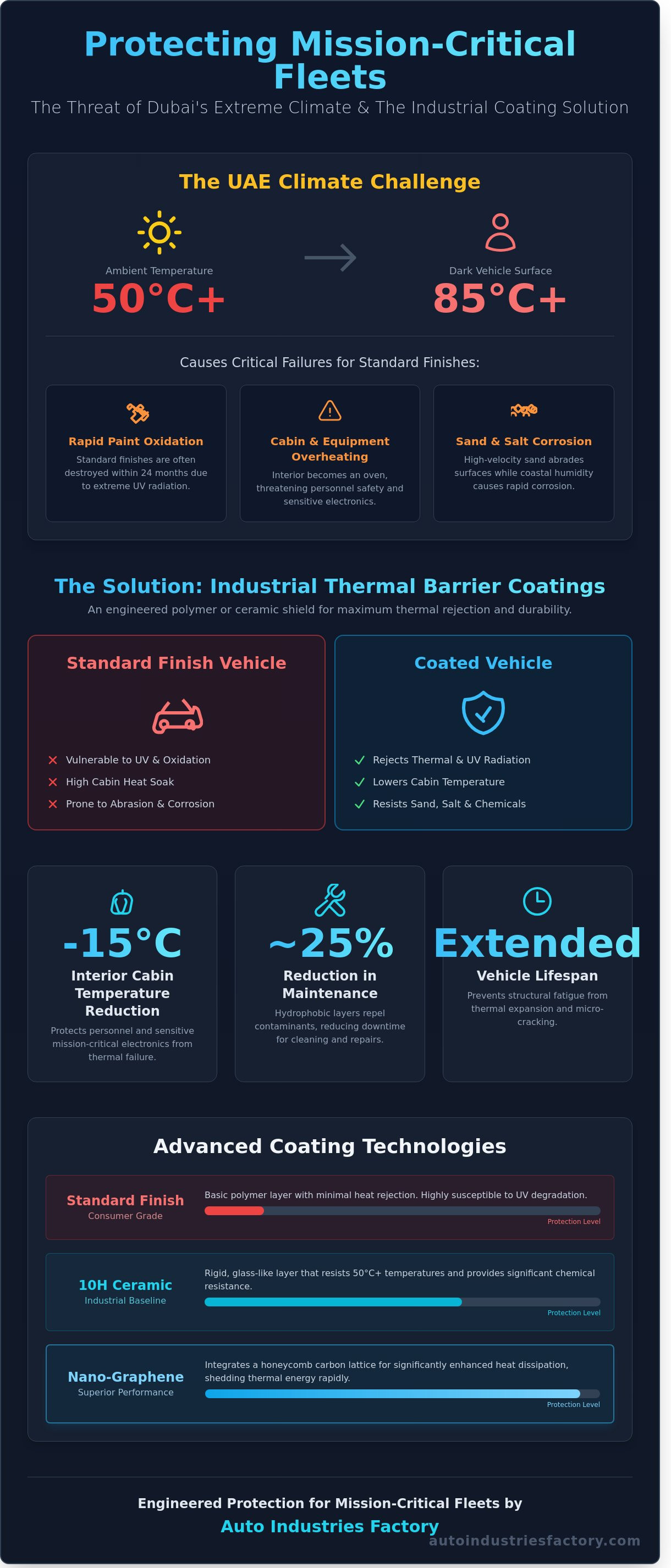
Did you know that the surface temperature of a dark-colored vehicle in Dubai can exceed 85°C when ambient temperatures hit the 50°C mark? You've likely seen the results of this thermal stress first-hand, from rapid paint oxidation to interior cabins that feel like ovens. Standard automotive finishes simply aren't engineered for the extreme UV radiation and thermal expansion found in the UAE. This is why mission-critical fleets now rely on industrial-grade heat resistant vehicle coatings Dubai to maintain operational integrity and protect specialized equipment.
We agree that for ambulances, police units, and tactical vehicles, heat isn't just an inconvenience; it's a threat to equipment and personnel safety. You'll learn exactly how these advanced thermal barriers shield your fleet from 50°C+ temperatures while preventing mechanical wear from sand and salt corrosion. We will explore the technical advantages of these coatings, including their ability to reduce interior cabin heat by up to 15°C and significantly extend the lifespan of your mission-critical vehicles.
Key Takeaways
- Understand why standard finishes fail in 50°C+ heat and how specialized heat resistant vehicle coatings Dubai provide the thermal rejection required for mission-critical fleets.
- Discover the performance benefits of Nano-Graphene and 10H ceramic technology for superior heat dissipation in heavy-duty and tactical vehicle applications.
- Identify why industrial conversion specialists offer superior protection compared to standard detailing shops for specialized vehicles like ambulances and security units.
- Learn how to conduct a professional thermal load assessment to select the most effective coating based on your fleet's specific operational environment.
- Explore Auto Industries Factory’s integrated fabrication and specialized painting solutions designed to maximize fleet uptime and durability in the UAE climate.
The Critical Role of Heat Resistant Vehicle Coatings in Dubai’s Climate
Auto Industries Factory (AIF) specializes in mission-critical vehicle conversions where performance failure isn't an option. In the extreme climate of the United Arab Emirates, standard automotive paint is usually the first point of failure for heavy-duty fleets. Heat resistant vehicle coatings Dubai provide a specialized defense layer that goes beyond traditional aesthetics. These systems are engineered polymer or ceramic shields designed for maximum thermal rejection. By applying Thermal Barrier Coatings to exterior surfaces, operators protect the vehicle's structural integrity. This technology is essential for fleets operating in 50°C+ peak summer temperatures across the GCC.
To better understand this concept, watch this helpful video:
Combating the UAE Summer Heat
UV radiation levels in Abu Dhabi and Dubai are exceptionally high. This intensity accelerates paint oxidation, often destroying factory finishes within 24 months. AIF’s coating solutions act as a secondary skin. They regulate cabin temperatures by up to 15 degrees, which protects sensitive mission-critical electronics from thermal failure. When on-board medical equipment or tactical communication systems overheat, the vehicle becomes a liability. Reliability starts with effective thermal management. Our application of heat resistant vehicle coatings Dubai ensures your fleet remains operational during the most punishing months of the year.
Beyond Heat: Sand and Humidity
Protection in the Northern Emirates requires specific abrasion resistance. Desert sandstorms in Sharjah and Ajman act like high-velocity sandpaper on vehicle exteriors. Advanced coatings prevent the pitting and erosion caused by wind-borne silica. These coatings provide a sacrificial layer that absorbs the impact of sand particles, preserving the underlying substrate for years. In coastal regions like Fujairah and Ras Al Khaimah, humidity levels often exceed 90%. This moisture, combined with salt air, triggers rapid corrosion. Hydrophobic layers in modern coatings repel water and contaminants. This reduces maintenance downtime by approximately 25% because vehicles resist chemical etching and stay cleaner during extended field operations. Explore our full range of protection through our services.
Advanced Coating Technologies: Graphene, Ceramic, and Industrial Shields
9H and 10H ceramic coatings represent the baseline for heavy-duty fleet protection in the Middle East. While consumer-grade products offer basic gloss, industrial 10H applications provide a rigid, glass-like layer that resists the 50°C temperatures common in the UAE, making them essential for heat resistant vehicle coatings Dubai. Nano-Graphene technology takes this protection further by integrating a honeycomb lattice of carbon atoms into the coating. This molecular structure significantly enhances heat dissipation, allowing the vehicle to shed thermal energy much faster than traditional polymer-based waxes or sealants.
Auto Industries Factory (AIF) specializes in both industrial powder coating and high-performance liquid ceramic applications. Powder coating involves an electrostatic process where dry resin is baked onto metal components like bull bars or roof racks at temperatures exceeding 200°C. This creates a thick, impact-resistant shield that won't chip during off-road use. Liquid ceramic applications focus on the vehicle body, utilizing covalent bonding to fuse with the paint's molecular structure. This chemical reaction ensures the coating becomes a permanent part of the substrate rather than a temporary top layer.
Thermal Rejection Mechanisms
These coatings function as a sophisticated thermal barrier by reflecting up to 90% of infrared (IR) rays and nearly 99% of ultraviolet (UV) radiation. This reflection prevents the vehicle's metal panels from absorbing energy, which keeps cabin temperatures lower and protects sensitive medical or communication electronics in mission-critical units. Thermal emissivity defines the efficiency with which a surface emits thermal radiation to its surroundings. High-emissivity coatings ensure that any heat absorbed is released quickly rather than soaking into the vehicle's frame. Additionally, the hydrophobic nature of these surfaces reduces surface tension, meaning dust and saline moisture from the Arabian Gulf can't bond to the vehicle, reducing maintenance time by approximately 40%.
Durability Standards for Specialized Fleets
Standard consumer coatings often fail within 12 months when exposed to the GCC's abrasive sandstorms. Industrial-grade finishes are tested against the H-scale for pencil hardness, where 10H signifies maximum resistance to physical abrasion. For safari vehicles or tactical units, this hardness is vital to prevent "desert pinstriping" from thorny vegetation and high-velocity sand. A professional application of heat resistant vehicle coatings Dubai offers an expected lifespan of 3 to 5 years, even when vehicles operate daily in extreme desert environments. Fleet managers looking for long-term protection can explore specialized fabrication and coating services to ensure their mission-critical assets remain operational and aesthetically professional under the harsh sun.
Specialized Vehicle Protection: Why Standard Ceramic Coatings Fall Short
Most detailing shops in the UAE focus on aesthetic ceramic coatings designed to make a luxury car shine in a showroom. While these products provide basic hydrophobic properties, they lack the chemical density required for mission-critical fleet survival. Auto Industries Factory (AIF) specializes in heavy-duty thermal solutions that prioritize engineering over aesthetics. A standard consumer-grade coating often fails when surface temperatures exceed 70°C on a dark-painted hood in the midday Dubai sun. Our industrial-grade heat resistant vehicle coatings Dubai applications are formulated to maintain structural integrity at much higher thermal thresholds.
Choosing a conversion specialist over a detailing shop is about operational uptime. Detailers treat the surface; we treat the system. We understand how heat transfers through a vehicle's chassis and how it impacts sensitive internal electronics. Standard coatings are typically 2 to 3 microns thick. Our specialized protection layers are engineered for the harsh reality of 50°C ambient temperatures and high-velocity sand abrasion. We don't just apply a product; we integrate a protective shield into the vehicle's functional design.
Ambulance and Emergency Vehicle Requirements
Auto Industries Factory (AIF) specializes in the rigorous demands of ambulance conversion paint protection. Medical units must maintain a sterile, heat-resistant exterior to reduce the load on internal climate control systems. If the exterior paint absorbs too much heat, the air conditioning works twice as hard, increasing fuel consumption and mechanical wear; to explore professional cooling and HVAC standards, you can learn more about Zee Jay Mechanical. Our coatings include specialized reflective properties that enhance the visibility of emergency liveries while bouncing UV radiation away from the cabin. This ensures longevity for high-mileage government fleets that operate 24/7 in extreme conditions.
Off-Road and Safari Durability
Protecting safari vehicle conversions requires a different approach to heat resistant vehicle coatings Dubai. Sand acts like an abrasive grit at high speeds, stripping away standard paint and thin ceramic layers within months of operation. We apply high-performance coatings to custom accessories, including bull bars, roof racks, and external roll cages. These components are prone to thermal fatigue, where constant heating and cooling cycles cause metal expansion and paint flaking.
- Chassis Protection: We prevent thermal fatigue on modified suspensions and chassis components that are exposed to hot sand.
- Abrasion Resistance: Our coatings withstand brush and scrub contact during desert expeditions.
- Heat Rejection: Specialized formulas reduce the surface temperature of metal accessories by up to 15 degrees, making them safer for operators to handle.
By focusing on these technical requirements, we ensure that every fleet vehicle remains operational and professional, regardless of the environmental stress it faces.
Selecting and Maintaining Protective Coatings for UAE Fleets
Auto Industries Factory (AIF) specializes in engineering vehicles that withstand the most extreme environments on the planet. Selecting the right heat resistant vehicle coatings Dubai isn't just about aesthetics; it's a technical requirement for fleet longevity. Dubai's ambient temperatures frequently hit 50°C, while ground temperatures on asphalt can exceed 60°C during July and August. This creates a massive thermal load that degrades standard factory paint within 24 months. To prevent this, fleet managers must follow a rigorous five-step selection and deployment process.
- Step 1: Thermal Load Assessment. We analyze the vehicle's specific role. An ambulance idling in direct sun requires different thermal dissipation than a high-speed security interceptor.
- Step 2: Material Selection. You must choose between Graphene (best for heat dissipation), Ceramic (superior UV protection), or specialized industrial heat-shielding paints for heavy-duty hardware.
- Step 3: Surface Decontamination. Every trace of iron fallout, sea salt from the Arabian Gulf, and microscopic silica sand must be removed using industrial-grade clay bars and chemical decontaminants.
- Step 4: Precision Application. The coating must be applied in a dust-free, temperature-controlled environment to ensure molecular bonding.
- Step 5: Maintenance Schedule. We establish a GCC-specific protocol that accounts for high salinity and abrasive sand.
Professional Application Standards
DIY kits usually fail in the UAE because they don't account for the 80% to 90% humidity levels common in coastal Dubai. High humidity traps moisture under the coating, leading to premature delamination and "bubbling" within weeks. AIF's heat resistant vehicle coatings Dubai are applied in a controlled factory setting where temperatures are maintained between 20°C and 25°C. This allows for a precise 24-hour curing period. Our quality control checks involve gloss-meter readings and thermal imaging to ensure the coating is uniform and capable of reflecting 95% of UV radiation.
Aftercare and Maintenance in the UAE
Maintenance in the desert requires a specialized approach. Sand is essentially crushed silica; it acts like sandpaper on a vehicle's surface. Standard brush washes are prohibited for coated fleets as they cause micro-scratches that compromise the heat-reflective layer. Instead, use a pH-neutral "snow foam" wash every 7 to 10 days to lift sand particles safely. We recommend a professional inspection every six months to check the coating's integrity, especially on leading edges like bull bars and hoods. If the hydrophobic properties drop by more than 30%, a maintenance "top-up" layer is applied to restore the thermal barrier.
Protect your mission-critical assets with engineering-grade protection. Explore our specialized fleet coating and fabrication services to maximize your vehicle uptime.
Industrial-Grade Coating Solutions by Auto Industries Factory
Auto Industries Factory (AIF) specializes in delivering rugged, mission-ready vehicles that thrive in the harshest environments of the Middle East. We don't treat coating as an afterthought. Instead, it's a fundamental stage of our fabrication process. By applying heat resistant vehicle coatings Dubai fleet managers trust, we ensure every conversion meets the extreme thermal demands of the UAE climate. Our integrated approach means your vehicle's protected from the inside out, preventing corrosion and heat soak before components are even assembled.
Our facility in Ajman serves as a primary hub for specialized vehicle conversions across the Emirates. We provide specialized painting and services that include heavy-duty finishes for various platforms. Whether it's a Toyota Land Cruiser for a security detail or a fleet of Nissan Patrols for emergency response, our factory handles large-scale units with precision. We focus on durability because mission-critical fleets can't afford downtime caused by heat-related paint failure or structural degradation.
The AIF Engineering Advantage
Precision's the cornerstone of our manufacturing. We utilize CNC laser cutting and advanced press brake technology to shape raw materials with 0.1mm accuracy. Our team performs precision welding to create robust structures like internal roll cages and external brush guards. Once the metalwork's complete, the units move to our in-house painting facilities. These chambers are specifically scaled to accommodate large ambulances and tactical vehicles, ensuring a flawless, industrial-grade finish. You can learn more about us and our high engineering standards to see how we maintain quality control throughout the entire build cycle.
Get a Professional Consultation
Every fleet has unique operational requirements. A police interceptor needs different thermal management than a long-haul commercial delivery van. We tailor our heat resistant vehicle coatings Dubai solutions to match your specific duty cycle and environmental exposure. Our team works directly with government procurement officers and commercial fleet managers to provide scalable solutions that fit strict technical specifications. We don't offer generic fixes; we provide engineered protection built for the desert.
Don't let the UAE sun compromise your fleet's performance. Reach out to our engineers today to discuss your conversion project and get a detailed technical assessment. Contact Auto Industries Factory for an expert estimate and ensure your mission-critical vehicles are built to last.
Secure Your Fleet’s Mission Readiness in the UAE Heat
Dubai’s extreme climate, where summer surface temperatures often exceed 60°C, makes standard automotive finishes obsolete for professional operations. You need a solution that stands up to intense UV radiation and thermal expansion without degrading. High-performance heat resistant vehicle coatings Dubai provide this essential barrier, shielding mission-critical electronics and specialized equipment from heat-induced failure. By integrating advanced graphene and ceramic technologies, fleet managers can significantly reduce maintenance cycles and preserve the structural lifespan of their vehicles.
Auto Industries Factory (AIF) delivers these results through a rigorous, engineering-first approach. We're the leading specialized vehicle manufacturer in the UAE, utilizing our own in-house industrial painting and fabrication facilities to maintain total quality control. Our rugged coatings are already trusted by emergency and tactical services across the GCC to ensure reliability in life-saving situations. Choosing the right protection isn't just about aesthetics; it's about mission readiness and long-term asset value in the desert.
Upgrade Your Fleet with Expert Heat Resistant Coatings
Let’s get your vehicles ready for the toughest conditions the UAE has to offer.
Frequently Asked Questions
Do heat resistant coatings actually lower the temperature inside my vehicle?
Yes, heat resistant coatings lower the interior temperature by reflecting up to 90% of infrared radiation. High-grade thermal coatings can reduce exterior surface temperatures by 15°C, which leads to a 5°C to 8°C drop in cabin heat. This reduction lowers the load on your air conditioning system by 20%, improving fuel efficiency for mission-critical fleets; for those in the UK, Ultra Cold AC offers mobile car air conditioning regas Milton Keynes to ensure peak system performance. Auto Industries Factory (AIF) specializes in these thermal management solutions for rugged UAE environments.
How long does a professional ceramic coating last in the Dubai heat?
A professional ceramic coating typically lasts between 2 and 5 years in the intense Dubai heat. The 50°C summer temperatures and high UV index require 9H-rated products for maximum durability. Regular maintenance every 6 months ensures the hydrophobic properties remain intact. Using professional heat resistant vehicle coatings Dubai services provides a durable shield that prevents paint oxidation and clear coat failure over long periods.
Can I apply heat resistant coatings to custom bull bars and roof racks?
You can apply heat resistant coatings to custom bull bars, roof racks, and other external fabrications. AIF applies these coatings to protect powder-coated steel and aluminum from the UAE's 90% humidity and salt-laden air. This treatment prevents the finish from chalking or fading under direct sunlight. It's a standard requirement for heavy-duty safari and military vehicles operating in the Rub' al Khali desert.
Is graphene better than ceramic for vehicles in the UAE?
Graphene is generally better than ceramic for vehicles operating in the UAE's extreme climate. It offers higher thermal conductivity, which helps dissipate heat across the surface 25% more effectively than traditional ceramic. Graphene also reduces the risk of water spotting by 30%, which is vital during the humid months in Dubai and Ajman. It provides a slicker, more durable finish for high-utilization commercial fleets.
What is the curing time for industrial vehicle coatings in Dubai?
The initial curing time for industrial vehicle coatings in Dubai is 24 to 48 hours. During this period, the vehicle must remain in a dust-free, temperature-controlled environment. Full chemical curing takes 7 to 10 days to reach maximum 9H hardness. AIF manages this process in specialized facilities to ensure the heat resistant vehicle coatings Dubai bond perfectly to the substrate, guaranteeing long-term reliability for emergency and security vehicles.
Do specialized vehicle coatings protect against sandstorm damage?
Specialized vehicle coatings protect against sandstorm damage by creating a sacrificial 9H hardness layer. This layer absorbs micro-abrasions from sand particles moving at speeds over 60 km/h during seasonal storms. While no coating is completely scratch-proof, these advanced formulas reduce visible swirl marks and pitting by 70%. They ensure your fleet maintains a professional, flawless appearance even after years of desert operation.
Can heat resistant coatings be applied to ambulances and police cars?
Heat resistant coatings are frequently applied to ambulances and police cars to protect sensitive onboard technology. AIF specializes in these mission-critical conversions, ensuring that interior temperatures stay within the 20°C to 25°C range required for medical equipment. By reflecting solar energy, these coatings prevent electronic malfunctions and extend the lifespan of communication gear. They're essential for vehicles built to protect and save lives.
How much does a professional vehicle coating service cost for a fleet?
Professional vehicle coating services for a fleet depend on the number of units and the specific protection level required. Industry data shows that bulk commercial applications in the UAE typically start from 1,200 AED to 2,500 AED per vehicle. This investment reduces long-term maintenance costs and preserves the resale value of the fleet. AIF provides tailored estimates based on your specific operational requirements and vehicle count.


