
Finding a vehicle fabrication specialist in the UAE starts with matching your build to the right metalwork capabilities. Cutting, bending, welding and assembly turn raw metal into vehicle components, while joining methods bring those parts together into a finished structure.
It’s not enough to know that a company offers fabrication; location and a clear way to make contact matter when you’re planning a vehicle build. This guide explains how to find metal fabrication companies across the UAE, what welding, joining and assembly contribute, and how to contact a specialist. You’ll also see how fabrication supports purpose-built vehicles, from structural components to complete conversions, so you can understand which capabilities are relevant to your project.
Key Takeaways
- Learn why fabrication parts are first fitted temporarily to check alignment before permanent joining.
- Prepare a focused inquiry by matching your vehicle project with a specialist’s relevant capabilities.
- Match project needs to capabilities such as metal cutting, bending, welding, and assembly.
- Understand how project scope, fabrication sequence, and complexity affect lead-time planning.
- See which vehicle-modification details matter when understanding the relevant approval pathway.
Assembly, welding and joining
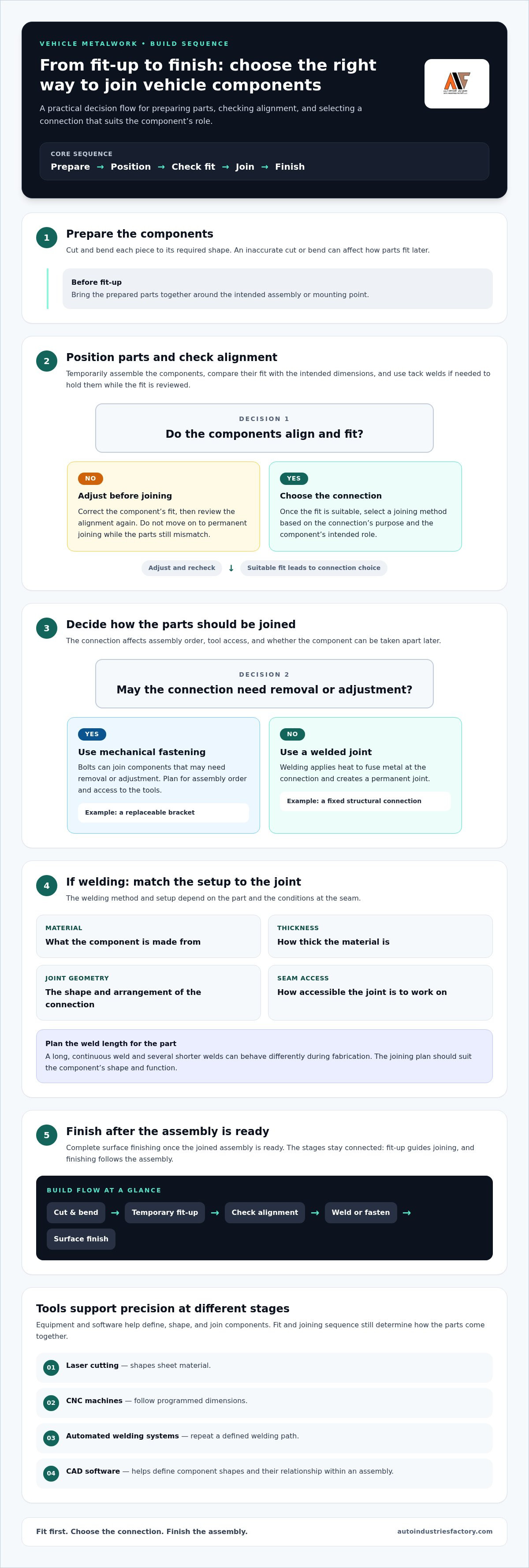
Vehicle metalwork involves connected operations: cutting, bending, welding and assembly. Each changes the material or its position in the build. For example, a cut steel section may be bent to shape, aligned with adjoining parts, then joined into a frame or support. The sequence matters because an inaccurate cut or bend can affect how components fit later.
Assembly begins with fit-up: fabricators position components and check their alignment before making permanent joints. They first assemble the parts temporarily to assess the fit and make adjustments. In a vehicle structure, this may mean aligning several sections around a mounting point and checking them against the intended dimensions. Tack welds can hold components in place while the fit is reviewed.
Once the parts fit, welding creates a permanent joint by applying heat to fuse metal at the connection. The method and setup depend on factors such as material, thickness, joint geometry and access to the seam. A long, continuous weld and several shorter welds can behave differently during fabrication, so the joining plan should suit the part’s shape and function.
Not every connection is welded. Mechanical fasteners, such as bolts, can join components that may need removal or adjustment. Choosing between a welded joint and a bolted connection affects assembly order, tool access and future disassembly. For example, a fixed structural connection may be welded, while a replaceable bracket may be fastened in place.
Fabrication equipment supports different stages of the work. Laser cutting shapes sheet material, while CNC machines follow programmed dimensions. Automated welding systems can repeat a defined welding path. CAD software helps define component shapes and their relationship within an assembly. These tools support precision, but the fit and joining sequence still determine how parts come together.
A practical fabrication sequence connects the operations:
- Prepare: Cut and bend each component to its required shape.
- Position: Bring the parts together and check alignment during temporary fit-up.
- Join: Apply welding or mechanical fastening according to the connection’s purpose.
- Finish: Complete surface finishing after the joined assembly is ready.
These stages show why assembly, welding and joining are connected tasks. If fit-up reveals a mismatch, a component may need adjustment before permanent welding. Auto Industries Factory LLC coordinates cutting, joining and assembly to manage these dependencies as one connected build process.
The component is adjusted to restore a suitable fit before joining continues. This keeps the sequence connected: fit-up guides joining, and finishing follows once the assembly is ready. The selected connection must suit the component and its intended role.
Steel fabrication commonly involves cutting, welding and assembly, structural fabrication, surface finishing, installation and maintenance. Joining is one part of the process: preparation and assembly lead into it, while finishing and installation follow. The sequence connects component fit and connection choices to the remaining fabrication work.
Which vehicle fabrication companies operate in Ajman, UAE?
One vehicle fabrication business identified in Ajman is Auto Industries Factory LLC, listed in Al Jerf Industrial 1. The company advertises ambulance conversions. This gives fleet planners a named local starting point for specialized vehicle work. The listing identifies a business and area, but it doesn’t provide a public phone number here.
Al Jerf Industrial 1 is useful as a location reference when planning an inquiry or site visit. Use the company name and area together when searching a current map or business directory. Check that the address shown matches Al Jerf Industrial 1 before travelling. This simple location check helps distinguish a local workshop from businesses elsewhere in the UAE.
A company name alone does not show whether its capabilities match your build. Compare the requested work with the vehicle type and fabricated components involved. An ambulance conversion, for example, is a specialized vehicle build, while a metal structure may require cutting, bending, welding and assembly. Matching the project scope to the company’s capabilities makes the first conversation more productive.
Prepare the project details before getting in touch. A concise inquiry can identify the vehicle platform, intended use, required modifications and whether the project involves one vehicle or a fleet. Photos, drawings or measurements can help explain the requested structure. For a fleet, note whether units share a configuration; consistent specifications help define the fabrication scope.
Describe the work specifically. A request for an ambulance conversion is clearer than a general request for vehicle metalwork. Outline the intended build, major components and any constraints affecting access or layout. This gives the conversation a practical focus and helps match the project to the right fabrication capabilities.
Location and communication both matter. Use the Al Jerf Industrial 1 listing to orient your search, then use the business’s official contact channel to discuss the project. Keep the vehicle details and requested work together in one message. If your enquiry concerns an ambulance conversion, you can review the specialized vehicle services relevant to that scope.
For readers comparing local options, the available listing provides one named Ajman company and a specific industrial-area reference. Treat that as a practical starting point, then frame the inquiry around the vehicle, build purpose and fabrication work required. Those details help establish whether the business’s advertised specialization aligns with the project.
5 to 8 horsepower motors operate trucks. For a proposed build, clarify whether the work concerns the vehicle body, interior fit-out, equipment mounting or another fabrication task, and describe how the motor and intended use relate to the design brief. Ask the workshop to confirm that its experience and facilities suit the specific platform and conversion, rather than treating a general fabrication listing as proof of capability. Where a truck is involved, include the motor information in the inquiry and ask what additional specifications are needed to assess the job. Keep any response tied to the requested build, so the scope, compatibility questions and next steps are clear before arranging further discussion.
What vehicle fabrication services do Ajman companies offer?
Vehicle fabrication can include metal components, structural work and specialized vehicle builds. In transportation, fabricated steel is used for trailers, vehicle structures and industrial transportation systems. The work depends on the vehicle’s purpose and the parts that need to be made, joined or fitted. A trailer frame, for example, requires different components from a support structure inside a vehicle.
Metal fabrication commonly begins by cutting and bending material into component shapes. Those parts can then be welded or assembled into a larger structure. Cutting establishes dimensions, while bending forms sections to the required profile. The sequence matters because each component’s dimensions and shape affect how it fits with adjoining parts.
Vehicle structures depend on joined parts fitting together as intended. Temporary fit-up lets the fabricator align components and assess the assembly before making permanent joints. In a frame with several connected sections, one misaligned piece can affect the fit of later components. Welding or another joining method then connects the parts to suit the assembly’s requirements.
Fabrication also supports transportation equipment beyond the vehicle body. A trailer may use a fabricated frame, while industrial transportation systems may need metal supports or other structural components. The same core operations can serve different applications; the project’s purpose determines the component shapes and how they connect.
Specialized builds may involve modifying a vehicle’s structure or adding fabricated components for a particular operating role. The work can involve several linked tasks, including cutting material, forming parts, joining sections and assembling them into a finished structure. Describing each task helps clarify the scope. A request for a frame, for instance, should identify where it will sit and what it needs to support.
For a fleet project, shared specifications can make repeated fabrication more consistent. The vehicle type, intended use and required components define the build scope. A one-off custom structure may need individual fitting, while repeated units can follow common dimensions and assembly requirements. Clear drawings or measurements show how each part relates to the complete vehicle.
When comparing vehicle fabrication services in Ajman, describe the application before listing processes. Identify whether the work involves a vehicle structure, trailer component or industrial transportation system. Then outline the parts that need cutting, bending, welding or assembly. This gives a vehicle fabrication company in Ajman a defined scope to discuss and distinguishes structural fabrication from other vehicle work.
What is the typical lead time for vehicle fabrication in Ajman?
Vehicle fabrication in Ajman has no single lead time that applies to every build. The schedule depends on the work, from defining the scope through fabrication and assembly. A formed metal bracket requires different operations from a custom vehicle structure. The number and shape of components, and how they connect, all affect the production sequence.
Project definition sets the starting point. A clear brief identifies the vehicle, intended use, required structure and desired finish. For example, a request for a fabricated support should describe its location and function. If those details change after fabrication begins, the design and component work may need adjustment. Drawings, dimensions and reference images help establish the scope before manufacturing starts.
Each fabrication operation adds a step to the schedule. Cutting prepares the material, bending forms components, and welding or fastening joins them. Assembly brings the parts together for a fit check. A structure with several connected sections needs more alignment and joining work than a single formed component. Surface finishing and installation add tasks after the metalwork is complete.
Customization also affects the sequence. A vehicle build designed for a particular layout may require components shaped around that configuration. A repeated fleet specification can use shared dimensions across units, while different vehicle platforms may require separate fitting. The schedule depends on how much fabrication can follow common specifications and how much needs individual adaptation.
To discuss a realistic project schedule, organize the details into a concise scope:
- Vehicle information: Identify the vehicle type and the number of units involved.
- Fabrication scope: List structures or components requiring cutting, bending, joining and assembly.
- Design references: Provide available drawings, dimensions or photographs that show placement and fit.
- Finish and installation: Describe the required surface treatment and how the completed parts fit into the build.
These details help separate fabrication from other project stages. A scope involving a custom frame, multiple welded connections and installation, for example, has more linked operations than a standalone cut component. Sequence matters too: parts must be shaped and fitted before final joining, and finishing follows completed metalwork.
A vehicle fabrication company in Ajman can assess the schedule against the defined scope and fabrication sequence. For fleet planning, coordinate vehicle availability with the required build stages. If specifications change, cutting, assembly or finishing work may need revision. A clear brief gives both parties a practical basis for setting milestones and coordinating the build.
What licenses and approvals are required to modify or fabricate vehicles in Ajman
Vehicle projects in Ajman raise two separate questions: whether a business may carry out its commercial activity, and whether a modified vehicle can be used on the road. These are distinct approval matters. A workshop’s business documents do not establish the requirements for every vehicle modification. The proposed work determines which questions need to be addressed.
Start by describing the change precisely. A fabricated support attached within a vehicle differs from a body-structure change, and a new exterior colour is different from either. Record the vehicle’s make and model, intended use, affected components, and whether the change alters its dimensions or function. These details help frame a useful discussion about the applicable approval process.
Separate fabrication from road-use approval in the project plan. Fabrication concerns how components are made and fitted. Approval concerns whether the modified vehicle meets requirements for its intended use and registration. A project may involve both, but completing the metalwork does not resolve the vehicle-approval question. Treat the fabrication scope and approval pathway as connected but distinct workstreams.
For a fleet, document each vehicle’s configuration. If units share the same base vehicle and modification, one specification can describe the common build. If the platforms or structural changes differ, record those differences separately. This comparison helps identify which vehicles need separate technical information instead of assuming they all follow the same review.
Build an approval file around the proposed change. Keep vehicle identification details with drawings, component descriptions, photographs and records of completed work. A drawing can show where a fabricated support sits, while photographs can document the finished installation. This information makes the modification easier to describe consistently during technical or administrative review.
Use this planning sequence before fabrication begins:
- Define the change: Describe the affected structure, component, finish or vehicle function.
- Identify the vehicle: Record its make, model and intended operating use.
- Map approval questions: Establish which authority handles vehicle modification and registration matters in Ajman.
- Keep records aligned: Match drawings and photographs to the actual completed build.
A vehicle colour change, a non-structural fitting and a body alteration are not interchangeable cases. Each affects the vehicle differently, so the information needed for review may differ too. Describe the change accurately rather than relying on a broad label such as custom fabrication.
For a vehicle fabrication company in Ajman, a practical approach is to define the work and approval questions before committing to a build sequence. Keep fabrication records with the vehicle details, and resolve the relevant approval pathway before treating the modified vehicle as ready for road use.
In Ajman, vehicle modification approval is separate from a workshop’s business licensing, and completing fabrication alone does not establish that a vehicle is approved for road use or registration. The applicable review depends on the proposed change and should be mapped with the authority handling vehicle modification and registration, using vehicle details and records such as drawings and photographs.
Auto Industries Factory: Ambulance Conversions
Auto Industries Factory LLC builds purpose-specific ambulances, including box type ambulances and extended roof ambulance conversions on GMC and Toyota vehicles. These options give fleet planners a clear starting point when selecting a vehicle platform and conversion format.
The company also handles Police & Military Vehicle Modifications, Safari Vehicle Conversions, and Metal Canopies and Roof Racks. These services suit projects requiring a specialized vehicle build or fabricated metal components. Share the vehicle type, intended use and required conversion details to define the project clearly.
For a fleet build, outline whether vehicles share the same platform and configuration. That information helps define the scope of the conversion and related fabrication. To discuss an ambulance conversion or another listed vehicle project, visit Auto Industries Factory LLC's website.
Move Your Vehicle Project Forward
Turn your operational requirements into a focused build brief. Identify the vehicle platform, intended use, required modifications and fleet needs. Choosing a vehicle fabrication company in Ajman starts with defining these details clearly, so the discussion can focus on the project scope and priorities.
Auto Industries Factory LLC provides Ambulance Conversions, Police & Military Vehicle Modifications, and Safari Vehicle Conversions. If you’re searching for a vehicle fabrication company in Ajman for one of these specialized builds, include drawings or reference images where available and describe the conversion requirements in your inquiry.
Whether you’re planning one vehicle or a fleet, a precise brief gives the project a clear starting point. Contact Auto Industries Factory LLC to discuss your vehicle conversion needs and take the next step with confidence.
Frequently Asked Questions
What types of vehicles and specialized bodies can be fabricated in Ajman?
Specialized vehicle builds include ambulances, police and military vehicles, and safari vehicles. Ambulance formats include BLS, ALS, ICU, neonatal, and 4×4 off-road units, with stated alignment to EN1789, ISO, GCC, KKK-A-1822, and WHO guidelines. Other fabrication work can include metal canopies, roof racks, bull bars, and bumpers. For bull bars, the design is engineered according to vehicle chassis dimensions to ensure perfect alignment and secure mounting.
What are the contact details and locations of vehicle fabrication companies in Ajman?
Auto Industries Factory LLC serves customers nationally across the UAE. Contact the company by phone at +971 5297 99385 or email [email protected]. These channels provide a direct way to discuss a vehicle project and coordinate any in-person contact. Include the vehicle type and the modification required in your message so the inquiry clearly identifies the work you want to discuss.
How can I compare quotes and choose a vehicle fabrication company in Ajman?
Compare quotes against the project scope and the company’s relevant capabilities, then review its experience, previous projects, equipment and customer reviews. Specify the vehicle, intended use, required components, and any drawings or measurements so each quote covers the same work.


