
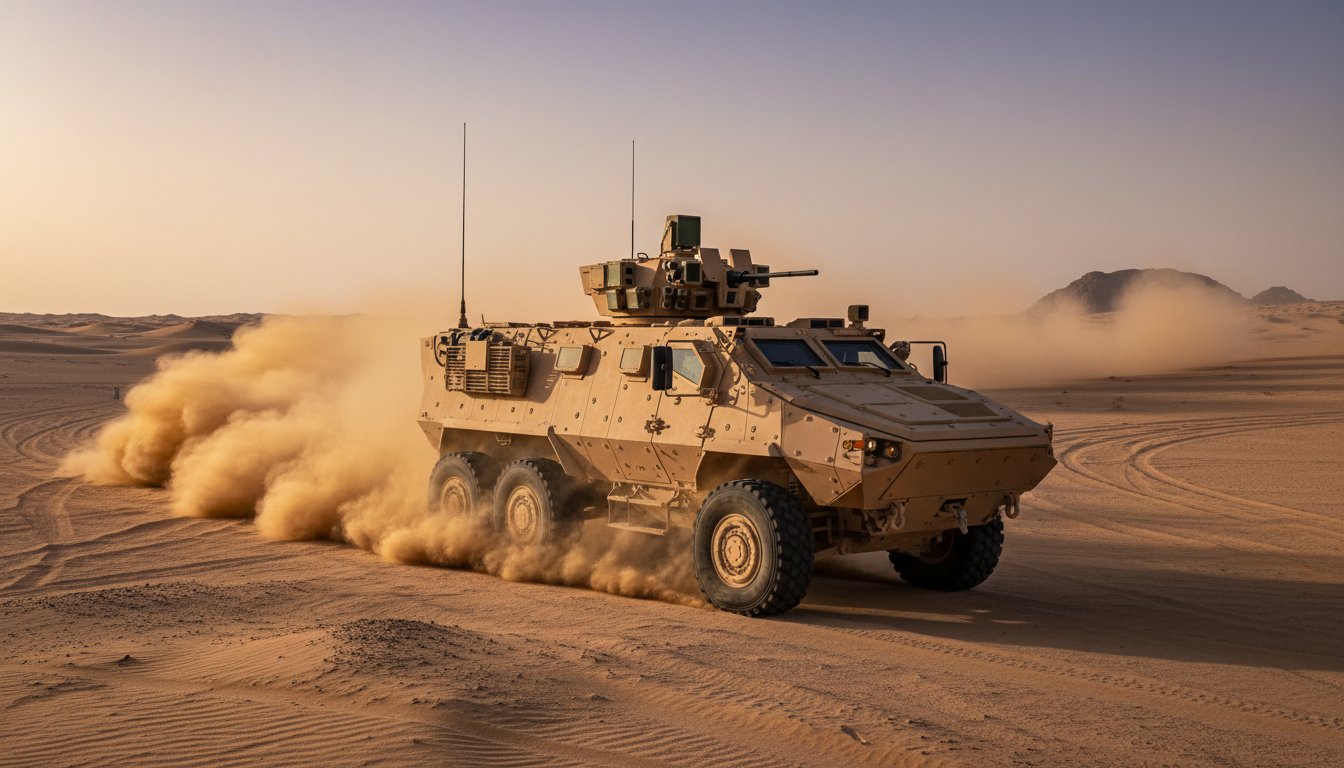
Selecting the right Armored Personnel Carrier is a mission-critical decision where technical complexity and operational risk intersect. Sifting through dense specifications while worrying about a vehicle's performance in the extreme heat and rugged terrain of Oman can lead to uncertainty and a legitimate fear of failure when it matters most. The success of any tactical operation hinges on the reliability and protective capabilities of your chosen military apc, making a confident, informed choice absolutely essential. A mistake in procurement isn't just a budget issue; it's a direct threat to crew safety and mission effectiveness.
This ultimate guide is engineered to eliminate that uncertainty. We cut through the jargon to provide a clear, authoritative breakdown of an APC’s core components, advanced mission systems, and the precision fabrication process. By the end, you will not only understand the capabilities and limitations of modern armored vehicles but also gain the confidence to match a specific configuration to your unique operational requirements. You will be equipped with the knowledge to select a vehicle that guarantees maximum crew protection and flawless performance, ensuring you partner with a fabricator who delivers mission-ready solutions built for the toughest challenges.
Anatomy of an APC: Core Design and Protection Principles
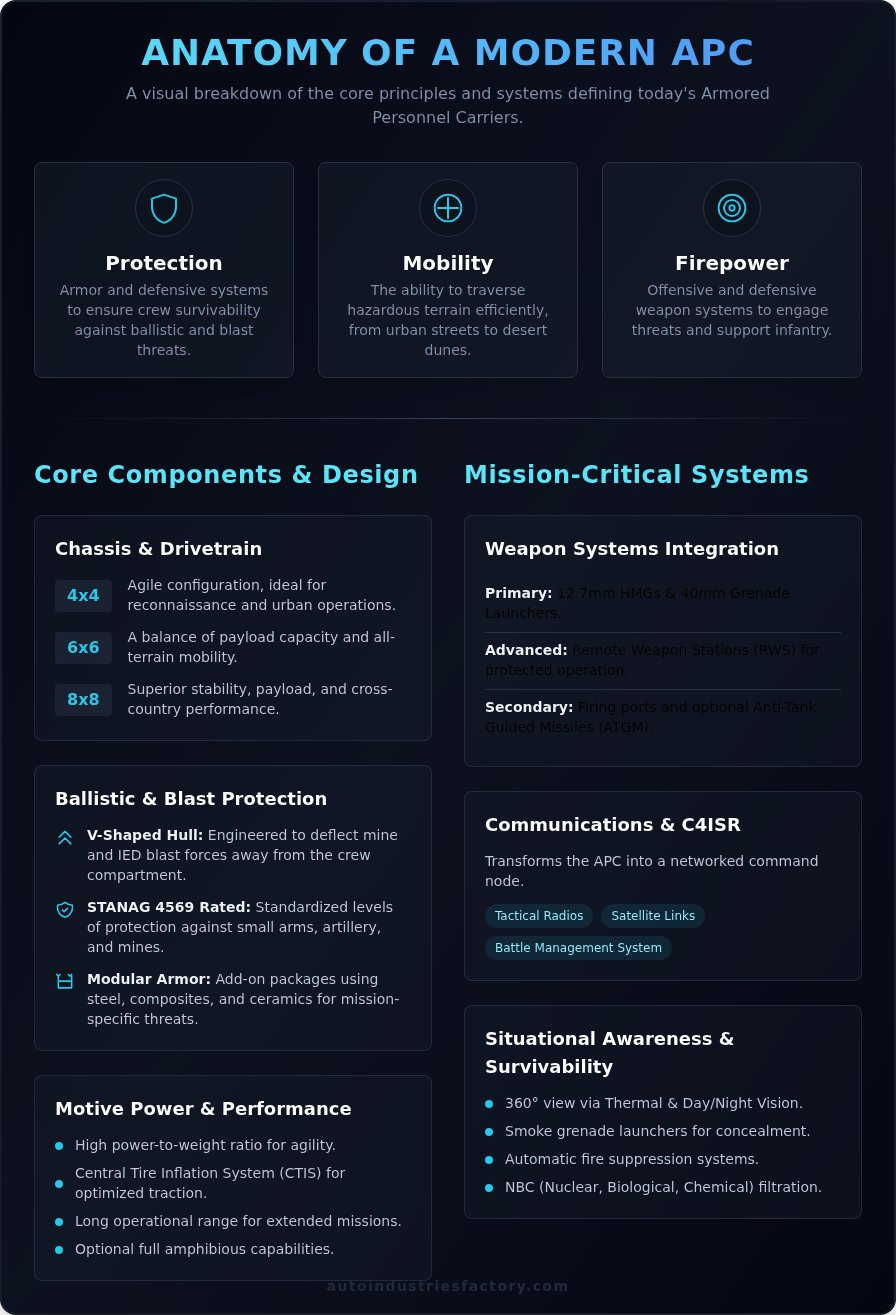
At its core, an Armored Personnel Carrier (APC) has one primary mission: to move troops across hazardous environments safely and efficiently. The engineering behind every military apc is a masterclass in balancing three competing demands: protection, mobility, and firepower. Over-emphasize armor, and mobility suffers. Prioritize speed, and protection might be compromised. This critical triangle dictates the entire design, starting from its foundational structure.
The vehicle is built upon a base chassis, which supports a purpose-built monocoque hull. This hull design integrates the body and frame into a single, robust structure, maximizing internal volume for personnel while forming the primary protective shell. For a comprehensive Armoured Personnel Carrier Overview, it's clear that while technology evolves, these fundamental principles of integrated design remain paramount for crew survivability and mission success.
The Chassis and Drivetrain: Foundation of Mobility
The foundation of an APC's performance is its chassis and drivetrain. These can be purpose-built military designs or heavily modified commercial platforms. Wheeled configurations are common, each offering distinct advantages for different operational needs:
- 4x4: Agile and ideal for reconnaissance or urban operations.
- 6x6: A balance of payload capacity and all-terrain mobility.
- 8x8: Offers superior stability, payload, and cross-country performance.
A heavy-duty suspension system is critical for navigating the rugged terrain found in Oman, from desert dunes to rocky wadis, ensuring crew comfort and vehicle stability. A robust drivetrain is engineered to withstand extreme heat and harsh conditions, delivering reliable power to all wheels.
Ballistic and Blast Protection: The Armor Shell
An APC's hull is its shield. Modern armor utilizes advanced materials like high-hardness steel alloys, lightweight composites, and ceramics to defeat threats. Protection levels are often rated using standards like STANAG 4569, which provides a clear measure of resistance against specific threats like small arms fire, artillery fragments, and mine blasts. To counter improvised explosive devices (IEDs) and mines, many APCs feature a V-shaped hull, engineered to deflect the blast force away from the crew compartment. Modular, add-on armor packages allow for enhanced protection tailored to specific mission threats.
Motive Power and Performance
A powerful engine is essential, but performance is truly defined by the power-to-weight ratio, ensuring the vehicle remains agile even when fully loaded. Advanced systems like a Central Tire Inflation System (CTIS) allow the driver to adjust tire pressure on the move, optimizing traction on sand, rock, or pavement. A long operational range, dictated by fuel capacity and engine efficiency, is mission-critical for extended patrols. While not standard on all models, some specialized APCs also possess full amphibious capabilities, enabling them to traverse rivers and lakes.
Mission-Critical Systems: From Armament to C4ISR
The modern military APC is far more than an armored transport. It is a sophisticated, mobile command post and weapons platform where mission success hinges on the seamless integration of advanced technologies. These mission-critical systems provide the crew with superior firepower, battlefield awareness, and the connectivity needed to dominate complex operational environments. True effectiveness is achieved not by individual components, but by how they function together as a cohesive and reliable whole.
Weapon Systems Integration
A military APC must possess robust self-defense and offensive capabilities. Integration focuses on providing flexible, effective firepower while maximizing crew protection. Common configurations include:
- Primary Armaments: Typically heavy machine guns (like the 12.7mm M2 Browning) or automatic grenade launchers (40mm Mk 19) provide substantial suppressive fire against infantry and light vehicles.
- Remote Weapon Stations (RWS): These advanced systems allow the gunner to operate the main armament from within the safety of the vehicle's armored hull, using high-definition and thermal optics to acquire targets.
- Secondary Systems: Firing ports allow embarked infantry to engage targets from a protected position, while many platforms can be upgraded to carry Anti-Tank Guided Missiles (ATGMs) to counter heavier armor threats.
Communications and C4ISR Integration
On the modern battlefield, information is a critical asset. C4ISR (Command, Control, Communications, Computers, Intelligence, Surveillance, and Reconnaissance) transforms an APC into a networked node. This is achieved through a durable suite of integrated electronics, including tactical radios, satellite links, and robust crew intercoms. A central Battle Management System (BMS) displays real-time positional data, enemy locations, and orders on a digital map, ensuring every vehicle operates with shared awareness. The complexity of integrating these secure systems is a major factor in development, as detailed in studies on APC Procurement Issues.
Situational Awareness and Survivability Systems
Knowing the threat before it strikes is paramount. Advanced systems provide a 360-degree view of the battlespace, day or night. This is achieved with a combination of traditional periscopes and advanced electro-optics like thermal cameras and day/night vision systems. To enhance survivability, APCs are equipped with defensive aids like smoke grenade launchers to create instant visual concealment. Internally, automatic fire suppression systems protect the engine and crew compartments, while advanced NBC (Nuclear, Biological, Chemical) filtration systems ensure the crew can operate safely in contaminated environments.
The Fabrication Process: How a Military APC is Built
Transforming raw materials into a mission-ready military APC is a testament to precision engineering and master craftsmanship. This journey from concept to combat-capable vehicle requires an integrated, end-to-end manufacturing process where every stage is meticulously controlled. By managing the entire fabrication in-house, we ensure unparalleled quality, security, and adherence to the strictest defense standards, guaranteeing a vehicle built for extreme durability and operational success.
Phase 1: Design, Engineering, and Material Selection
Every project begins with a detailed client consultation to define the specific operational requirements, from threat level protection to terrain capability. Our engineers then use advanced Computer-Aided Design (CAD) software to model the vehicle, performing Finite Element Analysis (FEA) to simulate ballistic impacts and structural stress. Modern design builds upon a rich operational past, which you can explore in the History of Armored Personnel Carriers. We source only certified, high-hardness ballistic steel and composite materials, designing each component not just for maximum protection but also for efficient manufacturing and future upgradability.
Phase 2: Hull Fabrication and Armor Integration
This is where the APC’s protective shell takes form. Raw armor plates are cut with micron-level accuracy using CNC laser cutters and then shaped by powerful press brakes. Our certified welders use advanced techniques to join these plates, creating a monocoque hull with seamless ballistic integrity-a critical step where even the smallest flaw is unacceptable. The armored hull is then integrated with the base vehicle chassis, and every aperture is precisely fitted. This includes:
- Reinforced doors and hatches with heavy-duty locking systems.
- Ballistic glass viewports and vision blocks.
- Strategically placed firing ports.
Phase 3: Systems Integration, Finishing, and Testing
With the armored structure complete, the vehicle becomes a complex integration of systems. Technicians install custom wiring harnesses to power everything from advanced communications and surveillance equipment to climate control. The interior is outfitted with blast-mitigating seats, spall liners for secondary projectile protection, and secure mounts for equipment. The exterior receives a multi-stage finishing process, culminating in a Chemical Agent Resistant Coating (CARC) in the required camouflage pattern. Finally, every military apc undergoes a battery of rigorous tests-including mobility trials, systems checks, and quality control inspections-to ensure it is flawless and ready for deployment.
Procurement Guide: Selecting the Right APC for Your Mission
Selecting the right Armored Personnel Carrier is a mission-critical decision that extends far beyond a vehicle's spec sheet. A successful procurement strategy focuses on total cost of ownership (TCO), operational readiness, and the reliability of your manufacturing partner. For defense forces in Oman and the wider region, making an informed choice means balancing advanced capabilities with long-term sustainability and support.
Threat and Environmental Analysis
The ideal military APC is defined by its intended mission. Before evaluating any platform, procurement officers must conduct a rigorous analysis of the operational landscape. Key considerations include:
- Threat Profile: What are the primary dangers? Assess the likelihood of encountering small arms fire, IEDs, RPGs, or artillery fragmentation. This determines the required STANAG protection level.
- Operational Environment: A vehicle optimized for urban patrols will differ from one designed for Oman's vast desert plains or rugged mountain ranges. Factors like extreme heat, sand, and steep gradients demand specialized engine cooling, filtration, and suspension systems.
- Mobility and Payload: Determine the required troop capacity, essential equipment loadout (communications, medical, C4I systems), and the balance between strategic road speed and tactical off-road performance.
Customization vs. Off-the-Shelf Solutions
While standard, mass-produced APCs offer rapid acquisition and proven platforms, they often represent a compromise. Custom fabrication allows for a vehicle built precisely for your operational needs. The benefits are significant: enhanced crew survivability, improved mission effectiveness, and integration of specific subsystems like advanced optics or counter-measure suites. A purpose-built vehicle ensures no capability gaps are left unaddressed. Discuss your unique mission requirements with our engineers.
Logistics, Training, and Lifecycle Support
The initial purchase price is only a fraction of an APC's total cost. A robust logistics and support plan is paramount for maintaining fleet readiness. Consider the availability of spare parts, ease of field maintenance, and the manufacturer's commitment to providing comprehensive training for both operators and maintenance crews. Partnering with a proven expert like Auto Industries Factory ensures you have a clear upgrade path and dependable support throughout the vehicle's entire service life, minimizing downtime and maximizing your investment.
Secure Your Tactical Advantage with a Purpose-Built APC
From core design principles and mission-critical systems to the intricate fabrication process, it is clear that a modern Armored Personnel Carrier is a complex integration of technology and engineering. Selecting the right platform is not merely a purchase; it is a strategic decision that directly impacts operational success and personnel safety. Understanding these key elements is the first step toward equipping your forces with a superior tactical asset.
For defense and security forces in Oman, partnering with a proven expert is paramount. Auto Industries Factory specializes in military and security vehicle conversions, offering end-to-end in-house fabrication in the UAE. Our solutions are engineered and battle-tested for the unique demands of harsh desert environments, ensuring every military apc we produce delivers unparalleled durability and performance.
Ready to move your project from concept to reality? Consult Our Experts on Your Custom Military APC Project and let us build the protection your mission demands.
Frequently Asked Questions
What is the primary difference between an APC and an Infantry Fighting Vehicle (IFV)?
The primary difference lies in their combat role and armament. An Armored Personnel Carrier (APC) is fundamentally a "battle taxi," designed to transport infantry safely to the front line with light, defensive armament like a heavy machine gun. In contrast, an Infantry Fighting Vehicle (IFV) is engineered to fight alongside the troops it carries. IFVs are equipped with heavier weapons, such as autocannons and anti-tank guided missiles, enabling them to provide direct fire support and engage enemy armor.
How many soldiers can a typical military APC carry?
The capacity of a typical military APC varies significantly based on its design and mission profile. Most models are engineered to carry a full infantry squad, which is typically between 8 and 12 soldiers, in addition to a crew of two or three (commander, driver, gunner). For example, a classic BTR-80 can transport seven troops, while modern modular platforms can be configured to accommodate up to 10 dismounts, balancing protection with personnel capacity requirements.
What are the main advantages of a wheeled APC over a tracked APC?
Wheeled APCs offer significant advantages in strategic mobility and operational cost. They are faster on paved roads, require less maintenance, and are generally more fuel-efficient, making them ideal for rapid deployment and long-range patrols in regions with developed infrastructure. Wheeled platforms also have a quieter acoustic signature. In contrast, tracked APCs provide superior off-road performance in challenging terrains like deep mud, snow, or extremely soft sand, offering unparalleled tactical mobility where roads are non-existent.
Can a commercial truck chassis be converted into a reliable military APC?
Yes, converting a robust commercial truck chassis into a reliable military APC is a highly viable and cost-effective solution, particularly for internal security and logistical support roles. This process involves extensive engineering, including reinforcing the frame, upgrading the engine and suspension for heavy-duty performance, and fitting a custom-fabricated armored body. While these conversions provide excellent protection for specific threat levels, a purpose-built military APC is typically engineered for the higher stresses of frontline combat operations.
What does STANAG 4569 Level 2 or 3 protection actually mean?
STANAG 4569 is a NATO standardization agreement for vehicle protection levels. Level 2 protection ensures the crew is safe from 7.62×39mm API (armor-piercing incendiary) rounds, artillery shell fragments from a 155mm shell detonating 80 meters away, and a 6 kg blast mine. Upgrading to Level 3 provides a significantly higher degree of security, defending against 7.62×51mm AP (armor-piercing) rounds, artillery fragments at 60 meters, and the blast from an 8 kg anti-tank mine.
How does the climate in Oman affect APC design and maintenance?
The climate in Oman presents unique engineering challenges for APCs. The extreme ambient heat demands advanced, high-capacity engine cooling systems and powerful air conditioning (HVAC) to prevent crew fatigue and protect sensitive electronics. Fine sand and dust require heavy-duty, multi-stage air filtration systems to protect the engine and powertrain from abrasive damage. Furthermore, coastal humidity necessitates the use of specialized corrosion-resistant coatings and materials to ensure long-term durability and mission readiness in the region.


