Procuring a tactical vehicle is a mission-critical decision where compromise is not an option. You are tasked with guaranteeing personnel safety, but the market for an mrap for sale is filled with questions: Are decades-old surplus vehicles still viable against modern threats? How can you verify ballistic protection levels and secure long-term parts availability in Oman? The choice between a readily available surplus model and a custom-engineered vehicle is one of the most significant you'll make, directly impacting operational readiness and survivability.
This definitive 2026 buyer's guide is your strategic resource. We dissect the key differences between surplus and new-build platforms, provide the technical knowledge to evaluate advanced protection standards, and guide you in finding a trustworthy partner for a custom build tailored to your specific mission requirements. Our goal is to empower you to make a confident, informed procurement decision that ensures maximum protection and long-term operational value for your fleet.
What is an MRAP? Understanding the Core Principles of Survivability
Before exploring the market for an mrap for sale, it is essential to grasp what defines these formidable vehicles. At its core, a Mine-Resistant Ambush Protected (MRAP) vehicle is an armored platform engineered with one paramount objective: maximizing crew survivability in hostile environments. Unlike conventional armored vehicles, every aspect of an MRAP is purpose-built to withstand improvised explosive devices (IEDs), mine blasts, and small-arms ambushes.
This singular focus on protection makes them highly versatile for a range of high-threat missions. Common operational roles include:
- Armored Troop Transport: Securely moving personnel through contested areas.
- Route Clearance: Leading convoys to detect and neutralize roadside threats.
- Command and Control: Serving as a mobile, protected headquarters.
- Explosive Ordnance Disposal (EOD): Transporting specialized teams and equipment safely.
The V-Hull: The Heart of MRAP Design
The most iconic feature of an MRAP is its V-shaped monocoque hull. This is not an aesthetic choice; it is a life-saving piece of engineering. When a mine or IED detonates beneath the vehicle, the "V" shape expertly deflects the explosive force and shrapnel up and away from the crew compartment. This stands in stark contrast to traditional flat-bottomed vehicles, which absorb the full brunt of the blast directly upwards into the chassis and cabin. This design, combined with significant ground clearance, creates a highly effective standoff distance from the detonation point, drastically increasing occupant safety.
Advanced Armor and Materials
An MRAP's survivability is built on a multi-layered defense system. The foundation is a heavy-duty chassis and a crew capsule constructed from hardened ballistic steel. This is often supplemented with advanced composite armor packages that can defeat high-caliber rounds and rocket-propelled grenades. Internally, crew protection is further enhanced by blast-attenuating seats and floating floors, which isolate occupants from the violent shockwaves of a blast. Even the windows are a critical component, consisting of multi-layered transparent armor (ballistic glass) capable of stopping rifle rounds while maintaining visibility.
A Brief History: Forged in Modern Conflict
The modern MRAP was born from the urgent operational needs of the conflicts in Iraq and Afghanistan. As asymmetric threats like IEDs became the primary cause of casualties, a new class of vehicle was required. This led to the rapid development and deployment of iconic platforms like the BAE Caiman, Oshkosh M-ATV, and Navistar MaxxPro. These vehicles saved countless lives and proved the effectiveness of the MRAP design philosophy. This combat-proven heritage is a key reason why civilian and private security entities in regions like Oman seek out a surplus mrap for sale today.
The Critical Choice: Military Surplus MRAP vs. Modern Custom-Build
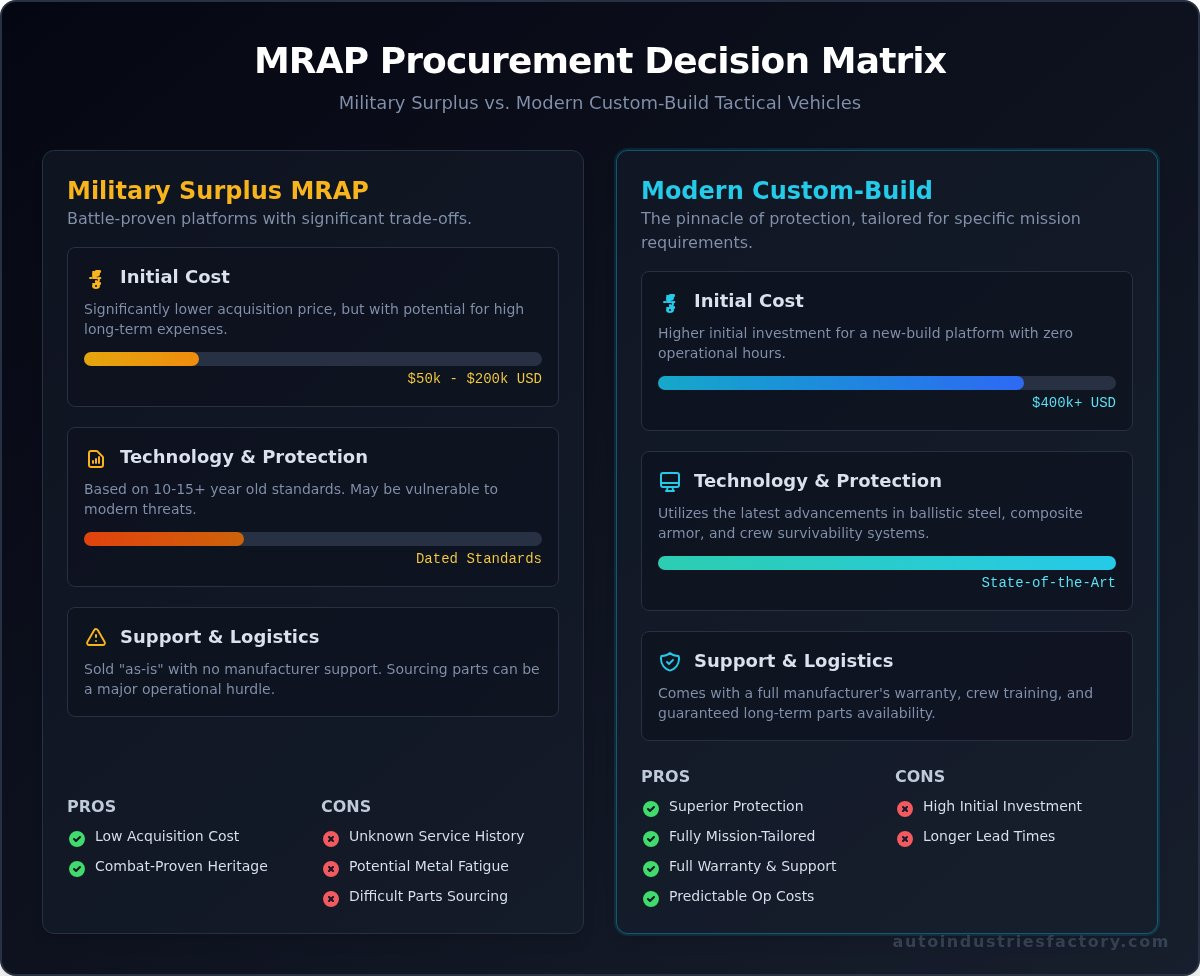
When searching for an mrap for sale, the most critical decision you will make is choosing between a government surplus vehicle and a modern, custom-fabricated platform. This choice dictates not only your initial investment but also the vehicle's long-term operational readiness, maintenance costs, and mission suitability. Both paths offer distinct advantages, and the right decision depends entirely on a clear evaluation of your budget, threat environment, and logistical capabilities.
The Case for Surplus MRAPs
The primary appeal of a surplus MRAP is its significantly lower acquisition cost, often a fraction of a new build. These are battle-proven platforms, designed and tested under rigorous military standards. The various vehicle classes detailed in the U.S. Army MRAP program offer options for different roles. However, this lower price comes with considerable risks: aging technology, an unknown and often harsh service history, and potential metal fatigue. Sourcing spare parts in Oman can be a significant logistical challenge, and their "as-is" condition means you inherit all existing and future maintenance burdens.
The Advantage of a Custom-Fabricated Tactical Vehicle
A custom-built MRAP represents the pinnacle of modern protective vehicle engineering. Fabricated with advanced materials and manufacturing techniques, it offers superior protection and performance. The key advantage is complete mission-specific customization-from integrating the latest C4ISR systems to configuring weapon mounts and crew ergonomics. Crucially, a new vehicle comes with a full manufacturer's warranty, comprehensive crew training, and guaranteed long-term parts and service support, ensuring maximum uptime and predictable operational costs.
| Feature | Military Surplus MRAP | Modern Custom-Build |
|---|---|---|
| Initial Cost | Low (e.g., $50k - $200k USD) | High (e.g., $400k+ USD) |
| Technology | Dated (10-15+ years old) | State-of-the-Art |
| Support & Warranty | None (As-is) | Full Manufacturer Support |
| Customization | Limited to retrofitting | Fully Tailored to Mission |
Which Path is Right for Your Mission?
Your operational requirements should be the final arbiter. A surplus mrap for sale may be suitable for organizations with limited budgets, in-house heavy vehicle maintenance teams, or for use in non-critical roles like training or base security. For high-threat environments, special operations, or missions requiring flawless integration of advanced systems, a custom-built vehicle is the only viable choice. Always consider the Total Cost of Ownership (TCO)-a low initial price can be quickly eclipsed by extensive refitting costs, parts importation, and critical operational downtime.
Key Technical Specifications to Evaluate in an MRAP
Beyond the price tag, the true value of any MRAP lies in its engineering and mission capability. A thorough technical assessment is non-negotiable. This checklist empowers you to ask suppliers the right questions and verify that the vehicle meets your precise operational demands. When evaluating any mrap for sale, focus on these three core pillars: survivability, mobility, and mission systems integration. A superior vehicle excels in all three.
Protection: Armor Levels and Standards
The primary function of an MRAP is crew survivability. This is quantified by internationally recognized standards. Do not accept vague assurances; demand certification documents for specific protection levels. The development of these robust standards was driven by operational necessity, a topic frequently covered in publications like the official U.S. Army report on MRAP vehicles, which details their life-saving impact. Key standards include:
- Ballistic Protection: Look for ratings like NATO STANAG 4569 (Levels 1-5) or CEN 1063 (B6/B7). A Level 2 STANAG rating protects against standard 7.62mm rounds, while higher levels defeat armor-piercing threats.
- Mine & IED Protection: This is rated by the equivalent explosive mass the hull can withstand (e.g., STANAG 4569 Level 2a/2b for a 6 kg blast). The V-hull design is critical here.
- Add-on Armor: Inquire about the capability to fit modular armor kits. This allows you to adapt the vehicle's protection level to evolving threat environments without procuring a new fleet.
Mobility: Powertrain and Suspension
An MRAP’s armor is useless if it cannot reach its objective or escape a threat. For Oman's diverse terrain, from the sands of Sharqiyah to the rugged Hajar Mountains, mobility is paramount. Assess the powertrain's torque output for climbing steep grades and the transmission's reliability under high stress. A critical choice is the suspension: solid axles offer rugged durability and easier field maintenance, while independent suspension provides superior speed and comfort over rough terrain. A Central Tire Inflation System (CTIS) is an essential feature, allowing operators to adjust tire pressure on the move for optimal traction on sand, rock, or pavement.
Mission Systems and Customization
A modern MRAP is a platform, not just a vehicle. Its utility is defined by the systems it can support. Verify the vehicle's electrical architecture can handle advanced C4ISR (Command, Control, Communications, Computers, Intelligence, Surveillance, and Reconnaissance) equipment. Ask about hardpoints and ring mounts for either a manned turret or a Remote Weapon Station (RWS). Finally, confirm the presence of critical life-support subsystems like an automatic fire suppression system (AFSS) for the engine and crew compartments and a Nuclear, Biological, Chemical (NBC) overpressure air filtration system. When you find the right mrap for sale, it should be configurable for your specific mission set.
The Procurement Process: How to Acquire an MRAP Vehicle
Acquiring a Mine-Resistant Ambush Protected (MRAP) vehicle is a significant strategic investment, not a standard automotive purchase. The process involves rigorous planning, stringent legal compliance, and careful supplier evaluation. Following a structured procurement path ensures your organization acquires a tactical asset that is not only mission-capable but also fully compliant with Omani and international regulations. This guide demystifies the journey from initial requirement to final delivery.
Step 1: Defining Your Operational Requirements
Precision is paramount. Before you begin searching for an mrap for sale, you must clearly define its intended purpose. A vague concept will lead to an inadequate solution. We recommend developing a formal specification sheet that details:
- Primary Mission: Will the vehicle be used for border patrol, convoy security, tactical response, or personnel transport in high-threat zones?
- Threat Environment: Specify the anticipated ballistic threats (e.g., 7.62x51mm AP) and blast protection levels required (e.g., STANAG 4569).
- Crew & Payload: Determine the necessary crew capacity and the weight and dimensions of essential onboard equipment, such as communication suites or weapon systems.
Step 2: Vetting Suppliers and Manufacturers
Your supplier is your partner in mission readiness. Look beyond the sales brochure and scrutinize their capabilities. A premier supplier should demonstrate in-house engineering, advanced fabrication facilities, and robust quality control protocols. Request past performance references and case studies relevant to your operational needs. A manufacturer confident in their product will provide transparent access to their testing procedures and certifications, ensuring the vehicle’s durability and reliability.
Step 3: Navigating Export Controls and Logistics
This is the most critical phase. As controlled defense articles, MRAPs require extensive documentation. Omani buyers must be prepared to provide an End-User Certificate (EUC), a government-verified document confirming you are the final recipient and stating the vehicle's intended use. Furthermore, if the vehicle or its components are of U.S. origin, International Traffic in Arms Regulations (ITAR) will apply, adding another layer of compliance. Working with a supplier experienced in global logistics and export licensing for the GCC region is non-negotiable. They will manage the complex paperwork and ensure seamless, legal delivery to Oman.
Navigating this complex process is simpler with a trusted partner. At Auto Industries Factory, our expertise in tactical vehicle manufacturing and international logistics ensures a streamlined and compliant procurement experience from start to finish.
Why Auto Industries Factory for Your Custom Tactical Vehicle
Selecting the right partner to procure and up-armour your tactical vehicle is as critical as choosing the base chassis. When you evaluate an mrap for sale, the conversion and fabrication quality determines its operational effectiveness and survivability. At Auto Industries Factory (AIF), we provide end-to-end solutions, transforming a base vehicle into a mission-ready asset built for the region's most demanding conditions.
Precision Engineering and In-House Fabrication
We are not just assemblers; we are expert fabricators. By managing the entire conversion process under one roof, we guarantee unparalleled quality control and adherence to strict international protection standards. Our commitment to excellence is built on a foundation of superior craftsmanship and advanced technology.
- Total Process Control: From initial 3D design and engineering to precision CNC laser cutting and press brake forming, every component is manufactured in-house.
- Expert Technicians: Our certified welders and technicians specialize in ballistic steel fabrication, ensuring the structural integrity and protective envelope of your vehicle are flawless.
- Guaranteed Standards: This direct oversight ensures every vehicle we deliver meets or exceeds the specified ballistic and blast protection levels, providing true peace of mind.
Solutions Tailored for the GCC and Oman
Operating from our strategic base in the UAE, we possess an intrinsic understanding of the unique operational challenges faced by security forces in Oman and across the GCC. Our vehicles are not simply imported; they are purpose-built for the environment. We engineer solutions optimized for extreme high-temperature performance, sand ingress protection, and durability across rugged desert and mountain terrain. This regional focus also means we provide responsive, local after-sales support, training, and maintenance services, minimizing downtime and maximizing fleet readiness.
Beyond MRAPs: A Full Spectrum of Specialized Vehicles
Our deep expertise in tactical vehicle conversion is informed by a broad portfolio of special-purpose builds. We have a proven track record of engineering and delivering heavy-duty police vehicles, advanced life-support ambulances, and other mission-critical platforms. This diverse experience provides us with unique insights into vehicle dynamics, systems integration, and crew ergonomics that we apply to every mrap for sale project we undertake. Let our comprehensive knowledge elevate your operational capability. Discuss your requirements with our vehicle specialists.
Final Briefing: Securing Your Advanced MRAP Solution
Navigating the market for a Mine-Resistant Ambush Protected vehicle requires a clear strategy. As this guide has detailed, your most critical decision lies between acquiring a military surplus asset and investing in a modern, custom-built platform tailored to your precise operational demands. A thorough evaluation of technical specifications, from ballistic protection levels to powertrain durability, is non-negotiable for ensuring mission success. For organizations in Oman evaluating an mrap for sale, these factors are paramount to a successful and sustainable procurement.
When mission outcomes depend on equipment superiority, partnering with an expert fabricator is the only viable path. At Auto Industries Factory, a specialized vehicle fabricator based in Ajman, UAE, we provide complete in-house design, engineering, and manufacturing solutions. Our proven experience converting vehicles for military and police forces ensures that your tactical asset is rugged, reliable, and built to dominate the most demanding environments. Don't leave safety to chance; leverage our expertise to build your definitive tactical solution.
Contact our experts for a confidential consultation on your tactical vehicle needs. Equip your team with the uncompromising protection they deserve.
Frequently Asked Questions: Acquiring Your MRAP
What is the average price of an MRAP vehicle?
The price of an MRAP vehicle varies significantly based on its condition, specifications, and origin. A surplus, demilitarized MRAP can range from $250,000 to $500,000 USD. For a new, custom-built tactical vehicle engineered for specific operational needs, costs typically start at $600,000 and can exceed $1,000,000 USD, depending on the armor level, powertrain, and integrated mission systems. Final costs in Oman may also be affected by shipping and import duties.
Can a civilian or private company legally purchase an MRAP in Oman?
Yes, but it is a highly regulated process. In Oman, the purchase and ownership of armored vehicles by civilians or private entities require special authorization and permits from government bodies such as the Royal Oman Police (ROP) and the Ministry of Defence. Approval is typically granted to licensed private security companies, financial institutions, or organizations that can demonstrate a legitimate need for high-level protection. We can assist qualified clients in navigating these stringent regulatory requirements.
What is the main difference between an MRAP and an Armored Personnel Carrier (APC)?
The primary design difference lies in their specific threats. An MRAP (Mine-Resistant Ambush Protected) vehicle features a V-shaped monocoque hull designed specifically to deflect blasts from landmines and IEDs away from the crew compartment. An APC, conversely, is engineered primarily to transport troops safely through conventional battlefield threats, offering robust protection against small arms fire and artillery shrapnel but lacking the specialized underbelly protection of an MRAP.
How long does it take to custom-build a new tactical vehicle?
The production timeline for a new, custom-built tactical vehicle is contingent on several factors, including chassis availability, armor complexity, and the level of bespoke systems integration. A typical manufacturing cycle from initial design approval to final delivery ranges from 6 to 10 months. At Auto Industries Factory, we prioritize precision engineering and a streamlined workflow to meet demanding delivery schedules without compromising our rigorous quality and performance standards for every vehicle we build.
Do you provide after-sales support, spare parts, and maintenance training?
Absolutely. We provide comprehensive, mission-ready support for every vehicle we deliver. Our after-sales solutions include a robust supply chain for OEM and aftermarket spare parts, dedicated technical assistance, and scheduled maintenance programs. Furthermore, we offer specialized training courses for our clients' maintenance crews and operators, ensuring your fleet remains in peak operational condition and your personnel are fully proficient in its upkeep and field deployment.
What is the typical lifespan of a surplus MRAP versus a new build?
A newly manufactured MRAP, built with advanced materials and components, has an expected operational lifespan of 20-25 years or more with consistent, professional maintenance. When evaluating a surplus MRAP for sale, its remaining lifespan is more variable. While built to be incredibly durable, a surplus unit may have an unknown service history. It can still offer 10-15 years of reliable service, but it will likely require a more intensive maintenance and refurbishment program.


