
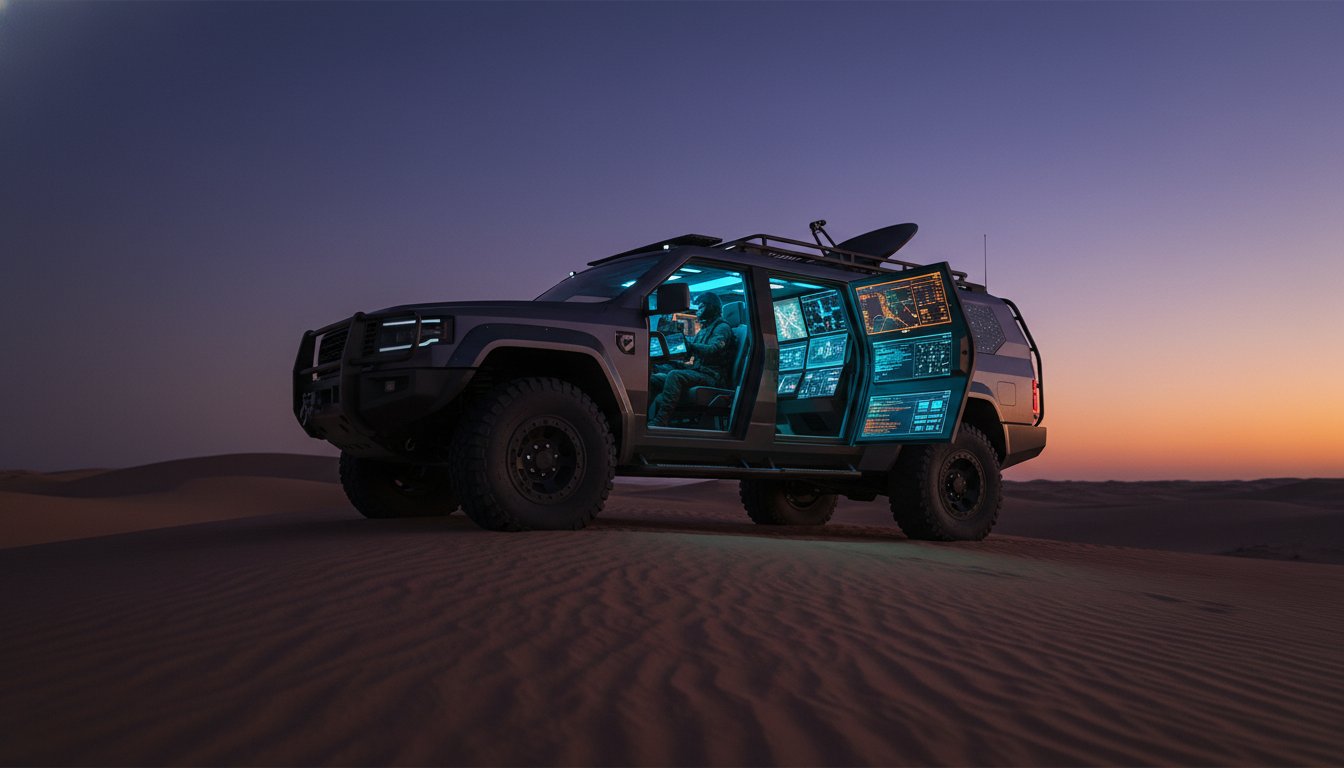
In the 50°C heat of extreme desert environments, a 30-second communications blackout isn't just a technical glitch; it's a mission failure that compromises tactical security. You've likely seen standard conversions fail when the mercury rises, or watched overseas equipment struggle with the fine sands of challenging regional terrains. Auto Industries Factory LLC specializes in high-performance conversions, and we know that partnering with a specialized mobile command center vehicle builder shouldn't mean waiting 180 days for a unit that isn't optimized for the region's unique operational demands.
We understand that for emergency services and defense teams operating in challenging environments across the region, reliability is the only metric that matters. Failure isn't an option. You need a platform where the cooling systems don't quit and the off-grid power remains steady through 24-hour shifts. This article explains how to design a high-performance, turnkey mobile HQ tailored for extreme environments. You'll discover the specific engineering required for seamless communication integration and why local fabrication from our facilities in Ajman, UAE, is the key to minimizing downtime and ensuring long-term maintenance support across the region.
Key Takeaways
- Learn how to integrate silent lithium-ion power systems and multi-carrier satellite connectivity like Starlink to maintain a high-tech tactical advantage in remote Omani environments.
- Discover why partnering with an expert mobile command center vehicle builder is essential for transforming rugged platforms like the Toyota Land Cruiser into mission-ready field headquarters.
- Understand the engineering transition from fixed command posts to rapid-response units designed for the specific operational demands of 2026 and beyond.
- Evaluate the critical trade-offs between SUV, van, and heavy truck platforms to find the perfect balance of interior workspace and off-road durability for GCC terrain.
- Gain insights into the professional CAD design process, ensuring precision weight distribution and optimal airflow for sensitive electronic equipment in extreme heat.
What is a Mobile Command Centre and Why Customise?
A mobile command center is a rugged, high-tech vehicle engineered to function as a tactical headquarters in the field. This unit bridges the gap between a central station and a remote incident site, providing a localized hub for communication and strategy. As defined in this overview of What is a Mobile Command Centre?, these vehicles are essential for coordinating complex operations during emergencies. For missions scheduled through 2026, Oman's security and emergency sectors are shifting away from static posts toward these rapid-response units. Agencies like the Royal Oman Police and national disaster response teams require this mobility to manage vast territories and unpredictable terrain effectively.
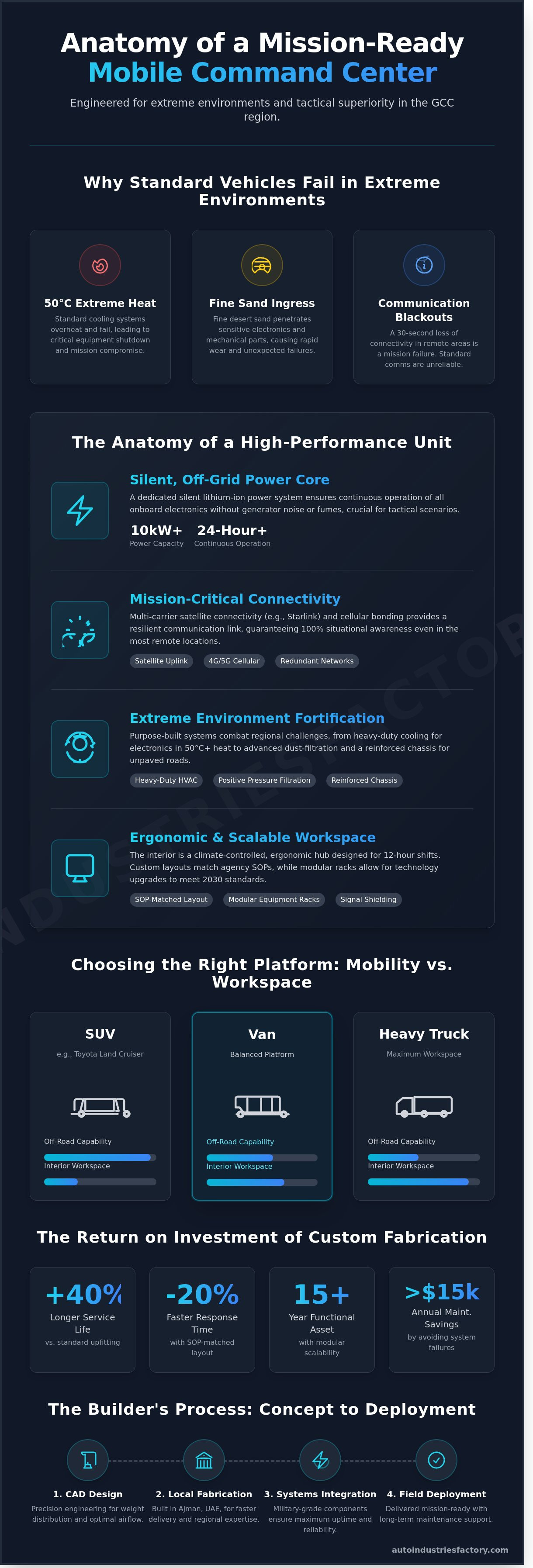
Partnering with a specialized mobile command center vehicle builder ensures the unit survives the Sultanate's harsh environmental conditions. Standard 'off-the-shelf' vehicles often succumb to the 50-degree Celsius summer heat or suffer from sand ingress within the first 12 months of operation. Customization isn't a luxury; it's a technical necessity for mission-critical reliability. When lives are on the line, the vehicle must act as a fortress of technology that remains operational regardless of external chaos.
To better understand the scale of these conversions, watch this video detailing the technical transformation process:
Industries such as border security, drone operations, and disaster management rely on these specialized platforms. A generic delivery van lacks the reinforced chassis and 10kW+ power systems needed to run 24/7 surveillance arrays. Custom builds integrate heavy-duty cooling and advanced dust-filtration systems that standard manufacturers ignore. These specialized units are becoming the backbone of Oman's 2026 National Emergency Management Plan, where decentralized command is a core requirement for resilience.
Core Objectives of a Mobile Tactical Unit
The primary goal is establishing 100% situational awareness. By integrating real-time data feeds from satellite uplinks and local drones, decision-makers see the full picture instantly. These units provide a climate-controlled, ergonomic workspace that prevents operator fatigue during 12-hour shifts. In remote areas like the Al Wusta region, custom comms packages ensure persistent connectivity where cellular networks fail. Every square inch is optimized for high-pressure decision-making.
The ROI of Custom Vehicle Conversion
Investing in custom fabrication delivers a 40% longer service life compared to basic upfitting. While a standard conversion might cost less initially, a purpose-built unit from an expert mobile command center vehicle builder maximizes uptime by using military-grade components. This reduces long-term maintenance costs, which can exceed $15,000 annually for poorly integrated systems. Custom layouts ensure the interior matches specific agency Standard Operating Procedures (SOPs), cutting response times by 20% during high-stress deployments. Precision engineering ensures the vehicle remains a functional asset for 15 years or more.
- Reliability: Heavy-duty fabrication prevents structural failure on unpaved roads.
- Efficiency: Custom electrical looms prevent the common "blackout" issues found in DIY builds.
- Scalability: Modular racks allow for hardware upgrades as technology evolves toward 2030 standards.
Choosing a custom solution means the vehicle is built around the mission, not the other way around. From CNC-cut cabinetry to specialized signal shielding, every detail is focused on ensuring the command team can focus on the task at hand without worrying about equipment failure. This engineering-first approach is what separates a professional command vehicle from a simple van conversion.
The Anatomy of a High-Performance Command Vehicle
Building a mission-critical platform requires more than just installing desks in a van. It demands a sophisticated integration of power, data, and environmental systems that remain operational when local infrastructure fails. As a premier mobile command center vehicle builder, Auto Industries Factory (AIF) focuses on engineering hulls that serve as self-sustaining ecosystems. Every component, from the sub-floor wiring to the roof-mounted arrays, is selected to withstand the rigorous vibration of off-road transit and the relentless environmental stressors found across the Sultanate of Oman.
Off-Grid Power and Energy Management
Energy independence is the foundation of any tactical unit. Traditional diesel generators are becoming obsolete for modern missions due to noise, heat signatures, and maintenance needs. We now prioritize 48V Lithium-ion battery architectures, such as EcoFlow or Victron energy banks, which provide up to 20kWh of silent power. This capacity supports a standard four-man crew for 10 hours without idling the engine. To ensure 100% uptime, we integrate dual-alternator systems and 400W rooftop solar arrays. These systems allow for covert operations where silence is mandatory. High-draw equipment like 43-inch 4K monitors and server racks require precise load balancing to prevent thermal trips during peak 5.5kW draws.
Advanced Communication Integration
Reliable data flow determines the success of emergency deployments. Our builds integrate multi-carrier cellular bonding that merges signals from Omantel and Ooredoo, creating a single, high-bandwidth pipe. For remote desert regions where 5G is unavailable, we deploy Starlink Flat High Performance kits or traditional VSAT links. This hybrid approach mirrors FEMA's mobile response strategy by ensuring that leadership maintains a common operating picture regardless of terrestrial network status. On-site video routing is handled via 12x12 12G-SDI matrices, allowing commanders to toggle between drone feeds, 360-degree CCTV, and satellite broadcasts on any internal or external screen instantly.
Climate Control for the GCC Environment
Operational success in Oman depends on managing extreme heat. When external temperatures hit 50°C in the Empty Quarter, the interior must maintain a stable 21°C for both personnel comfort and hardware longevity. We utilize dual-compressor AC systems with a combined 30,000 BTU capacity. To prevent thermal bridging, we apply 50mm closed-cell spray foam insulation throughout the chassis. We also install heavy-duty sand filtration systems on all air intakes to protect sensitive server fans from the fine dust typical of the Sharqiyah Sands. This level of environmental protection ensures that a mobile command center vehicle builder delivers a product that won't throttle performance during a mid-day crisis.
Workstation ergonomics focus on long-term endurance. We utilize modular L-track mounting systems on floors and walls, allowing for the rapid reconfiguration of hardware. High-back swivel captain chairs are standard, providing 360-degree access to multiple consoles without leaving the seat. If you're planning a fleet upgrade, you can consult with our engineering team to discuss specific layout requirements for your mission profile.
Choosing the Right Platform: SUV vs. Van vs. Heavy Truck
Selecting the base chassis is the most critical decision an agency makes during the procurement phase. It dictates the unit's operational range, equipment capacity, and deployment speed. In Oman, where summer temperatures often exceed 48°C and terrain varies from the rugged Hajar Mountains to the soft sands of the Empty Quarter, your platform choice must be deliberate. A professional mobile command center vehicle builder prioritizes the Gross Vehicle Weight Rating (GVWR) to ensure that heavy satellite arrays and server racks don't compromise the vehicle's center of gravity or engine longevity.
Engineering a mobile unit involves a strict trade-off between mobility and interior volume. Small SUVs offer rapid response but limited desk space; meanwhile, heavy trucks provide expansive briefing rooms but struggle in narrow urban corridors or remote wadis. We calculate weight distribution with 98% precision to ensure that suspension systems are reinforced before a single piece of tech is installed. This prevents "rear-end sag" and maintains braking efficiency under full mission loads.
Tactical SUVs: Rapid Response and Off-Road
For 2-3 person tactical teams, the Toyota Land Cruiser 300 and Nissan Patrol Y62 remain the dominant choices in the region. These platforms are preferred by Omani security forces for their legendary durability and parts availability. We focus on heavy-duty suspension upgrades and secondary battery systems to support 400kg of additional equipment without losing off-road agility. It's vital to balance the tech load with the vehicle's GVWR to prevent frame stress. Internal Link: See our Safari and Off-Road conversions for chassis reinforcement ideas that we apply to tactical command SUVs.
Command Vans and Sprinters: The Mobile Office
Vans like the Mercedes-Benz Sprinter or Ford Transit offer the best balance for 4-8 operators. With roughly 1.9 meters of interior standing height, these vehicles function as a "Silent HQ." We implement high-grade acoustic dampening and thermal insulation to keep the interior at a steady 22°C, even when the Omani sun is at its peak. This environment is essential for dispatchers who need to focus during high-stress incidents. As a specialized mobile command center vehicle builder, we integrate 12,000 BTU rooftop AC units and dedicated workstations that allow for seamless communication between ground teams and central headquarters.
Heavy-Duty Box Conversions: The Incident Command Coach
When disaster management requires multi-agency coordination over several days, we move to custom-fabricated box conversions on GMC or heavy truck chassis. These units maximize square footage and often feature motorized slide-outs that expand the briefing room by an additional 1.5 meters in width. These coaches are designed for longevity, featuring 15kVA on-board generators and external 5G mast systems. They're the ideal solution for large-scale events or national-level emergencies where a permanent footprint is needed in a temporary location. We've seen demand for these units increase by 22% in the last three years as regional infrastructure projects expand into more remote areas.
- Payload Management: We use lightweight honeycomb panels to reduce interior weight by 30% compared to traditional plywood.
- Power Redundancy: Dual-inverter systems ensure that even if one power source fails, the command screens stay live.
- Climate Control: Specialized desert-spec cooling systems are standard to protect sensitive server hardware from heat-induced failure.
The Builder’s Process: From CAD Design to Field Deployment
Auto Industries Factory (AIF) specializes in a high-precision engineering lifecycle that transforms a standard chassis into a tactical hub. The process starts with a rigorous 'Mission Profile' consultation. We don't just ask what equipment you need; we ask where you'll use it. In Oman, a vehicle operating in the 50°C heat of the Empty Quarter requires vastly different cooling and filtration than one stationed in the humid coastal environment of Salalah. We finalize a comprehensive equipment list that accounts for every kilogram of payload, ensuring the vehicle remains within its gross vehicle weight rating (GVWR) while carrying 100% of its required gear.
Our engineering team utilizes 3D CAD modeling to solve complex spatial and mechanical challenges before a single piece of metal is cut. A professional mobile command center vehicle builder must prioritize weight distribution to maintain stability on rugged Omani terrain. We map out internal airflow to protect sensitive electronics, ensuring that server racks remain cool even when external temperatures spike. This stage also includes precise electrical load calculations for 15kW power systems, ensuring the vehicle can sustain 24/7 operations without relying on shore power. Engineering a low center of gravity is vital for preventing rollovers during high-speed emergency deployments.
In-House Fabrication vs. Outsourced Components
AIF maintains a 95% in-house manufacturing rate to control every aspect of quality and lead times. Our in-house laser cutting allows for millimeter-perfect equipment mounting, which is essential for housing sensitive tactical gear. We manufacture custom metal canopies and internal cabinetry using heavy-duty alloys that withstand the constant vibration of off-road use. This eliminates the weak points found in modular, off-the-shelf shelving units. Precision Fabrication is the backbone of vehicle longevity.
Tactical Upfitting and Equipment Mounting
Security and accessibility are the primary drivers of our tactical upfitting phase. We provide secure, rapid-access storage for weapons and sensitive electronics, using shielded enclosures to prevent data breaches or interference. External protection is just as vital for an mobile command center vehicle builder working in the Middle East. We install custom-engineered bull bars and 6mm thick underbody skid plates to protect the drivetrain from Omani rock crawls. Explore our specialised vehicle conversion services to see how we harden platforms for the most demanding field environments.
Build a vehicle that never fails the mission. Request a technical consultation with our fabrication experts today.
Why Auto Industries Factory (AIF) is the Premier UAE Builder
Auto Industries Factory (AIF) specializes in high-performance vehicle conversions that define the standard for regional security and emergency response. Based in Ajman and Dubai, we're strategically positioned to serve the entire GCC, offering a direct logistical advantage for fleets operating in Oman. Our proximity to the border ensures that clients in Muscat, Sohar, and Salalah receive rapid delivery and consistent on-site support. We don't just assemble pre-made kits; we are a master mobile command center vehicle builder that engineers every solution from the ground up to meet specific mission profiles.
Our foundation in life-saving technology sets us apart from standard converters. We've spent years perfecting the "Ambulance Built for Life-Saving" philosophy, and we translate that same precision into every tactical command unit. A mobile command center requires the same 99.9% reliability as an emergency medic vehicle. We integrate medical-grade electrical systems and reinforced structural frames that withstand the rigors of high-stakes environments. This expertise ensures your communication hubs stay operational when seconds count and failure isn't an option.
Total quality control is the hallmark of our manufacturing process. AIF maintains 100% in-house production, meaning our master engineers oversee every weld, wire, and tactical component. We utilize advanced CNC laser cutting and heavy-duty press brakes to ensure every structural element fits with zero margin for error. This vertical integration allows us to guarantee full compliance with GCC-spec chassis requirements and Omani safety regulations. Whether you're outfitting a fleet for police use or government border security, our vehicles are built to exceed the most stringent regional standards.
Rugged Reliability for the Middle East
Operating in Oman requires hardware that survives 50°C heat, fine desert sand, and coastal humidity. We engineer our vehicles with heavy-duty cooling systems and specialized dust filtration that standard builders often overlook. Every unit comes with a local warranty and a rapid-response maintenance plan designed specifically for UAE and Oman fleets. We've proven our durability through successful deployments with military and government agencies. This ensures that our mobile command centers remain functional in the harshest environments on earth without compromising sensitive electronic equipment.
Turnkey Solutions: Design, Build, and Paint
We provide a comprehensive service that covers every stage of vehicle development. From the initial structural fabrication to the final application of professional tactical paint, we handle everything under one roof. Choosing a mobile command center vehicle builder that manages the entire lifecycle ensures a cohesive design and faster turnaround times. Our team is ready to discuss your specific mission requirements and provide technical guidance. Contact our engineering team today for a free estimate and professional consultation on your next fleet project.
DEPLOY YOUR TACTICAL ADVANTAGE: ENGINEERED FOR OMAN’S TOUGHEST MISSIONS
Auto Industries Factory (AIF) specializes in precision-engineered tactical solutions that thrive in Oman's 50-degree summer heat and rugged desert landscapes. Choosing an expert mobile command center vehicle builder ensures your unit isn't just a van with screens; it's a hardened HQ featuring 0.1mm accuracy through our in-house CNC and laser cutting expertise. Whether you're deploying a heavy-duty truck for border security or a rapid-response SUV for Muscat's urban core, our 100% in-house fabrication guarantees mission-critical reliability. We manage the entire lifecycle from initial CAD design to final field deployment. Our facility has delivered over 750 specialized vehicle conversions since 2010, cementing our reputation as a trusted UAE auto factory. These builds are designed to meet the strict regulatory standards of the Middle East while providing a seamless operational interface for your crew. Don't risk mission failure with unproven contractors. It's time to upgrade your fleet with a solution that's as durable as the terrain it covers. Get a Free Estimate for Your Mobile Command Centre Build and start your conversion today. We look forward to engineering your next field headquarters.
Frequently Asked Questions
What is the typical lead time for a custom mobile command centre?
A typical lead time for a custom project ranges from 12 to 16 weeks depending on the technical complexity of the build. This timeframe includes the initial design phase, heavy-duty fabrication, and the installation of specialized communication arrays. We provide a detailed 45 point production schedule to ensure every milestone is met for our Oman based clients.
How many people can work inside a mobile command van?
Our mobile command center vehicle builder solutions accommodate between 4 and 12 operators based on the chosen chassis size. A standard van conversion usually supports a 4 person tactical team, while larger truck based units feature 8 dedicated workstations. Each station includes ergonomic seating and 24 inch monitors to maximize operational efficiency during long missions.
Can a mobile command centre operate without the engine running?
Yes, our vehicles operate for 8 to 12 hours without the engine running by using integrated lithium ion battery banks or silent diesel generators. We install 5kW to 10kW auxiliary power units (APUs) that handle climate control and high performance servers. This setup ensures a low thermal signature and zero noise during covert surveillance or extended field deployments.
Which chassis is best for an off-road tactical command vehicle in the UAE?
The Toyota Land Cruiser 70 Series and the Mercedes-Benz Unimog are the most reliable choices for the region's rugged terrain. These platforms offer the 4x4 capabilities needed for the Al Hajar Mountains and the desert sands of the Empty Quarter. We reinforce these frames with heavy-duty suspension systems to support 1,500kg of additional tactical equipment and armor.
Are your mobile command centres compliant with GCC/UAE regulations?
Every vehicle we deliver is 100% compliant with GCC standards and Royal Oman Police (ROP) technical requirements. We ensure all modifications meet the 2024 safety regulations for structural integrity and electrical safety. Our team handles the documentation process, providing certified engineering drawings that simplify the registration process in Muscat or Salalah.
What type of internet connectivity is most reliable for field operations?
Bonded cellular systems combined with Starlink satellite terminals provide 99.9% uptime for field operations. We use Peplink routers to merge signals from 3 different Omani telecom providers, creating a single high speed data pipe. This configuration delivers 150Mbps download speeds even in remote areas where standard mobile signals are weak or non-existent.
Do you provide training for the operators on the integrated technology?
We provide a comprehensive 3 day training program for all operators and technical staff. This hands-on course covers the 12 core systems of the vehicle, including power management, satellite alignment, and software integration. Our engineers conduct these sessions at your facility in Oman to ensure your team is 100% mission ready from day one.
Can you retrofit an existing vehicle into a mobile command centre?
Auto Industries Factory (AIF) specializes in retrofitting existing fleet vehicles to extend their operational life. As a leading mobile command center vehicle builder, we provide retrofits that typically cost 30% less than a new build, with prices starting at $45,000. We strip the interior, upgrade the electrical looms, and install the latest 2024 tactical hardware to transform your older assets.


