
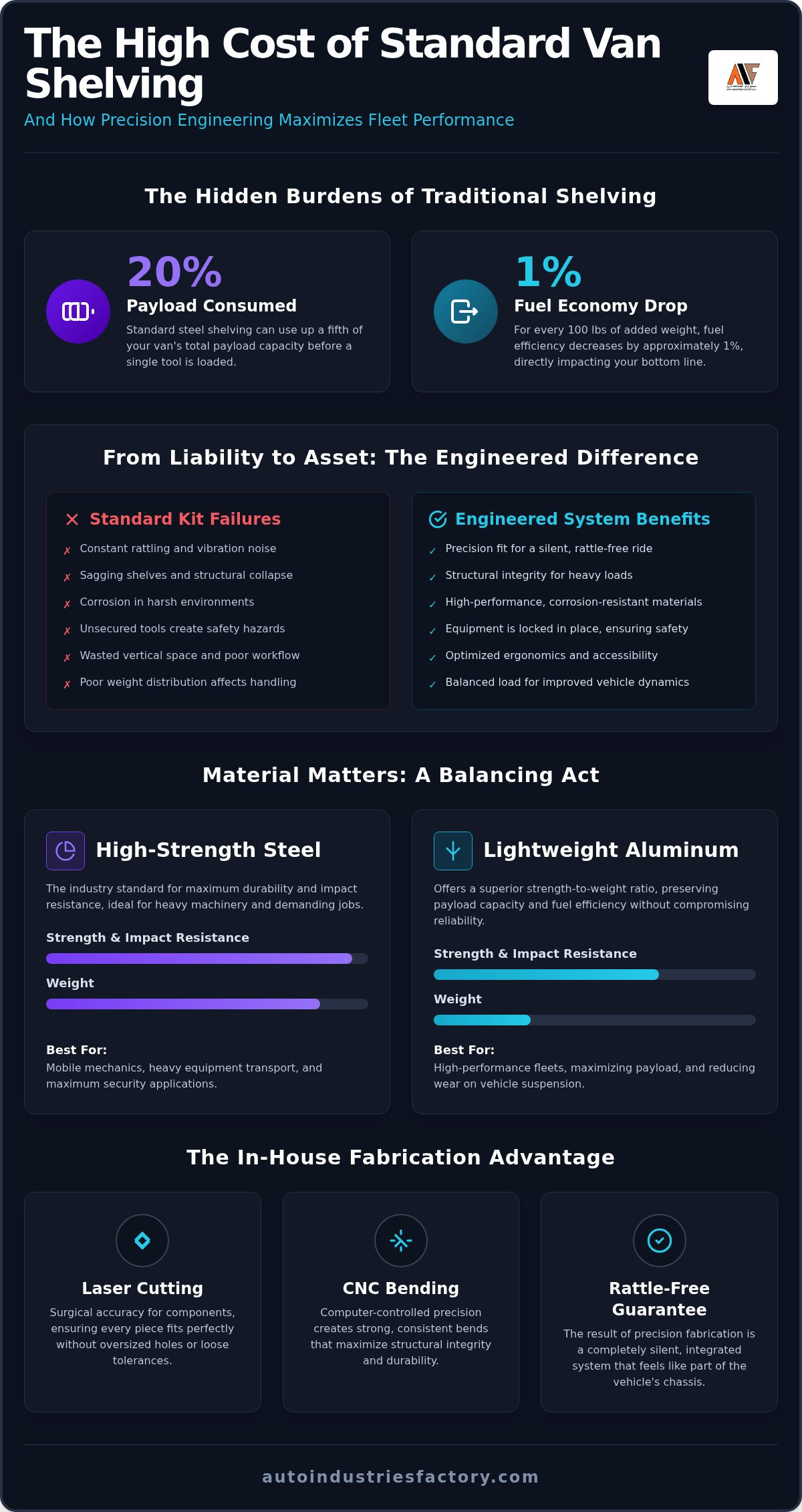
Did you know that traditional steel shelving packages can consume up to 20% of your vehicle's total payload before you even load a single tool? For every 100 lbs of added weight, your fuel economy drops by approximately 1%. For specialized fleets, these aren't just minor inconveniences; they're direct hits to your bottom line. Most professionals accept rattling shelves and wasted vertical space as unavoidable parts of the job, but precision-engineered mobile service van interior shelving proves that your workspace should be as rugged and efficient as the tools it carries.
We understand the frustration of using pre-fab kits that fail under heavy loads or corrode in harsh environments. You need a structural solution that prioritizes technician safety and equipment protection. This guide will show you how custom-engineered storage systems maximize your payload capacity while ensuring a rattle-free, durable interior. We'll break down the engineering behind optimized workflows and the use of high-performance materials to keep your fleet running at peak performance. Discover how a master craftsman approach to fabrication turns a standard transport vehicle into a mission-critical mobile asset.
Key Takeaways
- Learn how engineered organization reduces technician downtime and eliminates safety hazards caused by unsecured equipment during transport.
- Compare the structural integrity of high-strength steel for heavy tools against lightweight aluminum alloys that maximize your fleet's payload.
- Discover how custom mobile service van interior shelving integrates with specialized platforms like the Toyota Hiace to create a high-performance mobile workspace.
- Understand the importance of combining shelving with reinforced partitions and integrated power systems for a safe, climate-controlled environment.
- Explore how in-house laser cutting and CNC bending ensure a rattle-free, precision fit that standard pre-fab kits cannot match.
Why Mobile Service Van Interior Shelving is Critical for Fleet Efficiency
Operations managers often view shelving as a final touch, but it's actually the engine of field productivity. A disorganized van costs more than just a technician's patience; it bleeds billable hours. When a specialist spends ten minutes searching for a specific fitting at every stop, those minutes compound into lost service calls by the end of the week. This is why a modern Conversion van requires a tailored approach to interior architecture that prioritizes logic and accessibility.
Beyond productivity, there's the critical issue of safety. Unsecured heavy tools become lethal projectiles during a sudden braking event or collision. Properly engineered mobile service van interior shelving acts as a structural cage that keeps equipment locked in place. Weight distribution also plays a vital role. Poorly balanced shelving accelerates tire wear and impacts vehicle handling. Since every 100 lbs of extra weight reduces fuel economy by approximately 1%, choosing a high-performance system is a long-term financial strategy for any fleet.
To better understand this concept, watch this helpful video:
Beyond Storage: Shelving as a Functional Tool
An expert layout turns the van into a high-speed workspace. When we engineer mobile service van interior shelving, we focus on ergonomics, placing high-frequency tools at waist level to reduce physical strain. This master craftsman approach includes visual inventory management. If a bin is empty, the technician knows immediately before leaving the site, preventing costly return trips for forgotten parts. A clean, organized mobile workshop also communicates brand value, signaling to your clients that your operation is precise and professional.
The True Cost of 'Standard' Shelving Failures
Generic shelving kits often fail where it matters most. Low-grade welds and thin-gauge materials can't withstand the constant vibration of rough roads. These failures lead to rattling, sagging, and eventually, structural collapse that damages expensive equipment. Standard plastic bins often warp or crack in high-temperature environments, unlike our custom-fabricated metal solutions. At Auto Industries Factory LLC, we integrate these builds into our services to ensure your fleet remains robust and reliable in the most demanding conditions.
Engineering the Build: Aluminum vs. Steel vs. Custom Alloys
Selecting the right material for your fleet is a balance of physics and fiscal responsibility. Most off-the-shelf kits force a compromise between weight and durability, but an engineered approach views the vehicle as a holistic system. Steel remains the industry standard for heavy-duty applications, providing maximum impact resistance for mobile mechanics carrying heavy machinery. However, for high-performance platforms where payload is at a premium, aluminum alloys offer a superior strength-to-weight ratio that preserves fuel efficiency and reduces wear on the suspension.
Precision is the differentiator in high-end mobile service van interior shelving. While stamped kits rely on oversized holes and loose tolerances, our master craftsman approach utilizes in-house laser cutting and CNC machining. This ensures every component fits with surgical accuracy. When modifying a chassis, adherence to Federal Motor Vehicle Safety Standards ensures that structural changes don't compromise occupant protection or vehicle integrity during an impact. This level of engineering is what separates a rattle-free workshop from a noisy, vibrating liability.
For mission-critical fleets requiring extreme performance, custom alloys can be deployed to meet specific load-bearing requirements. If your operation involves heavy-duty platforms like the GMC or Toyota Hiace, you might consider how expert metal cutting and bending can create a storage solution that outlasts the vehicle itself.
Structural Integrity and Vibration Resistance
Vibration is the primary enemy of mobile storage. Laser-cut components allow for tighter tolerances, which eliminates the "play" that leads to weld failures in cheaper alternatives. We prioritize reinforced mounting points that tie directly into the vehicle's structural ribs rather than just the thin skin of the van. Structural resonance is the frequency at which an interior component naturally vibrates, which can lead to material fatigue and noise if not properly dampened through engineered mounting. By controlling these frequencies, we ensure a quiet cabin and long-term durability.
Surface Finishes and Environmental Protection
The environment inside a service van is often harsh, especially in regions with high humidity or heavy dust. We utilize industrial-grade powder coating because it provides a more resilient barrier than standard liquid paint. This finish resists chipping from tool impacts and prevents the onset of corrosion. For specialized sectors like medical or food-service conversions, we focus on non-porous, easy-clean surfaces that meet strict hygiene standards. Whether you're operating an ambulance or a mobile workshop, your mobile service van interior shelving must be as easy to maintain as it is to use.
Trade-Specific Configurations for Specialized Mobile Services
Generic storage packages often fail because they ignore the physical requirements of specialized trades. A mobile mechanic requires a different structural load capacity than a fiber optic technician. High-performance mobile service van interior shelving must be engineered to the specific weight and dimensions of the gear it houses. For mobile mechanics, this involves integrating heavy-duty workbenches with oil-resistant powder coatings that prevent chemical degradation of the metal surfaces. These builds are designed to withstand the daily impact of heavy tools and machinery without sagging or losing structural integrity.
In tactical and emergency response environments, shelving isn't just storage; it's a deployment system. We design quick-access configurations for communication gear and medical kits, ensuring high-priority items are available instantly. This philosophy extends to mobile clinics, where we integrate shelving with specialized medical refrigeration and sterile storage compartments. Precision engineering ensures these sensitive components remain secure even during high-speed transit. See how we apply these principles in our Ambulance Conversion services.
Telecommunications and fiber optic fleets require a different level of precision. These builds often include specialized spool holders and climate-controlled compartments to protect sensitive electronics from extreme heat. By using CNC machining, we create exact-fit holders that prevent fiber cables from kinking or sustaining damage during transit. This master craftsman approach ensures that every inch of the van is optimized for the specific technical workflow of the operator.
Maximizing Vertical and Horizontal Space
Traditional flat-back shelves waste valuable inches against the curved walls of a van. We utilize contoured shelving that follows the interior wall curvature of the vehicle, reclaiming lost floor space for larger equipment. This is often paired with pull-out drawers for small parts and drop-down ladder racks that utilize the roof without increasing the vehicle's center of gravity unnecessarily. This layout reduces the physical strain on technicians by keeping frequently used items within an ergonomic reach zone.
Modular vs. Fixed Fabrication
Choosing between modular and fixed fabrication depends on your mission profile. Modular, adjustable shelving offers flexibility for evolving service needs, allowing you to reconfigure the layout as your toolset changes. However, for extreme off-road use or high-impact environments, fully welded fixed units provide unmatched structural rigidity. We design these systems with future fleet scalability in mind, ensuring your investment remains viable as your business grows. Whether you need the adaptability of a modular system or the ruggedness of a fixed build, our solutions are engineered for long-term durability.
Integrating Shelving with Complete Vehicle Fabrication
Installing high-performance mobile service van interior shelving is not a standalone task; it's an architectural modification. A professional build considers the vehicle as a unified workspace where storage, safety, and power systems work in harmony. This begins with the installation of structural van partitions, often called bulkheads. These partitions serve two critical functions. They act as a primary safety barrier between the technician and heavy equipment, and they allow for better climate control by isolating the cabin from the larger workshop area. This is particularly important in regions where extreme temperatures can impact both technician comfort and the shelf-life of sensitive materials.
A master craftsman approach ensures that every component, from the inverter housing to the LED lighting, is integrated into the shelving design. We don't just bolt racks to the walls. We build a comprehensive environment that supports your specific operational needs. For those managing complex fleets, you can learn about our full range of Specialized Vehicle Conversions to see how we handle these high-stakes modifications.
Step 1: Structural Assessment and Flooring
Before the first shelf is mounted, the vehicle's floor must be prepared to handle concentrated weight. Standard van floors aren't designed for the point-loads generated by heavy steel racks filled with machinery. We reinforce the sub-floor to prevent warping and ensure a level base for the entire storage system. Choosing between anti-slip rubber or industrial-grade plywood depends on your trade. Rubber provides excellent sound dampening and moisture resistance, while plywood offers a rigid, flat surface for mounting. Our engineers ensure that all mounting points avoid interference with vehicle wiring harnesses or fuel lines, maintaining the integrity of the OEM chassis.
Step 2: Electrical and Lighting Integration
Modern mobile workshops require consistent power. We integrate shelving-mounted power outlets and inverter housings directly into the fabrication. By routing cables behind the shelving units, we create a clean, professional finish that prevents snagging or electrical hazards. Task lighting is equally vital. We install high-output LED strips directly above workbenches and inside deep shelving units to ensure technicians can find what they need in low-light conditions. This level of integration transforms a simple transport van into a high-performance mobile workshop that is ready for immediate deployment.
Ready to upgrade your fleet with a precision-engineered solution? Request a custom vehicle conversion quote today.
The Auto Industries Factory LLC Advantage: Custom In-House Fabrication
Auto Industries Factory LLC isn't an assembly point for third-party kits; it's a full-scale manufacturing facility dedicated to mission-critical vehicle architecture. Our advantage lies in complete control over the entire production cycle. By managing everything from initial design to final delivery in-house, we eliminate the delays and quality inconsistencies common with outsourced components. This master craftsman approach ensures that your mobile service van interior shelving is engineered to survive the most demanding operational environments on the planet.
Our facility in the UAE is specifically equipped to handle regional challenges like extreme heat and pervasive dust. While imported kits often use standard fasteners that loosen under thermal expansion, our welded and CNC-machined solutions are built for thermal stability. We bring the same level of precision used in our ambulance and military vehicle modifications to every commercial fleet build. This ensures a level of ruggedness and reliability that off-the-shelf products simply cannot match.
Our 7-Step Custom Fabrication Process
We follow a rigorous engineering workflow to ensure every unit meets our high standards for safety and performance. This process begins with a detailed consultation to understand your specific tool loads and technician workflows. Our engineering team then creates a bespoke CAD design, which is fed directly into our state-of-the-art laser cutting and CNC bending machines. This digital-to-physical precision ensures that every shelf fits the vehicle's internal ribs perfectly.
- Initial Consultation: Defining load-bearing and ergonomic requirements.
- CAD Design: Creating a digital twin of the interior storage.
- Laser Cutting: High-precision metalwork with zero margin for error.
- CNC Bending: Ensuring structural uniformity across all components.
- Expert Welding: Utilizing reinforced joints for vibration resistance.
- Protective Coating: Applying heat and corrosion-resistant finishes.
- Quality Control: Final stress testing and safety inspection.
Scaling for Large Fleets
Consistency is vital when managing large-scale fleet deployments. Whether you're upfitting 10 units or 100, our automated fabrication processes ensure that the first unit is identical to the last. This standardization simplifies maintenance and inventory management for your entire operation. We also offer custom branding and color matching through our specialized painting department, allowing your mobile service van interior shelving to reflect your corporate identity while providing a professional, clean appearance for client-facing technicians.
Ready to transform your fleet into a high-performance mobile workspace? Contact Auto Industries Factory LLC for a custom fleet shelving consultation and discover the power of precision engineering.
Engineering the Next Generation of Fleet Performance
Precision-engineered storage is the foundation of a high-performance fleet. We have explored how the choice between high-strength steel and lightweight aluminum alloys impacts your payload and fuel economy. You now understand that a true mobile workshop requires more than just shelves; it demands the integration of safety partitions, ergonomic layouts, and built-in electrical systems. Choosing in-house fabrication ensures every component is built with the precision of a master craftsman, removing the risks associated with generic third-party kits.
Investing in custom mobile service van interior shelving transforms your vehicles from simple transport units into mission-critical assets. Our state-of-the-art facility utilizes CNC machining and laser cutting to deliver robust solutions that withstand extreme environments. We specialize in complex conversions for ambulances and tactical vehicles, providing national service coverage for fleets of any scale. Your technicians deserve a workspace that is as reliable as their expertise. It's time to build a fleet that works as hard as you do.
Request a Technical Consultation for Your Service Fleet from Auto Industries Factory LLC
Frequently Asked Questions
How much weight can custom van shelving hold?
Load capacity depends on the material gauge and the structural reinforcement of the mounting points. High-strength steel shelving units are engineered to support heavy machinery and power tools, often exceeding several hundred kilograms per shelf when properly anchored. Aluminum options offer a lighter alternative but still maintain high structural integrity for medium-duty applications. We calculate specific load-bearing capacities during the design phase to ensure your mobile service van interior shelving never sags or fails under pressure.
Will installing interior shelving void my van's warranty?
Professional installation of interior shelving does not void the vehicle's manufacturer warranty. Most manufacturers view these modifications as standard aftermarket upfits. We ensure compliance by using existing mounting points or reinforcing the chassis according to engineering best practices. This master craftsman approach prevents structural damage to the vehicle skin. It's always advisable to use a certified upfitter who understands the specific load limits of platforms like the Toyota Hiace or GMC to maintain your coverage.
Which is better for a service van: aluminum or steel shelving?
The choice between aluminum and steel depends on your specific mission profile and payload requirements. Steel is the superior choice for high-impact environments and heavy tool loads due to its extreme durability. Aluminum is a premium alternative that significantly reduces vehicle weight, which improves fuel economy and maximizes your remaining payload. For many specialized fleets, a hybrid approach using custom alloys provides the best balance of strength and efficiency for a long-lasting mobile workspace.
Can shelving be customized for specific tool brands or equipment?
In-house laser cutting and CNC machining allow for total customization to match specific tool brands or specialized medical equipment. We don't rely on generic bins that allow tools to rattle. Instead, we create precision-fit housings and securement points for your exact gear. Whether you need specialized spool holders for fiber optics or sterile compartments for a mobile clinic, our fabrication process ensures every piece of equipment has a dedicated, rattle-free home within the van.
How long does the custom fabrication and installation process take?
Timelines for custom fabrication vary based on the complexity of the build and the number of vehicles in the fleet. A single standard conversion might take a few days, while a complex, mission-critical ambulance or mobile workshop requires more extensive engineering. Because we handle everything from CAD design to final coating in-house, we eliminate the delays associated with third-party suppliers. This streamlined process ensures your fleet returns to the road as quickly as possible without compromising on build quality.
Is it possible to move shelving between different van models?
Standard modular units can often be transferred between vehicles; however, custom-contoured shelving is engineered for a specific vehicle chassis. Precision-fit shelving that follows the curvature of a Toyota Hiace will not sit flush against the walls of a different van model. Moving fixed units can also lead to structural issues if the mounting points don't align perfectly. We recommend designing shelving for the specific vehicle to ensure maximum safety and to maintain a quiet, rattle-free interior.
What safety standards should mobile service van shelving meet?
Shelving systems must comply with general material storage safety standards and Federal Motor Carrier Safety Regulations regarding weight limits and securement. The most critical factor is ensuring that mobile service van interior shelving acts as a protective barrier during sudden stops. We prioritize reinforced bulkheads and heavy-duty mounting to prevent equipment from becoming projectiles. Following these engineering standards protects your technicians and ensures your fleet remains compliant with regional safety regulations and insurance requirements.
How do I calculate the payload remaining after shelving installation?
To calculate remaining payload, subtract the combined weight of the shelving, tools, and technicians from the vehicle's Gross Vehicle Weight Rating (GVWR). You can find the GVWR on the compliance label inside the driver's door frame. It's vital to remember that every 100 lbs of shelving consumes about 1% of your fuel economy. Our engineers provide detailed weight estimates for every custom build, helping you stay within legal limits while maximizing the utility of your mobile service workshop.


