
An off-the-shelf rack is often the weakest link in a fleet's productivity and safety chain. When you're managing a professional operation, you understand that every minute a technician spends wrestling with a stuck clamp or reaching dangerously over a high roof is a minute of billable time lost. Selecting the right ladder racks for commercial vans is a mission-critical decision that impacts your bottom line and your team's physical well-being. It's not just about storage; it's about engineering a workflow that stands up to heavy-duty use and the punishing wear of harsh climates.
This guide will show you how to identify the most durable and efficient systems to maximize your vehicle's utility. We'll explore the technical differences between high-grade aluminum and reinforced steel, the ergonomic advantages of drop-down mechanisms for high-roof platforms, and how custom-engineered fabrication prevents the corrosion that plagues cheaper alternatives. You'll learn how to transform your fleet into a professional, organized mobile workspace that complies with safety standards and protects your long-term vehicle assets. From load capacities to precision mounting, we are breaking down the engineering required for a truly rugged fleet solution.
Key Takeaways
- Identify how strategic roof storage maximizes interior cargo space and streamlines technician workflow for better daily productivity.
- Compare ergonomic drop-down systems with traditional clamp racks to select the configuration that fits your specific van roof height.
- Evaluate the structural benefits of aluminum versus steel to ensure your ladder racks for commercial vans provide long-term corrosion resistance.
- Determine critical load capacities and mounting point requirements to maintain fleet safety and protect your high-value vehicle assets.
- Learn the advantages of custom-engineered fabrication for specialized vehicles, ensuring a precise fit that outlasts generic, off-the-shelf options.
Optimizing Fleet Utility with Professional Van Ladder Racks
Ladder racks for commercial vans are heavy-duty external storage frameworks designed to transport oversized equipment that can't fit within the vehicle's standard footprint. By shifting ladders, conduits, and long-form materials to the roof, fleet managers reclaim valuable interior square footage. This allows for better organization of specialized tools and inventory inside the van, essentially turning the vehicle into a high-capacity mobile workshop. It's about more than just storage; it's about optimizing the entire footprint of your fleet vehicles for maximum utility.
Operational efficiency is the primary driver for these upgrades. When a technician doesn't have to navigate a cluttered interior to find a specific tool, "search time" drops significantly. Professional racks ensure that high-priority equipment is always accessible from the exterior, allowing for rapid deployment at the job site. This organization also prevents dangerous interior accidents where loose ladders might shift during sudden stops, protecting both the driver and the vehicle's internal panels from impact damage.
To visualize how modern engineering improves these workflows, watch this demonstration of ergonomic rack systems in action:
Why Standard Roof Rails Aren't Enough for Commercial Use
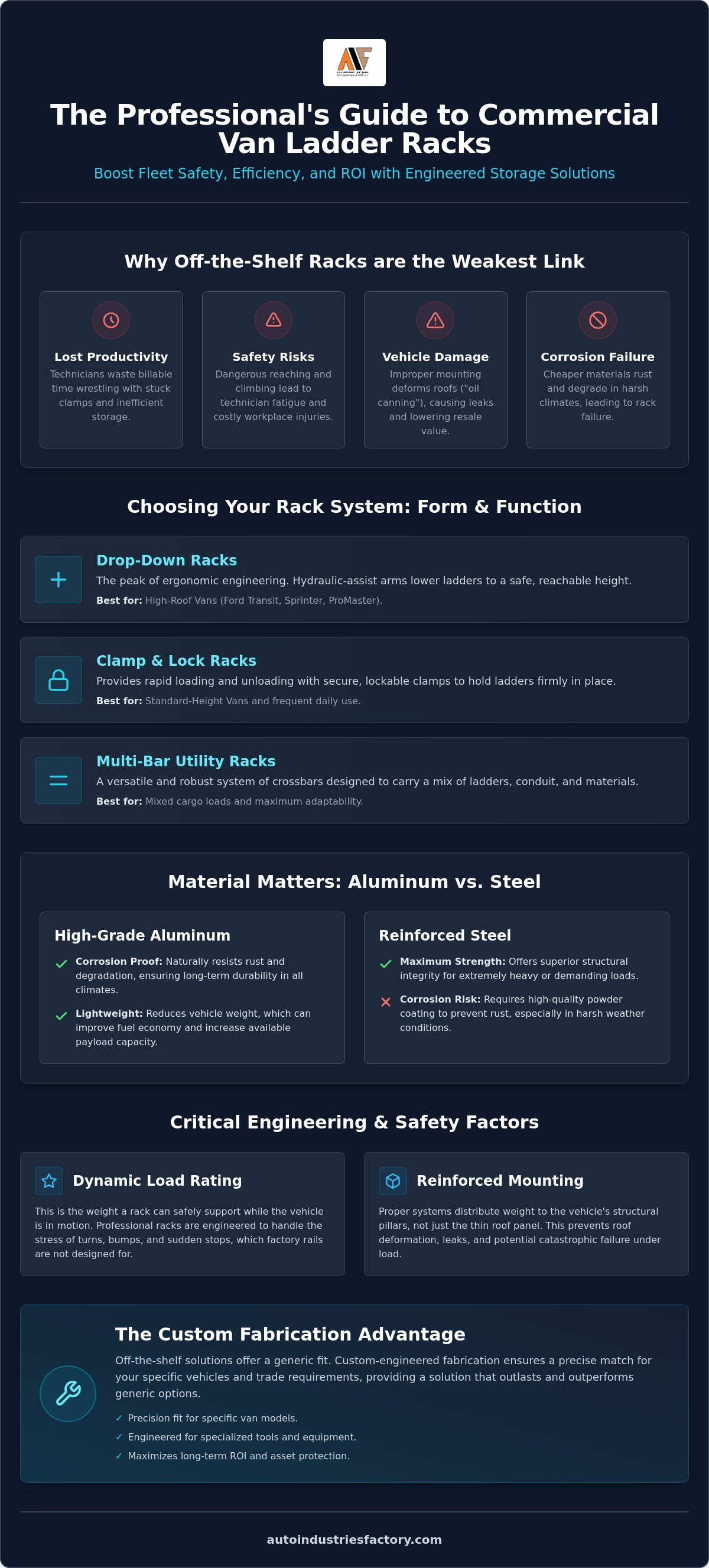
Standard factory rails are built for light consumer loads, not the daily rigors of heavy-duty trade work. The critical distinction lies in the dynamic load rating, which is the weight a rack can safely support while the vehicle is in motion and subject to centrifugal forces. Professional truck bed rack systems and van racks use reinforced mounting points to distribute weight across the vehicle's structural pillars. Without this reinforcement, heavy ladders can cause roof deformation or "oil canning," a phenomenon where the metal flexes and pops, leading to permanent leaks and structural failure. Using non-rated equipment often complicates insurance claims and fails to meet workplace safety requirements for commercial fleets.
Maximizing Fleet ROI Through Smart Upfitting
Selecting the right ladder racks for commercial vans directly impacts your bottom line by extending the operational lifespan of the vehicle asset. By preventing interior scraping and exterior roof damage, these systems maintain the van's resale value and structural integrity. Ergonomics also play a critical role in ROI. Reducing the physical strain required to lift heavy equipment prevents long-term technician fatigue and costly workplace injuries that sideline your best workers. Our specialized vehicle conversion services ensure that every component is built for the specific demands of the job. A precision-engineered rack system projects an image of technical mastery and reliability to every client on the job site.
Comparing Ladder Rack Systems: Drop-Down, Clamp, and Cargo Racks
Selecting the correct architecture for ladder racks for commercial vans isn't a one-size-fits-all process. The hardware must match the vehicle's geometry and the physical capabilities of your team. While simple utility bars work for occasional use, high-frequency operations require specialized mechanisms to maintain safety and speed. Professional fleets typically choose between four primary configurations: drop-down, clamp and lock, multi-bar utility, or interior mounts. Each system serves a distinct operational profile based on roof height and cargo variety.
Drop-down racks represent the peak of ergonomic engineering for high-roof platforms. These systems utilize hydraulic-assist arms to pivot the ladder away from the roof and lower it to a reachable height at the side of the van. This mechanical advantage is crucial for maintaining OSHA ladder safety standards; it eliminates the need for technicians to climb onto the bumper or reach dangerously overhead. For high-roof vehicles like the Toyota Hiace or Ford Transit, dual-sided configurations allow for maximum equipment density without compromising access or safety.
Drop-Down Mechanisms for High-Roof Efficiency
Hydraulic-assist systems are designed to do the heavy lifting, reducing the physical strain on workers by up to 70 percent during loading. This technology is particularly vital for fleets employing high-roof vans where the mounting points are well above the average person's reach. You can choose between single-sided setups for lighter needs or dual-sided configurations to carry multiple ladder types. These systems are engineered to lock securely in the stowed position, preventing mechanical failure even during high-speed transit or off-road maneuvers common in safari or military applications.
Crossbar and Utility Rack Versatility
For fleets that transport more than just ladders, multi-bar utility racks offer the greatest versatility. By using adjustable crossbars, you can secure conduits, timber, or specialized equipment with ease. Modern designs prioritize aerodynamics to minimize wind noise and prevent the fuel consumption spikes often associated with bulky roof attachments. If your operation requires unique mounting solutions, you can explore our Custom Vehicle Accessories to see how we integrate these into total fleet builds. Our in-house fabrication ensures these racks are precision-cut to fit the specific mounting points of your vehicle platform.
For those managing high-value or sensitive fiberglass ladders, interior ladder racks provide an excellent alternative. These systems mount to the internal ceiling, protecting equipment from UV degradation and theft. This is a strategic choice for specialized vehicle conversions where maintaining a low exterior profile is necessary for parking in restricted-height garages. If you are unsure which configuration fits your specific vehicle platform, our team can help you design a customized fleet solution that prioritizes both technician safety and long-lasting performance.
Engineering Durability: Material Selection and Load Capacities
Generic bolt-on kits often fail under the thermal and mechanical stress of industrial operations. The choice between aluminum and steel for ladder racks for commercial vans depends entirely on the mission profile of the fleet. Aluminum provides significant weight savings, which helps keep the vehicle within its Gross Vehicle Weight Rating (GVWR) while maximizing payload for other tools. However, for mission-critical applications like safari conversions or heavy-duty military modifications, reinforced steel remains the industry standard for sheer structural strength and impact resistance.
Managing the vehicle's GVWR is a safety requirement that every fleet manager must prioritize. Overloading the roof changes the center of gravity, which can lead to handling instability or structural failure of the van's pillars during high-speed maneuvers. Adhering to safety standards, such as Washington State ladder transport regulations, requires a rack that maintains its integrity under both static and dynamic loads without compromising the vehicle's balance. Our engineering team calculates these load factors during the design phase to ensure total compliance and safety.
The Advantage of Custom Metal Fabrication
Standard kits rely on bolts that can loosen over time due to constant road vibration and thermal expansion. Our in-house fabrication process utilizes precision laser cutting and CNC machining to create components that fit the specific geometry of platforms like the Toyota Hilux, Land Cruiser, or Ford Transit. Custom-welded joints provide a rigid, unified structure that outperforms modular systems in high-vibration environments. By using laser-cut mounting brackets, we ensure that the load is distributed evenly across the strongest points of the vehicle's roof, preventing the deformation common with generic alternatives.
Corrosion Resistance for National Fleet Use
In high-heat environments or coastal regions with high humidity, corrosion is a relentless enemy of metal accessories. We utilize advanced powder coating and specialized protective finishes to shield the metal from sand abrasion and moisture. While simple galvanization offers some protection, high-grade powder coating provides a more durable barrier that won't chip or peel under intense UV exposure. This level of protection is consistent with our approach to other exterior modifications; you can explore our Custom Bull Bars to see how we apply these heavy-duty standards to every part of the vehicle. Proper finishing ensures that locking mechanisms and pivot points remain functional for the entire lifespan of the fleet asset.
Selection Criteria: Matching Racks to Van Models and Trade Requirements
Selecting ladder racks for commercial vans requires a technical assessment of both the vehicle platform and the daily operational cycle. A generic rack often fails because it doesn't account for the specific stress points of the van's roof or the unique cargo requirements of the trade. Whether you're outfitting a single unit or a regional fleet, the integration of these systems must be treated as a precision engineering task. You must evaluate the vehicle's physical mounting limits alongside the specific tools your technicians deploy every day.
The integration of roof storage with other specialized vehicle conversions is where master craftsmanship becomes evident. For fleets that utilize metal canopies or specialized box-type ambulance bodies, a standard rack simply won't fit. These complex setups require custom-fabricated mounting brackets that clear external modifications while maintaining a low center of gravity. Ensuring that your rack works in harmony with conduit carriers or side-mounted toolboxes is essential for a truly efficient mobile workspace. If you need a solution that balances these complex requirements, you can request a custom fabrication estimate for your specific fleet configuration.
Trade-Specific Rack Configurations
Each trade has a unique load profile that dictates the rack's architecture. Plumbers and electricians typically require integrated conduit carriers, which are sealed, weather-resistant tubes that protect copper piping and PVC from theft and environmental damage. General contractors, on the other hand, prioritize multi-purpose utility racks that can secure varied loads like timber, scaffolding, and oversized pipes. For service technicians who make frequent stops, the priority shifts to rapid-access drop-down systems that minimize the time and physical effort spent at each job site. Matching the mechanism to the task is the only way to ensure long-term technician productivity.
Beyond trade-specific needs, the same principles of efficient cargo management apply to the relocation industry, where organized transport is vital for a smooth transition; to see how professional movers handle complex logistics, you can visit Choose and Move.
Vehicle Compatibility and Mounting
The mounting interface is the most critical safety point of the installation. Older van models often rely on rain gutter clamps, while modern high-performance platforms utilize factory-drilled fixed mounting points. The wheelbase length of the van also plays a vital role in stability; a longer wheelbase allows for better weight distribution but requires a rack with more crossbars to prevent cargo sagging. Our team analyzes these factors to ensure the installation doesn't compromise the vehicle's structural integrity. You can learn more About Us and our rigorous engineering standards to understand how we maintain safety across different vehicle generations.
Custom Fabrication Solutions at Auto Industries Factory LLC
Auto Industries Factory LLC doesn't just supply hardware; we engineer comprehensive fleet systems. Our in-house design process starts with detailed CAD drawings that account for every millimeter of your vehicle's roofline. We utilize advanced laser cutting and CNC machining technologies to ensure that our ladder racks for commercial vans fit with mathematical precision. This specialized approach eliminates the structural weaknesses and vibrations often found in generic, mass-produced kits that rely on universal brackets.
When you're managing a fleet with non-standard requirements, off-the-shelf options are a compromise you can't afford. Our fabrication team customizes rack dimensions to clear specialized equipment or to match the unique profiles of extended-roof conversions. By handling everything from metal bending to final powder coating in-house, we maintain absolute control over the quality and durability of the finished product. It's a master craftsman's approach to industrial-scale fleet management.
Beyond the Rack: Total Fleet Upfitting
We approach vehicle modification from a holistic perspective. Roof storage shouldn't exist in isolation; it must work in tandem with other exterior reinforcements. Our engineers specialize in integrating ladder racks with custom bull bars and bumpers to create a unified protective framework for your assets. For mission-critical vehicles, we also customize access points and rear-mounted ladders to facilitate rapid equipment deployment. This level of integration is essential for vehicles operating in high-stress environments. You can see how we apply these rugged standards to Safari Vehicle Conversions designed for extreme terrain and heavy-duty utility.
Engineering for Mission-Critical Reliability
Ambulances, police units, and military vehicles require a higher standard of storage reliability. In an emergency response, a shifting load or a jammed locking mechanism is more than just an inconvenience; it's a liability. We specialize in custom-fabricated storage for box-type ambulances and high-performance patrol vehicles where standard mounting points don't exist. The Auto Industries Factory LLC commitment to ruggedness and technical precision ensures that your equipment remains secure during high-speed maneuvers or off-road transit. If your fleet requires a specialized conversion that stands up to industrial-grade use, you can Request a Quote for Custom Fleet Accessories today. We are ready to build the robust, precision-engineered tools your team needs to succeed.
Engineer Your Fleet for Long-Term Efficiency
Investing in high-performance ladder racks for commercial vans is a strategic move that transforms your vehicles from simple transport assets into precision-engineered mobile workshops. By prioritizing ergonomic access and structural durability, you eliminate the operational bottlenecks that drain technician productivity. These systems aren't just accessories; they're mission-critical components that protect your team and maintain the long-term value of your fleet. Choosing a solution built for the specific stresses of your trade ensures that your operation remains safe, compliant, and professional on every job site.
Auto Industries Factory LLC leverages specialized in-house laser cutting and CNC machining to deliver accessories that surpass standard market kits. We're trusted for mission-critical ambulance and military conversions, providing the national fleet support and custom engineering required for the most demanding environments. Our team is ready to provide the technical expertise needed to protect your assets through superior metal fabrication. Request a Custom Fabrication Quote for Your Fleet and equip your vehicles with the rugged performance your business demands. We're ready to help you build a more efficient future.
Frequently Asked Questions
What is the maximum weight capacity for a commercial van ladder rack?
Weight capacities typically range from 500 to 1,000 lbs depending on the specific model and material. You must also verify the vehicle manufacturer's roof load limit to ensure the combined weight of the rack and cargo doesn't exceed the van's structural capacity. Overloading the roof can negatively impact handling and increase the risk of a rollover during sudden maneuvers.
Do ladder racks affect the fuel efficiency of my commercial van?
Yes, any external storage system increases aerodynamic drag, which can lead to a slight decrease in fuel economy. However, modern ladder racks for commercial vans are engineered with low-profile crossbars and wind deflectors to minimize this resistance. Selecting an aerodynamic design helps maintain fleet efficiency while providing the necessary storage utility for your technicians' daily operations.
Can I install a ladder rack on a high-roof van without a ladder?
You can certainly install the rack, but accessing equipment on a high-roof van without a ladder is dangerous and inefficient. For these taller platforms, we recommend a drop-down rack system. This mechanical solution allows the technician to lower the equipment to a reachable height at the side of the vehicle, eliminating the need to climb onto the bumper or use a secondary step ladder.
What is the difference between a drop-down rack and a clamp-down rack?
A drop-down rack uses a hydraulic-assist arm to pivot and lower the equipment to chest height, while a clamp-down rack requires you to manually lift the ladder onto the roof. Drop-down systems are the ergonomic gold standard for high-roof vans because they reduce physical strain. Clamp-down racks are a secure, cost-effective solution better suited for low-roof vehicles where the technician can easily reach the mounting points.
Are aluminum ladder racks strong enough for heavy-duty industrial use?
High-grade aluminum is exceptionally strong and is often the preferred choice for ladder racks for commercial vans due to its high strength-to-weight ratio. It provides the durability needed for daily industrial use while remaining naturally resistant to corrosion. While steel is reserved for extreme load-bearing safari or military applications, aluminum is more than sufficient for most plumbing, electrical, and HVAC fleet requirements; for those in the climate control industry, you can explore HVAC Maintenance and Repair Services to keep your service equipment in top condition.
How do I maintain my ladder rack to prevent corrosion and mechanical failure?
Regular maintenance involves inspecting all mounting hardware for tightness and lubricating pivot points on mechanical racks. You should wash the rack frequently to remove salt, sand, and chemical debris that can degrade the finish. If you notice chips in the powder coating, touch them up immediately to prevent oxidation from spreading. This proactive approach ensures the locking mechanisms remain functional for the life of the vehicle.
Is professional installation required for commercial van ladder racks?
Professional installation is highly recommended to ensure the system is securely anchored to the vehicle's structural pillars. Expert installers use precision torque settings and specialized sealants to prevent roof leaks and mechanical failure during high-speed transit. Because these racks are mission-critical components, professional mounting provides the peace of mind that the system complies with safety standards and won't compromise the vehicle's warranty.
Can I customize a ladder rack for a non-standard vehicle type?
Yes, custom fabrication is the best way to outfit non-standard vehicles or specialized conversions like ambulances and safari trucks. Using CAD design and in-house laser cutting, we can engineer a rack that fits unique dimensions or clears other exterior modifications. This ensures a precision fit that generic kits cannot provide, allowing you to maximize the utility of specialized fleet assets without compromising on structural integrity.


