
A mobile workshop isn't just a vehicle with shelves; it's a high-stakes engineering challenge where one structural failure can sideline your entire operation. If your current mobile workshop van conversion relies on basic carpentry rather than industrial-grade fabrication, you're likely battling equipment damage and wasted on-site hours. You need a platform that projects professional authority and stands up to the rigors of the field.
We understand the high stakes of mission-critical applications. You need uninterrupted power for heavy tools and a layout that maximizes organization without compromising safety. This guide promises to help you master the complexities of professional design, transforming your fleet into a high-performance service powerhouse. We'll explore structural reinforcement, heat-resilient power systems, and the latest 2026 FMCSA digital inspection standards to ensure your units are both compliant and indestructible. From managing the shift toward fast-charging LFP battery systems to implementing modular interior layouts, we provide the technical roadmap for a truly mission-ready vehicle.
Key Takeaways
- Learn how a professional mobile workshop van conversion maximizes on-site efficiency by reducing tool-hunting time and increasing your fleet's billable hours.
- Identify the critical engineering specifications for onboard power and pneumatic systems to ensure your heavy-duty tools never face downtime.
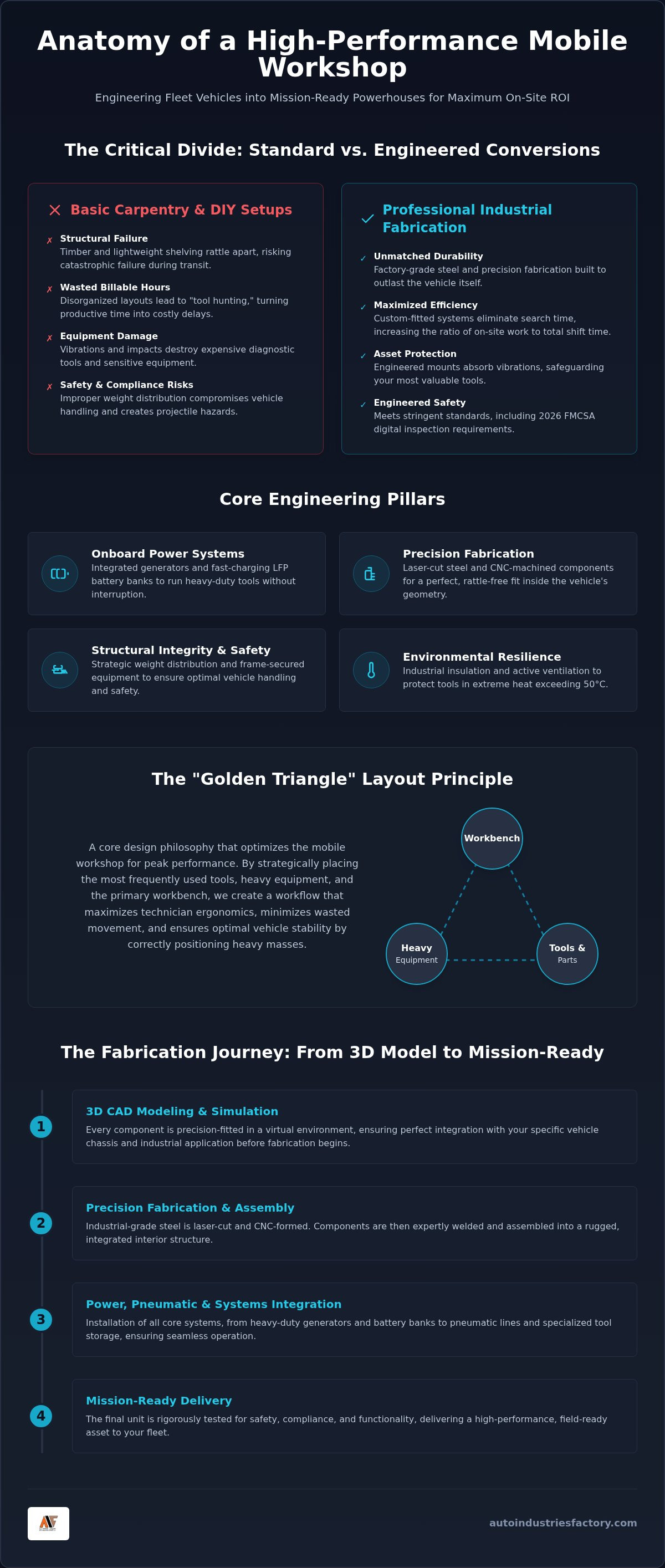
- Discover the "Golden Triangle" layout principle to optimize technician ergonomics and place heavy equipment for maximum vehicle stability.
- Master environmental resilience techniques, including industrial insulation and active ventilation, to protect sensitive equipment in temperatures exceeding 50°C.
- Understand the 3D CAD modeling process that ensures every component is precision-fitted for your specific industrial application before fabrication starts.
Beyond Basic Shelving: The ROI of Professional Mobile Workshop Van Conversions
The industrial landscape in 2026 has shifted decisively away from centralized service centers toward rapid, on-site response models. This transition demands more than just a vehicle that carries tools. It requires a platform that functions as a mobile command center. A high-performance mobile workshop van conversion is a strategic asset that directly impacts your bottom line by turning your fleet into a high-speed service powerhouse. When you move the workshop to the machine, you don't just fix equipment; you eliminate the logistical bottlenecks that stall major projects.
Professional builds eliminate the "tool hunting" that plagues basic setups. Every minute a technician spends digging through disorganized bins is a minute of lost billable time. By organizing tools into precision-fabricated systems, you turn wasted motion into productive output. This level of organization also builds immediate authority with your clients. When mobile mechanics arrive in a mission-ready vehicle, they project a level of competence that basic shelving cannot match. It's the difference between a contractor and a partner who invests in engineering precision.
Durability is another critical factor in the return on investment. Timber-based DIY setups or lightweight retail shelving often rattle apart under the stress of off-road transit or high-heat environments. We rely on factory-grade steel and specialized metal fabrication to ensure your interior survives the same harsh conditions as the chassis. A professional conversion is designed to outlast the vehicle itself, providing a rugged environment that protects your expensive diagnostic equipment and heavy power tools from vibration damage.
To better understand how a professional build impacts daily operations, watch this breakdown of a service van conversion:
Maximizing Fleet Uptime and Efficiency
Bringing the workshop directly to heavy machinery eliminates the nightmare of transporting broken equipment back to a base. You lower operational overhead by removing the need for permanent remote facilities in every region you serve. Mobile Workshop Efficiency is defined as the ratio of on-site work time to total shift duration. High-efficiency builds ensure your technicians spend more time turning bolts and less time behind the steering wheel or searching for parts in a cramped cargo area.
Safety and Compliance Standards
Engineering a workshop requires deep knowledge of vehicle dynamics. Weight distribution is critical; placing heavy equipment like generators or compressors incorrectly shifts the center of gravity and compromises vehicle handling. Professional mobile workshop van conversion ensures every heavy item is secured to the vehicle’s structural frame. This prevents equipment from becoming projectile hazards during emergency braking. Meeting regional safety regulations for mobile industrial units is not just about compliance; it's about protecting your most valuable assets: your people and your tools.
Core Engineering Components: Power, Pneumatics, and Precision Fabrication
Engineering a high-performance mobile workshop is a task of complex system integration. You cannot simply bolt tools to the floor and expect industrial reliability. It begins with precision fabrication. We utilize in-house laser cutting and CNC machining to create racking systems that conform exactly to the vehicle's internal geometry. This level of precision eliminates the structural rattles and weld failures common in generic, off-the-shelf shelving. When your technicians are navigating rough terrain, the integrity of these mounts is what prevents catastrophic equipment damage.
Pneumatic systems add another layer of capability for heavy-duty field repairs. Installing an industrial-grade compressor requires dedicated ventilation and specialized vibration isolation to protect the vehicle's chassis. For the primary work surface, laser-cut steel is the only viable choice for professional use. It resists chemicals, heavy impacts, and extreme heat in ways that timber or plastic surfaces never could. If you are ready to upgrade your fleet's technical capabilities, you can explore our specialized vehicle modification services to see how we handle complex mobile workshop van conversion projects.
Integrated Power Solutions for Continuous Operation
Calculating total wattage is the first step in power design. You must account for the simultaneous draw of power tools, interior lighting, and climate control systems. Shore power hookups are essential for overnight charging, ensuring the vehicle is mission-ready every morning. Smart power management systems are installed to isolate the house batteries from the starter battery. This prevents the critical failure of a dead engine when working in remote, high-heat environments.
Custom Racking and Heavy-Duty Storage
Organization is the engine of productivity in a mobile workshop van conversion. Our drawer systems utilize industrial ball-bearing slides that handle massive tool loads without sagging or jamming. CNC-cut vertical tool boards allow for rapid tool identification; if a wrench is missing, the technician sees the empty space instantly. We also engineer specialized, secure compartments for hazardous materials and small consumables to keep the workspace clear and safe during transit.
Sector-Specific Layouts: Optimizing for Your Trade
Efficiency in a mobile workshop van conversion isn't just about fitting everything in. It's about optimizing the workflow for the specific tasks at hand. We apply the "Golden Triangle" architectural principle to every build. This balances the workbench, primary tool access, and parts storage to minimize the technician's physical movement. By reducing the number of steps required to complete a repetitive task, we directly increase the number of billable hours your fleet can generate in a single shift.
Structural stability is a core engineering requirement for any professional unit. We place the heaviest equipment, such as onboard generators or heavy-duty compressors, directly over or slightly forward of the rear axle. This placement maintains the vehicle's center of gravity and prevents the rear suspension from bottoming out during transit. For vehicles operating with multiple technicians, we implement zoning strategies. This ensures that one person can operate at the main workbench while another accesses side-mounted storage bins without creating a bottleneck in the central aisle.
Our team understands that a plumber's needs differ vastly from a heavy machinery mechanic's. You can view the full range of our architectural capabilities by exploring our specialized vehicle modification services to see how we tailor every inch of cargo space.
The Mechanical & Fleet Maintenance Layout
Heavy machinery repair requires a layout built for ruggedness and fluid management. We integrate oil recovery systems and bulk fluid storage tanks directly into the lower racking levels to keep the center of gravity low. Work surfaces are reinforced with laser-cut steel to support engine components and heavy-duty vices. Sensitive diagnostic computers are housed in dedicated, vibration-isolated cabinets that protect them from the dust and debris common in mechanical field work.
The Electrical & Utility Response Layout
Engineering for Environmental Resilience: Heat and Dust Mitigation
Operating environments in the UAE and surrounding regions present extreme thermal and particulate challenges that can quickly compromise standard vehicle modifications. A professional mobile workshop van conversion must be engineered to survive external temperatures that frequently exceed 50°C. We utilize a multi-layered approach to environmental resilience, starting with high-performance insulation. By combining reflective radiant barriers with closed-cell industrial foam, we create a thermal envelope that protects both your technicians and your sensitive diagnostic equipment from radiant heat soak.
Active ventilation is a non-negotiable requirement for onboard power systems. Generators and heavy-duty inverters produce immense internal heat during operation. Without specialized cooling ducts and high-cfm extraction fans, these compartments become heat traps that trigger equipment shutdowns. We design these systems to maintain constant airflow, ensuring your power supply remains stable even during peak summer hours. Dust mitigation is another critical engineering pillar. We implement positive-pressure strategies for electronic racking and pneumatic systems to prevent fine desert sand from infiltrating sensitive components.
Corrosion resistance is equally vital for vehicles operating in coastal or high-salinity areas. We apply industrial-grade protective coatings to all custom metalwork and exposed structural points. This prevents the humid, salt-heavy air from compromising the integrity of your precision-fabricated racking. If your fleet requires this level of ruggedness, request a technical consultation to discuss an environmentally resilient build for your next project.
Thermal Management and HVAC Integration
Stationary work requires cooling solutions that don't rely on the vehicle's engine. We integrate independent AC units powered by auxiliary battery banks or shore power to maintain a workable interior climate. To further improve efficiency, we implement thermal breaks within our mobile workshop van conversion metalwork. These breaks prevent the exterior vehicle skin from conducting heat directly into the interior workspace. Thermal Equilibrium in a mobile workshop context is the state where the interior cooling capacity effectively offsets the heat gain from the external environment and onboard machinery.
Structural Reinforcement for Rugged Terrain
Standard factory suspensions aren't designed to carry the constant, static load of a full industrial workshop over unpaved terrain. We provide comprehensive suspension upgrades, including heavy-duty springs and dampers tailored to your specific equipment weight. For off-road utility applications, we offer chassis reinforcement to handle the intense torsional stress of remote field operations. Our deep expertise in Safari Vehicle Conversions allows us to apply military-grade structural knowledge to every industrial workshop we build.
The Fabrication Journey: From 3D Modeling to Mission-Ready Delivery
The transition from a standard cargo vehicle to a high-performance mobile workshop van conversion begins with a deep technical audit. This goes beyond a simple checklist; it's a comprehensive analysis of your tool counts, peak power loads, and specialized equipment footprints. We don't guess; we engineer. By identifying every pneumatic requirement and electrical draw at the start, we ensure the final build operates as a cohesive unit rather than a collection of parts. This initial consultation sets the stage for a vehicle that won't just carry your tools, but will actively enhance your technician's workflow.
Once the data is captured, we transition to 3D CAD modeling. This stage is where we optimize every millimeter of the interior. We visualize the workflow, ensuring that the layout principles discussed in previous sections are perfectly executed within the specific constraints of your vehicle's chassis. Precision fabrication follows, utilizing in-house laser cutting to produce components that fit with zero-tolerance gaps. Our TIG and MIG welding processes provide the structural integrity required to withstand years of industrial vibration and heavy-duty field use. We don't rely on bolt-on accessories that rattle loose; we build integrated structures.
Final finishing is about more than aesthetics. We provide industrial-grade painting and professional branding to ensure your mobile units reflect your company's authority. A unified fleet image builds trust before your technician even opens the rear doors. This comprehensive process turns a single van into a professional service powerhouse, ready for the toughest on-site challenges.
Precision Design and Engineering
We utilize 3D scans of the industry's leading platforms, including the Toyota Hiace, Mercedes Sprinter, and Ford Transit. This ensures that every racking system and workbench is contoured to the base vehicle's unique internal geometry for a perfect fit. Virtual load-testing allows us to simulate the center of gravity and weight distribution before a single piece of steel is cut. We even prototype custom brackets for non-standard industrial tools, ensuring that even your most specialized equipment has a secure, vibration-damped home during transit.
Quality Control and Testing
Reliability is proven through data, not assumed. Every mobile workshop van conversion undergoes rigorous electrical system stress testing and load-bank validation to ensure the auxiliary power can handle peak demands in high-heat environments. We perform high-pressure testing on all pneumatic and fluid delivery lines to prevent on-site leaks or failures. To learn more about our commitment to engineering excellence and our specialized fabrication facility, you can read About Auto Industries Factory LLC.
Engineering Your Fleet for the Future of On-Site Service
Success in field operations requires more than just the right tools; it demands a mobile environment engineered for reliability and precision. By prioritizing structural integrity through in-house CNC and laser cutting, you ensure your equipment survives the most demanding industrial terrain. A high-performance mobile workshop van conversion doesn't just transport your inventory. It optimizes your workflow through strategic layouts and resilient power systems that maintain thermal equilibrium in extreme desert heat. These engineering choices directly impact your operational uptime and long-term ROI.
Our team specializes in high-performance vehicle platforms and is trusted by government and defense sectors to deliver mission-critical modifications. We don't just build shelving; we engineer solutions that maximize your billable hours and protect your technical assets from vibration and heat damage. If you're ready to transform your fleet into a powerhouse of on-site efficiency, Request a Technical Consultation for Your Workshop Conversion today. Let's build a vehicle that works as hard as your technicians do.
Frequently Asked Questions
What is the best base van for a mobile workshop conversion?
High-roof, long-wheelbase platforms like the Mercedes Sprinter, Ford Transit, or Toyota Hiace are the industry standards for professional builds. These vehicles provide the vertical clearance required for stand-up workbenches and the payload capacity for heavy metal racking. Your specific choice should depend on the total weight of your machinery and the typical terrain of your job sites.
How do you manage the weight of a fully equipped workshop van?
We manage weight through a combination of structural reinforcement and strategic equipment placement. By positioning heavy components like generators and compressors over the rear axle, we maintain a stable center of gravity and prevent suspension sag. We also utilize high-strength, laser-cut steel for the racking to maximize storage density without exceeding the vehicle's Gross Vehicle Weight Rating.
Can you install an air conditioner that works while the engine is off?
Yes, we install independent auxiliary HVAC systems that operate without the primary engine running. These units are typically powered by a dedicated high-capacity LFP battery bank. This setup allows technicians to work in a climate-controlled environment during stationary on-site tasks. It effectively protects the vehicle's starter battery from depletion while maintaining a comfortable workspace in high-heat environments.
Do you provide custom racking for specific tool brands?
We provide precision-engineered racking tailored to your specific tool inventory and brand preferences. Using CNC machining, we create custom brackets and specialized drawer systems that secure everything from heavy-duty impact wrenches to delicate diagnostic computers. This ensures a rattle-free environment and rapid tool identification. Every component is designed to survive the rigors of industrial transit.
How long does a professional mobile workshop conversion take?
A professional mobile workshop van conversion typically takes between four to eight weeks once the design phase is finalized. The exact timeline varies based on the complexity of the integrated electrical and pneumatic systems. We prioritize engineering precision over speed to ensure every weld and circuit meets our rigorous industrial safety standards before the vehicle is delivered to your fleet.
Is it possible to convert a 4x4 pickup truck into a mobile workshop?
Yes, we specialize in converting high-performance 4x4 platforms like the Toyota Hilux or Land Cruiser into specialized mobile workshop units. These conversions often involve installing custom metal canopies and heavy-duty roof racks to house tools and parts. This is the ideal solution for remote field service where standard vans cannot navigate the rugged terrain of the UAE's toughest industries.
What kind of power source is best for heavy industrial tools on-site?
The best power source for heavy industrial tools is a combination of a high-output inverter and an integrated diesel generator. For silent operation, high-capacity lithium battery banks are becoming the standard in 2026. We calculate your peak wattage requirements to ensure your mobile workshop van conversion provides uninterrupted power for welding, grinding, or running pneumatic compressors in the field.
Do you offer branding and painting as part of the conversion?
We offer professional vehicle color changes and industrial-grade painting as a core part of our fabrication journey. Our in-house painting facilities ensure a durable finish that withstands harsh environmental conditions and high-salinity coastal air. This allows you to maintain a unified and authoritative fleet image that matches the high engineering standards of your interior workshop conversion.


