
Can a standard medical conversion survive a 50°C desert emergency without the onboard systems failing? When lives are on the line, "good enough" is a dangerous gamble for any fleet operator. You recognize that a high-performance ambulance equipment fitout UAE requires more than just mounting a stretcher. It demands rugged engineering that survives extreme heat and high-stakes operational pressure. It's about building a mobile intensive care unit that remains a sanctuary of precision, even when the external environment is at its most hostile.
In this article, you'll discover the technical requirements and engineering standards necessary for professional fitouts that align with the new 2026 Federal Authority for Ambulance and Civil Defence regulations. We'll explore the critical role of EN 1789 compliance, the necessity of 10G-rated structural reinforcements, and how to optimize interior ergonomics for medical staff. We'll preview the essential components of a mission-ready fleet, from specialized HVAC systems that maintain a steady 22°C to reliable oxygen integration and custom metal cabinetry designed for durability.
Key Takeaways
- Understand the technical distinctions between Type A and Type B units to ensure your vehicle fleet meets specific medical and operational requirements.
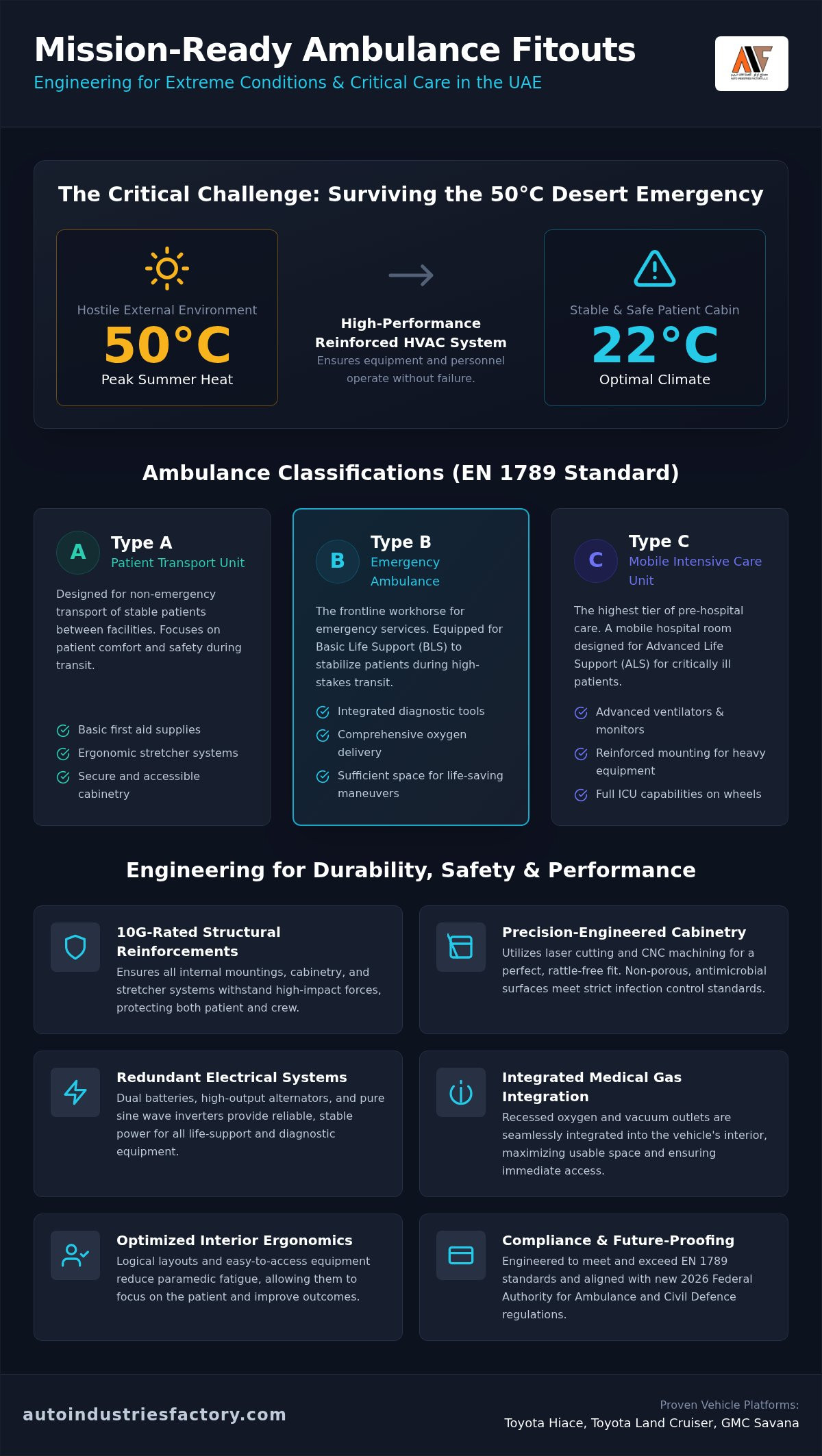
- Learn how a specialized ambulance equipment fitout UAE utilizes reinforced HVAC systems to maintain stable internal temperatures during 50°C summer peaks.
- Identify the essential EN 1789 safety standards and local health authority regulations required for legal and safe operation across the Emirates.
- Discover how precision manufacturing techniques like laser cutting and CNC machining create durable cabinetry that withstands the rigors of mission-critical use.
- Gain insights into why high-quality interior ergonomics and structural reinforcements are vital for improving both paramedic efficiency and patient outcomes.
What Defines a Professional Ambulance Equipment Fitout?
A professional ambulance equipment fitout UAE is far more than a simple van conversion. It represents the precise integration of medical, electrical, and structural systems into a heavy duty vehicle chassis. This engineering process transforms a standard commercial vehicle into a mobile life support environment. Every millimeter of space is calculated to ensure that life saving equipment is accessible within seconds. It's a specialized discipline that requires a deep understanding of both automotive limits and emergency medical protocols.
Fitout quality directly dictates patient outcomes. If a cabinet door jams or a power inverter fails during a critical transport, the consequences are severe. High performance engineering reduces paramedic fatigue by optimizing ergonomics. It allows medical staff to focus entirely on the patient rather than fighting with the vehicle's interior layout. A well designed unit ensures that everything from the defibrillator to the smallest bandage is exactly where it needs to be when seconds count.
The complexity of the fitout depends on the intended mission. Basic life support (BLS) units focus on stabilization and transport. In contrast, Advanced Life Support (ALS) configurations require sophisticated diagnostic tools and intensive care capabilities. Proper Ambulance classification ensures that each vehicle is equipped for its specific role. In the UAE, these ambulance conversions typically utilize robust platforms like the Toyota Hiace, Toyota Land Cruiser, or GMC Savana due to their proven reliability in regional conditions.
The Core Components of an Ambulance Interior
A professional interior starts with medical grade cabinetry. We use precision laser cutting and CNC machining to ensure a perfect fit that eliminates rattling and structural weakness. Surfaces must be non porous and antimicrobial to meet strict infection control standards. The fitout includes integrated oxygen delivery systems with recessed vacuum outlets to maximize floor space. Every seating position for medical personnel is engineered for safety; featuring ergonomic supports and secure stretcher mounting systems that withstand high impact forces.
Electrical Systems and Power Management
Reliable power is the heartbeat of a modern medical unit. A standard vehicle alternator cannot handle the load of defibrillators, ventilators, and climate control systems simultaneously. Professional conversions feature dual battery systems and high output alternators to ensure redundancy. Pure sine wave inverters are mandatory to protect sensitive diagnostic tools from power surges. Additionally, shore power connections allow the vehicle to maintain its equipment and internal temperature while stationary, ensuring the unit is always mission ready.
Ambulance Classification and Equipment Lists
Selecting the correct vehicle classification is the foundational step in engineering a mission-ready medical unit. The UAE adheres to stringent international benchmarks, primarily the EN 1789 standard, to categorize medical vehicles based on their clinical capabilities. This ensures every ambulance equipment fitout UAE project is purpose-built for its specific operational role. Whether the vehicle is intended for routine transfers or high-stakes trauma response, the internal configuration must match the medical mission.
Type A: Patient Transport Units. These vehicles are designed for the non-emergency transport of stable patients. While they lack the heavy-duty life support machinery of emergency units, they require precision cabinetry for basic first aid supplies and ergonomic stretcher systems. They are the primary choice for facility-to-facility transfers where intensive monitoring isn't required.
Type B: Emergency Ambulances. These units serve as the frontline workhorse for emergency services. They are equipped for Basic Life Support (BLS) and designed to stabilize patients during transit. A Type B ambulance equipment fitout UAE requires a balanced integration of diagnostic tools, oxygen delivery, and enough interior space for paramedics to perform life-saving maneuvers effectively. Ensuring UAE ambulance fleet compliance is critical for these units to meet national health authority benchmarks.
Type C: Mobile Intensive Care Units (MICU). These represent the highest tier of medical vehicle engineering. Designed for Advanced Life Support (ALS), Type C units are essentially mobile hospital rooms. They require reinforced structural mounting for heavy ventilators and advanced monitoring arrays. For specialized needs, we also develop custom fitouts for neonatal transport, featuring specialized incubator housing and vibration-dampening flooring.
Essential Medical Gear for Every Fitout
Every professional conversion must include a baseline of critical equipment secured in custom-machined brackets. This includes multi-parameter monitors to track vitals and Automatic External Defibrillators (AED) for cardiac intervention. Fixed and portable suction units with medical-grade tubing are integrated directly into the cabinetry for immediate access. Standardized immobilization gear, such as spinal boards and cervical collars, is stored in dedicated compartments to ensure rapid deployment during trauma calls.
Specialized Equipment for ALS Units
Advanced Life Support units demand a higher level of technical integration. These units house transport ventilators and precision infusion pumps for critical care. Telemetry systems are also a core feature, allowing for real-time data transmission. In UAE emergency medicine, telemetry allows the ambulance crew to transmit patient vitals and ECG data directly to the hospital trauma team before arrival. If you are looking to upgrade your fleet, exploring our bespoke ambulance conversion solutions will ensure your vehicles are equipped with the latest mission-critical technology.
Engineering for the UAE: Heat and Durability
Engineering a vehicle for the Arabian Peninsula requires a fundamental shift in design philosophy. While standard medical conversions might suffice in temperate climates, an ambulance equipment fitout UAE must survive prolonged exposure to 50°C+ ambient temperatures. Maintaining an internal climate of 22 to 24°C is not just a comfort requirement; it is a clinical necessity. Many medications and sensitive diagnostic reagents lose efficacy if exposed to extreme heat for even short durations. Our engineering process integrates heavy duty HVAC systems designed for continuous operation in high humidity, often utilizing advanced thermal technologies similar to those provided by apienergy.co.uk, ensuring the patient compartment remains a stable environment regardless of the external conditions.
Thermal management relies on high performance insulation materials. We line the vehicle walls and ceilings with specialized thermal barriers that reflect radiant heat and minimize conduction. This is paired with precision dust and sand ingress protection. In the UAE, fine particulate matter can penetrate standard automotive seals, leading to the premature failure of sensitive medical electronics. We utilize specialized gaskets and filtration systems to keep the interior sterile and the equipment functional, protecting the life saving technology housed within.
Structural Integrity and Safety Standards
The added weight of medical cabinetry, oxygen cylinders, and advanced life support gear places immense stress on a standard chassis. We perform structural reinforcements to handle the increased medical payload while maintaining vehicle stability. Every mounting point is engineered to meet International ambulance standards, including the critical 10G sledge test. This ensures that heavy equipment remains secure even during a high speed impact. For a deeper look at our engineering protocols, learn more about our Ambulance Conversion standards and how we prioritize crew safety.
Vibration and Noise Control
A chaotic, noisy environment hinders patient care and paramedic performance. We integrate acoustic insulation to dampen road noise and siren feedback, creating a calm atmosphere for the patient. Sensitive diagnostic equipment is secured using vibration-dampening mounts to prevent calibration errors. This level of precision ensures that paramedic communication remains clear and that patient vitals monitoring is accurate, even when the vehicle is navigating rough terrain or high speed emergency routes. A stable environment is essential for accurate diagnosis and effective treatment during transit.
Compliance and Standards for UAE Ambulance Fleets
Operating an emergency vehicle in the Emirates requires strict adherence to a complex regulatory framework. A professional ambulance equipment fitout UAE must align with the EN 1789 standard, which dictates the safety and performance criteria for road ambulances. This benchmark isn't just about having the right gear. It's about ensuring that every component, from the oxygen rack to the medical cabinet, can withstand a 10G impact without becoming a projectile. As of July 2026, all fleet operators must also ensure their vehicles meet the latest directives from the Federal Authority for Ambulance and Civil Defence.
Alignment with UAE national health authorities, including the Department of Health (DOH), Dubai Health Authority (DHA), and the Ministry of Health (MOH), is mandatory for legal operation. These bodies mandate specific equipment lists and vehicle dimensions that vary by classification. ISO certification in our fabrication process guarantees that every weld, laser cut, and electrical connection meets international quality benchmarks. Safety is engineered into the exterior as well. High intensity LED lighting, multi tone sirens, and high visibility reflective liveries are mandatory features that ensure the vehicle commands authority during emergency responses.
Documentation and Quality Assurance
Precision engineering requires meticulous documentation. Every vehicle we deliver includes technical data sheets for all installed medical and electrical systems. We provide weight bridge certificates to verify that the vehicle balance and center of gravity remain within safe operational limits after the fitout. Final inspection protocols are rigorous; we test every circuit and structural mount before the unit is cleared for active duty. This transparency ensures that fleet managers have a complete technical record for insurance and regulatory audits.
Maintenance and After-Sales Support
The mission doesn't end when the vehicle leaves the factory. Integrated medical devices require routine calibration to maintain diagnostic accuracy. Similarly, specialized HVAC and electrical systems need scheduled service intervals to prevent failure during extreme heat cycles. For comprehensive fleet support and technical assistance, explore Our Services to see how we maintain vehicle readiness. Keeping your fleet in peak condition is essential for long term reliability and patient safety.
Ready to ensure your medical units meet the highest regional standards? Contact our engineering team to discuss a compliant ambulance equipment fitout UAE for your organization.
Custom Fitout Solutions by Auto Industries Factory
Auto Industries Factory LLC delivers a complete, in-house engineering solution for specialized medical fleets. We don't just assemble components; we engineer every technical aspect of the ambulance equipment fitout UAE from the ground up. Our facility integrates design, structural reinforcement, and final painting under one roof. This centralized approach eliminates the communication gaps found with generalist converters. It ensures that every vehicle meets our master craftsman standards for durability and precision. We take full responsibility for the vehicle's transformation, providing a rugged solution that stands up to the most demanding operational cycles.
Our manufacturing process relies on advanced laser cutting and CNC machining. These technologies allow us to fabricate medical cabinetry and internal structures with sub-millimeter accuracy. Whether we're working on a box-type ambulance or an extended roof ambulance on GMC and Toyota platforms, the result is a seamless fit. This precision prevents the rattling and structural fatigue that often plague lower-quality conversions. Every professional ambulance equipment fitout UAE we produce is designed to maximize interior volume while maintaining the vehicle's center of gravity for safe, high-speed handling.
Our Fabrication Capabilities
Rugged environments demand rugged solutions. We specialize in precision metal bending and high-strength welding to create durable interior frames that withstand the UAE's harsh terrain. Our team also handles the custom fabrication of medical gas manifolds and secure oxygen storage systems. These components are mission-critical; they must remain secure during high-impact scenarios. Discover our About Us page for more facility details and a closer look at our engineering floor and CNC capabilities.
Why Choose Our Specialized Conversions?
We build for the UAE's specific operational challenges. Our layouts are flexible and can be tailored to the exact clinical requirements of private hospitals or government emergency services. We prioritize structural reinforcement to ensure the vehicle handles the increased weight of Advanced Life Support gear without compromising safety or performance. Our engineering expertise isn't limited to medical units. Check our guide on Police Vehicle Modifications for insights into our broader fleet upfitting capabilities. Every conversion we perform is a testament to our commitment to engineering excellence and regional reliability.
Engineering Your Mission-Critical Response
A professional ambulance equipment fitout UAE is a high stakes engineering feat that bridges the gap between automotive durability and clinical precision. You've seen how specialized HVAC systems and 10G rated structural reinforcements are essential for surviving the region's extreme climate. Adhering to EN 1789 standards and local health authority regulations isn't just about compliance; it's about ensuring every mobile intensive care unit remains a reliable sanctuary for patients and paramedics alike.
Auto Industries Factory LLC stands as an expert vehicle fabrication and conversion specialist. We provide comprehensive in-house manufacturing within the UAE, ensuring every weld and electrical circuit meets our master craftsman standards. We're dedicated to mission critical safety and long term fleet reliability, transforming standard chassis into robust life saving tools. Don't leave your fleet's performance to chance when the external environment is at its most hostile.
Request a Technical Consultation for Your Ambulance Fleet today. Let's work together to build a medical unit that performs flawlessly when every second counts.
Frequently Asked Questions
What is the standard for ambulance equipment fitout in the UAE?
The primary technical benchmark for an ambulance equipment fitout UAE is the European EN 1789 standard. This standard regulates the design, testing, and performance requirements for medical vehicles. Additionally, all conversions must align with the latest directives from the Federal Authority for Ambulance and Civil Defence. Compliance ensures that every interior component can withstand 10G crash impacts, providing maximum safety for both the patient and the medical crew during emergency transit.
Can you convert any van into an ambulance?
Not every van is suitable for a professional medical conversion. A vehicle must possess a high payload capacity and sufficient interior volume to house life saving equipment and personnel. We typically recommend specialized platforms like the GMC Savana or Toyota Hiace. These vehicles provide the structural integrity required for heavy medical fitouts and the reliability needed to operate continuously in the UAE's demanding environmental conditions.
How long does a typical ambulance equipment fitout take?
The timeframe for a conversion depends on the complexity of the medical configuration. A basic patient transport unit typically takes 1 to 2 weeks to complete. More complex projects, such as Advanced Life Support or Mobile Intensive Care Units, generally require 4 to 6 weeks. This period accounts for precision engineering, custom metal fabrication, electrical integration, and rigorous quality assurance testing before the vehicle is cleared for active service.
What are the requirements for oxygen systems in a UAE ambulance?
Oxygen systems in UAE ambulances must feature secure, crash tested mounting for cylinders and integrated medical gas manifolds. We install recessed outlets to maximize floor space and prevent accidental damage during patient care. The system must be designed for easy access and rapid cylinder exchange. All piping and connections must meet medical grade standards to ensure a reliable and sterile delivery of oxygen under high pressure conditions.
Do you provide custom cabinetry for medical vehicles?
We provide bespoke cabinetry solutions manufactured entirely in house using precision laser cutting and CNC machining. Our designs utilize antimicrobial surfaces and non porous materials to maintain strict infection control standards. Every cabinet is engineered for durability and rattle free operation. We tailor the internal storage layout to your specific equipment inventory, ensuring that every tool is securely fastened yet remains accessible within seconds during an emergency.
How do you ensure the ambulance interior stays cool in the UAE summer?
We utilize heavy duty HVAC systems specifically engineered to maintain an internal temperature of 22 to 24°C, even when external temperatures exceed 50°C. This is achieved through a combination of high performance thermal insulation in the walls and ceilings and reinforced cooling units. These systems are designed for continuous operation in high humidity, protecting both the patient's stability and the integrity of heat sensitive medical supplies and diagnostic reagents.
Is structural reinforcement necessary for an ambulance conversion?
Structural reinforcement is mandatory to handle the significant weight of medical equipment and cabinetry. A professional ambulance equipment fitout UAE includes reinforcing the chassis and floor to ensure the vehicle remains stable during high speed emergency maneuvers. We use precision welding and metalwork to create secure mounting points that meet international safety standards. This prevents structural fatigue and ensures that all heavy components remain fixed even during a high impact collision.
What is the difference between a Type B and Type C ambulance fitout?
The primary difference lies in the level of medical intervention the vehicle can support. A Type B fitout is designed for emergency ambulances providing Basic Life Support. A Type C fitout is engineered for Mobile Intensive Care Units providing Advanced Life Support. Type C units require more sophisticated electrical systems, advanced transport ventilators, and additional space for specialized medical teams to perform complex, life saving procedures while the vehicle is in motion.


