

A patient transfer ambulance isn't just a van with a stretcher; it's a precision-engineered medical environment that must survive a 10G multi-directional impact without a single component failing. You understand that fleet reliability isn't just about avoiding vehicle downtime. It's about the absolute safety of your passengers and the technical integrity of your professional reputation. In the UAE, where high operational demands and strict medical standards intersect, your patient transfer ambulance design must go beyond basic modifications. It requires an expert engineer’s approach to structural reinforcement and durable fabrication to ensure total compliance and long-term performance.
This article explores the technical requirements and engineering precision needed to convert standard vehicles into high-performance transport units. You'll discover how to balance heavy-duty materials with patient comfort while optimizing interior layouts for staff safety. We'll preview the shift toward monolithic ABS panels for infection control and the structural benchmarks, such as EN 1789 standards, that define a truly robust fleet. Learn how to eliminate compliance anxiety by focusing on a design that prioritizes both durability and safety.
Key Takeaways
- Differentiate between non-emergency and emergency vehicle engineering to align your fleet with specific UAE medical transport regulations.
- Master the ergonomics of interior layout optimization to maximize cabin space while ensuring secure stretcher placement and crew safety.
- Discover how precision laser cutting and CNC machining transform standard chassis into high-performance units through superior patient transfer ambulance design.
- Identify the essential medical-grade materials and seamless fabrication methods required to meet rigorous infection control and bio-containment standards.
- Follow the professional conversion journey from digital 3D modeling to structural reinforcement for a durable, mission-specific fleet.
Defining the Patient Transport Service (PTS) Ambulance
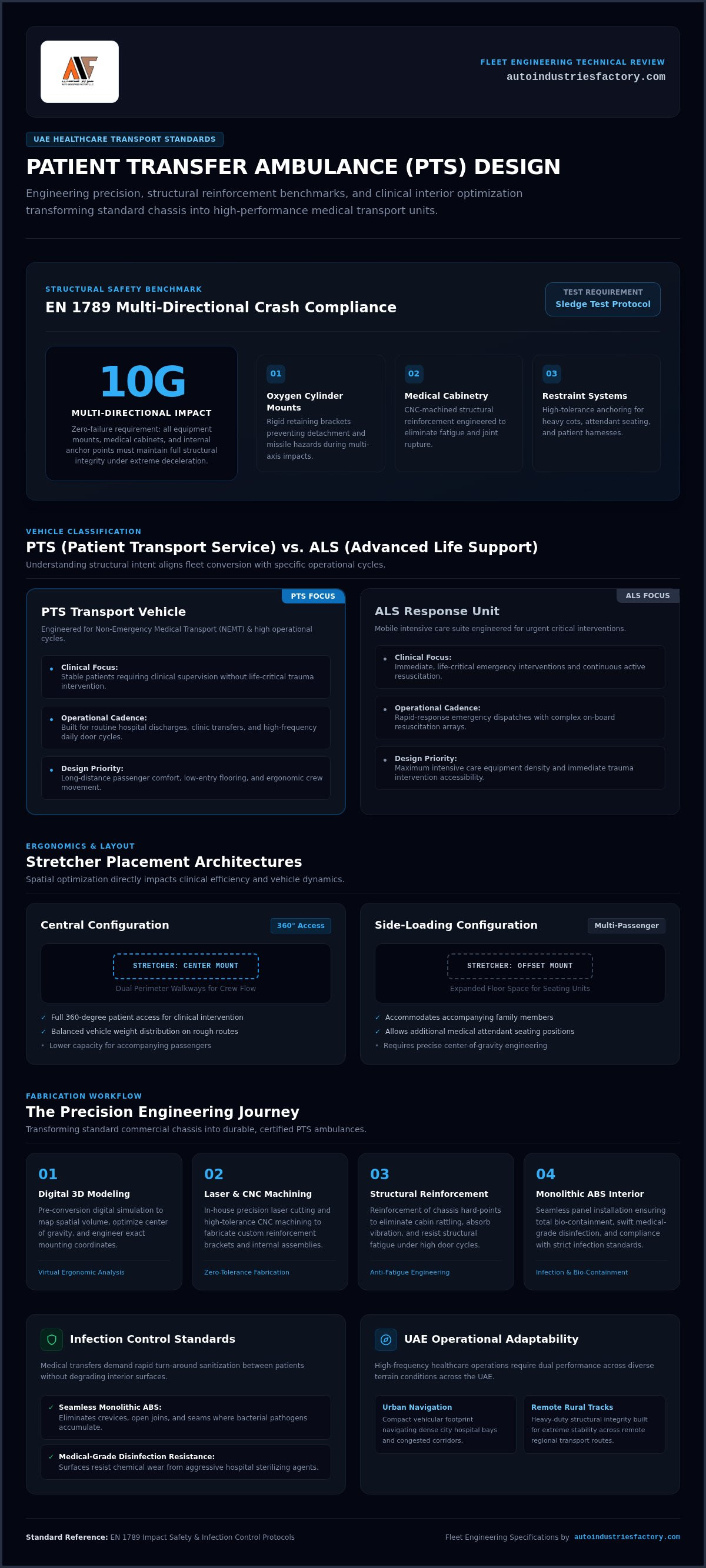
The mission of a Patient Transport Service (PTS) vehicle is distinct and specialized. It focuses on non-emergency medical transport (NEMT) for stable patients who require clinical supervision but not life-critical intervention. Effective patient transfer ambulance design prioritizes ergonomic efficiency and long-distance comfort over the rapid-response trauma capabilities found in emergency units. While Advanced Life Support (ALS) units are mobile intensive care suites, a PTS unit is a specialized transport solution built for high-frequency operational cycles. Understanding the nuances in ambulance design classifications is essential for fleet managers looking to optimize their resources and ensure patient safety.
To better understand how these medical environments are organized for maximum efficiency, watch this helpful video walkthrough:
Standard passenger vans often fail under the weight of medical transport demands. They don't have the structural integrity required for heavy medical cabinetry or the stress of repeated door-cycle usage. A purpose-built environment uses in-house laser cutting and CNC machining to ensure every reinforcement point is exact. This level of precision prevents cabin rattling and structural fatigue, which are common in inferior conversions. For a durable UAE fleet, the transition from a standard chassis to a medical unit must involve professional fabrication to meet the high stakes of the industry.
The Role of PTS in Healthcare Fleets
PTS vehicles reduce the burden on emergency response units by handling routine discharges and clinic transfers. Their compact design allows for better navigation through tight urban spaces and remote rural tracks across the UAE. Because these vehicles face high-frequency, daily use, every interior component must be rugged. Choosing specialized ambulance conversions ensures the unit remains operational rather than sitting in a repair bay, providing a reliable solution for national healthcare providers.
Regulatory Compliance and Safety Standards
Compliance in the UAE requires adherence to strict national safety standards. Structural requirements are non-negotiable, particularly for oxygen cylinder storage and attendant seating. Under standards like EN 1789, equipment mounts must survive a 10G multi-directional sledge test. This ensures oxygen brackets and medical cabinets won't detach during a collision. Every weld and bolt in the patient transfer ambulance design serves a protective purpose, turning a standard vehicle into a secure, medical-grade environment that protects both patients and staff.
Ergonomics and Interior Layout Optimization
Precision in patient transfer ambulance design starts with the spatial relationship between the patient and the provider. It's not enough to simply install equipment; you must engineer the flow of the cabin to ensure every second of care is efficient. Maximizing floor space requires a strategic approach to stretcher placement. While a central configuration offers 360-degree patient access for clinical intervention, side-loading layouts often provide better accommodation for accompanying family members and additional medical attendants. This decision directly impacts the vehicle’s center of gravity and overall stability during transport across the UAE's diverse road conditions.
Every layout choice must adhere to rigorous crash-test standards for ambulance patient compartments. This includes the integrity of seat restraints and the mounting systems for heavy medical cots. In a professional fabrication environment, in-house CNC machining creates high-tolerance structural reinforcements that keep these systems secure under extreme deceleration. If you're looking to optimize your fleet, you can explore our custom vehicle conversion solutions to see how we apply these precision engineering principles to every build.
Patient Comfort and Accessibility
A superior design prioritizes low-entry flooring and high-capacity ramp systems, typically supporting up to 500 kg to accommodate bariatric requirements and power stretchers. We integrate acoustic insulation to dampen road noise, which significantly reduces patient anxiety during long-distance transfers. Lighting design is equally critical; it must balance high-intensity clinical visibility for staff with dimmable, recessed options that allow for patient relaxation during transit.
Staff Efficiency and Safety
Reach-zone analysis is a non-negotiable part of the engineering process. Attendants shouldn't need to unbuckle their safety belts to access consumables or portable medical kits. We secure monitors and infusion pumps using mounts tested to survive 10G forces, ensuring heavy equipment stays put even during sudden maneuvers. Integrating hands-free communication between the cab and the patient compartment allows for seamless coordination without distracting the driver, maintaining a secure environment for all occupants.
Structural Engineering and Heavy-Duty Fabrication
The foundation of any high-performance patient transfer ambulance design lies in its structural integrity. At Auto Industries Factory LLC, we move beyond basic assembly by applying a master craftsman approach to vehicle modification. We utilize in-house laser cutting and CNC machining to produce precision-fit medical cabinetry and structural reinforcements that meet high-tolerance specifications. This technical precision is essential because standard vehicle frames aren't built to support the concentrated weight of medical systems over a long operational lifespan. By engineering custom sub-frames and utilizing advanced welding standards, we ensure every conversion remains robust under the most demanding UAE road conditions.
Fleet protection is another critical aspect of our engineering process. We manufacture and integrate heavy-duty bull bars and rear bumpers designed to protect the vehicle’s vital components from operational impacts. These additions aren't just for aesthetics; they are mission-critical shields that reduce vehicle downtime and maintenance costs. This focus on ruggedness ensures that your transport units remain in service, protecting both your investment and the patients you serve.
Chassis and Body Modifications
Standard van floors require significant reinforcement to handle the load of heavy medical equipment and hydraulic stretcher systems. We engineer these reinforcements to distribute weight evenly across the chassis, preventing structural fatigue. For popular platforms like the Toyota Hiace and GMC, we fabricate custom roof extensions that provide the necessary standing height for medical attendants without compromising the vehicle’s center of gravity. When a mission requires maximum interior volume, our team handles complete body fabrication for box-type ambulance configurations, built to national safety standards.
Precision Metalwork in Medical Interiors
We prioritize lightweight aluminium cabinetry over traditional wood or plastic composites. Aluminium offers superior durability and is fundamentally better for ambulance infection control and environmental decontamination due to its non-porous nature and resistance to harsh medical-grade cleaners. Our technicians also produce custom-fabricated oxygen manifolds and bracketry, ensuring life-support systems are vibration-resistant and securely mounted. You can explore our vehicle fabrication capabilities to see how our in-house manufacturing creates a more reliable, easy-to-maintain medical environment.
Infection Control and Environmental Systems
Superior patient transfer ambulance design must address the invisible threats of cross-contamination and environmental stress. While structural integrity protects against physical impact, the interior environment protects against clinical risks. Engineering a medical compartment for the UAE market requires a dual focus on rigorous hygiene standards and high-performance climate control. Every surface and system we integrate serves to create a sterile, stable environment that withstands the region’s extreme operational demands.
Material Selection for Durability and Hygiene
We prioritize non-porous, medical-grade materials that resist bacterial accumulation and withstand aggressive decontamination protocols. Fiber Reinforced Plastic (FRP) wall panels provide a seamless, impact-resistant surface that is easy to sanitize compared to traditional jointed panels. Our fabrication process includes the following features to ensure long-term hygiene:
- Seamless Flooring: We install heavy-duty, chemical-resistant vinyl flooring with coved edges. This prevents fluids and bacteria from pooling in corners or floor-to-wall transitions.
- Antibacterial Coatings: High-touch metal surfaces, including grab rails and cabinetry handles, receive specialized coatings to reduce pathogen survival rates.
- Precision Gapping: Using CNC machining, we ensure all interior components fit with minimal tolerances, eliminating dirt traps and recesses that are difficult to clean.
Climate Control in Specialized Vehicles
Operating in the national UAE climate demands HVAC systems that go far beyond standard automotive specifications. We engineer independent rear air conditioning units specifically for the patient compartment, ensuring the cabin stays at a clinical temperature even when external heat exceeds 45°C. To maintain this performance, we apply multi-stage thermal insulation layers throughout the vehicle body to minimize heat transfer from the exterior shell.
Reliability is critical during patient handovers. We integrate dual-battery systems or standalone lithium-ion auxiliary power packs to run environmental controls during engine-off periods. These systems provide up to 4.5 continuous hours of high-output climate control without the need for engine idling. This prevents engine wear and ensures a comfortable environment for stable patients during stationary periods. For infectious disease transport, our designs incorporate HEPA filtration (H13 or H14 rating) and negative pressure systems capable of achieving at least 12 air changes per hour (ACH). This level of engineering precision ensures your fleet meets the highest global benchmarks for bio-containment and patient safety.
If you need a fleet that remains operational in extreme conditions while meeting strict medical standards, contact us to discuss your custom ambulance conversion requirements.
The Conversion Journey: From Standard Van to Specialist PTS
The transition from a standard commercial van to a specialized medical unit is a rigorous engineering process. It begins with a detailed consultation to map fleet requirements and define the specific operational mission. Every patient transfer ambulance design starts as a digital blueprint. We use 3D modeling to visualize the medical interior before a single piece of metal is cut. This ensures that every bracket, cabinet, and oxygen manifold fits perfectly within the specific dimensions of the Toyota Hiace or GMC chassis, optimizing every square centimeter of available space.
Once the design is finalized, the fabrication phase begins in our specialized facility. We utilize in-house laser cutting and CNC machining to create high-tolerance structural reinforcements. These components are professionally welded into place to ensure the vehicle can handle the constant stress of high-frequency medical transport. This isn't simple assembly; it's a deep structural transformation. We reinforce the floors and assemble the medical cabinetry with the same master craftsman approach used in our mission-critical military and police modifications. This ensures every weld and joint is built for long-lasting performance and rugged reliability.
Customization and Branding
A unified fleet presence is essential for professional medical services across the UAE. We provide professional vehicle painting and high-visibility livery integration to ensure a consistent appearance. This process includes applying reflective markings and fleet-specific decals that meet national safety standards. A professional, clean exterior builds trust with patients and healthcare partners alike. You can learn more about our conversion process and how we handle large-scale fleet branding and customization projects.
Quality Assurance and Delivery
The final stage of the journey involves exhaustive quality assurance testing. We conduct electrical system stress testing to ensure medical reliability under full operational load. Every lighting circuit, HVAC unit, and auxiliary power pack is checked for sustained performance in high-ambient temperatures. Final safety inspections verify that all equipment mounts and structural modifications meet the 10G impact requirements essential for patient protection. After delivery, we provide comprehensive post-delivery support to ensure your specialized fleet remains operational. We don't just deliver vehicles; we deliver mission-ready solutions certified for national safety compliance.
Engineering a Future-Ready Patient Transport Fleet
Superior patient transfer ambulance design is the result of merging clinical necessity with heavy-duty fabrication. Throughout this guide, we've explored how structural reinforcements and high-tolerance interior layouts create a safer environment for both patients and medical staff. From seamless infection control surfaces to advanced HVAC systems capable of withstanding the UAE's extreme heat, every engineering choice must prioritize long-term durability and safety compliance.
At Auto Industries Factory LLC, we apply a master craftsman approach to every vehicle conversion. We utilize in-house CNC and laser cutting precision to ensure every component fits perfectly within Toyota Hiace and GMC platforms. This rugged engineering ensures your fleet remains operational and reliable for mission-critical transport. By focusing on precision metalwork and customized medical interiors, we help you eliminate compliance anxiety and reduce vehicle downtime. It's about protecting your passengers and your professional reputation through engineering excellence.
Request a Technical Consultation for Your Ambulance Fleet today to optimize your vehicle transport solutions. Let's build a fleet that sets the national standard for safety and performance.
Frequently Asked Questions
What is the primary difference between a PTS and a BLS ambulance design?
The primary difference lies in the clinical mission and equipment payload. While Basic Life Support (BLS) units are engineered for emergency intervention with intensive care equipment, a patient transfer ambulance design focuses on the comfort and safety of stable patients during non-emergency transport. PTS vehicles prioritize ergonomic seating and accessibility for mobility-impaired passengers, whereas BLS units require 360-degree patient access for resuscitation and trauma care.
Which vehicle platforms are best for patient transfer ambulance conversions?
The Toyota Hiace and GMC Savana are the most reliable platforms for specialized conversions in the UAE. These vehicles offer the structural durability needed for heavy-duty medical interiors and high-frequency operational cycles. We utilize these chassis because they allow for extensive customization, including extended roofs and structural reinforcements. Their widespread parts availability ensures minimal fleet downtime and long-term mechanical reliability for national transport services across the country.
How long does a typical patient transfer ambulance conversion take?
Conversion timelines depend on the complexity of the medical interior and specific fleet requirements. The process involves digital 3D modeling, precision laser cutting, and structural assembly followed by a rigorous quality assurance phase. While simple fit-outs are faster, comprehensive conversions involving roof extensions or specialized electrical systems require more time to ensure national safety compliance. We focus on engineering precision to deliver a mission-ready vehicle that meets all technical specifications.
What materials are best for ambulance interiors to ensure infection control?
Non-porous, medical-grade materials are essential for effective infection control. We prioritize Fiber Reinforced Plastic (FRP) for wall panels and lightweight aluminum for cabinetry because these surfaces don't harbor bacteria and resist harsh disinfectants. Seamless vinyl flooring with coved edges is also critical. It prevents fluids from pooling in corners, ensuring the patient transfer ambulance design remains easy to sanitize and clinically safe for every patient journey.
Can a patient transfer ambulance be converted into a 4x4 for off-road use?
Yes, we specialize in reinforcing high-performance platforms like the Toyota Land Cruiser for off-road medical missions. This involves modifying the suspension and adding protective body components like custom bull bars and underbody shielding. These 4x4 conversions are ideal for remote clinic transfers or desert-based medical support where standard vans cannot operate. Every modification is engineered to maintain structural integrity while navigating the challenging and rugged terrain of the UAE.
What are the essential electrical requirements for a PTS vehicle?
A reliable PTS vehicle requires a robust dual-battery system or a standalone lithium-ion auxiliary pack to power medical equipment and climate control independently of the engine. Essential components include pure sine wave inverters for sensitive medical devices, high-intensity LED lighting, and medical-grade refrigeration. We stress-test these electrical systems to ensure they maintain full operational load during long-distance transfers and stationary patient handovers, ensuring total reliability for medical staff.
How do heavy-duty AC systems impact ambulance design in high-heat climates?
High-heat environments necessitate independent rear AC units that are separate from the driver's cabin system. This requires significant structural planning to integrate multi-stage thermal insulation and high-output ventilation ducts throughout the patient compartment. The design must also account for increased electrical demand and heat dissipation. Our engineering ensures the cabin remains at a stable clinical temperature even when external national temperatures exceed 45 degrees Celsius during the peak summer months.
Is it possible to customize the seating capacity in a PTS ambulance?
We provide complete customization of seating layouts to meet your specific fleet needs. Using heavy-duty recessed floor tracking, the cabin can be reconfigured to alternate between stretchers, wheelchairs, and fixed attendant seating. This flexibility allows operators to maximize passenger capacity while ensuring every seat meets national safety standards for restraint integrity. Every layout is modeled in 3D during the design phase to optimize floor space and ensure crew accessibility.


