
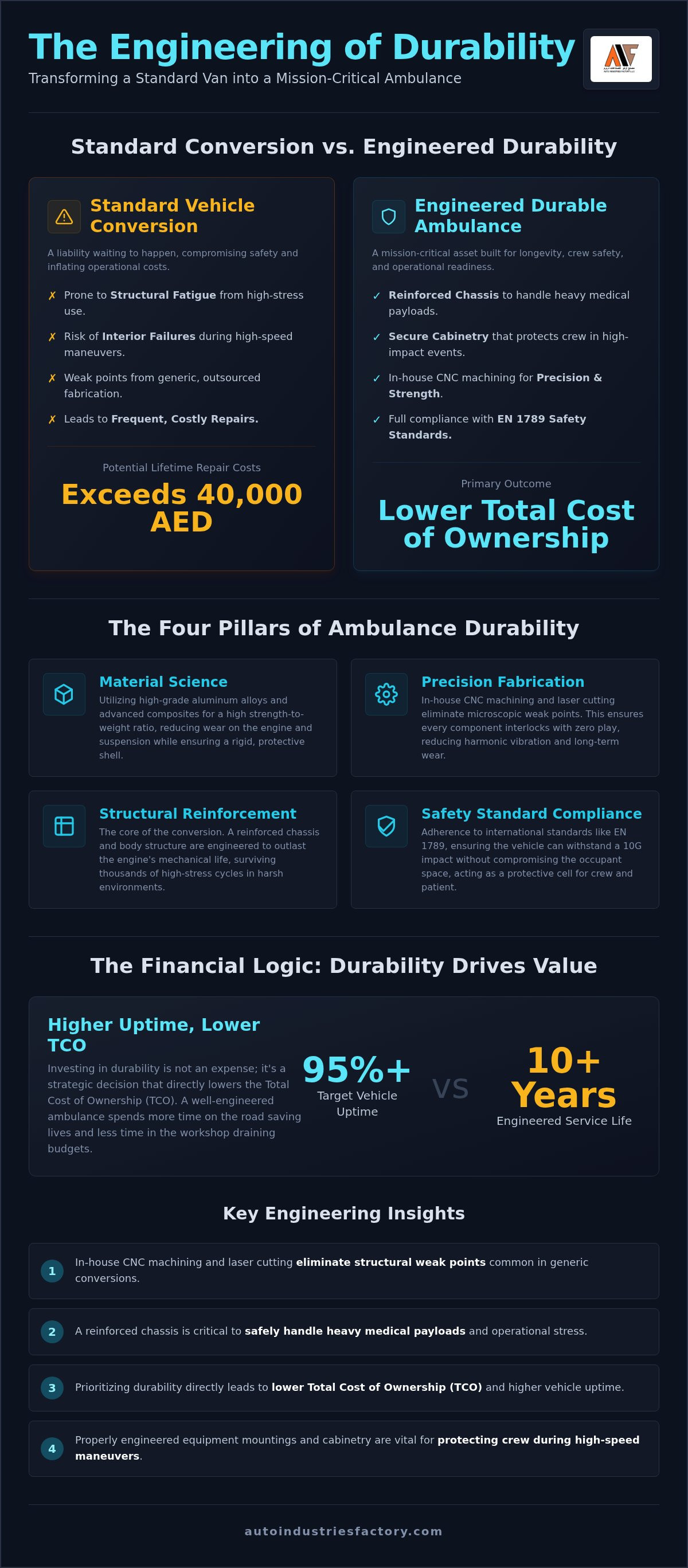
A standard vehicle conversion isn't an ambulance. It's a liability waiting for its first high-speed turn or heavy-impact collision. You understand that in the high-stakes environment of UAE emergency response, ambulance durability is the only metric that truly matters. When a vehicle's pushed to its limits daily, the difference between a successful mission and a catastrophic mechanical failure lies in the invisible engineering beneath the chassis. Poorly converted vehicles often lead to structural fatigue and interior failures that compromise safety and drain your operational budget through constant repairs that can easily exceed 40,000 AED over the vehicle's lifespan.
We're pulling back the curtain on the technical standards and fabrication secrets that transform a base platform into a mission-critical asset. You'll discover how precision metalwork, advanced CNC machining, and structural reinforcement create a vehicle that survives extreme operational stress while lowering your total cost of ownership. This article breaks down the specific safety protocols for interior cabinetry and equipment mounting that ensure your crew stays protected during high-impact events. We'll provide a clear look at the engineering required to achieve higher vehicle uptime and full compliance with international safety standards like EN 1789.
Key Takeaways
- Learn how in-house CNC machining and laser cutting eliminate the structural weak points often found in generic vehicle conversions.
- Understand the critical engineering differences between a standard commercial van and a reinforced chassis designed for heavy medical payloads.
- Discover how prioritizing high-level ambulance durability directly correlates to a lower Total Cost of Ownership and significantly higher vehicle uptime.
- Explore the technical standards for interior cabinetry and equipment mounting that ensure crew safety during high-speed emergency maneuvers.
- Identify the specialized metalwork, including custom-fabricated bull bars and rear bumpers, required to protect your fleet from extreme operational wear.
Defining Ambulance Durability in 2026: More Than Just a Rugged Exterior
True ambulance durability isn't just about a thick coat of paint or heavy-duty sirens. It's the technical intersection of structural integrity, material longevity, and system reliability. For emergency fleets operating in 2026, durability means the vehicle remains a safe, stable clinical environment after years of punishing service. It's an engineered outcome where every weld and bracket is designed to outlast the mechanical life of the engine itself.
This durability is the primary factor in emergency vehicle safety. When an ambulance navigates high-speed turns or sudden stops, the kinetic energy transferred to the interior cabinetry and medical equipment is immense. If the conversion lacks structural depth, these components can become projectiles during a collision. Beyond safety, durability dictates patient outcomes. A vehicle that vibrates excessively or suffers from structural fatigue creates an unstable environment for critical medical procedures performed in transit.
UAE emergency services face unique challenges. The combination of extreme ambient temperatures and 24/7 high-speed operations creates a high-wear environment that standard commercial vehicles aren't built to handle. Every deployment is a high-stress cycle for the chassis and the conversion. The ultimate goal of a durable build is "Mission-Ready" status. This means your fleet stays on the road rather than in the workshop, ensuring that help is always available when the call comes in.
The Role of International Standards
Benchmarks like the EN 1789 and KKK-A-1822 standards serve as the foundation for 2026 durability requirements. These frameworks provide the technical specifications for crash-test ratings, which are the most direct reflection of a conversion's structural strength. Meeting these national and international requirements ensures that the box-type or extended-roof structure can withstand a 10G impact without compromising the occupant space. It's about ensuring the vehicle acts as a protective cell during the worst-case scenario.
Durability vs. Reliability: Knowing the Difference
Reliability is the baseline expectation that the vehicle starts every time you turn the key. Durability is the advanced engineering that ensures the vehicle stays intact and functional for a service life of 10 years or more. A reliable base van, such as a GMC or Toyota HiAce, provides the power, but it needs a durable conversion to survive the rigors of EMS work. Operational durability is the specific ability to withstand thousands of high-stress cycles, from heavy equipment loading to high-speed response. Auto Industries Factory LLC addresses this by using in-house laser cutting and CNC machining to ensure every component meets exact tolerances for long-term performance.
Engineering Resilience: Material Science and Precision Fabrication
Structural consistency isn't a happy accident. It's the result of a controlled, in-house manufacturing process where every design file translates perfectly to the workshop floor. When fabrication is outsourced, tolerances slip and structural weak points emerge. In-house control ensures that every weld and joint meets the rigid specifications required for mission-critical reliability. This master craftsman approach allows for the seamless integration of complex medical systems into the vehicle's skeletal frame.
High-grade aluminum alloys and advanced composites are the backbone of modern builds. These materials provide the high strength-to-weight ratio essential for ambulance durability. By reducing the overall mass of the conversion, we minimize wear on the engine and suspension without sacrificing the rigid, protective shell needed for the crew and patient. Precision engineering at this stage prevents the structural fatigue that often plagues lower-quality conversions after only a few months of service.
Laser Cutting and CNC Precision
Laser-cut components eliminate the microscopic weak points common in manual fabrication. Our in-house laser cutting and CNC machining ensure that every bracket and frame interlocks with zero play. This precision fitment drastically reduces harmonic vibration during high-speed response. Vibration is the silent killer of vehicle conversions; it leads to loosened bolts, electrical shorts, and hairline fractures in the metalwork. Furthermore, CNC-machined metal cabinetry offers superior safety compared to standard wood or plastic. In a high-impact collision, these metal structures maintain their form, protecting occupants from flying debris and ensuring medical equipment remains securely anchored.
Corrosion Resistance and Protective Coatings
The harsh UAE environment, with its extreme heat and coastal salinity, can compromise metal structures in months if not properly treated. Professional painting and specialized protective coatings are mandatory for long-term survival. We apply industrial-grade finishes that seal every seam and joint, preventing rust from taking hold in the hidden recesses of the chassis. Professional welding techniques also play a role, as they eliminate the porous gaps where moisture often accumulates. For fleet managers looking to extend the service life of their vehicles, our professional vehicle painting and modification services provide a critical barrier against atmospheric corrosion, ensuring the vehicle looks and performs like new for years to come.
Structural Reinforcement: The Core of a Durable Ambulance Conversion
Standard commercial vans are designed to carry static cargo, not the dynamic, high-value payload of a mobile intensive care unit. While a delivery vehicle might handle heavy boxes, an ambulance must support a shifting weight of medical equipment and personnel under extreme centrifugal forces. Transforming a base vehicle into an "Emergency Ready" asset requires a complete re-engineering of the load-bearing surfaces. This structural reinforcement is what separates a short-lived conversion from one that provides years of mission-critical service.
High-level ambulance durability starts at the chassis level. We reinforce the primary stress points that dictate the vehicle's lifespan, specifically the flooring, oxygen tank mounts, and stretcher tracks. The floor isn't just a walking surface; it's a structural component that must support a 150kg stretcher and patient during high-G maneuvers. We use deep-anchor points for stretcher tracks to ensure they don't tear away from the sub-frame during emergency braking. Similarly, oxygen mounts are engineered to secure high-pressure cylinders that can become lethal projectiles if their mounting brackets fail during a collision.
Box Type vs. Van Type: Which is More Durable?
The structural advantages of a box-type ambulance are unmatched for heavy-duty ICU applications. These builds feature a rigid, custom-fabricated aluminum shell that offers superior torsional rigidity compared to standard van bodies. Because the box is a separate, engineered structure, it provides a more stable clinical environment and better protection in rollover scenarios. In contrast, an extended roof ambulance on a GMC or Toyota platform offers the urban agility needed for narrow streets while maintaining a reinforced interior. Modular box designs also allow for easier panel repairs, meaning a minor collision doesn't result in total vehicle downtime, effectively lowering your total cost of ownership.
Interior Integrity: Cabinetry and Mounts
A "rattle-free" interior is the hallmark of professional engineering. In a poorly converted vehicle, constant vibration leads to loose fasteners and failing cabinet doors within months. We utilize CNC-machined metal cabinetry and high-strength mounting brackets to ensure every component remains silent and secure regardless of road conditions. This interior integrity is a critical safety requirement. Mount durability ensures that heavy medical monitors and defibrillators stay anchored during high-speed response. For a deeper look at the technical requirements of these builds, read our comprehensive guide on Ambulance Conversion.
The Financial Logic: Total Cost of Ownership (TCO) and ROI
Procuring an emergency vehicle is a long-term capital investment where the sticker price is often the most misleading metric. While a lower-quality conversion might save money upfront, the subsequent maintenance costs and operational failures quickly erase those initial gains. A strategic focus on ambulance durability transforms the vehicle from a depreciating asset into a high-yield tool. Over a service life of 7 to 10 years, a precision-engineered build significantly lowers the Total Cost of Ownership by minimizing the frequency of structural and system repairs.
High-quality conversions also command a much higher residual value. In the UAE market, fleet managers recognize that a vehicle built with in-house CNC machining and laser-cut reinforcement maintains its integrity far better than a standard assembly-line modification. When it's time to decommission or upgrade, a durable vehicle retains its market value because the secondary buyer isn't inheriting a list of structural fatigue issues. This financial foresight ensures that your initial investment is protected throughout the entire lifecycle of the asset.
Reducing Fleet Downtime
The true cost of a poorly built ambulance is best measured in downtime. When a vehicle is out of service due to a failed cabinet mount or an electrical short, it creates a gap in emergency coverage and costs the provider thousands of AED in lost operational capacity. Robust electrical systems and high-grade medical mounts prevent these mid-mission failures. By utilizing easy-to-service components and accessible wiring looms, we ensure that necessary maintenance is fast and efficient. Ultimately, durability is an insurance policy against fleet obsolescence.
Longevity and Remounting Capabilities
One of the most significant economic advantages of a high-quality box-type ambulance is its ability to outlive its original chassis. A durable medical module, engineered with superior metalwork, can often be remounted onto a new vehicle frame once the original engine reaches its mileage limit. This "second life" for the medical box saves the provider from purchasing a completely new conversion, effectively doubling the ROI of the initial build. At Auto Industries Factory LLC, our history of specialized fabrication ensures that every module is built for this level of extreme longevity. If you are ready to optimize your fleet's financial performance, contact our engineering team for a technical consultation today.
Custom Durable Solutions from Auto Industries Factory
At Auto Industries Factory LLC, we treat every specialized vehicle conversion as a master craftsman project rather than a standard assembly line task. We don't just install equipment; we engineer comprehensive solutions. Our approach integrates advanced medical and communication systems into a ruggedized frame designed specifically for the UAE's unique operational demands. This ensures that ambulance durability is maintained even when the vehicle is equipped with heavy ICU gear and high-bandwidth telemetry systems. Our facility possesses the national capacity to serve large-scale emergency fleet requirements for both government and private sectors while maintaining the precision fitment of a custom engineering shop.
A critical part of our durability strategy involves external protection. We manufacture front metal bull bars and heavy-duty rear bumpers in-house to safeguard the vehicle's bodywork during high-stress deployments. These components aren't merely aesthetic; they are structural additions that absorb impact and prevent minor collisions from causing major vehicle downtime. By controlling the fabrication of these brush guards and bumpers, we ensure they integrate perfectly with the vehicle's safety sensors and cooling systems, maintaining the base platform's reliability while enhancing its ruggedness.
From Design to Deployment
Our in-house design team works directly with fleet managers to solve complex modification challenges before the first sheet of metal is processed. Having laser cutting, CNC machining, welding, and professional painting under one roof eliminates the quality variations found in fragmented supply chains. This vertical integration means every structural reinforcement and material choice is executed with absolute consistency. It allows us to pivot quickly between different vehicle platforms, such as GMC or Toyota, while keeping the same high standards of engineering excellence. You can explore our full range of technical capabilities and specialized services on the Auto Industries Factory LLC homepage.
Mission-Specific Customization
Durability must be adapted for specific mission profiles. We customize our builds for diverse environments, ranging from high-speed urban response to punishing 4x4 off-road and safari conditions. For vehicles operating in desert or remote terrain, we implement specialized suspension reinforcements and debris protection. Whether we are constructing a high-intensity ICU ambulance or a specialized medical workshop van, the core engineering remains focused on structural survival and crew safety. Our expertise in metal cutting and bending allows for bespoke interior layouts that maximize space without compromising the vehicle's center of gravity. For a detailed look at how we manage these technical stages from start to finish, read our guide on the Vehicle Conversion Process.
Secure Your Fleet with Engineered Resilience
Investing in a high-performance emergency vehicle requires moving beyond aesthetic modifications to focus on structural survival. We've explored how in-house laser cutting and CNC machining eliminate the weak points that lead to operational downtime. By prioritizing ambulance durability, you aren't just buying a vehicle; you're securing a mission-critical asset that delivers a lower total cost of ownership over a 10-year service life. Whether your operations require specialized box-type units or extended roof conversions, the foundation of every build must be rugged engineering that withstands the UAE's extreme conditions.
Don't let structural fatigue or interior failures compromise your response times. Our expert team combines master craftsmanship with precision technology to build ambulances that protect your crew and your budget. If you're ready to upgrade your fleet with vehicles built for extreme reliability, it's time to partner with a specialist who understands the high stakes of emergency medicine. Request a Technical Consultation for Your Fleet to see how our specialized fabrication can transform your operational readiness. Build for the mission, and ensure your fleet is always ready to save lives.
Frequently Asked Questions
What is the typical lifespan of a high-quality ambulance conversion?
A high-quality ambulance conversion typically has a service life of seven to ten years. While the mechanical chassis might reach its mileage limit sooner, the structural conversion, especially a box-type module, is engineered to endure years of operational stress. Proper maintenance and the use of corrosion-resistant materials ensure the interior systems and structural reinforcements remain mission-ready throughout the vehicle's entire deployment cycle.
How does structural reinforcement affect ambulance fuel efficiency?
Structural reinforcement involves adding mass, which can impact fuel consumption; however, the use of high-grade aluminum alloys minimizes this weight penalty. Precision fabrication also reduces aerodynamic drag and mechanical vibration. By optimizing the weight-to-strength ratio, engineers ensure that the vehicle remains durable without excessively increasing operational costs. This balance is critical for maintaining high performance during high-speed emergency responses across the UAE.
Can a durable ambulance module be transferred to a new chassis later?
Yes, a durable box-type ambulance module can be transferred to a new chassis. This process, known as remounting, is a significant economic advantage of high-quality builds. Because the medical module is a separate, reinforced structure, it often outlives the original vehicle's engine and transmission. Remounting allows fleet managers to refresh their fleet with new automotive technology while retaining their initial investment in the medical interior.
What materials are best for ambulance interior cabinetry durability?
CNC-machined aluminum and high-pressure composites are the superior choices for interior cabinetry. These materials offer maximum ambulance durability by resisting the constant vibration and heavy impact loads of emergency driving. Unlike standard wood or thin plastics, aluminum cabinetry won't splinter during a collision and provides secure anchor points for heavy medical monitors. This ensures a safer environment for both the medical crew and the patient.
How do international standards like EN 1789 measure vehicle durability?
International standards like EN 1789 measure durability through rigorous dynamic crash testing and equipment retention checks. These protocols ensure the conversion can withstand a 10G impact from multiple directions without structural failure. The standards also mandate specific vibration resistance levels for all interior components. Compliance with these benchmarks guarantees that the vehicle's structural integrity meets the highest safety requirements for national emergency services.
Does a more durable ambulance require more frequent maintenance?
A more durable ambulance does not require more frequent maintenance; it actually reduces the need for structural repairs. Low-quality conversions often suffer from loose cabinets, rattling panels, and electrical shorts caused by vibration. A precision-engineered vehicle remains tight and silent for longer periods. While standard engine and medical equipment checks are still necessary, the robust fabrication limits the downtime associated with fixing structural fatigue or mounting failures.
What are the most common points of failure in low-quality ambulance conversions?
Common failure points in low-quality conversions include cabinet hinges, floor-mounted stretcher tracks, and electrical wiring looms. Inadequately reinforced floors often warp under the weight of heavy medical gear, leading to track misalignment. Additionally, manual welds in the sub-frame can develop hairline fractures over time. These issues compromise safety and lead to high repair costs that quickly exceed the initial savings of a cheaper, non-specialized conversion.
How does climate affect the durability of specialized medical vehicles?
The UAE's extreme heat and coastal humidity can rapidly degrade specialized medical vehicles. High temperatures stress electrical systems and adhesives, while salt-laden air accelerates corrosion in untreated metal joints. Professional painting and industrial-grade protective coatings are essential to maintain ambulance durability in this environment. We utilize specialized insulation and corrosion-resistant alloys to ensure the vehicle's structural and electronic integrity remains uncompromised by the harsh local climate.


