

A mobile command vehicle is only as strong as its structural foundation. True operational success in high-stakes environments requires a hardware-first engineering approach that prioritizes ruggedness before the first wire is even run. When you're deployed in extreme climates, you can't afford to worry about chassis fatigue or a total communication blackout caused by inferior builds. It's a high-stakes challenge where "good enough" engineering leads to mission-critical equipment failure.
We understand that integrating complex tech systems into a single, mobile unit feels like a logistical nightmare. You need a platform that doesn't just house your technology but actively protects it. This guide explores how specialized mobile command vehicle conversion transforms standard chassis into advanced, mission-critical command and control centers. You'll learn how precision CNC machining and structural reinforcements create a ruggedized, reliable hub. We will preview the essential steps for seamless systems integration and the strict safety standards required for field-ready performance. Discover how expert engineering turns a standard vehicle into a strategic operational asset.
Key Takeaways
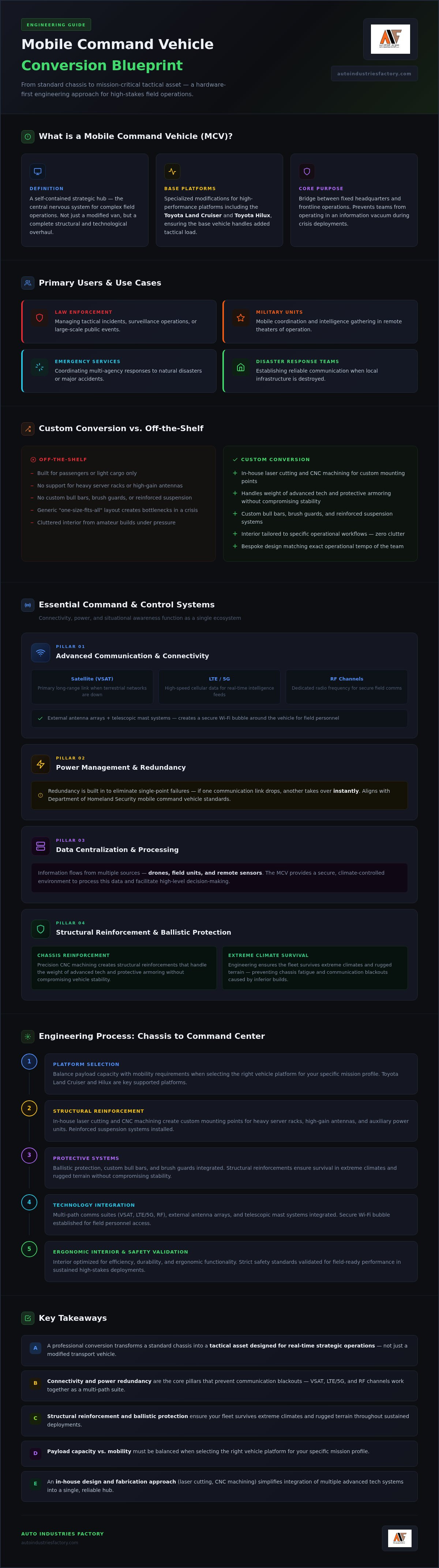
- Understand how a professional mobile command vehicle conversion transforms a standard chassis into a tactical asset designed for real-time strategic operations.
- Identify the core technology pillars, including connectivity and power redundancy, that prevent communication blackouts during critical field deployments.
- Learn the engineering requirements for structural reinforcement and ballistic protection to ensure your fleet survives extreme climates and rugged terrain.
- Discover how to balance payload capacity with mobility requirements when selecting the right vehicle platform for your specific mission profile.
- See how an in-house design and fabrication approach simplifies the complexity of integrating multiple advanced tech systems into a single, reliable hub.
What is a Mobile Command Vehicle Conversion?
A mobile command vehicle (MCV) is far more than a modified van with a few laptops. It is a self-contained strategic hub, designed to act as the central nervous system for complex field operations. The shift from a standard transport vehicle to a mission-critical tactical asset is a feat of precision engineering. A professional mobile command vehicle conversion involves a complete structural and technological overhaul. We take a standard chassis and transform it into a ruggedized platform capable of sustained operations in the most demanding environments.
This conversion process is essential for specific high-stakes users who can't afford equipment failure. We specialize in modifications for high-performance platforms like the Toyota Land Cruiser and Hilux, ensuring the base vehicle handles the added tactical load. Primary users include:
- Law Enforcement: For managing tactical incidents, surveillance operations, or large-scale public events.
- Military Units: For mobile coordination and intelligence gathering in remote theaters.
- Emergency Services: For coordinating multi-agency responses to natural disasters or major accidents.
- Disaster Response Teams: For establishing reliable communication when local infrastructure is destroyed.
Bespoke design is the only way to ensure operational success. A generic, "one-size-fits-all" layout creates bottlenecks during a crisis. We focus on creating a workspace that matches the exact operational tempo of the team using it. Every inch of the interior is optimized for efficiency, durability, and ergonomic functionality.
The Role of Command and Control in the Field
Effective command and control requires the centralization of massive amounts of data. In the field, information flows from multiple sources, including drones, field units, and remote sensors. An MCV provides the secure, climate-controlled environment needed to process this data and facilitate high-level decision-making. It serves as a vital bridge between a fixed headquarters and frontline operations. Without this mobile link, teams risk operating in an information vacuum. A well-engineered vehicle ensures that commanders have a reliable space to manage the mission without interruption, regardless of the chaos outside.
Why Conversion Beats Off-the-Shelf Solutions
Standard vehicles are built for passengers or light cargo. They aren't designed for mounting heavy server racks, high-gain antennas, or auxiliary power units. A custom mobile command vehicle conversion addresses these physical limitations through extensive structural reinforcement. We use in-house laser cutting and CNC machining to create custom mounting points that handle the weight of advanced tech and protective armoring without compromising vehicle stability.
Conversion allows for the integration of specialized police vehicle modifications that off-the-shelf models don't offer. This includes custom bull bars, brush guards, and reinforced suspension systems. By tailoring the interior layout to specific operational workflows, we eliminate the clutter that plagues amateur builds. You get a vehicle built to perform under pressure, ensuring your team stays connected and protected.
Essential Command and Control Vehicle Systems
Engineering a strategic hub requires more than just installing gear. It demands a holistic approach where connectivity, power, and situational awareness function as a single ecosystem. During a mobile command vehicle conversion, we prioritize redundancy to eliminate single-point failures. If one communication link drops, another must take over instantly. This level of reliability aligns with Department of Homeland Security mobile command vehicle standards, ensuring the hub remains operational during sustained deployments in high-stakes environments.
Advanced Communication and Connectivity
Connectivity is the lifeline of any command operation. We integrate multi-path communication suites including Satellite (VSAT), LTE/5G, and dedicated radio frequency (RF) channels. This setup creates a secure Wi-Fi bubble around the vehicle, allowing field personnel to access the network safely. To maximize range, we install external antenna arrays and telescopic mast systems. These tools ensure the hub stays connected to both the frontline and headquarters, even when local infrastructure is compromised.
Power Management and Redundancy
Mission-critical electronics require a stable, uninterrupted power source. Our builds feature high-capacity battery banks managed by intelligent charging systems. For stationary use, we integrate silent generators that provide power without compromising the vehicle's acoustic signature. When stationed at a base, shore power connections allow the vehicle to run indefinitely. This layered power strategy ensures that the command center never goes dark, regardless of how long the mission lasts.
Situational Awareness Tools
Seeing the whole picture is vital for rapid decision-making. Interior video walls and multi-screen stations display direct feeds from UAVs and tactical cameras. We also ensure seamless integration with armoured personnel carrier communication protocols, allowing for a unified tactical view across the entire fleet. This data-heavy environment requires precision mounting to protect sensitive screens from vibration and impact.
Long-duration missions take a toll on operators. We design ergonomic workstations with adjustable seating and climate control to maintain peak performance. We also build for the future. Systems are modular, allowing for the easy addition of new technology as mission requirements evolve. If you're looking for a partner to handle your next fleet upfitting challenge, focus on an engineering-first approach that guarantees reliability in the field.
The Engineering Process: From Chassis to Command Center
Every successful mobile command vehicle conversion begins with a rigorous tactical requirements analysis. We don't just guess; we use advanced CAD design to map out every component before a single piece of metal is cut. This phase ensures that the weight of servers, multi-screen stations, and ballistic protection doesn't compromise the vehicle's center of gravity or handling. Our engineering team calculates payload capacities for specific platforms like the Toyota Land Cruiser and Hilux to guarantee that the modified unit remains agile and safe in the field.
Structural Fabrication and Reinforcement
We take a hardware-first approach to durability. Using in-house laser cutting and CNC machining, we create precise mounting points that standard automotive shells lack. Standard chassis require significant modification to handle the increased payload of mission-critical technology. We build internal racking systems specifically for high-vibration environments, ensuring sensitive electronics stay seated during high-speed or off-road transit. To protect the exterior from environmental hazards, we integrate custom bull bars and bumpers that shield the vehicle's vital components from impact.
Climate Control and Thermal Management
Sensitive electronics and human operators both fail when exposed to extreme national temperatures. Our builds feature heavy-duty HVAC systems designed to maintain a stable internal climate even when external temperatures soar. We apply advanced insulation layers to prevent heat soak from the exterior metal shell, which is critical for protecting server racks from thermal throttling. Airflow optimization is a key part of our design process; we ensure that the heat generated by on-board computers is efficiently vented away from operator stations to maintain comfort during long-duration missions.
Interior Fit-Out and Ergonomics
The interior of a strategic hub must be both functional and resilient. We manufacture custom metal cabinetry and anti-glare workstation surfaces that withstand years of heavy field use. For night operations, we install tactical lighting with dedicated blackout and red-light modes to preserve operator night vision and maintain a low profile. Safety during transit is non-negotiable. We install safe, shock-absorbing seating to protect personnel from injury during rapid transport over rugged or unpredictable terrain. Every element is designed to minimize fatigue and maximize operational focus.
The final stage involves a professional vehicle color change and rigorous field testing. We don't consider a build complete until every system has been stress-tested under simulated mission conditions to ensure total reliability.
Selecting the Right Platform for Your Mobile Command Vehicle
Choosing the base chassis is the most critical decision in the engineering process. It dictates the ultimate payload capacity, geographic reach, and durability of the strategic hub. We don't just pick a vehicle; we match the platform to the mission's specific tactical needs. A mobile command vehicle conversion must account for the weight of integrated technology while maintaining the mobility required for rapid deployment. We prioritize platforms with high parts availability to ensure that national fleet operations remain uninterrupted by maintenance delays.
Van-Based Command Units
Vans are the industry standard for urban environments where a smaller footprint and rapid deployment are essential. High-roof options, such as the Toyota Hiace or GMC models, provide the necessary vertical space for operators to work comfortably for long durations. These units are ideal for incident command and mobile surveillance operations. Their discreet appearance allows them to blend into city traffic while housing a fully functional command and control suite. They offer a balance of interior volume and maneuverability that larger trucks can't match in tight spaces.
Truck and SUV-Based Tactical Units
For operations in remote areas or along rugged border zones, superior off-road capability is a non-negotiable requirement. We utilize high-performance platforms like the Toyota Land Cruiser and Hilux for these builds because of their proven reliability in extreme climates. These vehicles provide the structural strength needed for extensive reinforcement and car armouring in high-threat environments. Their 4x4 systems ensure that the command center can reach the frontline, regardless of the terrain, providing a robust and reliable mobile hub for tactical teams.
Large-Scale Command Trailers
When the mission involves multi-agency coordination or requires a large team of operators, large-scale command trailers offer the maximum available workspace. These units serve as semi-permanent strategic hubs for long-term disaster recovery sites or major public events. Because of their significant weight, they require heavy-duty towing vehicles equipped with reinforced suspensions and specialized braking systems. This platform allows for the most extensive technology integration, including full-sized video walls and multiple redundant server racks.
Every mission has a unique profile that demands a specific engineering response. If you're ready to begin your next mobile command vehicle conversion, explore our specialized vehicle conversion solutions to find the platform that fits your operational requirements.
Custom Mobile Command Solutions by Auto Industries Factory
Auto Industries Factory LLC provides a solution-oriented approach to complex fleet challenges. We don't just assemble components; we engineer mission-specific units from the ground up. Our "In-House" advantage is central to our process, offering complete control over design, structural reinforcement, and final fabrication. By managing every stage of the mobile command vehicle conversion within our facility, we eliminate the risks associated with third-party contractors. This ensures that every weld, cut, and system integration meets our uncompromising standards for durability and performance.
Our expertise extends across a wide range of mission-critical applications. We apply the same engineering precision to our ambulance conversion projects as we do for our high-threat military and police modifications. This diverse experience allows us to build vehicles that are as safe as they are technologically advanced. Every build undergoes rigorous quality control to ensure it complies with national safety standards, providing operators with a reliable, ruggedized environment for sustained field operations.
Why Professional Fabrication Matters
Precision engineering is the difference between a successful mission and equipment failure. We utilize advanced in-house laser cutting and CNC machining to ensure the perfect fitment of tactical gear, server racks, and communication arrays. This level of precision prevents structural fatigue and protects sensitive electronics from the vibrations of off-road transit. Our master craftsmen also provide professional painting and finishing, ensuring your unit maintains a unified and authoritative fleet appearance. Because we handle the engineering in-house, your team has direct access to the experts for any post-delivery modifications or future technological upgrades, ensuring your fleet remains at the cutting edge.
Ready for Your Command Center?
The path to a reliable strategic hub starts with a technical consultation. We don't believe in "off-the-shelf" solutions for tactical needs. Our process involves a comprehensive assessment of your bespoke requirements, from ballistic protection levels to specific connectivity suites. We specialize in high-performance platforms like the Toyota Land Cruiser and Hilux, ensuring your command center has the power and mobility to perform in any environment. Explore our specialized vehicle services to see the full scope of our modification capabilities. Contact us today to begin the technical assessment of your fleet and partner with an engineering leader dedicated to your operational success.
Deploying Your Mission-Critical Strategic Hub
A successful mobile command vehicle conversion requires more than just high-tech equipment; it demands a foundation of rugged engineering and precision fabrication. We've explored how structural reinforcement and system redundancy prevent single-point failures in the field. From selecting the right high-performance chassis to integrating complex UAV feeds, every decision must prioritize reliability under pressure. A hardware-first approach ensures that your technology remains protected, regardless of the environment.
At Auto Industries Factory LLC, we leverage our full in-house fabrication facility to maintain total control over every build. As specialists in rugged tactical conversions, we use precision CNC and laser engineering to ensure your gear fits perfectly and survives extreme climates. We don't just deliver a product; we provide a comprehensive solution for your most complex fleet challenges. Our commitment to national safety standards and master craftsmanship means your team can focus on the mission with total confidence in their equipment.
Ready to upgrade your fleet with a hub built for the frontline? Request a Technical Consultation for Your Command Vehicle today. Let's build a platform that protects your team and secures your operational success.
Frequently Asked Questions
What are the primary systems included in a mobile command vehicle conversion?
A professional mobile command vehicle conversion includes three core pillars: connectivity, power, and situational awareness. We integrate multi-path communication suites like VSAT and 5G along with redundant power systems such as high-capacity battery banks and silent generators. For tactical decision-making, we install video walls and multi-screen stations that display direct feeds from UAVs. Every system is built using in-house CNC machining to ensure structural durability and seamless technical integration.
Can you armor a mobile command vehicle for high-risk operations?
Yes, we specialize in complete structural reinforcement and armoring for high-threat environments. Our engineering team handles ballistic protection integration during the conversion process, ensuring the vehicle can withstand tactical threats without compromising mobility. We utilize precision laser cutting and welding to add protective layers to the chassis and cabin. This transformation is ideal for military and police units operating in volatile regions where safety and protection are mission-critical requirements.
How long does the mobile command vehicle conversion process take?
The timeline for a conversion project depends on the complexity of the integrated systems and the level of structural modification required. The process moves through tactical requirements analysis, CAD design, fabrication, and final testing. While timelines vary based on your specific fleet needs, our in-house design-to-delivery model streamlines the workflow. We manage every stage within our facility to minimize delays and ensure the final unit meets our rigorous quality control standards for deployment.
Which vehicle platforms are best for off-road command centers?
For off-road and remote operations, we recommend high-performance platforms like the Toyota Land Cruiser and Hilux. These vehicles offer the rugged durability and 4x4 capability necessary for border patrol or disaster response in difficult terrain. We reinforce the suspension and add custom bull bars to protect vital components. These platforms have high parts availability nationally, ensuring your fleet remains operational even after sustained use in extreme, unpaved environments.
Do you provide technical support for the integrated communication systems?
We provide direct access to our engineering team for support and post-delivery modifications. Since we handle the entire design and fabrication process in-house, our technicians have a deep understanding of your specific system architecture. This ensures that any troubleshooting or future technology upgrades are handled with precision. We don't just deliver a vehicle; we act as a solution-oriented partner to ensure your command and control systems remain reliable throughout their operational life.
Can an existing fleet vehicle be converted into a command unit?
Yes, we can transform existing fleet vehicles into specialized command units provided the chassis can support the intended tactical payload. Our engineers perform a thorough assessment of the vehicle's current condition and structural integrity before beginning the conversion. We use precision CNC machining to integrate new racking systems and power management tools. This mobile command vehicle conversion approach allows agencies to maximize their current assets while upgrading to a more advanced, mission-specific operational hub.
What power redundancy options are available for long-term missions?
To prevent single-point failures during long-term missions, we offer multiple power redundancy options. These include high-capacity battery banks, intelligent charging systems, and integrated silent generators for prolonged stationary use. We also install shore power connections for base-of-operations scenarios. This layered strategy ensures that mission-critical electronics and communication arrays stay powered indefinitely. Our engineering team calculates the total power draw to ensure the redundancy systems are perfectly matched to your operational tempo.
How do you ensure equipment stays cool in extreme national heat?
We manage extreme national heat through heavy-duty HVAC systems and advanced thermal insulation. Sensitive electronics are protected by dedicated cooling for server racks to prevent thermal throttling. We also apply high-performance insulation layers to the vehicle's shell to minimize heat soak from the exterior metal. Airflow optimization is a core part of our CAD design process, ensuring that both the equipment and the operators remain at peak performance levels during intense heat.


