
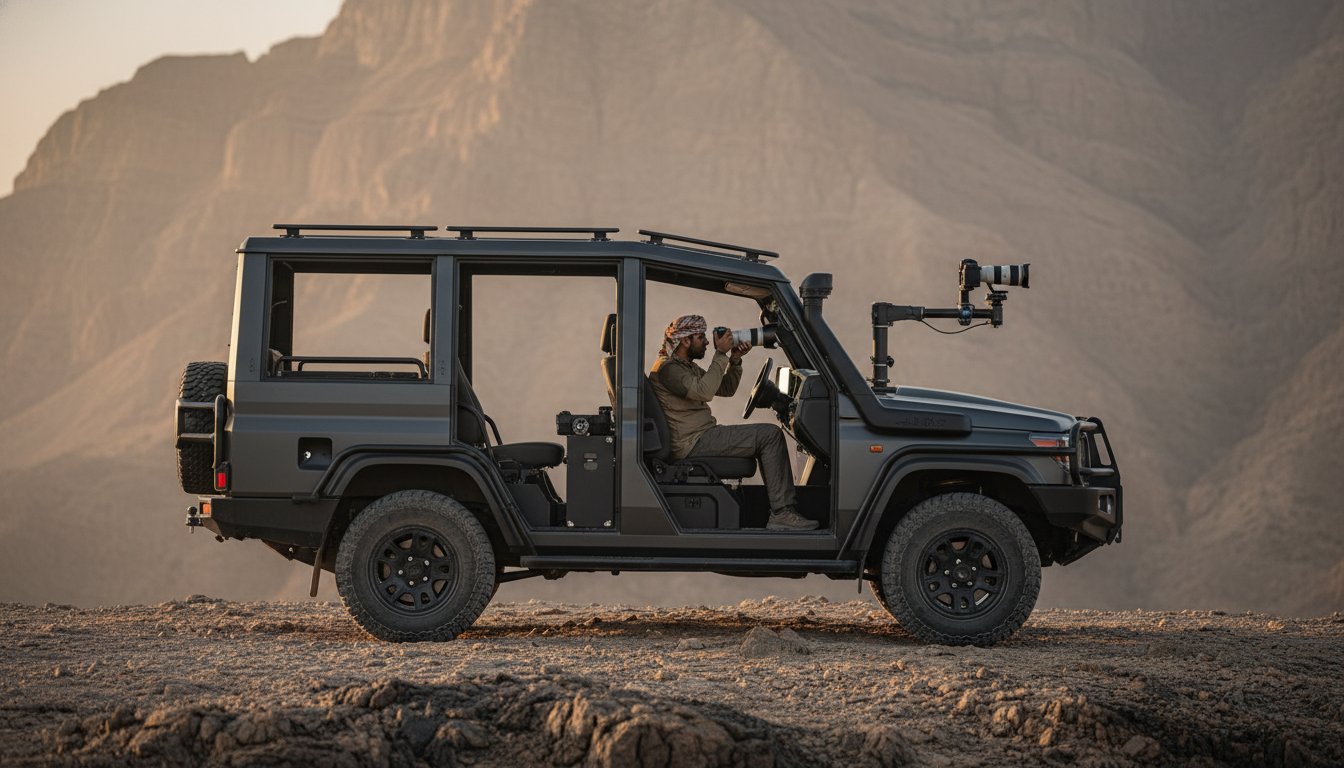
What if your vehicle was the primary reason you missed the shot of a lifetime? A true photography safari vehicle isn't just a modified truck; it's a precision-engineered tripod on wheels designed for ballistic-grade gear protection. You know the frustration of a rare leopard sighting being ruined because a standard vehicle pillar blocked your lens at the critical moment. Professional photographers understand that standard 4x4s aren't built for the technical demands of high-end wildlife capture. Based in Oman, Auto Industries Factory LLC provides specialized photography safari vehicle conversion solutions that solve these fundamental engineering flaws by removing visual obstructions and stabilizing the entire platform.
We agree that a field-ready unit must prioritize the lens over passenger count. You'll discover how specialized engineering transforms rugged platforms into professional-grade photography units that offer unobstructed views, gear safety, and technical precision. This guide details the structural reinforcement required for pillarless designs, the integration of mission-critical power systems, and the rigorous fabrication process that ensures your fleet is ready for the most demanding remote environments. From our facility in Oman, we position ourselves as a master craftsman for the global safari industry, delivering solutions where every millimeter of visibility is optimized for the professional eye.
Key Takeaways
- Learn how pillarless engineering and structural reinforcement eliminate visual blind spots while maintaining the vehicle's off-road durability.
- Discover the advantages of a photography safari vehicle conversion that utilizes tilt-down door panels for unique, floor-level camera angles.
- Understand the role of heavy-duty suspension tuning in dampening engine vibrations to provide a stable shooting platform for long-exposure photography.
- Identify the mission-critical electrical integrations, including pure sine wave inverters, required to charge high-end gear safely in the field.
- Gain insight into the expert fabrication journey, highlighting how in-house laser cutting and specialized welding produce custom, safari-ready components.
Beyond the Standard Safari: Why Specialized Photography Conversions Are Essential
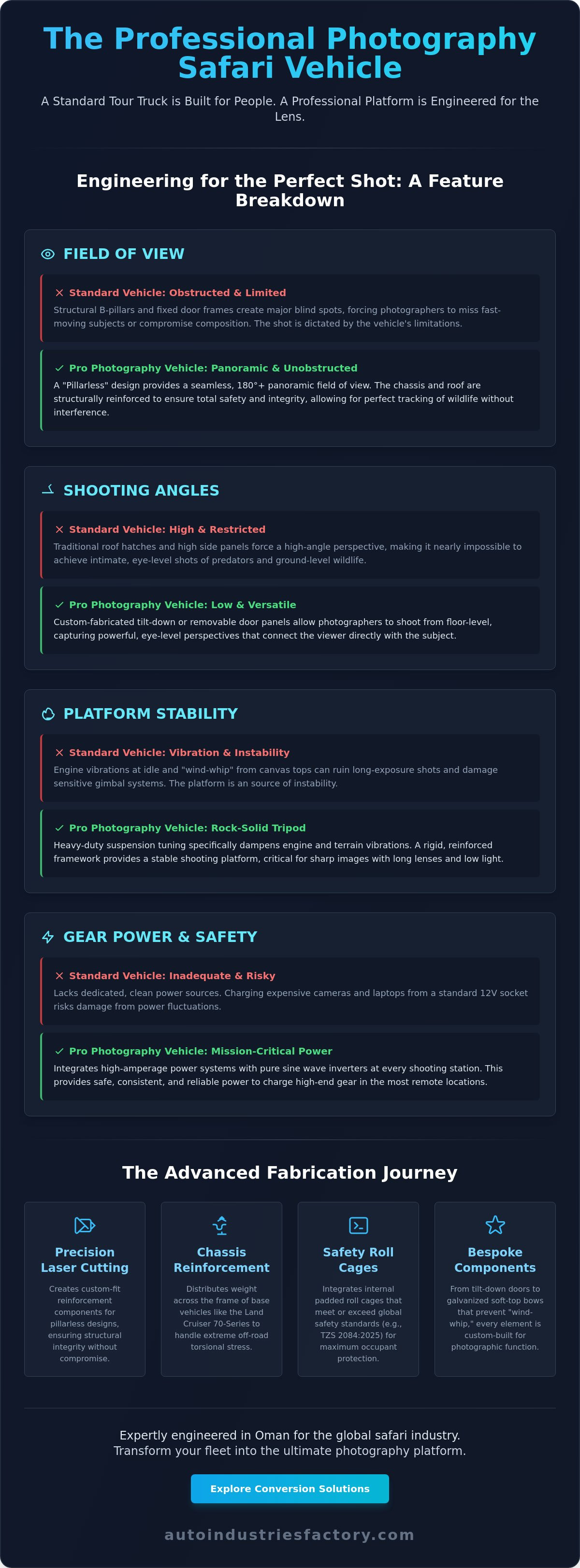
A standard tour vehicle is built for people; a photography safari vehicle conversion is built for the lens. While a typical safari vehicle prioritizes seating capacity to maximize revenue per trip, a professional platform prioritizes the arc of the shot. This requires a fundamental shift in engineering. You aren't just looking for a seat. You're looking for a 180-degree field of view that remains stable during a high-speed chase or a long-wait stakeout.
Achieving this panoramic view often involves a "Pillarless" design. Removing the structural B-pillars allows for unobstructed panning, but it creates massive structural risks if not handled correctly. This is where professional custom vehicle fabrication becomes mission-critical. The chassis and roof frame must be reinforced to ensure that visibility never comes at the cost of passenger safety or vehicle integrity in harsh off-road terrains.
To better understand how these technical features translate to the field, watch this helpful video:
The Limitations of Standard Roof Hatches
Traditional pop-tops often restrict low-angle shooting because the frame of the hatch sits too high. Photographers frequently need to get eye-level with predators. This is nearly impossible when confined to a standard roof opening. Additionally, standard canvas tops suffer from "wind-whip" during transit. This vibration isn't just annoying; it can damage sensitive gimbal mounts and long-lens stabilization systems over time. Professional builds replace these compromises with rigid, engineered solutions.
Defining the Professional Photography Unit
A professional photography conversion is a structural modification that prioritizes line-of-sight and gear stability over passenger volume. Success in these builds is measured by three distinct metrics: the degree of unobstructed view angle, the efficiency of vibration dampening at engine idle, and the consistent availability of high-amperage power at every shooting station. By focusing on these technical pillars, the vehicle becomes an extension of the camera rather than an obstacle to the perfect frame.
Engineering Unobstructed Views: Structural Reinforcement and Pillarless Designs
Removing the B-pillar is the defining technical challenge of a professional photography safari vehicle conversion. This modification provides the 180-degree panning range wildlife photographers require to track subjects without interference. Since the B-pillar is a critical load-bearing component, we don't simply cut it away. Our engineers in Oman utilize laser cutting and CNC machining to manufacture precision-fit reinforcement components. These parts distribute weight across the chassis of the Toyota Land Cruiser 70-Series or Hilux, ensuring the frame withstands the torsional stress of remote, uneven terrain without compromising the vehicle's structural lifespan.
Pillarless Conversions and Chassis Integrity
Occupant safety remains our primary directive. When pillars are removed, we integrate internal padded roll cages that meet rigorous safety specifications. While we adhere to global standards like Tanzania's TZS 2084:2025, our fabrication process is grounded in our Oman facility to ensure local and international durability requirements are exceeded. For soft-top configurations, we install galvanized bows that prevent "wind-whip" at high speeds. This rigid framework protects both the passengers and their sensitive optical equipment from the vibrations that often plague standard tour vehicles.
Custom Door and Panel Fabrication
Capturing eye-level wildlife shots requires moving beyond the constraints of a standard door. We fabricate custom fold-down rear panels that double as ultra-stable, floor-level shooting platforms. These panels support the combined weight of the photographer and high-end telephoto lenses without bowing or failing. This level of durability is only possible through industrial-grade hinges and expert metalwork. If you are planning a custom vehicle for photo expeditions, the door mechanics are as vital as the chassis. For operators looking to upgrade, our safari vehicle conversions provide the technical precision required for professional success.
Stabilization and Power: Integrating Mission-Critical Gear Protection
A high-performance photography safari vehicle conversion must function as both a mobile power station and a rock-solid tripod. Standard factory electronics are rarely equipped to handle the high-amperage demands of multiple high-end digital cameras and drones simultaneously. We integrate pure sine wave inverters to provide clean, stable power that won't damage sensitive gear. This technical precision ensures that every seat is a fully functional workstation with dedicated USB-C and AC charging points. By building these systems into the vehicle's core electrical architecture, we eliminate the need for unreliable external power banks.
Power Management for Expedition Photography
Dual battery systems with smart isolators are a requirement for remote expeditions. This configuration ensures that charging your equipment never drains the primary starter battery, even during long stationary periods in the bush. We prioritize strategic port placement and internal cable routing to prevent clutter in the shooting zone. This keeps the work area clear for 180-degree lens sweeps, allowing you to focus on the subject rather than managing tangled wires.
Suspension Tuning for Stationary Stability
Standard off-road suspension is often too bouncy for professional photography. When the engine is idling, vibration travels through the frame to the camera, which can ruin a critical shot at low shutter speeds. We tune heavy-duty suspension systems using adjustable dampers. This allows the operator to stiffen the platform during a shoot to minimize engine-idle shake. When it's time to move, the dampers can be adjusted to handle the rugged terrain of the Serengeti or the Kalahari without compromising the vehicle's durability.
Environmental protection is the final piece of the engineering puzzle. We fabricate sealed, dust-proof storage lockers to protect expensive sensors and lenses from the fine particulate matter found in arid safari environments. Ergonomics are also refined through custom-height armrests and 360-degree swivel seats that reduce physical fatigue during 12-hour tracking sessions. These integrated solutions turn a standard 4x4 into a precision instrument. Contact us for professional safari vehicle conversions that protect your technical investment and ensure every shot is razor-sharp.
The Fabrication Journey: From Design Consultation to Safari-Ready
Every photography safari vehicle conversion begins as a technical blueprint tailored to specific operational demands. Our Oman-based engineering team conducts a deep-dive consultation to map out lens clearance, storage accessibility, and crew workflow. We don't just build vehicles; we design mobile studios that must survive the world's most unforgiving landscapes. This phase ensures that the technical requirements discussed in earlier sections, such as vibration control and power distribution, are integrated into the final chassis design from day one.
At Auto Industries Factory LLC, we bridge the gap between design and deployment through vertical integration. Our facility in Oman houses advanced laser cutting and welding stations, allowing us to manufacture every custom bracket and reinforced panel in-house. This centralized control over the fabrication journey means we don't rely on third-party components. It ensures that every weld and cut meets our authoritative standards for mission-critical reliability before the vehicle ever touches the dirt.
Customizing for the Toyota Land Cruiser Platform
While we modify various 4x4s, the Toyota Land Cruiser 70-series remains our primary platform for professional photography units. Its mechanical simplicity allows our engineers to perform the deep structural modifications needed for professional photography without compromising the vehicle's legendary field-repairability. From our regional hub in Oman, we modify these chassis to withstand extreme thermal cycles and abrasive environments, ensuring they remain safari-ready for years of continuous operation.
Fleet Management and Scalability
For tour operators, consistency across a fleet is the difference between a smooth season and a logistical failure. We apply the same precision-engineered templates to every unit, ensuring that parts are interchangeable and the user experience is uniform. This standardized approach to quality control includes testing every conversion against high-vibration environments and applying protective finishes that resist intense UV exposure. To explore the broader technical requirements for these builds, read The Ultimate Guide to Safari Vehicle Conversions.
Engineering Your Competitive Edge in the Field
A professional photography safari vehicle conversion is the bridge between a good shot and a portfolio-defining masterpiece. We've explored how removing B-pillars creates the necessary 180-degree sightlines and how specialized vibration dampening ensures your images stay sharp even at engine idle. These technical solutions aren't just additions; they're fundamental structural re-engineerings of the Toyota Land Cruiser and Hilux platforms. By prioritizing gear safety and pure sine wave power availability, you ensure your equipment remains protected and ready for the most demanding expedition environments.
Our master craftsmen specialize in full structural reinforcement for pillarless designs, utilizing in-house CNC machining and laser cutting to produce precision-fit components. We understand the high stakes of professional wildlife photography and build rugged, reliable platforms that reflect that reality. Whether you're managing a luxury fleet or a private expedition unit, the engineering must be flawless to guarantee results. Contact our engineering team to design your custom photography safari vehicle today. We're ready to transform your technical requirements into a world-class shooting platform that performs every time you're in the bush.
Frequently Asked Questions
What is the best vehicle chassis for a photography safari conversion?
The Toyota Land Cruiser 70-Series is the industry standard for a photography safari vehicle conversion because of its legendary durability and parts availability in remote regions. It provides a heavy-duty frame that can support the weight of structural modifications and specialized gear without buckling. The Toyota Hilux is another reliable option for smaller crews. Both platforms allow for extensive metalwork and canopy integration while maintaining high-performance off-road capabilities.
Can you remove vehicle pillars without compromising safety?
Structural pillars can be removed safely if the vehicle's chassis is reinforced with internal padded roll cages. These cages are engineered to compensate for lost vertical support and ensure occupant protection that meets standards like Tanzania’s TZS 2084:2025. Expert fabrication ensures the roof remains rigid during high-speed transit. This engineering approach allows for the 180-degree sightlines photographers need while maintaining the vehicle's integrity in the event of a rollover.
How do you protect camera gear from dust in an open-sided safari truck?
Protecting expensive gear requires the integration of sealed, dust-proof storage lockers within the vehicle's cabin or metal canopy. Arid safari environments produce fine particulate matter that can damage camera sensors and internal lens mechanics. Professional conversions often include these specialized compartments to keep equipment clean and functional. Using these sealed solutions is the only way to ensure your technical investment survives long expeditions in harsh, dusty terrains.
What kind of power system do I need for a photography safari unit?
A professional unit requires a dual battery system with a smart isolator and a pure sine wave inverter. This setup allows you to charge high-end digital cameras, drones, and laptops without draining the primary starter battery. By integrating AC and USB-C ports at every shooting station, you ensure constant power availability for your gear. This dedicated electrical architecture is essential for multi-day trips where external power sources don't exist.
How much does a professional photography safari vehicle conversion cost?
The total investment for a conversion depends on your specific technical requirements, the choice of chassis, and the level of gear integration needed for your fleet. Costs vary based on structural modifications like pillar removal, the complexity of the onboard power system, and the addition of custom bull bars or roof racks. Because every build is a custom engineering project, you should contact a conversion specialist to discuss your specific needs and obtain a detailed estimate.


