

A high-speed emergency response through the desert heat is the ultimate stress test for any specialized vehicle. If the engineering fails during a critical maneuver, the consequences are catastrophic for both the crew and the patient. You understand that adhering to the quality standards for ambulance conversion UAE isn't just a matter of checking boxes for the Department of Health; it's about ensuring a 10G-rated structural integrity that protects lives during every mission.
Navigating the nuances of the December 2023 Abu Dhabi Department of Health (DoH) updates alongside GSO and EN 1789 safety benchmarks can often feel like a moving target. This guide provides the technical clarity you need to master these essential standards for safe, compliant, and high-performance ambulance conversions. We'll examine the critical fabrication benchmarks, from reinforced medical cabinetry to high-capacity cooling systems, that ensure your fleet passes every inspection and delivers a maximum return on investment through superior engineering and rugged durability.
Key Takeaways
- Identify the core regulatory requirements by aligning GSO specifications with European EN 1789 benchmarks for full compliance with UAE health authorities.
- Ensure structural resilience and interior safety by utilizing medical-grade, fire-retardant materials integrated through high-precision CNC machining and laser cutting.
- Optimize mission-critical systems by implementing the quality standards for ambulance conversion UAE for electrical load management and secure oxygen manifold systems.
- Streamline your fleet’s certification and after-sales support by choosing a local UAE conversion partner with comprehensive, 100% in-house engineering and fabrication capabilities.
The Regulatory Framework: GSO 1794 and EN 1789 Standards in the UAE
Operating an emergency medical unit in the Emirates requires more than just a flashing light and a siren. The quality standards for ambulance conversion UAE are governed by a rigorous interplay between regional technical requirements and international safety benchmarks. Compliance isn't optional; without proper certification from the Ministry of Health and Prevention (MOHAP) and adherence to local health authority mandates, a vehicle can't be registered or licensed as a legal emergency response unit.
To better understand the common pitfalls in specialized vehicle builds and why engineering precision matters, watch this helpful video:
As of the December 19, 2023, update from the Abu Dhabi Department of Health (DoH), all licensed EMS providers must ensure their fleets meet specific engineering criteria. This regulatory framework ensures every conversion can withstand the unique environmental and operational demands of the Emirates, where high-speed response meets extreme ambient temperatures. By integrating these standards into our ambulance conversions, we ensure that every unit is mission-ready from day one.
GCC Technical Benchmarks
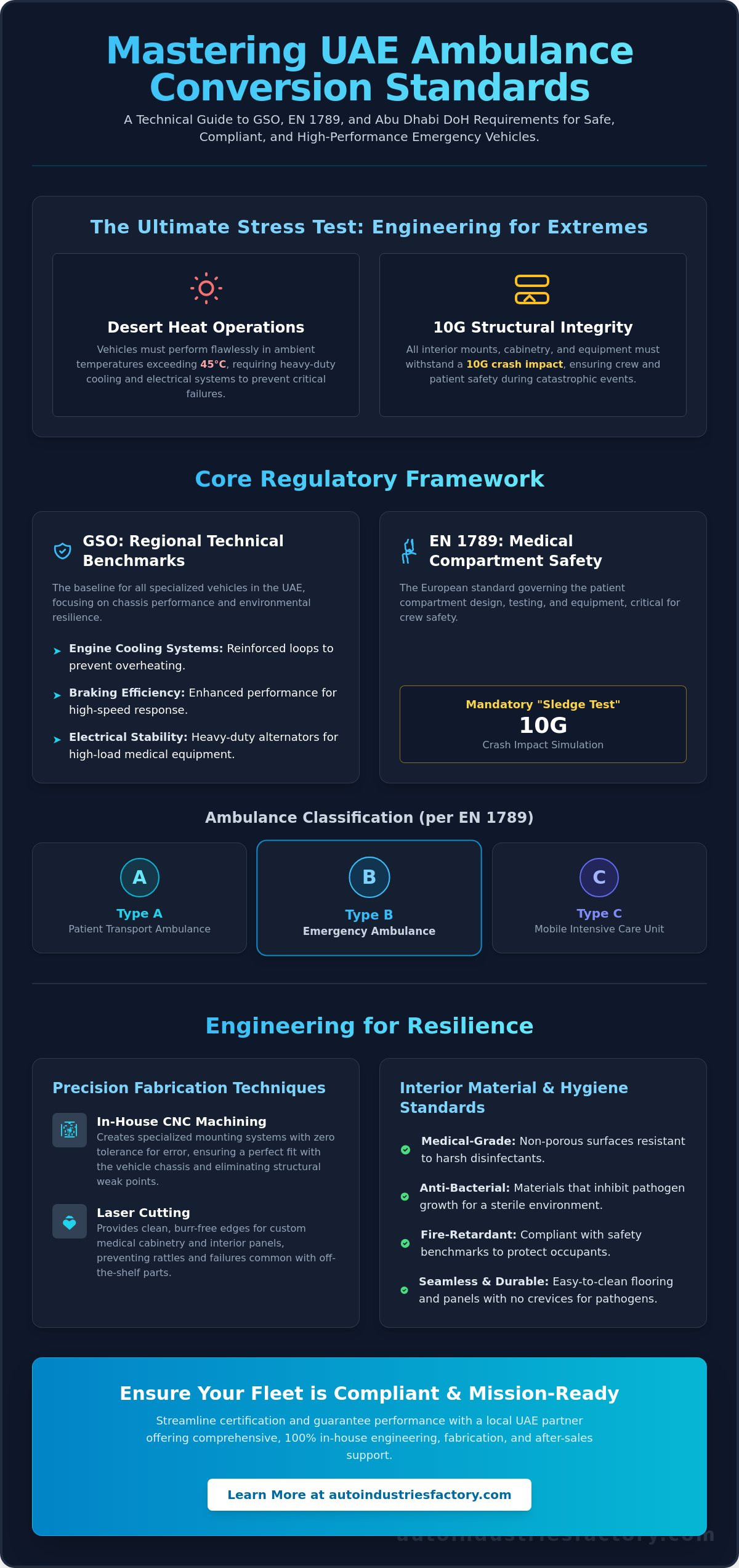
Regional technical benchmarks serve as the baseline for all specialized vehicles in the UAE. These regulations dictate essential performance metrics for engine cooling systems, braking efficiency, and electrical stability. Because UAE ambulances often operate in temperatures exceeding 45°C, the conversion must include heavy-duty alternators and reinforced cooling loops to prevent system failure during critical patient transport. These standards provide the fundamental technical baseline for all emergency vehicles in the region.
EN 1789: Medical Compartment Safety
While regional benchmarks cover the chassis, the European standard EN 1789 defines the safety and testing of the medical compartment. This standard is famous for its "Sledge Test," which requires all interior medical equipment, cabinetry, and mounts to survive a 10G crash impact. In the UAE, ambulances are classified into Type A (Patient Transport), Type B (Emergency Ambulance), and Type C (Mobile Intensive Care Unit) based on these specifications. Adhering to these quality standards for ambulance conversion UAE ensures that your medical crew can operate in a secure, crash-tested environment regardless of the emergency type.
Engineering for Resilience: Fabrication and Material Standards
Engineering an ambulance isn't just about fitting medical equipment into a van; it's about fundamental structural integrity. Superior quality standards for ambulance conversion UAE start with precision fabrication that can withstand the rigors of high-speed emergency response. We utilize in-house CNC machining and laser cutting to ensure every component fits with zero tolerance for error. This level of precision is critical when reinforcing an extended roof ambulance on GMC or Toyota platforms, where structural rigidity directly impacts vehicle stability during sharp maneuvers.
Precision Fabrication Techniques
In-house fabrication is the only way to guarantee that every bracket and mounting point meets exact engineering tolerances. CNC machining allows us to create specialized mounting systems that integrate perfectly with the vehicle's chassis. Laser cutting provides the clean, burr-free edges necessary for custom-designed medical cabinetry and interior panels. This eliminates structural weak points and prevents the rattles or failures that can occur when using generic, off-the-shelf components. If you're planning a fleet upgrade, exploring our specialized metal cutting and bending solutions can help you understand the engineering depth required for a compliant build.
Interior Hygiene and Durability
The interior of a converted unit must be a sterile, high-performance environment. Materials must be more than just durable; they must be medical-grade, anti-bacterial, and fire-retardant. Pathogens don't have a place to hide when you use seamless, easy-to-clean flooring and wall panels. Since these vehicles often face the intense GCC sun during standby, all materials are UV-resistant to prevent cracking or off-gassing over time. This focus on material science ensures the unit remains operational and safe for years.
Structural reinforcement is mandatory for specialized box-type conversions to handle the added weight of advanced life support equipment. Proper weight distribution is non-negotiable for crew safety. An unbalanced vehicle is a liability during high-speed response. By following the Abu Dhabi DoH ambulance standards, we guarantee that the center of gravity remains optimized, ensuring the vehicle handles predictably in even the most demanding conditions.
Critical Systems Integration: Electrical and Medical Compliance
An ambulance is essentially a mobile intensive care unit. For it to function effectively, the internal systems must operate with 100% reliability under extreme stress. Meeting the quality standards for ambulance conversion UAE requires more than just installing equipment; it demands a sophisticated integration of electrical, medical, and environmental systems that can survive the harshest GCC conditions. Every wire, pipe, and sensor must be engineered to prevent failure when a patient's life is on the line.
Advanced Electrical Load Management
Modern Advanced Life Support (ALS) equipment places a massive drain on a vehicle's electrical system. We don't just add a battery; we re-engineer the entire power architecture. This involves installing high-output alternators and dual-battery systems managed by intelligent split-charging units. These systems prioritize mission-critical medical devices, ensuring that ventilators, monitors, and defibrillators remain powered even if the engine is idling for long periods. An ambulance's electrical failure is a direct threat to patient life. Our engineering ensures that power delivery remains constant and surge-protected.
Medical Gas and Suction Standards
Oxygen delivery is the most critical medical system in the vehicle. It requires specialized piping and manifold systems that are both accessible and incredibly secure. Leak-testing and pressure monitoring are non-negotiable steps in our certification process. Auto Industries Factory LLC integrates these manifold systems and secure cylinder storage during the initial design phase to ensure total system integrity. This proactive approach prevents the common vibration-induced leaks found in lower-quality conversions.
Environmental control is equally vital. When external heat exceeds 50°C, the HVAC system must maintain a stable internal temperature of 22-24°C to protect patient stability and medication shelf life. This level of climate control aligns with the WHO operational guidance for ambulance systems, which sets the global benchmark for patient safety. Precision matters in every connection. We also ensure that GPS and telemetry units are shielded to prevent electromagnetic interference with sensitive medical electronics.
Ready to secure your fleet with engineered reliability? Explore our technical ambulance conversion solutions to see how we exceed local standards.
Choosing a Quality Partner for UAE Ambulance Conversions
Selecting a conversion partner in the Emirates is a decision that dictates the long-term reliability and safety of your fleet. The highest quality standards for ambulance conversion UAE are only achieved when a builder maintains 100% control over the entire engineering lifecycle. Working with a local manufacturer doesn't just simplify the MOHAP and health authority certification process; it ensures that your vehicles are built to withstand the specific regional environment with immediate access to after-sales support.
The In-House Advantage
Total control over design, fabrication, welding, and painting within a single facility eliminates the quality variances and delays common with third-party outsourcing. When every stage of the build happens under one roof, structural integrity is never a guessing game. Learn more about us and our commitment to engineering excellence. This integrated factory approach ensures that every GMC extended roof or specialized Toyota 4x4 unit meets the exact same rigorous benchmarks for mission-critical performance.
Customization for Mission-Specific Needs
Quality requirements differ significantly depending on the vehicle platform and the intended medical mission. A box-type ambulance offers superior interior volume for complex ICU and Neonatal transport but requires specialized structural mounting for the independent module. In contrast, a van-type conversion focuses on aerodynamic stability and rapid urban response. For more details on the conversion process, see our Ambulance Conversion: The Complete Guide. We tailor these builds for specific UAE terrains, ensuring quality standards for ambulance conversion UAE are met for both city streets and remote off-road rescue.
Before any unit is commissioned, it must pass a final, exhaustive QC protocol. This includes high-pressure water tightness testing to ensure seal integrity during intense sandstorms, as well as extended electrical load stress tests to verify ALS system stability. Dynamic road performance evaluations confirm that handling remains precise even under a full medical load. This uncompromising approach ensures your fleet delivers the maximum ROI and protection your crew and patients deserve.
Secure Your Emergency Response Fleet with Precision Engineering
Adhering to the quality standards for ambulance conversion UAE is the only way to ensure your fleet remains compliant with the December 2023 Abu Dhabi Department of Health updates. From the 10G crash-resistance of EN 1789 to the extreme heat tolerance required by GSO 1794, every technical detail matters. You've seen how precision fabrication and fail-safe electrical integration form the backbone of a reliable emergency unit. Investing in these benchmarks isn't just about passing inspections; it's about protecting lives during every mission-critical response.
Auto Industries Factory LLC provides the engineering expertise needed to navigate these complex regulations. Our facility utilizes advanced in-house CNC and Laser Cutting technology to deliver seamless structural integration on specialized GMC and Toyota platforms. We are specialists in GSO 1794 and EN 1789 compliance, ensuring your vehicles handle predictably under pressure. Contact Auto Industries Factory for a Custom Ambulance Quote today to build a fleet that defines reliability and safety in the Emirates. Your team deserves a vehicle that's as resilient as they are.
Frequently Asked Questions
What is the difference between Type A, B, and C ambulances in the UAE?
Type A ambulances are designed for the transport of patients who aren't expected to become emergency cases. Type B units serve as emergency ambulances for basic treatment and monitoring during transport. Type C units are mobile intensive care units equipped for advanced life support and complex monitoring of critically ill patients. These classifications follow the EN 1789 framework to ensure the vehicle is appropriately engineered for its specific medical mission.
Does an ambulance conversion need to be GSO 1794 compliant to be legal?
Compliance with GSO automotive standards is mandatory for vehicle registration in the UAE, though it's vital to reference the correct technical codes for automotive engineering. While GSO 1794 specifically pertains to food packaging, legal operation requires the chassis to meet GCC Standardization Organization requirements for engine performance and electrical stability. These quality standards for ambulance conversion UAE ensure the vehicle can handle the region's unique environmental stresses.
How long does a professional ambulance conversion typically take?
A professional ambulance conversion typically takes between four to eight weeks depending on the complexity of the build and the level of medical equipment integration. Standard van conversions move faster, while custom box-type units or specialized ICU modifications require more time for structural fabrication and electrical load testing. This timeframe ensures every unit undergoes rigorous quality control and certification before it enters service.
Can any vehicle chassis be converted into an ambulance in the UAE?
No, not every vehicle chassis is suitable for conversion into a compliant ambulance in the UAE. The chassis must meet specific gross vehicle weight ratings (GVWR) and interior dimension requirements to accommodate medical equipment and crew movement safely. High-performance platforms like the GMC Savana or Toyota Land Cruiser are preferred because they provide the necessary payload capacity and structural durability for heavy-duty emergency use.
What are the HVAC requirements for ambulances operating in the GCC?
HVAC systems must maintain a stable internal temperature between 22°C and 24°C even when external ambient temperatures exceed 50°C. This requires high-capacity cooling units, reinforced insulation, and specialized ventilation to protect both the patient and temperature-sensitive medications. Meeting the quality standards for ambulance conversion UAE for climate control is essential for operational safety and medication integrity during the peak summer months.


