
What if the right safari vehicle is defined less by its model and more by how your tour team uses it? A safari vehicle conversion with Auto Industries Factory LLC can be tailored around the vehicle type, operating conditions and practical needs of guides and tour operators across the UAE. Modifications may include extra cooling for vehicles that idle in the sun, storage for camping gear, off-road capabilities and communication systems.
Tour operators need more than a capable vehicle. The layout and equipment should support the way the team works, from carrying gear to guiding guests on the route. National production facilities can also help shorten turnaround times and make spare parts more readily available for operators throughout the country.
This article explains how to plan a conversion around operator requirements, what kinds of modifications may suit different touring needs, and how national fabrication and parts support fit into the decision. You’ll get a clear view of the considerations that shape a practical safari vehicle setup with Auto Industries Factory LLC, without treating every tour operation as if it had the same requirements.
Key Takeaways
- Match conversion choices to the vehicle, operating conditions and the way your tour team works.
- Consider how cooling and practical storage can support vehicles and equipment on safari operations.
- Local production can help with turnaround and spare-parts availability for converted vehicles.
- Tailor vehicle features to guides’ needs, including off-road capability and communication systems.
- Explore how custom fabrication and safari vehicle conversions can bring operator requirements together in one vehicle.
Custom vehicle modifications for safari operators
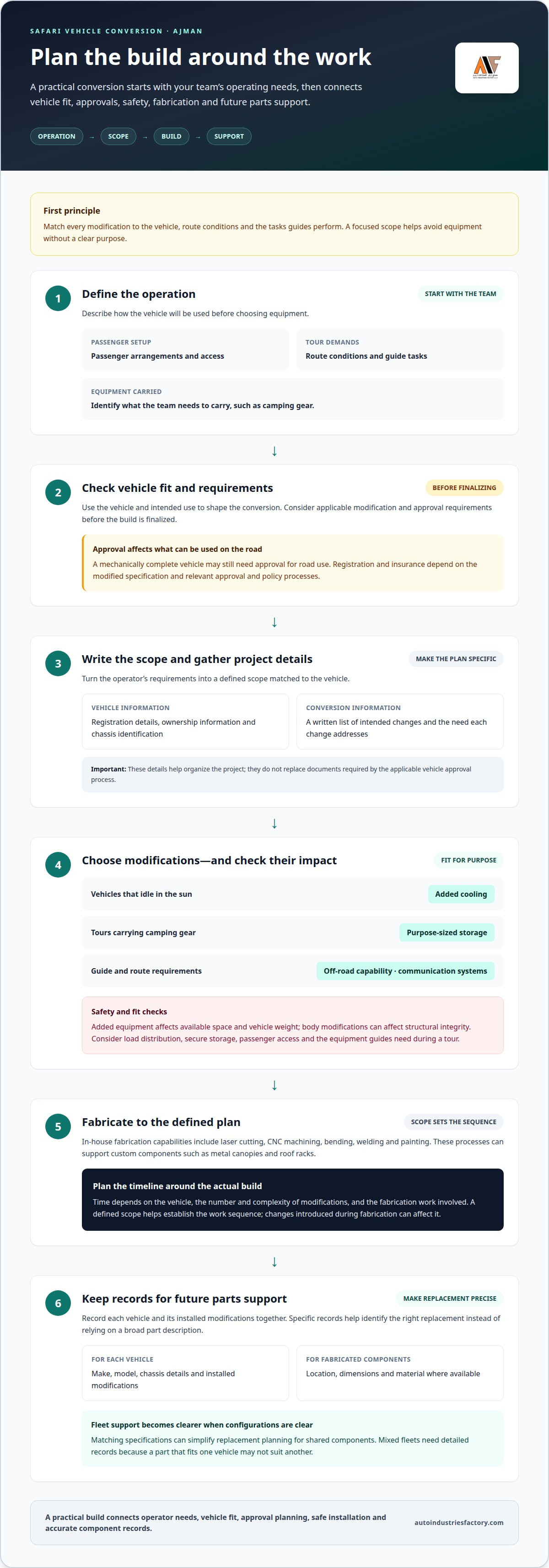
Safari modifications should match the vehicle, route conditions and the work guides perform. In Ajman, start by defining the tour team’s operating needs before selecting changes.
Modification Requirements
Modification requirements are the applicable vehicle and approval conditions that shape which changes can be made and used. Approval requirements should be considered before a conversion is finalized, because a mechanically complete vehicle may still need approval for road use.
Registration and insurance depend on the vehicle’s modified specification and the relevant approval and policy processes. Plan the conversion with those requirements in mind, rather than assuming every change will be accepted after installation.
Safety planning matters too. Added equipment affects available space and vehicle weight, while body modifications can affect structural integrity. Consider load distribution, secure storage, passenger access and the equipment guides need during a tour.
Conversion Process and Documents
A practical conversion starts by turning the operator’s requirements into a defined scope and matching it to the vehicle. This keeps modifications relevant to the tour and avoids adding equipment without a clear purpose.
For the project, assemble the vehicle’s registration details, ownership information and chassis identification, along with a written list of intended changes. These details help organize the project, but do not replace documents required by the applicable vehicle approval process.
Next, define operating needs: passenger arrangements, equipment carried, route conditions and guide tasks. The conversion scope can then address examples such as cooling for vehicles that idle in the sun or storage for camping gear. Keep the final specification aligned with the vehicle and its intended use.
Available Conversion Services
Choose modifications to support your safari operation rather than applying the same package to every vehicle. A guide carrying camping equipment, for example, has different storage needs from a team focused on passenger tours.
Examples include added cooling for vehicles that idle in the sun and storage sized around camping gear. Operators may also consider off-road capabilities and communication systems as part of the vehicle’s working setup. The right combination depends on how the team uses the vehicle and what it carries.
For a safari vehicle conversion in Ajman, connect every modification to an operating need. A focused scope makes it easier to assess how each change affects space, access and the vehicle’s overall configuration.
Conversion Timeline
A conversion timeline covers the project from defining the scope through fabrication and completion. For tour operators, it matters because vehicle downtime can affect fleet planning and scheduled operations.
The time needed for a safari vehicle conversion depends on the vehicle, the number and complexity of modifications, and the fabrication work involved. A defined scope helps establish the work sequence, while changes introduced during fabrication can affect it.
Set out equipment and storage needs before work begins. This lets the project schedule account for the chosen modifications and how they fit the vehicle, without assuming one duration applies to every build.
Local production and spare-parts availability
Auto Industries Factory’s in-house fabrication capabilities include laser cutting, CNC machining, bending, welding and painting. These processes support custom safari vehicle work, including metal canopies, roof racks and other fabricated components. Recording the vehicle and component specifications also helps make future replacement planning more precise.
Production capability shapes how a conversion can be built. Metal cutting, bending, welding and painting support fabrication work, while laser cutting and CNC machining help produce components to defined shapes. These processes can support tailored vehicle modifications without relying solely on ready-made parts. The intended fit and function still guide each fabrication decision.
Good spare-parts planning starts with clear identification. Keep a fleet record of each vehicle’s make, model, chassis details and installed modifications. For a fabricated component, record its location, dimensions and material where available. This helps identify the right replacement instead of relying on a broad description such as “roof bracket” or “storage support.”
- Record the vehicle and modification details together.
- Identify parts that may need replacement during regular operation.
- Keep component descriptions specific, including placement and fit.
- Group similar vehicles when planning shared replacement-part needs.
Consistent vehicle configurations can simplify fleet support. If several safari vehicles use the same fabricated component, matching specifications make replacement planning more straightforward. Mixed fleets need detailed records because a component that fits one vehicle may not suit another. Distinguish each configuration clearly in your records.
Planning fabrication with future maintenance in mind can make component replacement easier. Keep specifications for parts designed around the vehicle’s use. For example, record a roof rack support or metal canopy component against the vehicle and its mounting position. Accurate records help reduce guesswork when arranging a replacement.
If you are planning a safari conversion, map the vehicle types, modifications and parts that matter to your operation. Auto Industries Factory offers in-house vehicle fabrication, including metal cutting, bending, welding and painting, to support custom conversion work.
RSA Africa says local production can provide faster turnaround times and readily available spare parts for safari vehicle conversions. For operators, that value is most useful when production is tied to an accurate picture of each vehicle rather than treated as a separate task. Keep the conversion specification alongside the vehicle record, including what has been changed and where each component is fitted. When a replacement is needed, those details give the production team a clearer basis for identifying the required part and distinguishing it from components used in other configurations.
Before commissioning metalwork, operators can review which modifications are essential to ongoing operations and ensure their descriptions remain usable for future replacement. A record of fit, placement and material can support a consistent conversation between the fleet team and whoever handles fabrication. This makes the local-production option easier to incorporate into maintenance planning: identify the parts to track, preserve the relevant specifications, and update records when a vehicle’s setup changes. Readily available parts do not remove the need for careful matching; the vehicle and its installed configuration remain the reference point. Treating production and parts records as connected parts of the same process helps keep conversion choices practical over the vehicle’s service life.
Personalized safari conversions
A tailored conversion matches a vehicle’s setup to an operator’s routes, team roles and tour routines. A guided wildlife trip, a camp transfer and a mixed itinerary can place different demands on the same vehicle type. Start not with a feature list, but with a clear description of how the vehicle will be used during a typical operating day.
Begin with the vehicle and its intended use. Record the route conditions, how often it stops, what the team carries and which tasks guides perform. These details help separate essential changes from optional additions. An operator carrying camping equipment, for example, needs a different storage plan from a team carrying only gear for short excursions.
Map the workday from departure to return. Consider where the guide sits, how equipment is accessed and whether items need to stay organized during repeated stops. Storage that suits one tour may get in the way of another team’s routine if its gear differs. Make decisions based on actual use, not assumptions about how safari operators work.
- Vehicle use: Define whether the vehicle mainly handles guided tours, camp transfers or mixed operations.
- Team workflow: Note which guide tasks require access to equipment during a stop.
- Equipment: List the items carried, such as camping gear, and how they need to be arranged.
- Operating conditions: Describe route surfaces, idle periods and the conditions the vehicle regularly faces.
- Fleet consistency: Identify where vehicles share the same setup and where individual units differ.
Think about how modifications work together. A roof rack, for example, should be considered alongside the equipment the team carries and needs to access. A larger storage area may reduce space elsewhere. Reviewing the complete layout helps prevent one modification from obstructing guides or passengers.
Tailored planning is especially useful for mixed fleets. Vehicles assigned to different itineraries may need distinct configurations, while vehicles used for the same tour can share a consistent specification. That consistency makes operating procedures easier to repeat and gives the conversion team a defined scope for each vehicle, rather than a broad request such as “make it safari-ready.”
Before fabrication, turn the operating brief into a specification for the particular vehicle. Separate required functions from preferences, then connect each change to a real task or condition. This provides a practical basis for reviewing the proposed layout and adapting it to the vehicle. The result is a safari conversion shaped around the tour team’s work, not a generic build copied across every operation.
Vehicle features tailored to guides and tour operators
Guides need a vehicle setup that supports decisions and tasks throughout a tour. In Ajman, begin by connecting each feature to a real operating requirement. Off-road capabilities and communication systems are technologies used in the safari industry, but their value depends on the routes and team duties involved.
Consider off-road capability in relation to the surfaces and conditions on your routes. A vehicle used on uneven ground has different demands from one travelling mainly on established roads. Map the regular route types first, then define what the vehicle needs to handle. This gives the conversion scope a clear purpose instead of treating off-road modifications as a generic upgrade.
Communication needs also depend on the guide’s work. Consider when guides communicate, who needs to receive information and how the team coordinates during a tour. A guide leading a group may have different needs from a driver working independently. Define those roles before selecting equipment or planning how it fits in the vehicle.
Translate the team’s routine into practical checks:
- List the guide’s responsibilities before, during and after each tour.
- Describe the route conditions the vehicle regularly encounters.
- Identify who needs to communicate with the guide during operations.
- Map where equipment and controls should sit for convenient access.
- Review whether the proposed layout suits the vehicle’s intended use.
Access and placement matter. Equipment should suit the guide’s working position, while controls and carried items should not create unnecessary obstacles. A guide coordinating with other team members may need a different arrangement from a driver focused on independent route duties. Reflect that distinction in the conversion plan.
Modifications can affect one another. Additional equipment changes available space, so consider its placement alongside storage and passenger arrangements. A route-focused setup should account for both the vehicle’s capabilities and the guide’s tasks. Review the complete layout instead of assessing each component in isolation.
A strong specification starts with route, role and communication requirements. Name the terrain, describe the guide’s duties and identify team coordination needs. Then connect each requested modification to those requirements. This makes the build easier to assess and keeps the vehicle focused on operational use rather than unrelated additions.
Safari vehicle conversion services and modifications available in Ajman
Safari vehicle conversions can combine metal fabrication with modifications tailored to an operator’s needs. The scope may include metal canopies and roof racks, custom bull bars and bumpers, vehicle colour changes and other safari-focused work. Each item should serve a practical purpose, such as carrying equipment or changing the vehicle’s exterior for tour operations.
Metal canopies and roof racks provide options for carrying equipment. Shape the layout around the intended cargo and how the team accesses it. A vehicle carrying camping equipment, for example, needs a different arrangement from one carrying fewer items. The vehicle’s shape and available mounting positions also affect how a fabricated component fits into the overall build.
Custom bull bars and bumpers are another type of vehicle modification. Their design and fit should take account of the vehicle and its intended use. A bull bar is a fabricated component that needs to be engineered to the vehicle’s chassis dimensions, not selected without regard to the vehicle. The same principle applies to a brush guard: its fit should suit the build.
A vehicle colour change can update its exterior as part of a broader conversion. Consider how the finish suits the vehicle’s intended role and modified exterior. Colour changes are separate from structural fabrication, so define them clearly rather than bundling them into a vague request for a complete build.
- Canopies and roof racks: Plan around the equipment carried and its access needs.
- Bull bars and bumpers: Define the component and its fit with the vehicle.
- Color change: Specify the intended exterior finish as a separate work item.
- Combined modifications: Review how fabricated parts and exterior changes work together.
A clear scope helps coordinate these tasks. Start with the vehicle and the tour operation, then separate structural metalwork from exterior finishing. Note which parts support equipment transport, which alter the vehicle’s front protection components, and which change its appearance. This breakdown gives the conversion team a defined set of outcomes to plan and produce.
For a safari vehicle conversion in Ajman, the available work can be combined around the vehicle and its intended role. Operators can request a safari vehicle conversion by outlining the vehicle, required modifications and operating needs.
Choosing a safari vehicle conversion involves considering vehicle types and specific modifications. Begin by comparing the vehicle under consideration with the conversion outcomes required, rather than treating every safari build as interchangeable. Identify which requested changes are essential, which are optional, and whether each item belongs to fabrication, fitment or exterior finishing. This gives the operator a clearer basis for discussing scope with a conversion team.
Before confirming the scope, describe the intended use in practical terms and connect each modification to it. Be specific about the desired outcome rather than requesting a complete conversion without details. If you plan several changes, review them together so the final specification reflects the selected vehicle and work. Comparing vehicle types and modifications deliberately keeps the brief focused and gives the team a shared reference for planning.
Auto Industries Factory LLC: Safari Vehicle Conversions
Auto Industries Factory LLC provides safari vehicle conversions for tour operators who need a vehicle configured around their team and operating requirements. Its Ajman-based fabrication capabilities support tailored builds, including metal canopies and roof racks where equipment-carrying needs call for them.
Bring a defined project scope: vehicle details, tour use, route conditions, guide tasks and equipment to be carried. These points help shape a conversion plan around practical priorities instead of adding features without a clear purpose. For example, a team carrying camping gear can describe its storage needs as part of the build requirements.
Safari vehicle conversions are the relevant service when an operator needs changes beyond a standard vehicle setup. Contact Auto Industries Factory LLC to discuss your conversion requirements.
Plan the next build around your operation
A safari vehicle conversion in Ajman should begin with a clear operating brief. Set out how the vehicle will be used, what the tour team needs it to carry, and which tasks guides perform. That brief gives the build a practical direction and helps keep each requested modification tied to a real use.
To get started, bring together the vehicle details and the requirements that matter most to your tours. Auto Industries Factory LLC offers Safari Vehicle Conversions, Ambulance Conversions, and Police & Military Vehicle Modifications. Share your operating brief to begin defining a vehicle project around your team’s needs.
Contact Auto Industries Factory LLC today to discuss your safari vehicle requirements. A clear brief is a strong starting point for building a vehicle around the way your team works.


