
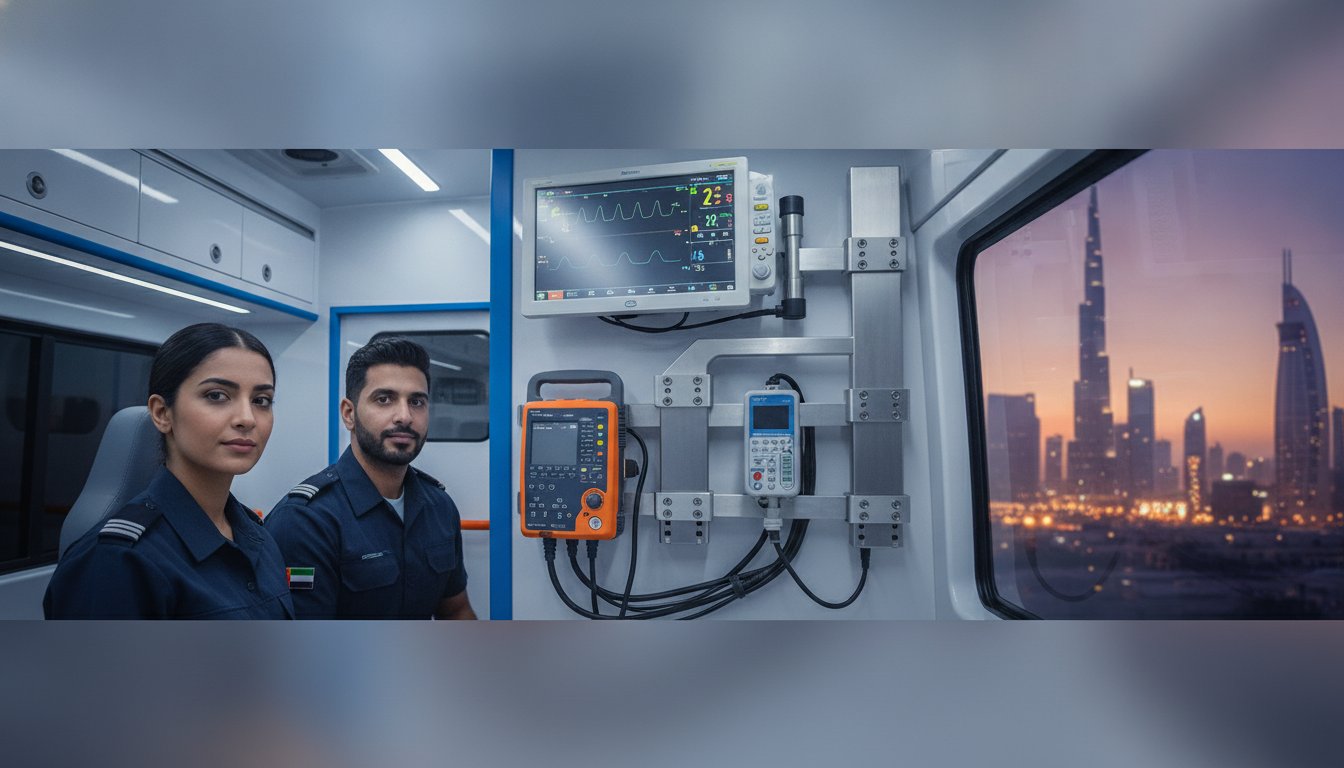
With an average of 1,500 ambulance accidents occurring annually in the U.S., the interior of a vehicle can quickly become a zone of high-velocity hazards. In these high-stakes moments, an unsecured monitor or oxygen tank isn't just equipment; it's a potential projectile that threatens both patients and crew. You've likely dealt with mounts that rattle loose from constant road vibration or brackets that aren't compatible with your specific fleet's hardware. Achieving secure mounting for medical devices in ambulance requires more than just a standard bracket. It demands a structural engineering approach that prioritizes both safety and rapid accessibility.
We agree that your focus should be on saving lives, not worrying if a pump will break free during a sharp turn. This guide shows you how custom fabrication and precision metalwork create a crash-tested environment that meets the rigorous SAE J3043 standards. You'll learn how to integrate monitors and life-saving tools into a seamless, corrosion-resistant layout that's easy to disinfect. We'll preview the engineering principles that turn a standard conversion into a reliable, mission-critical workspace that protects your team and your equipment.
Key Takeaways
- Understand the physics of G-forces and why structural integration is critical to prevent medical equipment from becoming hazardous projectiles during transport.
- Discover how precision CNC machining and laser-cut structural plates provide secure mounting for medical devices in ambulance for unmatched stability.
- Identify the key requirements of SAE J3043 and EN 1789 standards to ensure your fleet meets global safety and compliance benchmarks.
- Master ergonomic layout strategies that place life-saving monitors and oxygen supplies within immediate reach for optimized paramedic workflow.
- Learn the advantages of a unified engineering approach that bridges custom vehicle fabrication with mission-critical medical necessity.
The Science of Secure Mounting: Why It Dictates Ambulance Safety
Secure mounting for medical devices in ambulance isn't just about keeping things tidy. It's the mechanical integration of life-saving equipment directly into the vehicle's structural frame. This engineering ensures that every monitor, pump, and tank can withstand extreme G-forces during sudden stops or collisions. When you consider the vast range of tools found in a modern ambulance equipment overview, the engineering complexity becomes clear. Each piece of hardware must be locked down with precision to prevent catastrophic failure in the field.
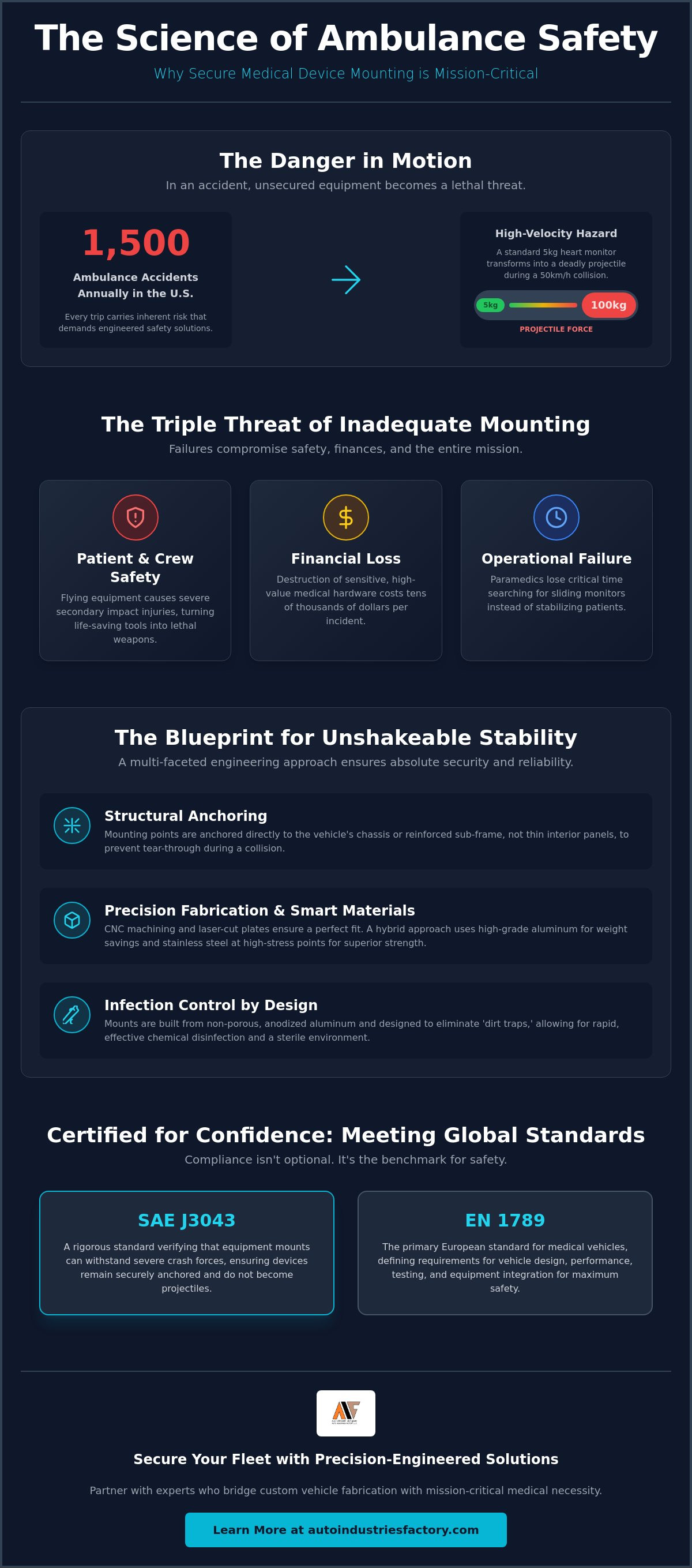
The physics of transport are unforgiving. In a 50km/h collision, a standard 5kg heart monitor transforms into a 100kg projectile. Without a crash-tested mount, that device becomes a lethal threat to everyone inside the patient compartment. It's why we focus on precision fabrication to lock these items down. To better understand this concept, watch this helpful video:
Beyond immediate safety, achieving secure mounting for medical devices in ambulance protects your investment. High-value medical hardware contains sensitive sensors and delicate calibration settings. Constant vehicle vibration can degrade these components over time, leading to premature failure or inaccurate readings. A secure mounting system acts as a dampener, extending the operational life of your fleet's technology. We also utilize an 'Onboard vs. Ready' framework. This means equipment remains fully functional and accessible while locked, allowing paramedics to operate devices without risking an unsecured state.
Identifying the Risks of Inadequate Mounting
When mounts fail, the consequences are three-fold. First, there's the risk of secondary impact injuries where the equipment itself strikes a person. Second, you face massive financial losses from destroyed hardware that costs tens of thousands of dollars. Finally, loose equipment causes operational delays. Paramedics shouldn't have to hunt for a sliding monitor while trying to stabilize a patient in a moving vehicle. Reliable engineering eliminates these variables.
The Role of Mounting in Infection Control
Modern ambulance conversions must prioritize hygiene. We use non-porous materials like anodized aluminum for mounting hardware because they don't harbor bacteria. Our engineering team designs mounts to eliminate 'dirt traps' or small crevices where pathogens can hide. This allows for rapid, effective chemical disinfection. These materials are chosen specifically for their resistance to biological fluids and the harsh medical-grade cleaners required to keep the environment sterile.
Advanced Fabrication Techniques for Medical Device Stability
True stability isn't found in a catalog; it's engineered on the factory floor. While many providers treat mounts as simple bolt-on accessories, we view them as integral structural components. Achieving secure mounting for medical devices in ambulance requires a deep understanding of vehicle dynamics and precision metalwork. We start with the vehicle's "bones," ensuring every mounting point is anchored directly to the chassis or a reinforced sub-frame. This foundation prevents the hardware from pulling through thin interior panels during a collision.
Material selection is a critical balancing act for any professional conversion. We utilize high-grade aluminum for its weight-saving properties, which is vital for maintaining vehicle fuel efficiency and handling. However, for high-stress load points, we integrate stainless steel components for their superior tensile strength. This combination provides the ruggedness needed to meet SAE J3043 standards. We also incorporate vibration dampening into the mount design. This engineering protects sensitive monitors from the mechanical stress of constant road use, preventing sensor drift and hardware fatigue. Laser cutting plays a pivotal role here, allowing us to create structural plates that fit perfectly within the vehicle's interior curves to maximize contact area.
CNC Machining for Custom Brackets
Precision is our standard. Our in-house CNC machining allows us to create brackets that match the exact sub-millimeter footprint of specific medical brands. This eliminates the "play" or rattling common with universal mounts that don't quite fit. For large-scale fleet deployments, this technology ensures repetitive accuracy across every vehicle. Rapid prototyping also allows us to adapt quickly when manufacturers release new device versions, ensuring your fleet remains modern and compliant. If you need to upgrade your fleet, you can explore our specialized fabrication services to see how we handle these complex integrations.
Welding and Structural Integration
A mount is only as strong as what it's attached to. During the initial Ambulance Conversion phase, we weld structural plates behind the interior walls. These plates distribute the weight of heavy devices across a wider surface area, preventing the wall panels from warping or shearing under intense G-forces. Our specialized welding techniques ensure these attachment points are permanent and fail-safe. We test these points under simulated stress to verify they can handle the rigors of emergency response without compromise.
Compliance and Standards: Understanding SAE J3043 and EN 1789
Compliance isn't a suggestion; it's a legal mandate. For any fleet manager, understanding the regulatory framework is the first step toward a safe operation. The SAE J3043 standard, specifically the J3043_202505 revision published on May 26, 2025, stands as the primary industry benchmark for equipment retention and storage systems. This standard ensures that every bracket and track can handle the sudden, violent forces of an emergency response. When we engineer secure mounting for medical devices in ambulance, we look to these specifications to define our structural thresholds and ensure every weld and fastener meets the highest safety criteria.
While SAE standards are common in North America, EN 1789:2020+A1:2023 governs many international conversions. This standard is particularly strict regarding the layout of the patient compartment. It dictates not just how a device is held, but where it's positioned to minimize injury risks during high-speed transport. By adhering to both sets of standards, fabricators ensure their vehicles are ready for global deployment. Fleet managers must demand documented proof of compliance for all fabrication work. Without a certification trail, you're essentially gambling with the safety of your crew and patients.
Dynamic Load Testing Explained
Static testing involves pushing on a mount until it bends, but dynamic testing is far more rigorous. It simulates real-world 20G impacts to ensure the locking mechanisms remain engaged under peak stress. We don't just want the mount to "hold" the device. We need it to prevent any deformation that could release the hardware. SAE J3043 is the industry benchmark for equipment retention. If a mount can't survive a dynamic sled test, it shouldn't be in your vehicle. This level of testing provides the confidence that your equipment stays put when the road gets rough.
Brand Compatibility and Universal Systems
A major challenge in fleet management is the variety of equipment brands. You might use Zoll monitors, Stryker stretchers, and Philips defibrillators. Our engineering team adapts secure mounting for medical devices in ambulance to ensure a perfect fit for these industry leaders. You'll often choose between universal mounting tracks and dedicated fixed brackets. Universal tracks offer flexibility for future upgrades, while fixed brackets provide the highest level of structural rigidity. Designing for future-proofing means your mounting hardware can be updated as medical technology evolves. This prevents the need for a full interior overhaul when you purchase new devices.
Ergonomic Layout Design: Maximizing Workflow and Equipment Access
Engineering a high-performance ambulance interior goes beyond simple bracket placement. It requires a deep understanding of the "Golden Hour" workflow, where every second saved contributes to patient survival. We design the layout so that high-frequency tools, such as monitors and suction units, are within the paramedic's immediate reach. Achieving secure mounting for medical devices in ambulance means these items stay locked during high-speed maneuvers while remaining fully accessible. Swivel and tilt functionalities are integrated into our custom mounts, allowing the crew to view data from multiple angles without ever having to unlatch the hardware.
Effective utility management is another hallmark of a professional conversion. We build cable management channels directly into the mounting systems to route power and data lines. This eliminates trip hazards and prevents cables from snagging during critical procedures. Visibility is equally vital; we position monitors so they're readable from both the primary attendant seat and the side bench. Oxygen cylinder mounting requires a specific balance of heavy-duty security and rapid-swap capability. Our mounts utilize quick-release mechanisms that meet crash standards but allow for a tank change in seconds. If you're ready to optimize your fleet's efficiency, contact us for a custom conversion estimate today.
Optimizing the Stretcher System
For critical care transport (CCT), continuous monitoring is a necessity. We engineer mounting solutions that attach directly to the stretcher base, ensuring the patient remains connected to life-saving technology during the transfer from the scene to the vehicle. These systems must be tailored to the specific types of ambulances in your fleet. Our fabrication team ensures these stretcher-mounted devices don't interfere with the vehicle's primary locking floor tracks or patient loading systems.
Wall and Ceiling Mount Applications
Utilizing vertical space is the best way to keep the floor clear for paramedic movement. Ceiling-mounted IV tracks require specialized structural reinforcements to handle the dynamic swaying of a moving vehicle. Similarly, wall-mounted ventilators are positioned at a precise ergonomic height for airway management. This placement ensures the paramedic can monitor the patient's respiratory status while seated and belted, maintaining safety for everyone in the compartment. We use precision metalwork to ensure these high-mounted items never vibrate loose or sag over time.
Partnering for Precision: Custom Ambulance Conversion Solutions
The United Arab Emirates presents a demanding environment for any medical fleet. Extreme ambient temperatures and fine-grain desert sand can degrade standard mounting hardware over time. We solve this by utilizing a comprehensive in-house approach that manages every stage of production from initial design to final painting. Our engineers view the vehicle as a unified safety system. This means the custom bull bars and bumpers we fabricate for the exterior work in tandem with the internal secure mounting for medical devices in ambulance to protect the crew and patient during high-stress operations. We've built our reputation on mission-critical reliability, ensuring every weld survives the rigors of both urban response and desert transport.
From Design to Deployment
We apply a rigorous vehicle conversion process to every medical mounting project. This starts with a technical consultation where we collaborate with fleet managers to define custom equipment layouts based on their specific device inventory. Once the design is finalized, our team uses CNC technology to create the hardware with sub-millimeter accuracy. Every conversion undergoes a strict quality control protocol, including a final inspection to ensure medical-grade standards are met before the vehicle enters service. This structured approach ensures that every monitor and pump is perfectly integrated into the vehicle's cabin.
Supporting Specialized Medical Fleets
Scaling for large national ambulance services requires a partner who understands logistics and repetitive precision. Whether you're building a new fleet or retrofitting existing vehicles with modern, secure mounting for medical devices in ambulance, we provide the engineering depth to handle the volume. Modernizing an older fleet with new mounting tracks can extend the vehicle's service life and improve safety without the cost of a full replacement. We've helped numerous agencies transition to safer, more ergonomic layouts that protect their most valuable assets. Contact our specialists today for a technical consultation on your fleet needs at Auto Industries Factory.
Secure Your Fleet for Mission-Critical Performance
Safety in emergency transport isn't just about speed; it's about the structural integrity of the environment where care happens. We've explored how secure mounting for medical devices in ambulance bridges the gap between vehicle fabrication and life-saving necessity. By prioritizing structural reinforcement over simple bolt-on accessories, you protect your crew from projectiles and your equipment from the harsh vibrations of the road. Every mount we engineer is a testament to precision and durability.
Our in-house CNC and laser cutting capabilities allow us to deliver hardware that meets the highest international standards. We specialize in mission-critical vehicle conversions across the entire UAE, providing a level of reliability that off-the-shelf solutions simply can't match. Whether you're managing a local service or a national fleet, your hardware deserves an engineered foundation that won't fail when it matters most. We ensure every monitor and pump is anchored with the expertise of a master craftsman.
Request a Technical Consultation for Your Ambulance Fleet to see how our engineering can transform your operational safety. We're ready to help you build a safer, more efficient emergency response environment today.
Frequently Asked Questions
Why is SAE J3043 so important for ambulance mounting?
SAE J3043 is the primary benchmark for equipment retention because it defines the structural requirements for mounts to survive a 20G impact. It ensures that brackets and tracks are tested dynamically to prevent them from releasing equipment during a collision. Adhering to this standard protects the crew and patients from secondary impact injuries caused by loose hardware.
Can you retrofit secure mounts into an existing ambulance fleet?
You can retrofit secure mounts into an existing fleet to upgrade safety and compliance without purchasing new vehicles. This process involves reinforcing internal wall sections with structural plates to support the weight and force of modern medical devices. It's a strategic way to extend the service life of your current ambulances while meeting current safety standards.
What are the best materials for medical device mounting hardware?
Anodized aluminum and high-tensile stainless steel are the industry standards for mounting hardware. Aluminum offers a high strength-to-weight ratio to keep the vehicle's payload manageable, while stainless steel provides the ruggedness needed for high-stress attachment points. These materials are non-porous and resist corrosion, making them ideal for the strict disinfection protocols required in medical environments.
How do secure mounts improve paramedic efficiency during transport?
Achieving secure mounting for medical devices in ambulance improves efficiency by placing critical tools like monitors and suction units within the paramedic's immediate reach. This ergonomic layout reduces the need for crew members to unbuckle while the vehicle is in motion. Organized, locked-down equipment also eliminates the time wasted searching for sliding items during high-pressure patient care scenarios.
Is it possible to have a universal mount for different brands of defibrillators?
Universal mounting tracks allow you to swap different brands of defibrillators by using specific adapter plates for each device footprint. While fixed brackets are often brand-specific for maximum stability, a track system provides the flexibility to update your fleet's technology without replacing the entire mounting infrastructure. This future-proofs your conversion against changes in medical hardware brands.
What happens to medical equipment in an ambulance crash without proper mounting?
Unsecured medical equipment becomes a high-velocity projectile during a crash, often multiplying its weight by twenty times or more. A 5kg monitor can strike an occupant with the force of 100kg in a 50km/h collision. Beyond the immediate risk of injury or death, the equipment itself is usually destroyed, leading to massive financial losses and a complete loss of patient monitoring capability.
How do I choose between a fixed wall mount and a swivel-arm mount?
Choose a fixed wall mount for heavy equipment that requires maximum structural rigidity and minimal movement. Swivel-arm mounts are better for monitors and diagnostic tools that paramedics need to view from different angles, such as the attendant seat or the side bench. We recommend swivel mounts when versatility is required, provided they are crash-tested to ensure secure mounting for medical devices in ambulance during transport.


