
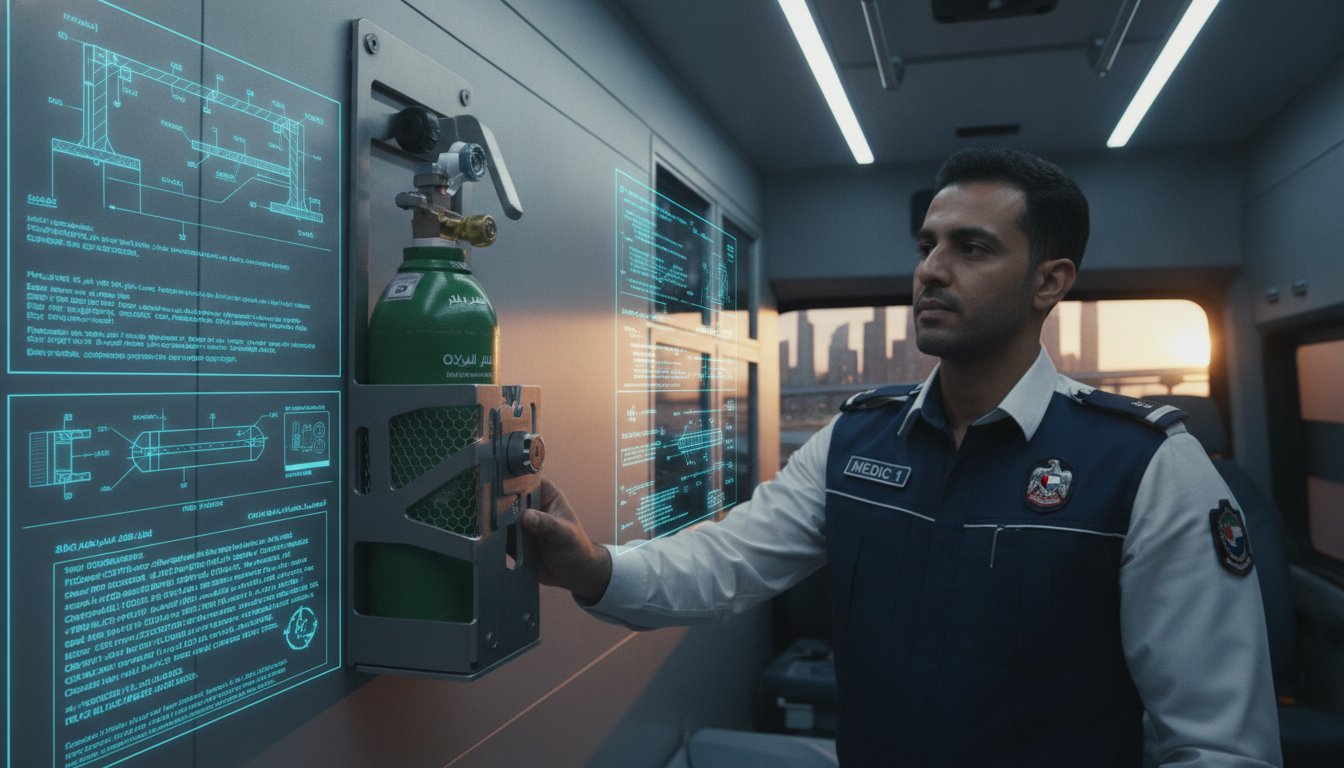
What happens to a 15-pound steel cylinder during a 50 km/h collision if the mounting bracket fails? In the high-stakes world of emergency response, an unsecured tank isn't just a medical tool; it's a potential projectile that threatens the lives of both patients and crew. You know that in a cramped interior, every second spent struggling with a stiff latch is a second taken away from life-saving care. Finding the right oxygen tank storage solutions for ambulances is about more than just clearing floor space; it's about structural integrity and operational speed.
We've entered an era where safety must be engineered into the vehicle's DNA rather than bolted on as an afterthought. This article shows you how precision-engineered storage solutions transform heavy oxygen tanks into secure, accessible assets that stay put during high-speed maneuvers. We'll preview the 2026 landscape of safety compliance, including the CAAS GVS v4.0 standards and EN 1789 requirements. You'll also learn how custom metal fabrication and laser-cut mounting systems provide a rattle-free environment that prioritizes paramedic ergonomics and mission-critical reliability.
Key Takeaways
- Understand how EN 1789 compliance ensures that oxygen storage systems withstand extreme impact forces to protect both crew and patients.
- Evaluate the performance differences between horizontal and vertical oxygen tank storage solutions for ambulances to maximize interior space and paramedic access.
- Learn why custom-fabricated aluminum or reinforced steel housings offer superior durability and structural integrity compared to standard off-the-shelf plastic brackets.
- Discover the engineering principles behind weight distribution and how strategic tank placement improves vehicle handling and accelerates cylinder swap speeds.
- Explore the precision of the bespoke integration process, utilizing CAD design and laser cutting to create a secure, rattle-free storage environment.
The Critical Role of Oxygen Tank Storage in Ambulance Safety
Effective oxygen tank storage solutions for ambulances represent far more than a simple metal bracket; they're a critical safety system integrated into the vehicle's structural framework. When an ambulance navigates high-speed turns or sudden stops, any equipment not welded or bolted to engineering-grade standards becomes a potential threat. We treat oxygen storage as a mission-critical component of our ambulance conversions. A pressurized cylinder is essentially a dormant kinetic energy source. If the mounting fails during a collision, that energy transforms the tank into a projectile capable of breaching interior partitions.
To better understand the technical setup required for these systems, watch this video on medical oxygen regulator configuration:
Safety in oxygen-rich environments demands a strict adherence to non-combustible material selection. Using specialized metalwork ensures that the storage area doesn't contribute to fire spread or off-gas toxic fumes during extreme heat. It's vital to follow established Oxygen tank safety standards, which emphasize that all components must be "oxygen clean" and free from oils or greases that could ignite. Our engineering process utilizes laser-cut steel and aluminum to ensure every housing meets these rigorous thermal and structural benchmarks.
Why Standard Brackets Often Fail in Emergencies
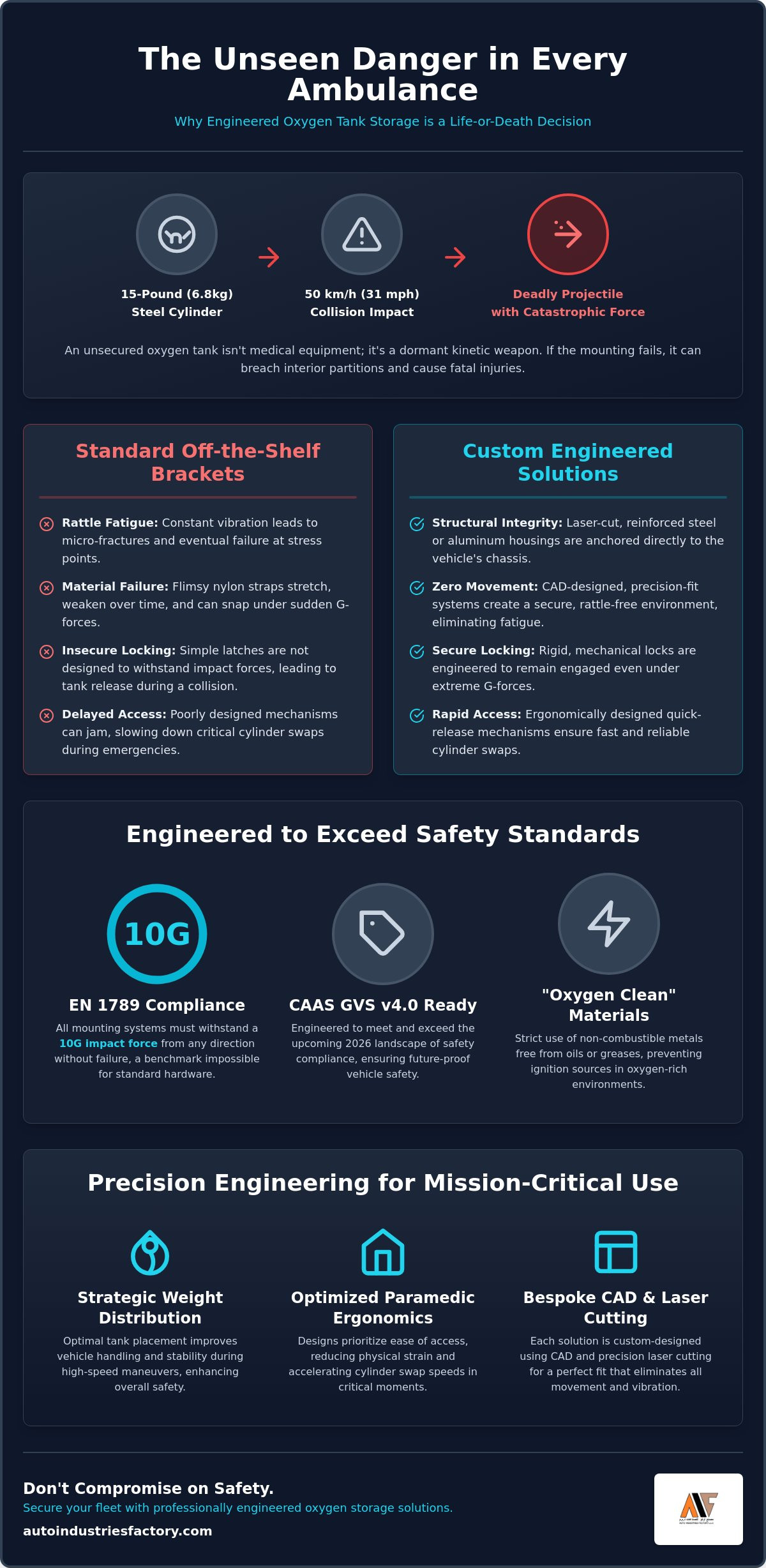
Standard off-the-shelf brackets aren't designed for the relentless vibration of 24/7 emergency response. Constant motion leads to "rattle fatigue," where low-quality metal components develop micro-fractures at the stress points. Generic nylon strap systems are particularly notorious failure points; they stretch over time and can snap under the sudden G-forces of a tactical maneuver. Professional oxygen tank storage solutions for ambulances replace these flimsy attachments with rigid, mechanical locking systems that remain secure regardless of road conditions.
The Consequences of Improper Cylinder Handling
Improperly secured tanks don't just pose a physical impact risk. They also threaten the patient’s oxygen supply. If a tank shifts, the regulator or valve assembly can strike a hard surface, leading to rapid decompression or a total system failure. This creates a secondary crisis for paramedics who are already managing a critical patient. Ease of access is equally important. If a crew struggles to swap a cylinder because of a poorly designed latch, it delays care. In a 10G impact event, an unsecured M-size cylinder exerts enough force to penetrate standard interior cabinetry and cause catastrophic injury to occupants.
Technical Standards and Storage Configurations
Technical standards serve as the engineering blueprint for safety. While understanding the risks of pressurized cylinders is the first step, implementing precise tolerances is what actually prevents failure. We utilize advanced CNC laser cutting to create housings that leave zero room for movement. This level of precision is mandatory for oxygen tank storage solutions for ambulances to function as intended. Adhering to the protocols for the Safe storage and transportation of medical gas cylinders ensures that high-pressure systems remain stable during the most aggressive emergency maneuvers.
EN 1789 and Crash Test Requirements
The EN 1789 standard requires that every medical equipment mounting system survives a 10G impact in any direction. Meeting this benchmark isn't possible with standard hardware or simple surface mounts. It requires structural reinforcement within the vehicle's side walls or chassis. We anchor our storage units directly into the reinforced frame to create a unified safety cell. Quick-release mechanisms are engineered to provide paramedics with immediate access; however, they also feature mechanical locks that won't fail under extreme force. These systems undergo stringent testing to ensure they remain a structural asset during a rollover or high-speed collision.
Configuration Options for Different Ambulance Types
Choosing between horizontal and vertical storage depends heavily on the vehicle platform and the size of the cylinders. In a Box Type ambulance, such as those built on GMC or Toyota chassis, vertical storage for large M-size cylinders is often preferred. This saves floor space and allows for better lifting ergonomics for the crew. In contrast, a Hiace van conversion might require horizontal storage to maintain a low center of gravity and fit within tighter interior dimensions. Our ambulance conversion guide explains how these different layouts affect the overall medical workflow.
Managing various cylinder sizes requires a modular engineering approach. A "D" size cylinder is portable and needs a mount designed for rapid field deployment. An "M" size cylinder is a heavy, stationary asset that requires a heavy-duty housing. By using laser-cut steel or reinforced aluminum, we create bespoke housings for each specific tank diameter. This eliminates the need for generic adapters that often rattle or loosen over time. Every configuration we design at Auto Industries Factory LLC is built to balance paramedic speed with absolute tank security. If you're planning a new build, our team at Auto Industries Factory LLC can help you determine the optimal configuration for your specific fleet requirements.
Custom Fabricated Solutions vs. Off-the-Shelf Brackets
Off-the-shelf brackets often rely on universal sizing that compromises safety for convenience. In contrast, custom-fabricated oxygen tank storage solutions for ambulances are engineered to the specific contours of the vehicle's interior. We utilize advanced CNC machining and metal cutting and bending to create housings that act as a structural extension of the ambulance itself. While plastic components might seem cost-effective initially, they lack the tensile strength to withstand the constant thermal cycling and mechanical stress found in emergency vehicles. We prioritize high-grade aluminum and reinforced steel to ensure the system remains rigid for the life of the fleet. This professional approach ensures that the mounting hardware doesn't warp or degrade when exposed to the high-pressure environment of medical gas delivery.
Adhering to NIOSH ambulance safety standards means designing systems that don't just hold equipment, but survive the extreme G-forces of a collision. Custom fabrication allows us to integrate the storage directly with the vehicle’s oxygen manifold and piping system. This prevents the friction and wear that occurs when pipes are forced into generic layouts. By aligning the storage unit with the pre-installed oxygen lines, we reduce the risk of leaks and system failures. It's a comprehensive solution that considers the entire oxygen delivery chain, from the cylinder valve to the patient's mask, ensuring mission-critical reliability in every conversion.
The Precision of In-House Fabrication
Our in-house fabrication process begins with CAD models that account for every millimeter of tank diameter. Laser cutting allows for zero-tolerance fits, eliminating the vibration that causes "rattle fatigue" in standard metal boxes. Specialized TIG and MIG welding ensure every joint is a permanent, high-strength bond that won't crack under the pressure of daily use. To maintain hygiene, we apply custom powder coatings that resist the corrosive effects of medical-grade disinfectants and chemical cleaning agents. This level of detail is impossible to achieve with mass-produced, one-size-fits-all components.
Comparison of Storage Methods
| Feature | Generic Straps | Standard Metal Boxes | Custom-Engineered Housings |
|---|---|---|---|
| Crash Safety | Low; high risk of snapping | Moderate; depends on fasteners | Maximum; exceeds 10G ratings |
| Paramedic Speed | Slow; difficult to adjust | Average; standard latches | Fast; ergonomic quick-release |
| Lifespan | 1-2 years; degrades quickly | 3-5 years; prone to rust | 10+ years; vehicle lifetime |
Custom-engineered oxygen tank storage solutions for ambulances reduce vehicle downtime by eliminating the frequent repairs and re-tightening required by generic mounting hardware.
Optimizing Ergonomics and Weight Distribution
Engineering a safe ambulance requires a deep understanding of vehicle dynamics. Heavy oxygen tanks, particularly the M-size cylinders commonly used for long-distance transport, act as significant ballast that shifts the vehicle's center of gravity. If these tanks are positioned incorrectly, they can cause the ambulance to lean during high-speed cornering or affect braking distance. Professional oxygen tank storage solutions for ambulances prioritize placing these heavy assets as low as possible and as close to the center line as the layout allows. This strategic positioning ensures the vehicle handles predictably under the extreme conditions paramedics face daily.
Vehicle Balance and Handling
We calculate the specific load impact of every cylinder on the vehicle's suspension system. Symmetrical placement is often the goal; however, when the layout requires a side-mounted cabinet, we use reinforced mounting points to distribute the weight across a larger area of the chassis. This prevents uneven wear on tires and suspension components. Vehicle stability isn't just a comfort issue; it's a safety requirement for high-speed emergency response. By integrating the storage into the initial conversion of key equipment for a modern emergency ambulance, we ensure the weight distribution is optimized from the ground up.
Paramedic Efficiency and Accessibility
Ergonomics in a moving vehicle can't be an afterthought. Paramedics need to operate oxygen systems under intense pressure, often with only one hand free. Our storage designs feature quick-release mechanisms that allow for one-handed cylinder swaps, reducing physical strain and minimizing the risk of back injuries. It's equally important that the crew can see the pressure gauge at a glance. We engineer our housings with cut-outs or transparent viewing ports so the gauge is visible without needing to unstrap the tank. This simple design choice prevents the "empty tank" surprises that can occur during critical patient transport.
Enclosed cabinets present unique challenges for leak detection and ventilation. Without proper airflow, a slow leak could create an oxygen-enriched atmosphere, which is a significant fire hazard. Our custom-fabricated cabinets include integrated ventilation paths that allow gas to dissipate safely. We also ensure that leak detection sensors or manual testing ports are easily accessible. If you're looking to upgrade your fleet's safety profile, contact Auto Industries Factory LLC for a custom ambulance conversion estimate today. These small engineering details distinguish a standard medical van from a high-performance, mission-critical asset.
Bespoke Oxygen Integration by Auto Industries Factory LLC
Auto Industries Factory LLC approaches oxygen integration as a core structural challenge rather than a storage accessory. Our end-to-end process begins with detailed CAD design, where we map the specific dimensions of your vehicle's interior to the required cylinder capacity. This digital blueprint ensures that the oxygen tank storage solutions for ambulances we provide fit with zero-tolerance precision. Once the design is finalized, our factory floor takes over. We utilize high-speed laser cutting and CNC bending to create a housing that's as rugged as the chassis it's mounted to. This isn't mass production; it's master craftsmanship applied to mission-critical safety.
Ruggedness is the baseline for every conversion we execute. We understand that in the heat of an emergency, equipment must perform without fail. Our bespoke oxygen tank storage solutions for ambulances are built to endure the vibration and mechanical stress of 24/7 fleet use. By handling every step of the fabrication in-house, we maintain absolute control over material quality and structural integrity. This commitment to engineering excellence is why our conversions are trusted by regional leaders for their most demanding missions. We don't just build brackets; we build integrated safety cells.
Comprehensive Fleet Modification Services
Auto Industries Factory LLC possesses extensive expertise in GMC and Toyota Hiace ambulance conversions, tailoring every internal component to the unique demands of the platform. Beyond standard medical vehicles, we also integrate specialized oxygen storage into Police and Military vehicle builds where durability requirements are even more extreme. Our fabrication capabilities allow us to create custom accessory mounts and unique configurations that standard suppliers simply can't offer. We remain committed to meeting national safety standards across the UAE, ensuring every vehicle we deliver is ready for high-stakes response.
Ready to Upgrade Your Fleet?
Consistency is vital when managing large-scale operations. Our facility is equipped for bulk fabrication, ensuring that the tenth vehicle in your fleet meets the exact same quality benchmarks as the first. We don't believe in generic fixes. Every project receives a dedicated engineering review to ensure the final product enhances both safety and paramedic workflow. If you're ready to transform your vehicle's interior into a secure, high-performance workspace, contact Auto Industries Factory LLC for a specialized vehicle estimate. Our team is standing by to provide the rugged, reliable solutions your mission requires.
Precision Engineering for Mission-Critical Safety
Safety in the medical transport industry isn't about checking boxes; it's about engineering systems that survive the worst-case scenario. We've explored how structural integration and ergonomic placement transform pressurized cylinders from hazards into reliable assets. By prioritizing EN 1789 compliant conversions, fleet managers ensure that their oxygen tank storage solutions for ambulances provide absolute security during high-speed maneuvers and 10G impacts. This transition from generic mounting to bespoke engineering is the standard for 2026. It's about protecting the people who save lives.
Auto Industries Factory brings specialized expertise to high-performance platforms like Toyota and GMC. Our in-house CNC and laser cutting technology allows us to fabricate bespoke housings that eliminate vibration and maximize interior space for paramedics. We don't settle for off-the-shelf compromises that rattle or fail over time. Every build is a testament to precision and rugged reliability. It's time to move beyond standard mounting and embrace structural safety that protects your team and your patients. We're ready to help you build a safer, more efficient fleet.
Request an Expert Consultation for Your Ambulance Fleet today to secure your operational future.
Frequently Asked Questions
What is the safest way to store oxygen tanks in a moving ambulance?
The safest way to store oxygen tanks is within integrated, crash-tested housings that are anchored directly to the vehicle's reinforced chassis. These oxygen tank storage solutions for ambulances use mechanical locking mechanisms rather than friction-based systems to ensure the cylinder remains stationary. Professional engineering prevents the tank from shifting during high-speed emergency maneuvers. This approach prioritizes structural integrity over simple convenience, ensuring the safety of both the medical crew and the patient.
Does the EN 1789 standard apply to oxygen cylinder brackets?
Yes, the EN 1789 standard specifically applies to all medical equipment mounting systems, including oxygen cylinder brackets. This regulation requires that any storage device must withstand a 10G impact in all directions without releasing the equipment. Meeting this standard is essential for ensuring that heavy cylinders don't become dangerous projectiles during a collision. Our conversions strictly adhere to these international safety benchmarks to provide maximum protection for the occupants.
Can I use standard industrial gas brackets for medical oxygen in a vehicle?
You shouldn't use standard industrial gas brackets for medical oxygen inside an emergency vehicle. Industrial mounts aren't engineered to handle the constant vibration and specific crash-test requirements mandated for ambulance interiors. Additionally, medical gas systems require components that are certified for oxygen service to prevent fire risks. Standard brackets often use materials or lubricants that aren't compatible with high-pressure medical oxygen environments, potentially compromising the entire delivery system.
How many oxygen cylinders can an ambulance safely carry?
The number of cylinders an ambulance can safely carry is determined by the vehicle’s maximum payload and center of gravity specifications. Most professional conversions accommodate two large M-size cylinders for the main supply and several smaller portable tanks for field use. Exceeding these limits can negatively affect vehicle handling and braking performance. We calculate specific weight distribution for every fleet build to ensure optimal stability and response speed during critical transport missions.
What materials are best for custom ambulance oxygen storage?
High-grade aluminum and reinforced steel are the superior materials for custom ambulance oxygen storage due to their non-combustibility and high tensile strength. Unlike plastic or nylon components, these metals don't degrade when exposed to medical disinfectants or extreme thermal cycling. Aluminum is often preferred for its high strength-to-weight ratio, which helps manage the vehicle's overall mass while providing a rugged, rattle-free housing for heavy pressurized tanks that must remain secure for years.
How often should ambulance oxygen storage systems be inspected?
Oxygen storage systems should be inspected during every scheduled vehicle maintenance or at least once every three months. Technicians should check for bolt tension, signs of "rattle fatigue" in the metal, and the functionality of quick-release latches. Regular inspections ensure that the mounting points remain secure against the chassis. Any signs of wear in the locking mechanism or structural cracks in the housing require immediate professional repair to maintain mission-critical safety standards.
Is it better to store oxygen tanks vertically or horizontally in a van conversion?
Vertical storage is preferred for paramedic ergonomics and ease of access, but horizontal storage is often necessary in van conversions to maintain a low center of gravity. In cramped interiors like a Toyota Hiace, horizontal placement helps distribute weight more evenly across the suspension. The final configuration should always balance the physical reach of the paramedic with the stability requirements of the specific vehicle platform being converted to ensure safe handling.
What are the risks of using nylon straps for oxygen tank security?
The primary risks of using nylon straps include material stretching, chemical degradation, and catastrophic failure during a high G-force impact. Straps don't provide the rigid, zero-tolerance fit required for professional oxygen tank storage solutions for ambulances. Over time, exposure to cleaning agents and UV light weakens the fibers, making them prone to snapping. Mechanical metal housings offer a much higher level of security and long-term durability for high-stakes emergency response environments.


