
A 20 mm bending limit isn’t a cutting limit. CNC press brakes can typically bend material up to 20 mm thick, depending on the material type, strength and machine tonnage. For sheet metal cutting and bending services in the UAE, the required cutting thickness depends on the material and cutting method, so it shouldn’t be assumed from a bending capacity.
Choosing a process based on thickness alone can leave parts that do not fit during welding, assembly, or installation. A sound specification also accounts for material, profile, bend angles, and repeatability. This guide explains what affects cutting thickness, how custom profiles are formed, and what information helps define parts for consistent fabrication. It also shows how cutting and forming fit into a complete metalwork workflow for UAE projects.
Key Takeaways
- Specify the required radius, angle and profile so formed parts match the intended fit and function.
- Choose a forming approach based on the part’s material, geometry and end use across industrial and commercial applications.
- Give clear dimensions and repeatable part requirements to help prepare components for welding, assembly and installation.
- Define angle and curve requirements precisely to support consistent forming across repeated parts.
- Separate cutting requirements from bending requirements when planning sheet metal work; each process has its own constraints.
Custom profiles and multi-radius bending
For sheet metal fabrication in the UAE, define the quality, material, and workplace-safety requirements according to the project and its intended use. Include applicable standards, inspection criteria, and documentation requirements in the project specification before production.
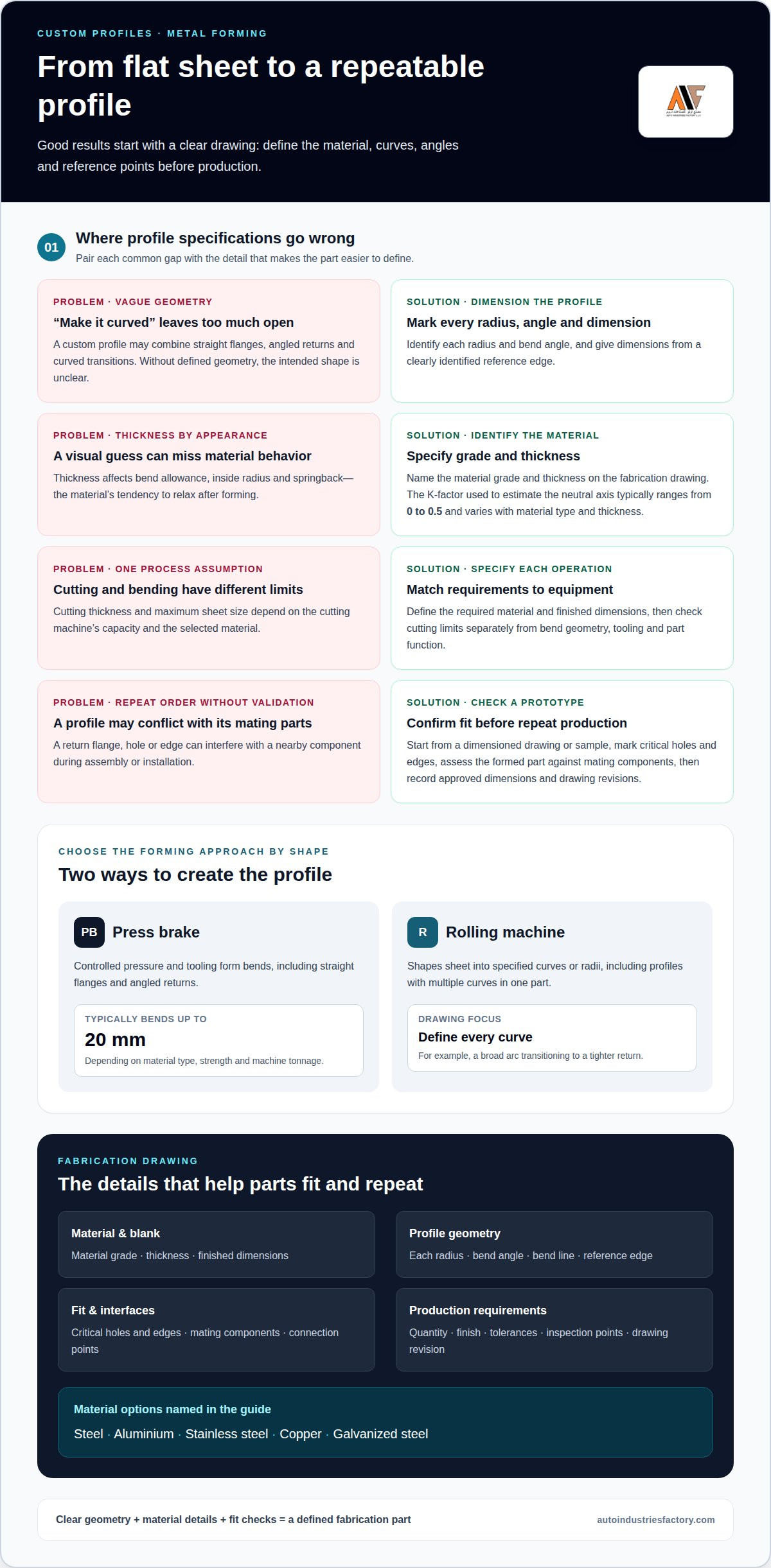
Steel, aluminium, stainless steel, copper, and galvanized steel can be used in metal-forming work. CNC press brakes can typically bend material up to 20 mm thick, depending on material type, strength, and machine tonnage. Cutting thickness and maximum sheet size depend on the cutting machine’s capacity and the selected material, so those limits must match the required part.
A custom profile may combine straight flanges, angled returns, and curved transitions. A press brake forms bends through controlled pressure and tooling; rolling machines shape sheet into specified curves or radii. Multi-radius profiles use different curves within one part, such as a panel that transitions from a broad arc to a tighter return. The drawing should mark each radius, bend angle, and dimension from a clearly identified reference edge.
Material thickness affects how a profile forms. It changes the bend allowance, inside radius, and springback, which is the material’s tendency to relax after forming. The K-factor, used to estimate the neutral axis in a bend, typically ranges from 0 to 0.5 and varies with material type and thickness. A fabrication drawing should identify the material grade and thickness rather than relying on appearance alone.
For standard or custom thicknesses, define the required material and finished dimensions first. Standard sheet can be cut into smaller pieces; a custom thickness must suit the bend geometry, available tooling, and part function. Maximum sheet dimensions depend on the machine bed and handling setup, while narrow or unusually shaped blanks may need a different cutting layout.
Custom parts and prototypes help resolve fit before repeat production. Start with a dimensioned drawing or sample, mark critical holes and edges, then assess the formed part against its mating components. For example, a prototype bracket can show whether a return flange clears a nearby panel. Record approved dimensions and drawing revisions for repeat orders.
Custom structural anchors need clear hole positions, edge distances, plate thickness, and intended attachment points. These details guide cutting and forming, while project drawings establish the required geometry. For custom metal fabrication, specify the profile, material, thickness, quantity, finish, and inspection points. A coordinated workflow can connect metal cutting and bending work with fabrication requirements.
To request a fabrication quote in the UAE, provide a drawing or sample, material grade, thickness, quantity, tolerances, finish, and delivery location. Include the application, project quality standards, and required cutting and bending operations. Clear inputs help define the part before production begins.
Requirements depend on the project and intended use. Define quality, material, and workplace-safety criteria alongside inspection and documentation needs before fabrication.
Industrial and commercial metal-forming applications
Metal forming supports construction, manufacturing, automotive work, and other industrial production across the UAE. Each application places different demands on the finished part. Architectural work may prioritize visible curves and consistent alignment, while machinery components must fit adjacent equipment. Start with the part’s function, then specify its geometry, material, and connection points.
Architectural metal products include curved canopies, staircases, railings, and support systems. In commercial fit-outs and architectural spaces across the UAE, turnkey specialists like Verve Interior Design & Build often coordinate such custom metalwork within comprehensive design and build plans. A curved steel canopy, for example, needs formed sections that follow the building’s shape and connect at planned supports. Drawings can show the curve, attachment positions, and interfaces with adjoining structures, helping keep fabrication aligned with installation requirements.
Structural steel elements also serve engineering and commercial projects. Bent sections can form frames, brackets, and supports, while rolled sections create curved features. For a railing, coordinate the handrail profile, posts, and fixing points. For a structural frame, specify bends to suit the assembly sequence and adjoining members.
Industrial applications span machinery, piping systems, structural frameworks, and equipment. Bent pipes can form parts of pipeline systems or industrial equipment, while shaped sheet components may become guards, covers, or enclosures. In HVAC and mechanical installations, bent tubes and pipes support ventilation, cooling, and piping routes. Plan routes around connections and clearances to reduce fitting conflicts during installation.
Pipe rolling and tube bending also support curved steel structures and canopies used in UAE construction. Proper bending can reduce the need for multiple welded joints, simplifying part layouts, although strength and connection details still depend on the engineering design. Grouping similar shapes and defining repeatable dimensions can support more efficient fabrication and assembly.
Heavy plate bending serves applications where thicker plate is specified for structural or industrial use. The forming process depends on the plate’s material, dimensions, bend geometry, and machine and tooling capacity. A long bend or tight radius places different demands on equipment than a smaller component. Drawings should identify the bend line, inside radius, angle, and finished dimensions so the formed plate can be assessed for its intended fit.
Steel rolling and bending can produce items such as tankers, trailers, buckets, and pressure vessels. These products vary in shape and function, so no single forming approach suits every job. A practical sequence is to define the application, prepare dimensioned drawings, identify connection interfaces, and plan inspection points before production. Across the UAE, steel fabrication supports construction and manufacturing projects that need formed components suited to their structures and equipment.
Fabrication-ready parts for welding, assembly, and installation
Fabrication-ready parts match the drawing and the next production step. Clear dimensions, interfaces, and inspection points help prevent fit problems during welding, assembly, or installation.
Across the UAE, fabrication companies offer laser, plasma, and waterjet cutting alongside CNC bending. Workshop location, material handling, and delivery logistics affect how parts move from production to the project site.
Precision and Structural Integrity
Precision means more than matching one dimension. Hole positions, edge conditions, bend angles, and mating surfaces must work together in the finished assembly. For a welded frame, for example, inconsistent cut lengths can pull joints out of alignment during fit-up.
Structural integrity depends on the design, material, forming sequence, and connection details. Review drawings for critical dimensions, load-bearing interfaces, and weld locations. Identify the measurements that control fit, then define how these features will be inspected before parts move to assembly.
Fabrication Technology and Equipment
Laser, plasma, and waterjet cutting each separate material using a different process. CNC bending uses a computer-controlled press brake to form sheet metal into precise shapes. Equipment choice depends on material, thickness, profile, and the required edge or bend characteristics.
For a fabrication quote, share a dimensioned drawing, material grade, thickness, quantity, and required finish. Include the cutting method if the design specifies one, along with critical tolerances and downstream operations. This helps the production team assess whether the part geometry suits the proposed equipment.
Technology matters when it supports the part’s requirements. A laser-cut panel with closely spaced openings, for instance, needs a suitable cutting setup and a drawing that defines each opening’s position. A bent bracket needs clear bend lines and finished dimensions. Ask how the fabrication sequence will preserve those features through cutting and forming.
Metal fabrication companies in the UAE serve industrial, construction, and commercial projects nationwide. To choose a suitable company, compare its cutting and bending capabilities with your part requirements rather than relying on a general equipment list. Check that its production process covers the required operations and that it can work from the project drawings.
Before releasing a drawing package, distinguish critical dimensions from reference dimensions so the workshop can interpret them clearly. Mark the material, quantity, finish, and revision on the document. For a prototype, record approved changes before repeat production. Controlled revisions reduce the risk of assembling parts made to different designs.
For vehicle-related fabrication, formed metal components may need to align with surrounding structures and installation points. A coordinated metal fabrication workflow connects cutting and bending requirements with the finished assembly. Define those interfaces early, especially where welding or installation access is limited.
Accurate angles and repeatable forming
Repeatable forming starts with a controlled process, not just a finished part. Using the same drawing, material, tooling, and machine settings helps produce matching bends across a batch. For a series of stainless steel covers, consistent angle measurement helps each cover align with its matching frame.
CNC rolling and bending machines produce curves and angles with controlled precision. A practical sequence is to set up the machine, form a first part, measure its angles and dimensions, then use the approved setup for subsequent parts. This provides a reference for repeat production and helps identify variation before it carries into assembly.
Metal forming involves more than pressing a flat sheet into shape. A press brake forms bends along defined lines, while rolling equipment creates curved sections. The drawing should distinguish bend angles from overall dimensions and identify the edges used as measurement references. For a panel with several bends, consistent reference points make inspection clearer.
Material affects forming behavior. Steel, aluminium, stainless steel, and copper are used for CNC bending, and each responds differently to pressure and tooling. Thickness and material strength also influence how a bend forms and how much it changes after pressure is released. Identify the selected material and thickness on the production drawing rather than relying on a generic description such as “metal”.
For sheet metal forming, sequence matters. Forming a flange before a nearby return may affect tool access or how the part sits against the machine. Review the bend order against the part geometry before production. Then measure the formed sample against the drawing, focusing on critical angles, hole positions, and mating edges.
Metal-forming services across the UAE support manufacturing, construction, and commercial projects. Delivery planning connects the workshop’s production sequence with the receiving site’s access, unloading arrangements, and installation schedule. A formed canopy section, for example, needs handling and transport that preserve its profile until installation.
Lead times depend on material sourcing, part geometry, batch quantity, machine scheduling, finishing, and inspection requirements. Delivery options across the UAE depend on the finished parts’ dimensions, handling needs, destination, and site access.
For repeat orders, keep the approved drawing revision and inspection dimensions with the production record. Note approved forming adjustments against the part drawing, then use that revision for the next batch. This gives manufacturing teams a practical basis for producing consistent parts without relying on memory or unrecorded machine adjustments.
Sheet metal cutting and bending
In the UAE, sheet metal cutting and bending services can include laser, plasma, and waterjet cutting, as well as CNC press-brake forming. A bending capacity does not establish a cutting limit: maximum cutting thickness depends on the material and machine capability.
CNC press brakes can typically bend material up to 20 mm thick, depending on material type, strength, and machine tonnage. Cutting capacity is also process-dependent. A laser, plasma, or waterjet system works differently, so the usable thickness depends on the material and the equipment. Match the process to the drawing, rather than treating one thickness as a universal limit.
Cutting prepares flat stock for forming or assembly. A fabrication drawing may specify a perimeter cut, mounting holes, slots, or several parts nested on one sheet. Laser, plasma, and waterjet cutting are available methods. The selected method affects the cut edge and the geometry that can be produced, so mark critical edges and openings on the drawing.
Bending turns a cut blank into a three-dimensional component. A press brake applies controlled force along a bend line to create angles, returns, channels, or brackets. For example, a flat panel can be cut with mounting holes and then bent into a protective cover. Hole positions and bend sequence must work together so the finished components align during assembly.
Material selection affects both operations. Steel, aluminium, stainless steel, and galvanized steel are used in fabrication, but their thickness and strength affect cutting and forming behavior. State the material grade and thickness in the specification. A vague description such as “metal sheet” leaves important production choices undefined.
For welding-ready parts, show where joints meet and which edges need fit-up. A cut plate with a bent flange, for instance, needs dimensions that let the flange sit against its adjoining component. Include finished dimensions, bend angles, hole locations, quantity, and revision on the drawing. These details connect cutting, forming, and welding without relying on informal assumptions.
Custom metal work can combine several cut and formed components. A canopy frame may use shaped brackets, while a roof rack can include bent supports and mounting plates. In each case, distinguish the flat pattern from the finished geometry on the part drawing. This prevents the flat blank from being mistaken for the final component.
Separate the requirements for cutting and bending when preparing a project. Identify material, thickness, cut features, bend lines, finished angles, and assembly interfaces. This gives the production team a clearer basis for planning the process and producing parts suited to their intended use. For project-specific metal cutting and bending, share the component drawing and its fabrication requirements.
Auto Industries Factory: Ambulance Conversions
Auto Industries Factory LLC supports UAE projects requiring ambulance conversions, including box type ambulances and extended roof ambulances on GMC and Toyota platforms. Its in-house fabrication capabilities include laser cutting, CNC machining, welding, and painting, supporting the production of metal components for specialized vehicle projects.
Turn to Auto Industries Factory LLC when your project involves converting a vehicle into an ambulance or requires related metal fabrication. The company also works on Police & Military Vehicle Modifications, Safari Vehicle Conversions, and Metal Canopies and Roof Racks. Explore its vehicle conversion and fabrication services to see how the work fits your project.
Contact Auto Industries Factory LLC to discuss your project requirements.
Turn Your Project Requirements Into the Next Step
Use your approved drawing to connect fabrication planning with the finished application. Set out the required geometry, material, interfaces, and intended use in one clear project brief. This gives the next discussion a practical focus: how formed components fit the vehicle or assembly, and which details matter most for installation.
For vehicle projects, Auto Industries Factory offers Ambulance Conversions, Police & Military Vehicle Modifications, and Safari Vehicle Conversions. Its metal cutting and bending work can also support project-specific fabrication needs. Share the application and part requirements to start a focused conversation about the right next step.
If you’re planning a UAE project that needs sheet metal cutting and bending services, connect the fabrication requirements to the intended vehicle application. Contact Auto Industries Factory to discuss your project and move forward with confidence.
Frequently Asked Questions
What is the maximum thickness you can cut?
There isn’t one cutting thickness that applies to every material and machine. The limit depends on the metal, its thickness, and the cutting equipment. State the material grade and thickness with your drawing so the process can be matched to the part. For comparison, CNC press brakes can typically bend material up to 20 mm thick, depending on material type, strength, and machine tonnage. That bending capacity is not a cutting limit.
How do laser, plasma, and waterjet cutting compare for UAE projects?
Laser, plasma, and waterjet are different cutting processes. The right choice depends on material, thickness, part geometry, and required edge characteristics. Do not select a process by name alone. Mark critical edges, holes, and slots on the drawing, then compare the proposed method with those requirements. For a project involving cut and bent parts, include finished dimensions and bend locations so the cut blanks suit the next operation.
What quality risks should I check for in cut edges, bend accuracy, and material finishes?
Inspect cut edges for burrs, rough areas, or distortion that could interfere with fit or welding. Measure bends against the drawing, especially angles and dimensions where components meet. Check the material finish for scratches, dents, or handling marks and compare it with the specified finish. For a trial part, record measurements and visible defects before approving repeat production. This creates a clear reference for later batches.
How do I choose a reliable sheet metal cutting and bending company in the UAE?
Choose a company whose processes match your drawings, material, and assembly needs. Clarify how cutting, bending, inspection, and revision control fit together, and assess a first part against critical dimensions before repeating production. For vehicle-related fabrication, Auto Industries Factory offers metal cutting and bending, with in-house laser cutting, CNC machining, welding, and painting. Provide a drawing, material details, quantity, and intended application to begin a focused discussion.
What metals, sheet thicknesses, and maximum sheet sizes can UAE fabricators handle?
Steel, aluminium, stainless steel, copper, and galvanized steel are used. CNC press brakes can typically bend material up to 20 mm thick, depending on material type, strength, and machine tonnage. Cutting thickness and maximum sheet size depend on the material, machine capacity, bed, and handling setup.


