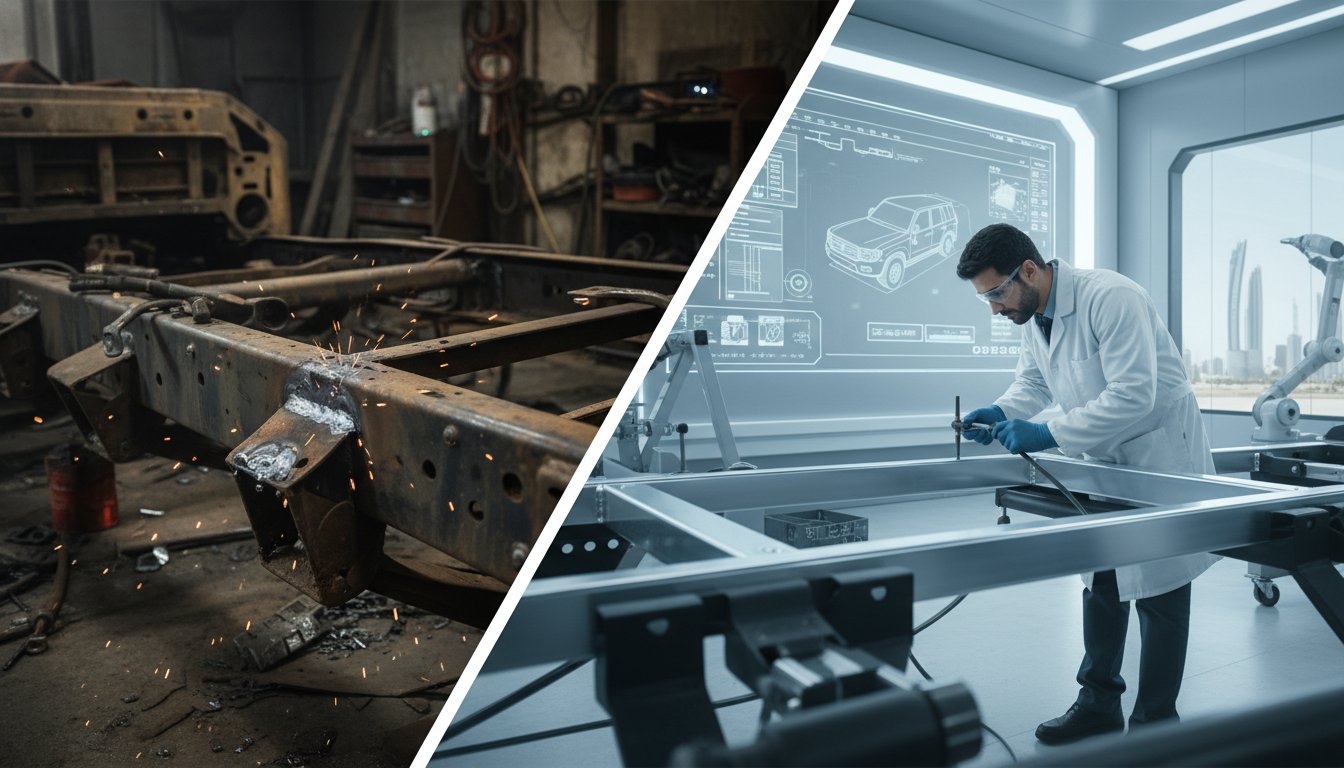
A "cost-effective" vehicle conversion becomes the most expensive mistake your business will ever make when it fails a mandatory RTA inspection or breaks down during a mission-critical operation in the desert. You already know that in the UAE, specialized vehicles like ambulances, police units, and safari trucks must meet rigorous engineering standards to survive 50-degree heat and punishing terrain. When safety is the priority, spotting the signs of a bad vehicle fabricator early is the only way to prevent structural failures that lead to thousands of Dirhams in wasted repair costs and dangerous downtime.
We understand that fleet managers often feel the pressure to balance budget constraints with the need for rugged, high-performance equipment. This article provides the clarity you need to vet potential partners with confidence. You'll learn the critical red flags of substandard engineering, from poor weld quality to non-compliant electrical systems. We also provide a comprehensive checklist to ensure your specialized fleet is built to last and fully meets UAE-specific safety regulations. By the end of this guide, you will have the expert knowledge required to choose a long-term engineering partner who prioritizes precision over shortcuts.
Key Takeaways
- Understand the critical difference between basic automotive repair and structural engineering to ensure your specialized fleet is built for heavy-duty reliability.
- Learn to identify the technical signs of a bad vehicle fabricator, such as substandard welding beads and the use of incorrect material grades that compromise safety.
- Evaluate a workshop’s engineering depth by verifying the presence of in-house CAD/CAM design capabilities and precision CNC machinery.
- Protect your investment by ensuring all vehicle conversions meet strict UAE regulatory standards, including GSO and MoIAT certifications.
- Discover how the AIF Engineering standard for precision fabrication and professional finishing maximizes the uptime and longevity of your UAE fleet.
Fabrication vs. Repair: Why Choosing a Specialist Matters in the UAE
Vehicle fabrication is the intersection of mechanical engineering and specialized manufacturing. In the UAE, many fleet managers mistake fabrication for standard automotive repair. While a mechanic typically replaces damaged parts with factory-made components, a fabricator designs and builds new structures from raw materials. This process requires a deep understanding of metallurgy and load-bearing physics. Identifying the signs of a bad vehicle fabricator early is essential because structural failures in the field don't just cause downtime; they cause accidents. To better understand the precision required in professional manufacturing, watch this helpful video: The UAE environment acts as a brutal testing ground for any custom work. In cities like Dubai and Ajman, ambient temperatures often exceed 50°C, while coastal humidity levels can reach 90%. These conditions accelerate metal fatigue and stress corrosion cracking. Professional industrial factories account for these variables during the design phase by using treated alloys and precision cooling. In contrast, "backyard fabricators" often use standard mild steel that hasn't been properly coated, leading to structural failure within 12 to 18 months of heavy field use.The High Stakes of Mission-Critical Conversions
When lives are on the line, there's no room for compromise. Substandard ambulance conversions can lead to oxygen tank mounts failing or heavy medical equipment becoming projectiles during a sudden stop. In safari trucks, poor roll cage welding can result in a total structural collapse during a rollover in the dunes. For police and military units, structural integrity is non-negotiable. These vehicles face high-impact scenarios where a single weak weld can compromise the entire crew's safety. A professional factory ensures every bracket and frame extension meets rigorous safety factors.The "Cheap Quote" Trap in Dubai and Ajman
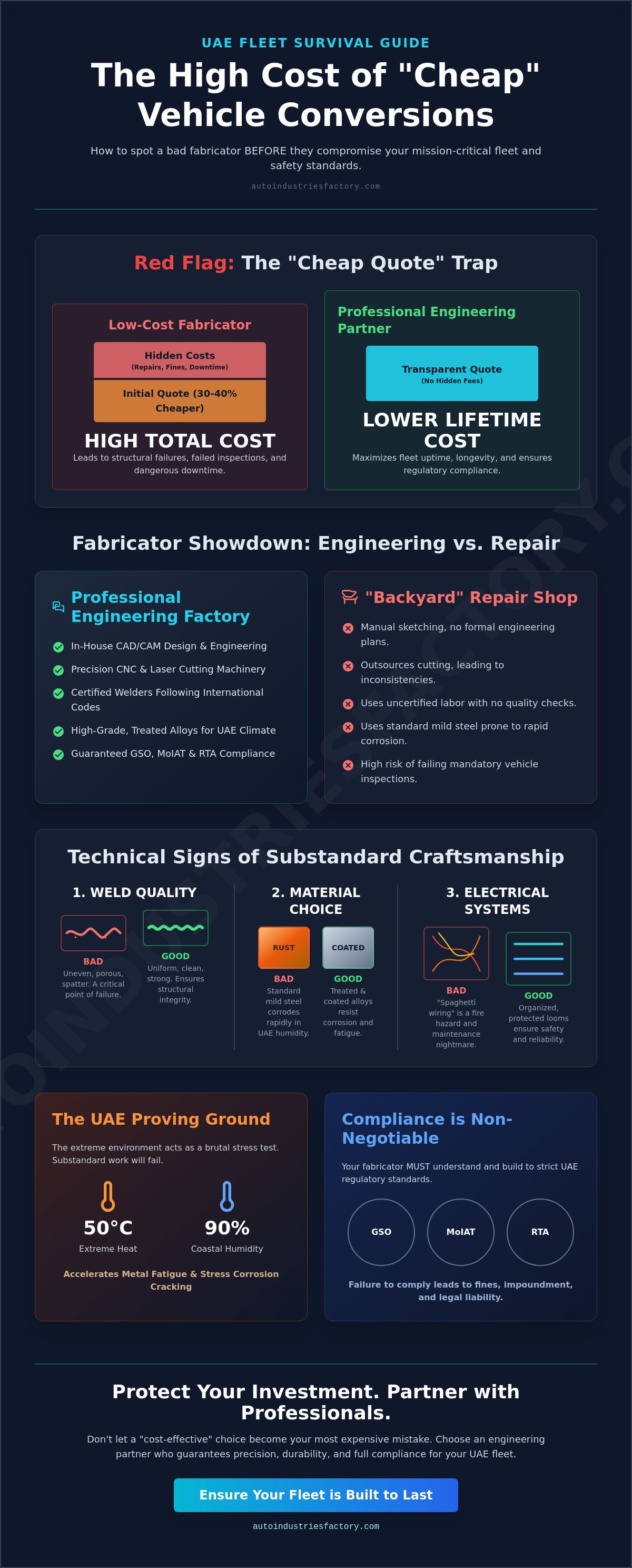
Low-cost fabricators often provide quotes that are 30% to 40% lower than established industrial factories. They achieve this by skipping essential reinforcements and using inferior joining techniques. This "cheap quote" usually leads to thousands of AED in maintenance costs and legal fines later. One of the clearest signs of a bad vehicle fabricator is their inability to cite international welding codesTop Red Flags in a Vehicle Fabrication Workshop
Identifying the signs of a bad vehicle fabricator starts the moment you walk onto the workshop floor. A professional facility in the UAE should operate with the precision of an assembly line, not a chaotic repair shop. Disorganization is the first warning. If you see tools scattered, metal offcuts piling up, or technicians working without clear safety gear, quality control is likely non-existent. A disorganized environment leads to missed weld points and structural oversights that compromise fleet safety.
Documented workflows are another non-negotiable requirement. A reputable factory follows a strict path from the initial design consultation to the final painting stage. If a fabricator can't produce a project timeline or a quality checklist, they're winging the build. This lack of process often results in delays that can cost your business thousands of dirhams in downtime. High-quality fabrication requires a systematic approach to ensure every vehicle in your fleet meets rigorous vehicle safety regulations and local UAE standards.
The Importance of In-House CNC and Laser Cutting
Many shops in Dubai act as middlemen rather than true manufacturers. They outsource their metal cutting to third-party providers, which is a major red flag. Outsourcing often results in inconsistent fitment and structural gaps because the person cutting the metal isn't the one installing it. Manual cutting can lead to variances of 5mm or more, whereas in-house CNC laser cutting maintains tolerances within 0.1mm.
Precision machinery like CNC cutters and hydraulic press brakes are essential for complex builds. These tools ensure that every custom bull bar or canopy fits the vehicle chassis perfectly every time. If a workshop lacks this specialized equipment, they're forced to use grinders and hammers to make parts fit. This "force-fitting" stresses the metal and creates weak points that will fail under the harsh vibrations of off-road or heavy-duty use.
Engineering Design vs. "Guesswork" Fabrication
It's a massive red flag if a fabricator starts cutting steel without a 3D design or a technical blueprint. Modern vehicle modification relies on CAD (Computer-Aided Design) to calculate weight distribution and aerodynamics. For heavy-duty 4x4 accessories, guesswork isn't just unprofessional; it's dangerous. An improperly designed bumper can block airflow to the radiator or interfere with airbag sensors, leading to catastrophic engine failure or safety risks.
Expert engineers use the design phase to conduct stress testing before a single spark flies. They analyze how a 100kg winch mount affects the front suspension geometry of a Toyota Land Cruiser or Nissan Patrol. Without these digital simulations, you're essentially paying for a prototype that hasn't been tested. You can see the difference that professional engineering makes by exploring our professional conversion services, where every build starts with a technical plan rather than a guess.
Technical Indicators of Substandard Craftsmanship
Identifying the signs of a bad vehicle fabricator starts with a rigorous visual inspection of the metalwork. Precision engineering requires uniform, clean joints, yet many low-tier workshops in the UAE produce "bird poop" welding. These messy welds are characterized by excessive porosity, uneven beads, and a visible lack of fusion. High-quality MIG or TIG welding should resemble a consistent stack of fallen dimes. If you see splattered metal or gaps in the seam, the structure's integrity is already compromised. Weld penetration is the critical measure of joint strength, as it defines how deeply the filler metal fuses with the base material. Without deep, consistent penetration, joints will snap under the intense vibration of off-road desert driving or heavy-duty fleet usage.
Welding Quality: The Backbone of Structural Integrity
Proper structural integrity is non-negotiable for fleet safety and long-term ROI. Substandard fabricators often rely on "tack" jobs, which are small spots of weld that don't provide a continuous bond, just to save time and gas. These shortcuts fail to meet basic commercial vehicle inspection criteria, putting your drivers and cargo at risk during high-speed transit on the E11 or E311. A professional fabricator uses continuous beads and ensures the heat signature doesn't warp the surrounding metal, a common mistake in shops lacking specialized jigs and cooling equipment.
Material Choice and Corrosion Protection
The UAE’s coastal humidity and extreme heat demand specific metallurgical choices to prevent premature failure. A major red flag is the use of non-galvanized or non-powder-coated metals for external components like bull bars or roof racks. Cheap mild steel will begin to oxidize within months, leading to structural rot that a simple coat of paint can't fix. Expert fabricators prioritize high-strength alloys and weight-saving materials, particularly in safari vehicle conversions, where every kilogram affects fuel efficiency and sand performance. Standard "one-size-fits-all" metal canopies usually fail within 12 months because they lack the flexibility to handle thermal expansion in 50°C temperatures.
Electrical Integration and Finishing Flaws
Substandard shops often use thick layers of body filler or low-grade industrial paint to hide pinholes in welds or existing rust patches. This is a common tactic in tactical or medical vehicle builds where the exterior looks professional but the foundation is weak. Another of the signs of a bad vehicle fabricator is inadequate electrical integration. Inexperienced shops often tap directly into existing factory harnesses without proper relays or independent fuses for specialized equipment. This leads to voltage drops, short circuits, or vehicle fires in mission-critical ambulances or security units. Professional integration requires independent, fused circuits and heat-resistant loom protection to ensure 100% uptime in the field.
Compliance Red Flags: UAE Regulations and Standards
Operating a fleet in Dubai requires more than just high-performance engines; it demands strict adherence to local and international safety protocols. One of the clearest signs of a bad vehicle fabricator is their inability to provide documentation from the Ministry of Industry and Advanced Technology (MoIAT) or the GCC Standardization Organization (GSO). Without these approvals, your modified vehicle is a legal liability that won't pass Road and Transport Authority (RTA) inspections. It's a risk that can lead to heavy fines or the immediate impounding of your assets.
Navigating UAE Vehicle Modification Laws
A professional fabricator must be MoIAT-registered to legally certify a conversion for road use. This registration ensures the workshop meets the technical requirements outlined in Cabinet Resolution No. 12 of 2021 regarding the UAE's vehicle safety standards. If a shop avoids discussing RTA compliance, it's a major red flag. Upon project completion, you should receive a formal Certificate of Conformity (CoC) and detailed technical drawings. These documents prove the structural integrity of the build and are essential for insurance coverage in the Emirates. Professional shops also ensure that weight distribution remains within the manufacturer's Gross Vehicle Weight Rating (GVWR) to prevent premature suspension failure.
Testing and Quality Assurance (QA) Protocols
Precision engineering requires rigorous validation, not guesswork. Bad fabricators often skip electrical stress tests or load-bearing analysis to save time and reduce costs. For specialized builds like ambulances, failure to adhere to the EN 1789 standard is unacceptable. This European standard, recognized across the UAE, requires medical compartments to withstand 10g of force during a collision. If your fabricator doesn't perform real-world testing, they're gambling with your personnel's safety. Look for ISO 9001:2015 certified facilities that implement documented QA checklists for every weld, bolt, and wire installed in vehicles like the Toyota Land Cruiser or Nissan Patrol.
Vague warranty terms are another warning. A reputable factory provides clear, written guarantees covering structural frames for at least 24 months and electrical systems for 12 months. Avoid shops that offer verbal promises instead of legally binding service level agreements. Protecting your investment means choosing a partner who stands behind their engineering with measurable data and official certifications. If they can't prove their builds survive 50-degree Celsius heat and high-vibration environments, they aren't fit for the UAE market.
Ensure your fleet meets the highest safety standards with our certified engineering team. Explore our compliant vehicle conversion services to see how we build for reliability and mission success.
Choosing the Right Partner: The AIF Engineering Standard
Auto Industries Factory (AIF) establishes the benchmark for precision engineering in the UAE. While identifying the signs of a bad vehicle fabricator is essential for protecting your investment, selecting a partner that operates with total transparency is the only way to guarantee fleet longevity. We don't just modify vehicles; we engineer mission-critical solutions that meet the rigorous demands of the Middle Eastern climate and terrain. Our facility in Ajman serves as a hub for innovation, where every weld and cut is executed to international standards.
AIF specializes in high-stakes conversions for government and private sectors. Our portfolio includes specialized ambulances, tactical police units, and heavy-duty military transports. These builds require more than basic metalwork. They demand an understanding of weight distribution, structural integrity, and electronic integration. By maintaining a clean, organized, and technologically advanced workshop, we eliminate the common signs of a bad vehicle fabricator like poor finishing or structural weaknesses.
The AIF In-House Advantage
Auto Industries Factory maintains 100% control over the conversion lifecycle. We don't outsource critical stages of production. Our "Design-Fabricate-Integrate" workflow ensures that every project stays on schedule and meets our strict quality control protocols. This process begins in our design suite and moves directly to our fabrication floor, utilizing advanced CNC laser cutting and precision press brakes to ensure every component fits perfectly.
- Chassis Expertise: We specialize in high-performance conversions for the Toyota Land Cruiser, Nissan Patrol, and GMC chassis.
- Advanced Metalwork: Our team uses 100% in-house CNC machinery for flawless metal shaping and durability.
- Professional Finishing: Every build concludes in our controlled painting and powder-coating booths to prevent corrosion in high-salinity UAE environments.
- Quality Assurance: Each vehicle undergoes a multi-point inspection before it leaves our Ajman factory.
Next Steps for Your Fleet Transformation
Protecting your fleet starts with a technical consultation. We invite fleet managers and procurement officers to visit our Ajman facility for a transparent look at our engineering process. Seeing our production line in person allows you to verify our capabilities and witness the precision we apply to every mission-critical build. Local support is the backbone of our operation. We provide rapid after-sales service and maintenance throughout the UAE, ensuring your vehicles remain operational when they are needed most.
Don't settle for subpar fabrication that compromises safety and performance. Our team is ready to provide the technical expertise your project requires. Contact Auto Industries Factory today for a professional fabrication estimate and discover why we are the trusted partner for the UAE's most demanding fleet projects.
Secure Your Fleet’s Future with Precision Engineering
Don't let substandard craftsmanship compromise your fleet's mission reliability. Identifying the signs of a bad vehicle fabricator early prevents costly downtime and safety risks on UAE roads. From visible weld porosity to a lack of GSO and MoIAT compliance, these red flags indicate a workshop that doesn't prioritize the rigorous standards required in Dubai. Protecting your investment means choosing a partner that integrates advanced technology with regulatory expertise.
Auto Industries Factory (AIF) specializes in high-performance conversions as a leading UAE ambulance manufacturer. Our facilities utilize full in-house CNC and laser machining to ensure every cut and bend meets exact engineering tolerances. We maintain GSO and MoIAT compliant facilities to guarantee your vehicles pass every inspection and perform under the harshest conditions. Your fleet represents your brand's commitment to safety; don't settle for anything less than precision.
Get a Free Engineering Consultation for Your Fleet
We look forward to helping you build a fleet that stands the test of time and terrain.
Frequently Asked Questions
What are the legal requirements for vehicle modification in the UAE?
Vehicle modifications in the UAE must comply with RTA and MoIAT regulations to ensure roadworthiness and safety. Under Federal Law No. 21 of 1995, any structural change requires a technical inspection certificate from an authorized center. Failing to secure these approvals results in fines starting at AED 1,000 and potential vehicle impoundment. A reputable fabricator handles the necessary documentation for MoIAT conformity, ensuring your fleet stays legal on Dubai roads.
How can I check the quality of a fabricator’s welding?
You can identify high-quality welding by looking for uniform, stacked coin patterns with consistent bead width across the joint. A bad fabricator leaves behind excessive spatter, porous holes, or cold laps where the metal didn't fuse properly. Use a flashlight to check the back of the joint for full penetration. If the welds look messy or uneven, it's one of the primary signs of a bad vehicle fabricator that compromises structural integrity.
Why is CAD design important for vehicle conversions?
CAD design is essential because it allows for precision engineering and accurate weight distribution calculations before any metal is cut. Using software like SolidWorks ensures that every component fits perfectly within the vehicle's specific dimensions. This digital blueprinting reduces material waste by 15% and guarantees that if you need a replacement part for your fleet later, it'll be identical to the original. Without it, you're relying on guesswork and manual errors.
What is the difference between a mechanic and a vehicle fabricator?
A mechanic focuses on maintaining or repairing existing systems using pre-manufactured parts, while a fabricator builds new structures from raw materials. Mechanics follow service manuals to keep a vehicle running. Fabricators use CNC lasers and press brakes to create custom solutions like bull bars or specialized ambulance interiors. Choosing a mechanic for structural fabrication is a common mistake that leads to poor fitment, safety risks, and long-term durability issues for your fleet.
Can a bad fabricator void my vehicle’s manufacturer warranty?
A bad fabricator can definitely void your manufacturer warranty if their work interferes with the vehicle's original electrical or structural systems. UAE dealerships often reject warranty claims if they find non-certified modifications to the chassis or wiring harness. To protect your investment, always ensure the fabricator provides a separate warranty on their work and follows the manufacturer's body builder guidelines. This careful approach maintains coverage and ensures the vehicle remains supported by the original dealer.
What should I look for during a factory visit?
During a factory visit, look for advanced machinery like CNC fiber lasers and a clean, organized assembly line. Observe if the technicians are using proper jigs for alignment and wearing safety gear. A professional facility should proudly display their ISO 9001:2015 certification and have dedicated bays for different stages of production. If the workshop is cluttered or lacks modern equipment, it's a major red flag that the final product won't meet industrial standards.
Why do specialized vehicles like ambulances need EN 1789 standards?
Specialized vehicles like ambulances require EN 1789 standards to ensure the interior medical cabinet and equipment can withstand a 10g crash impact. This certification guarantees that every component remains securely fastened during an accident, protecting both the crew and the patient. In the UAE, adhering to these international safety benchmarks is a hallmark of a premium fabricator. It shows they prioritize life-saving reliability over cheap, dangerous alternatives that could fail during an emergency.
How does the UAE climate affect vehicle fabrication choices?
The UAE climate, with summer temperatures exceeding 50°C and high coastal humidity, requires the use of corrosion-resistant materials and heat-reflective coatings. Fabricators must use high-grade powder coating and UV-stabilized plastics to prevent peeling and structural degradation. Identifying signs of a bad vehicle fabricator often involves spotting rust or faded paint on their previous projects. This usually indicates they used materials that can't handle the harsh Middle Eastern sun or the high salinity in the air.


