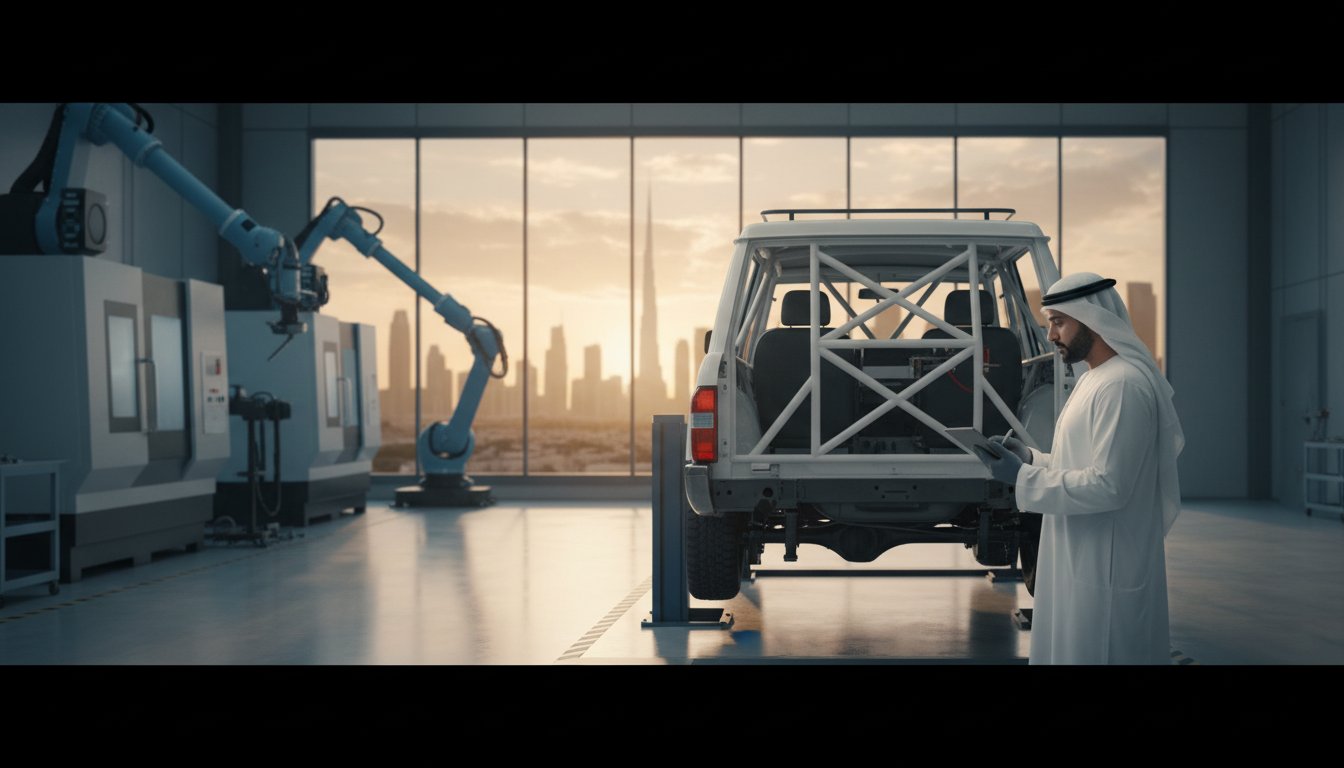
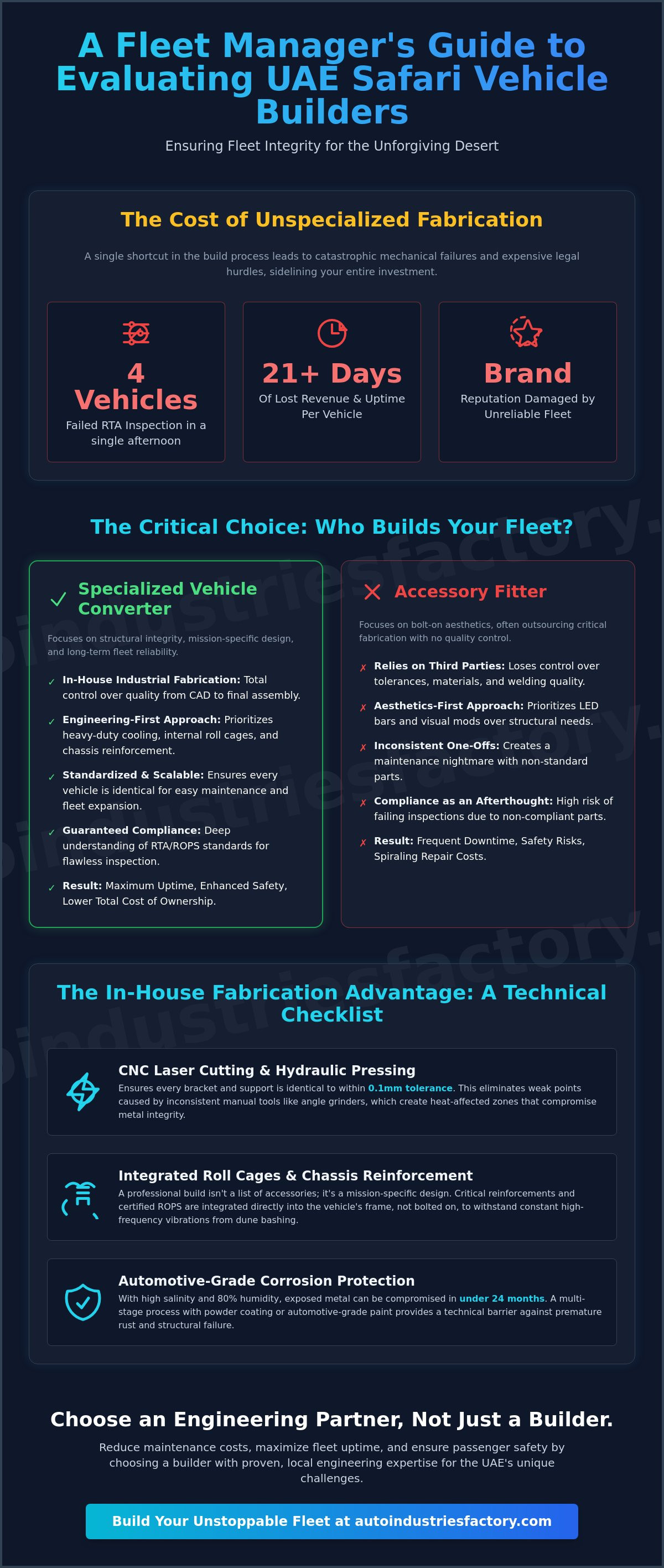
Last August, a fleet manager in Dubai watched four newly modified Nissan Patrols fail their RTA inspections in a single afternoon, resulting in 21 days of lost revenue per vehicle. You likely agree that the UAE desert is an unforgiving testing ground where a single shortcut in the fabrication process leads to catastrophic mechanical failure or expensive legal hurdles. It's frustrating to invest in a fleet only to have it sidelined by poor welding or non-compliant roll cages that don't meet local safety standards. Finding a partner who understands these high stakes is essential for maintaining your operational uptime.
This guide will help you master the technical and regulatory criteria for evaluating safari vehicle builders, ensuring your fleet is engineered for the 50-degree heat and shifting dunes of the Empty Quarter. You'll learn how to vet converters based on their engineering prowess, material choices, and ability to deliver a rugged, reliable product that stands up to heavy-duty use. We'll provide a professional checklist that covers everything from CNC laser precision and suspension upgrades to the specific documentation required for flawless RTA compliance and enhanced passenger safety.
Key Takeaways
- Understand why industrial-grade fabrication, such as CNC laser cutting, is critical for maintaining fleet integrity under extreme UAE desert conditions.
- Learn a systematic approach to evaluating safari vehicle builders by vetting their welding standards and structural reinforcement capabilities.
- Identify the specific RTA compliance and ROPS certification requirements necessary to legally operate a commercial safari fleet in Dubai and the wider UAE.
- Balance passenger comfort with operational durability by assessing secondary climate control systems and specialized thermal insulation.
- Discover how choosing a builder with local engineering expertise can significantly reduce maintenance costs and maximize your fleet's operational uptime.
The Stakes of Evaluating Safari Vehicle Builders in the UAE
The UAE desert presents a brutal engineering challenge that far exceeds the requirements of a standard off-road vehicle used for weekend hobbies. For a fleet manager, the process of evaluating safari vehicle builders is a high-stakes decision that dictates whether a business thrives or stalls in the sand. A build that looks rugged on the showroom floor can quickly become a liability when subjected to the relentless heat and fine silica of the Lahbab or Liwa dunes. Engineering for the desert isn't about looks; it’s about heat dissipation and structural rigidity. To better understand this concept, watch this helpful video: The financial reality is simple. Operational uptime is the only metric that matters for a commercial fleet. A poorly converted vehicle doesn't just cost money in repairs; it costs thousands of AED in lost bookings and damaged brand reputation. Professional fleet managers must distinguish between "accessory fitters" who focus on bolt-on aesthetics and "specialized vehicle converters" who understand structural integrity. In Dubai, most commercial fleets rely on the Toyota Land Cruiser and Hilux chassis due to their proven reliability, but even these platforms require significant modification to handle 10-hour daily cycles in 50°C temperatures.The Regional Context: Dubai to Abu Dhabi Safari Demands
The UAE’s coastal geography introduces high salinity into the air. This accelerates frame corrosion if the builder doesn't use specialized coatings. Since the industry transitioned from private desert drives to high-capacity commercial tours, the mechanical strain on suspension systems has tripled. You can learn more about our regional expertise and engineering history at About Auto Industries Factory, where we've spent years perfecting builds for these specific conditions. Commercial tours demand 100% reliability during peak season, meaning there's no room for component failure.
Defining the Professional Safari Build
A professional build isn't a list of accessories; it's a mission-specific design. While hobbyists focus on snorkel intakes and LED bars, professional converters focus on heavy-duty cooling systems and internal roll cage integration. Evaluating safari vehicle builders means looking for fabrication that supports fleet scalability. If a build isn't standardized across 50 units, your maintenance team will face a nightmare of custom one-off parts. True professional builds prioritize structural reinforcement over aesthetic modifications to ensure passenger safety and vehicle longevity.
Engineering Standards: Assessing Structural Fabrication Quality
Fleet managers often overlook the invisible engineering that prevents a vehicle from folding under pressure. When evaluating safari vehicle builders, the difference between a reliable tourer and a liability lies in the fabrication floor. A safari vehicle in the UAE doesn't just drive; it survives constant high-frequency vibrations and extreme thermal expansion. High-grade engineering ensures that the vehicle stays rigid when cresting a 30-degree dune or navigating the rocky terrain of Hatta.
The In-House Advantage: From Laser Cutting to Painting
A builder reliant on third-party workshops loses control over critical tolerances. Top-tier UAE factories utilize CNC laser cutting and hydraulic press brakes to ensure every bracket and roof support is identical to within 0.1mm. Manual tools like angle grinders create inconsistent heat-affected zones that weaken the base metal. Full in-house control allows for a seamless transition from CAD design to the final assembly line. Professional vehicle painting isn't just about aesthetics; it's a technical barrier against the 80% humidity levels often found in Dubai's coastal areas. Without a specialized powder-coated or automotive-grade finish, desert corrosion can compromise structural steel within 24 months of service.
Chassis Reinforcement Checklist
The UAE desert requires more than just a standard lift kit. Heavy-duty tour loads, which often exceed 2,500kg when fully loaded with seven passengers and recovery gear, demand structural modifications to the frame itself. Builders must strictly adhere to the Vehicle regulations in United Arab Emirates to ensure every modification is road-legal and safe. When inspecting a builder's work, use this checklist:
- Welding Integrity: Look for double-pass MIG welding on all roll cage joints; welds should be uniform without porosity.
- Roof Support: Structural modifications for extended roofs must include reinforced B and C pillars to prevent collapse during a rollover.
- Material Grade: Verify the use of cold-drawn seamless (CDS) tubing rather than cheaper, brittle alternatives.
Structural fatigue is the progressive weakening of a vehicle's metal components caused by the repetitive, high-impact stress of vertical drops and lateral G-forces during desert dune bashing. To combat this, precision fitment is essential. CAD-led design prevents the rattling and micro-movements that eventually lead to weld failure and structural cracks. Auto Industries Factory (AIF) specializes in these high-precision vehicle conversion services, ensuring every fleet vehicle is built to endure the harshest environments in the region.
The Guest Experience Checklist: Comfort and Operational Durability
Guest satisfaction in the UAE safari industry relies on the thin line between a thrilling ride and an uncomfortable ordeal. When evaluating safari vehicle builders, fleet managers must look past aesthetic appeal to verify the engineering of the passenger cabin. A vehicle that looks rugged on the outside but lacks thermal efficiency or ergonomic support will lead to negative reviews and high driver turnover. In the desert, where ambient temperatures often exceed 45 degrees Celsius, the interior environment is a critical safety component.
High-quality builders prioritize a three-pillar approach to the guest experience: thermal management, seat ergonomics, and material resilience. This ensures the vehicle remains operational for 10-hour daily cycles while maintaining a premium feel for tourists. You aren't just buying a modified SUV; you're investing in a mobile hospitality environment that must withstand extreme vibration and heat.
Interior Design for High-Frequency Tours
The ergonomics of desert safari truck design center on passenger stability during high-speed dune bashing. Professional builders install reinforced seating with integrated 3-point or 4-point safety harnesses that don't compromise legroom. Communication is equally vital. Integrated PA systems allow guides to provide commentary without shouting over engine noise or AC blowers. For a deeper look at specific layout options, refer to our guide on Safari Vehicle Conversions to see how space is optimized for both 5-seater and 7-seater configurations.
- Thermal Insulation: Use of aerospace-grade ceramic or foil-backed insulation behind door panels to reduce cabin heat soak.
- Secondary AC Systems: Installation of independent rear evaporators to ensure the third row stays at a constant 22 degrees Celsius.
- Marine-Grade Materials: Interior upholstery should use heat-resistant, anti-fungal vinyl that survives sweat and sand abrasion.
Heavy-Duty Accessories: More Than Just Aesthetics
External modifications serve as the first line of defense for your fleet. Vetting custom bull bars and bumpers is essential for protecting the vehicle’s cooling system and headlights during steep approaches. These components must be winched-ready and engineered to distribute impact forces into the chassis rather than the bodywork. Poorly mounted accessories will rattle loose within 5,000 kilometers of desert use.
Roof rack systems require specific attention to mounting point integrity. In the UAE, these racks often carry heavy recovery gear or spare tires; if the weight distribution isn't calculated correctly, it raises the center of gravity and increases rollover risk. Every metal component, from the rack to the bumper, must feature a high-micron powder-coated finish. This prevents the intense UAE sun and salty coastal air from causing premature corrosion and peeling. Evaluating safari vehicle builders on these technical details ensures your fleet remains profitable and safe for years, not just months.
Safety and Regulatory Compliance: Vetting for UAE Standards
Safety isn't an optional upgrade in the UAE safari industry; it's the foundation of your fleet's legal and operational viability. When evaluating safari vehicle builders, you must look beyond the aesthetics of leather seats and snorkel kits. A builder's ability to navigate the complex regulatory landscape of the Emirates determines whether your vehicle stays on the dunes or gets impounded during a spot check. The process begins with a deep dive into technical certifications and localized engineering standards.
Your vetting process should prioritize five critical steps. First, confirm the builder's working knowledge of RTA technical requirements. Second, demand ROPS certification documents. Third, inspect the integration of fire suppression systems and emergency exits. Fourth, verify MoIAT compliance for all manufactured parts. Finally, scrutinize the electrical safety of night safari lighting systems. Missing any of these steps creates significant liability for fleet managers.
RTA Compliance for Modified Vehicles
Navigating the RTA technical inspection in Dubai requires more than just a well-built car. You need a paper trail. Professional builders provide comprehensive documentation, including CAD design drawings and engineering certificates, to prove that modifications don't compromise the vehicle's structural integrity. It's common for modified 4x4s to fail inspections due to unapproved chassis welding or suspension lifts that exceed the standard 3-inch limit. A reputable builder ensures every bolt-on part and structural change meets the RTA's specific safety thresholds for commercial tour operators.
Roll Over Protection (ROPS) Standards
Roll Over Protection Systems are the most vital safety component in a desert fleet. While evaluating safari vehicle builders, you must decide between internal and external cages. Internal ROPS are preferred for high-end luxury tours because they remain hidden behind the interior trim, while external cages offer easier inspection access for heavy-duty dune bashing. In the UAE, the industry standard for ROPS requires the structure to support at least 1.5 times the vehicle's gross weight without collapsing into the passenger cabin. Testing protocols should involve static load tests or certified simulations that mimic a high-speed roll on a 30-degree dune slope.
Beyond the frame, fire safety and electrical integrity are paramount. Commercial safari vehicles must be equipped with 2kg dry powder fire extinguishers and clearly marked emergency glass hammers. For night operations, the electrical system is a frequent point of failure. Professional builders use marine-grade wiring and isolated dual-battery setups to prevent engine bay fires during high-draw situations. MoIAT (Ministry of Industry and Advanced Technology) compliance ensures that every custom-fabricated bracket or bumper meets national quality benchmarks, protecting your investment from premature wear and legal challenges.
Auto Industries Factory (AIF) specializes in engineering vehicles that exceed these rigorous safety benchmarks through precision manufacturing and expert fabrication. We don't just build for the desert; we build for the law.
View our custom vehicle conversion services to see how we meet and exceed UAE safety standards.
Choosing Auto Industries Factory for Your Safari Fleet
Auto Industries Factory (AIF) specializes in high-performance vehicle conversions that bridge the gap between heavy industrial fabrication and specialized desert engineering. When evaluating safari vehicle builders, fleet managers often find that many shops lack the infrastructure to handle large-scale commercial orders. Our facility in Ajman solves this by housing the entire production chain under one roof. We utilize in-house CNC laser cutting and advanced press brake technology to manufacture structural components with zero margin for error. This precision ensures that every roll cage, bull bar, and roof rack fits the chassis perfectly, maintaining the vehicle's structural integrity during high-impact dune bashing.
Our commitment to durability is visible in our material choices. We use heavy-duty, powder-coated steel and reinforced suspension components specifically tuned for the Toyota Land Cruiser and Hilux. These vehicles are the backbone of the UAE tourism industry, and our builds ensure they remain RTA-ready. By adhering to strict safety standards and local regulations, we help operators avoid registration delays and safety compliance issues. We don't just modify vehicles; we engineer solutions that maximize your fleet's uptime in the harshest environments on earth.
From Concept to Desert-Ready Fleet
Large-scale tour operators require a partner capable of managing complex logistics and consistent build quality. Our consultation process begins with a deep dive into your specific operational needs, passenger capacity, and terrain challenges. Whether you're managing a luxury desert resort or a high-volume tour company, we provide scalable Specialized Vehicle Services tailored to your brand. Our reach extends well beyond Ajman and Dubai. We regularly export custom-built fleets across the GCC, providing regional operators with the same rugged reliability found in our local UAE builds.
- Precision Engineering: In-house CNC laser cutting ensures every component is identical across your entire fleet.
- Scalable Production: Our industrial capacity allows us to handle dozens of conversions simultaneously without compromising on detail.
- Regional Logistics: We manage the export process for clients in Saudi Arabia, Oman, and Qatar, delivering turnkey safari solutions.
AIF Quality Assurance and Support
Reliability in the desert depends on what happens after the vehicle leaves the factory. Evaluating safari vehicle builders should always include an assessment of their long-term support capabilities. Because AIF is "Built in the UAE," our clients enjoy a significant advantage regarding parts availability and technical service. We provide comprehensive post-conversion support to ensure your commercial fleet stays on the dunes and out of the workshop.
Our team understands that every hour a vehicle is sidelined represents lost revenue. We offer dedicated maintenance schedules and rapid access to replacement fabrication parts. This local expertise means you aren't waiting weeks for international shipments or specialized components. We build our safari conversions to endure extreme heat, abrasive sand, and constant mechanical stress, giving you the confidence to push your fleet to its limits. Ready to start your project? Contact us for a free safari fleet estimate and let our engineers design your next generation of desert-ready vehicles.
Build a Fleet That Conquers the Dunes
Managing a high-performance safari fleet in the UAE requires more than just standard off-road modifications. It demands a partnership with experts who prioritize RTA-compliant engineering and structural integrity. When you're evaluating safari vehicle builders, look for facilities that utilize precision CNC laser cutting and heavy-duty fabrication to ensure every roll cage and bumper stands up to the harsh Rub' al Khali environment. Auto Industries Factory (AIF) specializes in these premium Toyota Land Cruiser and Hilux conversions, delivering vehicles that maximize uptime and guest safety. By focusing on durable engineering and local regulatory standards, you protect your capital investment and your brand's reputation for years to come. Our team at AIF brings decades of combined engineering experience to every build, ensuring your fleet remains a benchmark for quality in the Dubai desert. We don't just modify vehicles; we engineer mission-critical solutions that handle the 50-degree heat and shifting sands of the Emirates without compromise. It's time to upgrade your fleet with the rugged durability your passengers expect and the safety standards the law requires.
Get a Free Estimate for Your Safari Fleet Conversion
Frequently Asked Questions
What are the most important RTA requirements for safari vehicles in Dubai?
Safari vehicles must comply with RTA Order No. 2 of 2008 and subsequent safety updates for desert touring. Key requirements include a mandatory internal roll cage, a 2kg dry powder fire extinguisher, and a comprehensive first aid kit. Seating must feature 3 point seatbelts for every passenger. Each vehicle undergoes a specialized inspection at authorized centers like Tasjeel to ensure the structural integrity of the conversion meets strict safety standards for off-road use.
Why is in-house CNC laser cutting important for vehicle conversions?
In-house CNC laser cutting ensures 0.1mm precision for every component, which is a critical factor when evaluating safari vehicle builders. This technology allows AIF to produce consistent brackets, mounts, and structural plates that fit perfectly without manual grinding or forced fitment. By keeping this process in-house, we eliminate third party delays and maintain 100% control over the steel grade and cut quality. It's the difference between a rattle-free build and a vehicle that fails under the stress of 150km desert tours.
Which vehicle chassis is best for a safari conversion in the UAE?
The Toyota Land Cruiser 70 Series and the Nissan Patrol Y61 remain the gold standard for UAE safari operations due to their heavy-duty solid axle suspension. These models represent over 85% of the commercial safari fleets in Dubai because they handle high-torque desert driving without overheating. While the newer Land Cruiser 300 is gaining 15% market share, the older chassis provide a more rugged foundation for internal roll cage integration and long-term durability in deep sand dunes.
How long does a professional safari vehicle conversion typically take?
A professional safari vehicle conversion typically takes between 14 and 21 working days depending on the fleet size. This timeline includes the design phase, CNC fabrication, installation of the roll cage, and final upholstery work. We follow a 12 step quality control checklist during this period to ensure every weld and bolt meets our engineering standards. Larger fleet orders of 5 or more vehicles benefit from staged delivery schedules to keep your operations running smoothly.
What is the difference between an internal and external roll cage for safari trucks?
Internal roll cages are a legal requirement for RTA-registered safari vehicles to protect passengers during a rollover. These are fabricated from seamless cold-drawn steel tubes and integrated into the vehicle's pillars. External cages are primarily used for body protection and mounting heavy gear like roof racks. Most professional operators choose internal cages because they provide superior structural safety while maintaining the vehicle's aerodynamics and exterior aesthetic for high-end tourism.
Can you convert existing fleet vehicles or do you only work with new ones?
Auto Industries Factory (AIF) specializes in converting both brand new chassis and existing fleet vehicles. For older vehicles, we perform a 50 point structural assessment to ensure the frame is free from rust or fatigue before starting the conversion. Converting an existing vehicle can extend its operational life by 3 to 5 years. However, new vehicles are often preferred for high-utilization fleets to maximize the 5 year manufacturer warranty alongside our custom fabrication.
How do you ensure the AC system can handle 50°C UAE summers?
We guarantee AC performance in 50°C heat by installing high-ambient condensers and upgrading the thermal insulation in the cabin walls. Our engineering team adds auxiliary cooling fans and uses 10mm closed-cell foam insulation to reduce the heat load by up to 30%. This ensures the cabin temperature remains a comfortable 22°C even when the vehicle is idling in the midday sun. It's a critical factor when evaluating safari vehicle builders for the UAE's extreme climate.
Do you provide engineering certificates for modified vehicles?
Yes, we provide comprehensive engineering certificates and material test reports for every modified vehicle. These documents are essential for passing RTA technical inspections and securing commercial insurance coverage for desert operations. Our certificates confirm that the roll cage welding and seat mounting points meet international safety standards. We maintain a digital archive of these certifications for every VIN we process to assist fleet managers with future audits.


