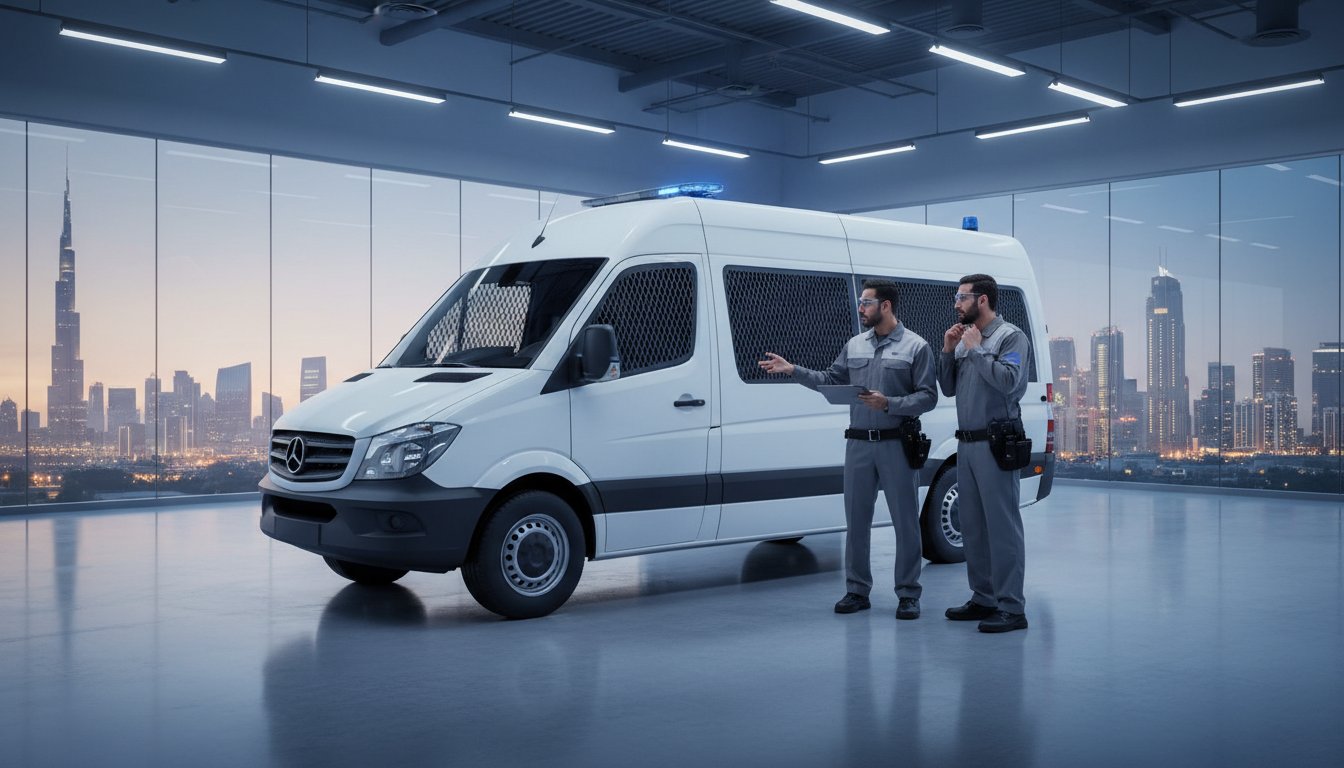
A standard commercial van becomes a significant liability when it lacks the specialized engineering required for high-stakes detainee transit. In the UAE, where summer temperatures regularly hit 45°C and SIRA regulations are non-negotiable, a basic conversion isn't enough to protect your personnel or your assets. Auto Industries Factory (AIF) specializes in professional prisoner transport vehicle modification, ensuring every reinforced weld and heavy-duty cooling vent is built for total mission reliability.
You've likely realized that maintaining a fleet which balances maximum security with strict RTA compliance is a complex engineering hurdle. This guide shows you exactly how to transform standard vans into mission-ready units that withstand extreme desert conditions while meeting every local legal standard. We'll preview the essential fabrication steps, from reinforced cell containment to advanced driver safety systems, that ensure your fleet stays secure and reduces long-term maintenance costs through precision manufacturing.
Key Takeaways
- Understand how AIF utilizes precision engineering to transform standard commercial vans into high-security containment units tailored for UAE law enforcement.
- Identify mission-critical security features, including high-strength metallic mesh and durable, easy-to-decontaminate interiors designed for heavy-duty use.
- Evaluate the specific threat levels of your fleet to decide between standard security upfitting and full ballistic prisoner transport vehicle modification.
- Ensure your specialized fleet meets all local regulatory requirements by navigating the essential RTA and SIRA compliance standards for the UAE.
- Discover the AIF conversion process, which combines in-house CAD design with expert fabrication to deliver rugged, reliable transport solutions.
What is Prisoner Transport Vehicle Modification?
Prisoner transport vehicle modification is the specialized engineering process of converting standard commercial chassis into high-security containment units. This transition isn't merely about adding bars to windows. It involves a comprehensive structural overhaul designed to meet the rigorous demands of law enforcement and private security sectors in the UAE. Most conversions in the region utilize reliable, heavy-duty platforms like the Toyota Hiace, GMC Savana, or Chevrolet Express, turning these everyday vans into mobile fortresses.
Professional modification is vital for both officer safety and inmate security. A standard vehicle isn't built to withstand the unique stresses of detainee transport, such as attempted escapes or internal damage. By utilizing prisoner transport vehicles that have been custom-engineered, agencies ensure that every trip between a police station and the courthouse is conducted with zero risk of breach. This technical precision is what differentiates a basic van from a mission-critical asset.
To better understand the scale and complexity of these conversions, watch this helpful video showing a detailed walkthrough of a security unit:
The Role of Specialized Conversions in UAE Law Enforcement
Modified vehicles play a central role in supporting police and judicial operations across the seven Emirates. Whether it's moving individuals for court hearings in Dubai or conducting federal transfers in Abu Dhabi, these units must operate flawlessly in extreme temperatures. Local manufacturing is a key advantage for the UAE market. By working with a regional expert like Auto Industries Factory (AIF), agencies benefit from rapid fleet deployment and immediate technical support. AIF serves as a trusted partner for police vehicle modifications, ensuring that every unit complies with local security regulations and environmental conditions.
Core Objectives of a Secure Transport Unit
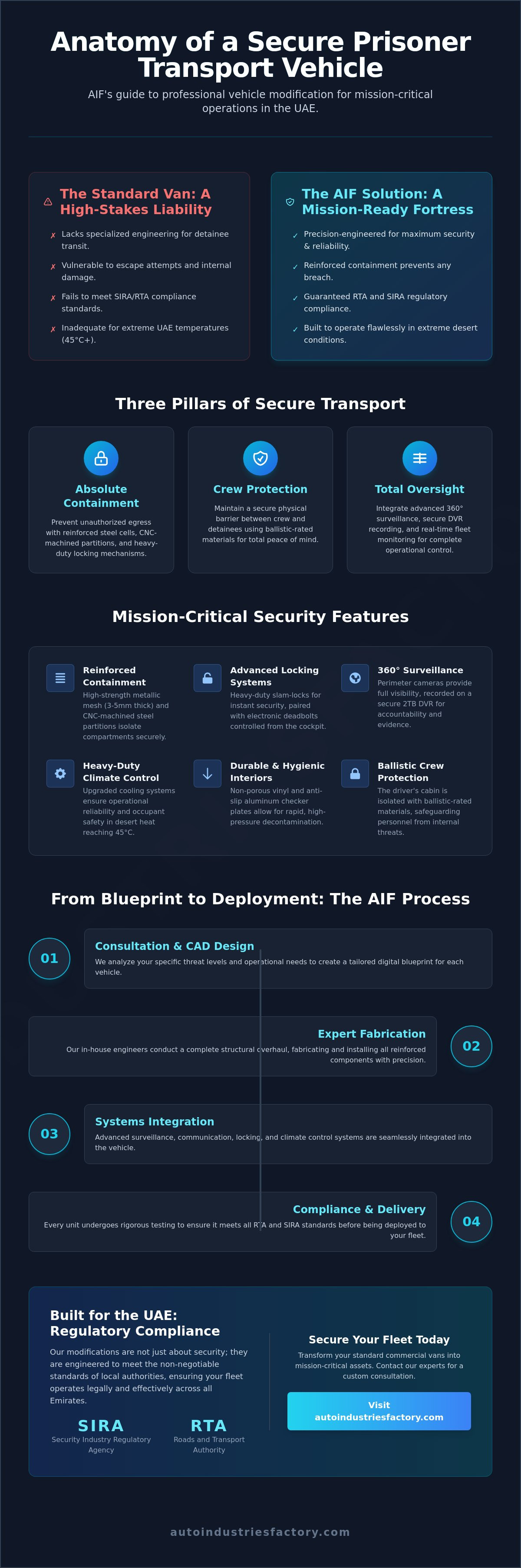
A successful prisoner transport vehicle modification focuses on three primary goals. First, it must prevent unauthorized egress. This is achieved through reinforced steel cells and heavy-duty locking mechanisms that still allow for rapid emergency evacuation if an accident occurs. Second, the design maintains a secure physical barrier between the driver and the transport compartment, often using ballistic-rated materials to protect the crew. Finally, these units integrate advanced surveillance and communication systems. Real-time fleet monitoring allows command centers in Dubai to track vehicle locations and view internal cabin feeds at all times, providing an extra layer of operational oversight.
Key Security Features for Mission-Critical Transport
A professional prisoner transport vehicle modification requires a balance of extreme durability and high-tech surveillance. In the UAE, security fleets must withstand both physical stress and the harsh local environment. We use high-strength metallic mesh to protect all glass surfaces and isolate the prisoner compartment from the driver's cabin. This mesh is typically 3mm to 5mm thick, providing a physical barrier that prevents window breakage and keeps inmates contained during high-risk transfers.
Flooring and seating materials are chosen for their ability to withstand heavy use and rapid decontamination. Non-porous, heavy-duty vinyl or anti-slip aluminum checker plates allow for quick pressure-washing. This is essential for maintaining hygiene standards in a high-turnover transport environment. Security is further reinforced with advanced locking mechanisms. We integrate heavy-duty slam-locks for immediate security when doors close, paired with electronic deadbolts controlled exclusively from the cockpit. For total oversight, 360-degree perimeter surveillance systems with secure 2TB DVR recording provide a continuous visual record of every mission, ensuring accountability and safety.
Inmate Containment and Compartmentalization
Effective prisoner transport vehicle modification involves creating multi-cell layouts to separate high-risk individuals from low-risk detainees. Our engineers use CNC-machined steel partitions to ensure precise fitment and maximum structural integrity. These partitions are built without sharp edges or exposed hardware. By following guidelines found in the official prisoner transportation manual, we implement anti-ligature interior designs. This prevents self-harm and eliminates spots where contraband or weapons could be hidden during transit. Every cell is a self-contained unit designed for maximum visibility from the guard's perspective while maintaining secure isolation.
Climate Control and Ventilation for the GCC
Operating in Dubai means vehicles must perform when external temperatures exceed 50°C. We upgrade standard HVAC systems to heavy-duty units capable of maintaining a steady 22°C inside the prisoner area even in peak summer. The driver and the transport compartment operate on independent climate zones. This ensures the driver stays alert while the rear remains cool. Specialized ventilation ducts provide constant airflow while maintaining total acoustic and physical isolation from the vehicle's exterior. If you need a fleet that meets these rigorous standards, explore our specialized vehicle conversion services to see how we build for reliability in the Middle East.
Armoring vs. Standard Modification: Choosing Your Protection Level
Every prisoner transport vehicle modification project begins with a rigorous threat assessment. Security agencies in Dubai and across the UAE must decide between standard security upfitting and full ballistic armoring. Standard modifications focus on containment. They include heavy-duty floor-to-ceiling partitions, reinforced window guards, and tamper-proof locking systems. These are ideal for low-risk municipal transfers where the primary threat is an escape attempt from within the cabin. Many agencies look toward the U.S. Federal Standards for Prisoner Transport to establish a baseline for safety protocols and vehicle integrity during these standard builds.
High-risk missions require a different engineering approach. When transporting high-profile detainees or operating in volatile environments, ballistic protection becomes mandatory. This involves stripping the vehicle to its chassis and integrating specialized materials into the body. The choice between these two levels dictates the vehicle's operational lifespan and its ability to protect the crew from external ambushes.
Ballistic Protection Levels (B4 to B7)
Selecting the appropriate armoring level is critical for mission success. B4 protection is designed to stop rounds from handguns like a .44 Magnum. It's a lightweight solution that offers protection without massive performance trade-offs. For maximum security, B6 and B7 levels are the industry standards in the UAE. These levels withstand high-powered rifle fire from weapons like the AK-47 and M16, as well as blast fragments from grenades. Auto Industries Factory (AIF) integrates ballistic steel and multi-layered glass while maintaining the vehicle’s original exterior profile. This "low-profile" approach is essential for urban security. For more technical details on materials, see our guide on car armouring.
Structural Reinforcement and Heavy-Duty Accessories
Armoring adds massive weight. A full B6 conversion can add 1,200kg to 1,500kg to a Toyota Land Cruiser or Nissan Patrol. This extra mass puts extreme stress on the vehicle's frame. We reinforce pillars and hinges to support the weight of armored doors, which can weigh over 100kg each. Beyond the cabin, we fabricate custom bull bars and rear bumpers designed for riot protection and clearing obstacles. These components aren't just for show. They're engineered for ramming capabilities in emergency evacuations. You can find more fabrication insights in our guide to custom bull bars and bumpers.
Performance must not be sacrificed for protection. Heavily modified prisoner transport vehicle modification projects require mandatory suspension and braking upgrades. Stock components often fail under the 30% to 50% increase in gross vehicle weight. We install heavy-duty coil springs, high-performance shock absorbers, and reinforced braking systems. Without these upgrades, braking distances can increase by over 40%, creating a safety hazard on UAE highways. We also utilize run-flat tire systems, ensuring the vehicle can travel at 50km/h for up to 50 kilometers even after a total loss of tire pressure.
The AIF Conversion Process: Precision Engineering in the UAE
Auto Industries Factory (AIF) specializes in transforming standard commercial chassis into high-security assets through a methodical, engineering-led workflow. The process begins with a detailed consultation at our Ajman facility to define specific prisoner transport vehicle modification requirements. We analyze fleet specifications, inmate capacity, and required security levels to create a tailored blueprint. Our engineers then develop full-scale digital designs using in-house CAD software. This digital prototyping ensures every partition, seat, and mounting point fits with 100% accuracy before any physical work begins.
Precision is the foundation of our manufacturing. We utilize high-speed CNC machining and laser cutting to produce metal components that meet strict law enforcement standards. This level of accuracy eliminates gaps in security cages and prevents the structural rattles often found in lower-quality conversions. Every vehicle undergoes a 50-point quality control inspection. This includes stress-testing the locking mechanisms and verifying the integrity of the reinforced flooring to ensure it can withstand years of heavy-duty use in the UAE environment.
In-House Fabrication Capabilities
Our Ajman-based facility handles the entire conversion under one roof, which eliminates the logistical delays of outsourcing. We use precision laser cutting to create seamless security partitions that separate the driver from the transport area without compromising visibility. Our fabrication team works with heavy-duty steel and reinforced aluminum to build tamper-proof environments. Following the structural build, we offer custom painting and branding services. We ensure all law enforcement identification and decals meet local UAE regulatory standards for high-visibility and professional appearance.
Technology and Communication Integration
Modern security transport requires sophisticated digital integration. We install advanced GPS tracking, multi-channel radio systems, and 360-degree emergency lighting arrays. Every electrical modification is professionally loomed and protected by flame-retardant conduits. This prevents short circuits and ensures the system remains fire-safe, even when operating in 50°C summer temperatures. Our technicians also integrate high-decibel siren systems and public address (PA) units. These systems allow officers to maintain control and communicate clearly during high-risk transfers across Dubai and the Northern Emirates.
Compliance and Regulations for Modified Vehicles in the GCC
Operating a prisoner transport vehicle modification in the UAE requires strict adherence to federal laws and local municipality regulations. You can't simply modify a commercial van; the unit must pass rigorous inspections by the Roads and Transport Authority (RTA) and the Security Industry Regulatory Agency (SIRA). These bodies ensure that every security feature, from the reinforced cage to the electronic locking systems, meets public safety protocols. Following Federal Law No. 21 of 1995 regarding traffic, any modification that alters the vehicle's structural integrity or weight distribution must be certified by an approved engineering facility.
The RTA requires a specialized technical inspection certificate before a modified vehicle is granted a "Security Vehicle" designation on its Mulkiya (registration card). This process involves verifying that the added weight of ballistic steel or internal partitions doesn't exceed the Gross Vehicle Weight Rating (GVWR). Using a certified manufacturer like Auto Industries Factory (AIF) is vital for legal compliance. We provide the necessary engineering drawings and material strength certificates that inspectors demand. Without these documents, your fleet will face registration delays or immediate impoundment during roadside checks.
Preparing for vehicle inspection involves gathering a specific dossier of paperwork:
- SIRA Approval: Certification for surveillance and security systems.
- Engineering Drawings: Detailed schematics of the internal modifications.
- Material Safety Data Sheets (MSDS): Proof of fire-retardant materials used in the cell area.
- Weighbridge Certificate: Updated weight data after the conversion is complete.
Meeting SIRA Standards for Security Vehicles
SIRA Law No. 12 of 2016 mandates specific surveillance protocols for all security-related transport in Dubai. Every prisoner transport vehicle modification must include high-definition internal and external cameras. These systems need to be tamper-proof and linked to a secure recording unit accessible by authorized personnel. For armored units, we ensure modifications meet international ballistic standards like CEN 1063 BR6 or BR7. AIF manages the technical documentation and regulatory filings for our clients. We handle the heavy lifting of bureaucracy so your security fleet meets every legal metric before deployment.
Durability and Warranty Support in the UAE
The UAE climate is unforgiving on specialized electronics and heavy-duty mechanical components. Standard modifications often fail when exposed to 50°C summer heat and high humidity. AIF builds conversions to last the entire 10 year vehicle lifecycle. We provide local maintenance and support at our facilities in Ajman and Dubai, ensuring your fleet stays operational with minimal downtime. Our engineering team uses corrosion-resistant materials and reinforced HVAC systems specifically designed for the Middle East. If you're ready to upgrade your security capabilities, contact our team for a custom consultation today.
SECURE YOUR FLEET WITH PRECISION ENGINEERING
Maintaining security during high-risk transit requires more than just basic van adjustments. It demands a specialized approach to prisoner transport vehicle modification that integrates advanced armoring with seamless functional design. Auto Industries Factory (AIF) delivers mission-critical reliability for security fleets by utilizing full in-house CNC and laser fabrication. This ensures every steel partition and reinforced joint meets the rigorous standards expected by law enforcement agencies across the UAE. Our engineering team focuses on three core pillars: maximum occupant containment, officer safety, and full compliance with GCC transport regulations. We've built a reputation for excellence by handling every stage of the conversion process under one roof in our Ajman and Dubai facilities. This vertical integration means your vehicles are ready for the most demanding environments without compromising on durability or long-term performance. It's time to upgrade your fleet with solutions that are built to protect what matters most. We're ready to help you achieve a higher standard of security and efficiency.
Request a Free Estimate for Your Prisoner Transport Fleet
Frequently Asked Questions
What types of vehicles can be modified for prisoner transport in the UAE?
Auto Industries Factory (AIF) specializes in converting a wide range of platforms including the Toyota Land Cruiser, Nissan Patrol, and heavy-duty vans like the Toyota Hiace or Mercedes-Benz Sprinter. We modify 4x4 SUVs for rugged terrain and 12 to 30-seater buses for high-capacity transfers. Each prisoner transport vehicle modification involves installing heavy-duty steel cages and reinforced flooring tailored to the specific chassis dimensions of the base vehicle.
How long does the vehicle conversion process typically take?
A standard conversion typically requires 25 to 45 working days to complete at our Ajman facility. This timeline accounts for precision CNC laser cutting of steel components, custom fabrication of the prisoner cell, and installation of security systems. Complex projects involving ballistic armoring or advanced surveillance integration may extend the schedule by 15 additional days to ensure every safety standard is met.
Is ballistic armoring mandatory for all prisoner transport vehicles?
Ballistic armoring isn't mandatory for all units; it's determined by the specific risk profile of the transport mission. While 100 percent of prisoner transport vehicles require secure containment cages, about 30 percent of specialized high-risk units in the UAE are fitted with BR6 or BR7 level armoring. We provide custom solutions where clients can choose between standard reinforced steel or full ballistic protection based on their operational requirements.
Can you modify existing fleet vehicles or do you only work on new ones?
We modify both brand-new vehicles and existing fleet units provided they pass a rigorous structural integrity inspection. Our engineers assess the chassis and suspension of used vehicles to ensure they can handle the 200kg to 800kg of additional weight from steel partitions and security hardware. Retrofitting existing fleets allows departments to maximize their current assets while upgrading to modern security and ventilation standards.
How do you ensure the transport compartment remains cool in the summer?
We install independent, high-capacity HVAC systems that maintain an internal temperature of 22 degrees Celsius even when outside temperatures reach 50 degrees in Dubai. The prisoner compartment features heavy-duty thermal insulation and dedicated air ducts to ensure constant airflow. This specialized cooling setup prevents heat exhaustion during transit and is a standard feature in every prisoner transport vehicle modification we perform in the UAE.
What kind of maintenance is required for a modified security van?
Maintenance focuses on the heavy-duty locking mechanisms, HVAC filtration, and electronic surveillance systems every 5,000 kilometers or six months. We recommend monthly lubrication of the 10-gauge steel door hinges and a quarterly inspection of the reinforced suspension components. Regular servicing ensures the security partitions remain rattle-free and the emergency extraction systems function perfectly under high-stress conditions.
Are these modifications compliant with SIRA and RTA regulations?
Every conversion we deliver is fully compliant with SIRA (Security Industry Regulatory Agency) and RTA (Road and Transport Authority) standards for the UAE. We provide the necessary certification and technical documentation required for vehicle registration and security licensing. Our fabrication process adheres to ISO 9001 quality management protocols, ensuring that every weld and partition meets the strict safety regulations enforced in Dubai and the wider Emirates.
Do you provide international shipping for converted vehicles?
Auto Industries Factory provides comprehensive international shipping services for converted vehicles to over 50 countries from our UAE base. We manage the entire logistics process, including sea freight from Jebel Ali Port and all export documentation. Whether you're ordering a single unit or a fleet of 20 vehicles, our team ensures the modified security vans arrive at your destination fully cleared and ready for immediate deployment.


