
A fleet vehicle is fit for its mission only when its conversion works as an integrated system. A specialized fleet conversion in the UAE brings vehicle engineering, fabrication, equipment integration, and compliance considerations together around the fleet’s intended use. Ambulance layouts and medical equipment installations, for example, need to be planned alongside the vehicle platform, not added as an afterthought.
Fleet operators need more than a modified vehicle: they need a configuration suited to its role and day-to-day operations. This guide explains how conversion planning, ambulance configurations, equipment fitment, and compliance considerations shape a specialized vehicle project.
You’ll also learn how fabrication and system integration work together, which project factors influence the conversion approach, and how a specialist can turn fleet requirements into a practical vehicle specification.
Key Takeaways
- Map the fleet’s mission and destination requirements before selecting a vehicle platform or conversion scope.
- Coordinate engineering, fabrication, fitment, and system integration so modifications work together as a complete vehicle.
- For ambulance projects, align the vehicle layout and equipment installation with the intended ambulance configuration.
- Compare conversion providers by their ability to handle the fabrication and modification work your fleet actually needs.
- Identify which vehicle types and conversion options best match your operating conditions before defining the project specification.
In-house engineering, fabrication, fitment, and system integration
UAE fleet conversions need to balance mission equipment, vehicle performance, and maintenance access. Added weight, heat exposure, and mechanical strain are important considerations for specialized fleet conversion UAE, so account for them in the engineering plan and routine maintenance from the outset.
Requirement Assessment and Engineering
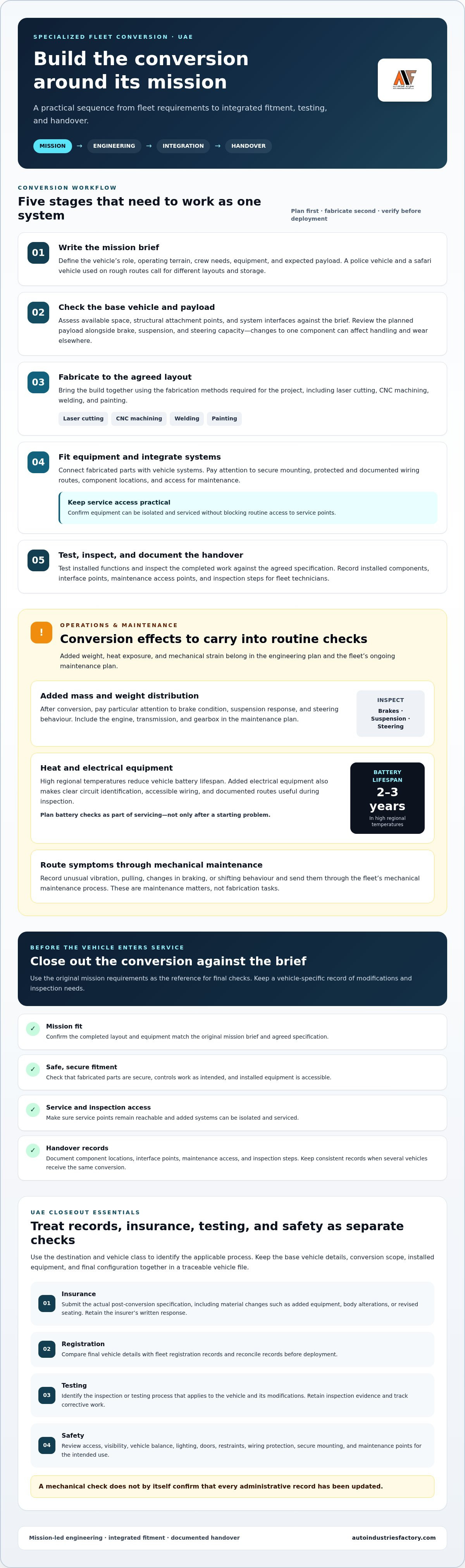
Begin with a written mission brief covering the vehicle’s role, operating terrain, crew needs, equipment, and expected payload. A police vehicle, for example, has different layout and storage needs from a safari vehicle used on rough routes. Before fabrication, assess the base vehicle, available space, structural attachment points, and system interfaces against those requirements. Review the planned payload alongside brake, suspension, and steering capacity. Changes to one component can affect handling and wear elsewhere.
Build, Fitment, Testing, and Delivery
Once the layout is established, fabrication can bring together laser cutting, CNC machining, welding, and painting. Fitment integrates fabricated parts with vehicle systems, with attention to secure mounting, wiring routes, and maintenance access. Before handover, test installed functions and inspect the work against the agreed specification. Document the installed components and maintenance access points so fleet technicians know what has changed and where inspections are needed.
Added equipment can change a vehicle’s mass and weight distribution. After conversion, pay particular attention to brake condition, suspension response, and steering behaviour. Include these systems in the vehicle’s maintenance plan, along with the engine, transmission, and gearbox. If the vehicle develops unusual vibration, pulling, changes in braking, or shifting behaviour, record the symptoms and route them through the fleet’s mechanical maintenance process. These are maintenance matters, not fabrication tasks.
Heat is another harsh UAE operating factor. High regional temperatures reduce vehicle battery lifespan to 2-3 years, so battery condition deserves close attention in fleet maintenance planning. Added electrical equipment also makes clear circuit identification and access useful during inspection. Keep wiring routes documented, and include battery checks in planned servicing rather than waiting for a starting problem to disrupt fleet operations.
Before approving delivery, compare the completed conversion with the original mission brief. Confirm that equipment is accessible, fabricated components are securely fitted, and maintenance teams can reach service points. Keep a record of each vehicle’s modifications and any changes that affect routine inspection. A consistent handover process helps managers track differences between units, especially when several vehicles receive the same conversion.
Confirm that fabricated parts are secure and controls operate as intended. Check that added systems can be isolated and serviced without blocking routine access. Record interface points, component locations, and inspection steps in the handover material, then ensure fleet technicians can use it. For vehicles being prepared for demanding logistics and regional freight duties, Auto Industries Factory LLC ensures that the equipment layout and payload suit the intended role and that service access remains practical after integration.
Destination-market compliance and safety requirements
For UAE fleet closeout, treat insurance, registration, and testing as separate steps. Document the altered vehicle specification for the insurer, identify the applicable inspection route, and reconcile vehicle records before deployment.
Start with the destination and vehicle class. Modified ambulances, police units, and safari vehicles can have different layouts and equipment, so one checklist won’t suit every fleet. Record the base vehicle identification, conversion scope, installed equipment, and final configuration together in a traceable vehicle file.
Insurance review should use the actual post-conversion specification, not just the original vehicle description. Provide a clear summary of material changes, such as added equipment, body alterations, or revised seating. Ask the insurer to document its decision and any policy changes in writing. This gives fleet managers a clear reference if a claim involves a converted component.
Registration and inspection planning also depend on accurate vehicle information. Prepare the conversion documentation, identify the inspection or testing process that applies to the vehicle and its modifications, and keep the outcome with the vehicle file. A passed mechanical check does not by itself confirm that every administrative record has been updated.
Use a safety review to catch practical issues before a vehicle enters service. A new canopy or equipment cabinet, for example, can affect visibility, access, vehicle balance, and reach to service points. Check lighting, doors, restraints, wiring protection, and equipment mounting against the intended use. Record any required changes before handover.
- Insurance: submit the converted configuration and retain the insurer’s written response.
- Registration: compare the final vehicle details with the fleet’s registration records.
- Testing: retain inspection evidence and track any required corrective work.
- Safety: inspect access, visibility, secure mounting, and maintenance points.
Assign an owner to each closeout step. A fleet manager can track insurance and records, while the technical team logs inspection findings and completed work. Use a consistent file structure across converted units, clearly separating each vehicle’s identification and conversion details. This makes missing documents easier to spot when vehicles return for maintenance or move between operating teams.
Before release, compare the approved project specification with the completed vehicle. Confirm that fitted equipment matches the documented configuration and that outstanding inspection findings have been resolved. For fleets planning vehicle modifications, including compliance and safety checks in the project scope connects fabrication records with fleet closeout.
Ambulance conversion classes and medical equipment integration
Plan an ambulance around its intended role, crew, and equipment, not its label alone. Fleet buyers can distinguish patient transport, emergency response, and advanced care as operational categories. These describe different fit-out needs, not formal UAE classifications. Define the mission first, then translate it into a vehicle layout and equipment plan.
Start with a requirements list for each configuration. Record crew positions, patient access, equipment locations, storage needs, and working space. A stretcher, monitor, and oxygen cylinder, for example, all affect the layout and movement inside the vehicle. Show where each item will be secured and how staff will reach it.
Vehicle body style also shapes usable interior space. A box-type ambulance has a distinct body configuration, while an extended-roof ambulance on a GMC or Toyota platform offers a different working space. Compare the platform, roof profile, door openings, and interior dimensions with the fleet’s equipment plan to identify fitment constraints before fabrication.
Equipment integration involves more than placing items inside the patient compartment. Plan mounting points, storage, wiring routes, and access panels together. For example, position a monitor where the crew can reach it without blocking a doorway or equipment cabinet. Keep cable routes clear of moving doors and service access. A coordinated drawing helps fabricators and fitters follow the same layout.
Separate vehicle-system work from clinical equipment decisions. Conversion planning can address physical fitment, mounting, power access, and interior arrangement. Medical teams determine which equipment their service needs and how it will be used. This keeps vehicle engineering focused on installation rather than clinical decisions.
Build and handover should follow the approved layout. Check that doors open fully, storage is accessible, and mounted equipment can be reached from its planned position. Test installed vehicle functions and review wiring access with the fleet maintenance team. Document equipment mounts, electrical connections, and removable-panel locations to support consistent servicing across units.
For fleets with several ambulance configurations, maintain a separate specification for each type. Patient-transport and advanced-care vehicles may have different layouts, even when built on the same base platform. Record the vehicle platform, body configuration, equipment locations, and approved changes. This gives procurement, operations, and maintenance teams a clear reference for ordering, operating, and servicing each vehicle.
Which UAE companies convert specialized commercial and government fleets?
In the UAE, choose a vehicle-conversion and fabrication specialist whose capabilities match the fleet’s mission. A safari vehicle, ambulance, and government vehicle each require different modifications. Look for a provider that can translate the vehicle’s intended role into a defined build scope, then fabricate and fit the required components.
Start with the conversion type, not a broad company label. A fleet needing a metal canopy or roof rack has different requirements from one planning a complete ambulance conversion. Write down the vehicle platform, operating environment, equipment, passenger or crew needs, and maintenance access requirements. A clear brief makes it easier to define the work.
Next, match the provider’s capabilities to the project stages, from fabrication through fitment. A police fleet modification may involve fabricated storage or protective components, while a safari vehicle build may focus on equipment suited to its route. Base your choice on the actual scope rather than assuming every vehicle workshop handles specialized conversions.
Review the proposed build plan before approving production. It should connect the vehicle platform with the planned modifications and explain how components will be installed. For fleets with multiple units, request a consistent specification that identifies shared features and vehicle-specific differences. This makes scopes easier to compare and reduces ambiguity at handover.
Use these decision points to assess fit:
- Relevant work: Match the provider’s conversion category to your vehicle’s purpose.
- Fabrication scope: Identify which components the project requires, such as a canopy, roof rack, or custom metal part.
- Platform fit: Specify the make, model, and body configuration being converted.
- Fleet consistency: Define which features must remain consistent across units.
- Handover records: Set out the drawings, installation details, and vehicle-specific changes needed by fleet teams.
For government and commercial procurement, make evaluation criteria clear to technical and purchasing teams. Compare proposals against the same brief, including the vehicle platform, conversion scope, equipment interfaces, and handover requirements. An ambulance and a police vehicle should not be assessed against identical fit-out details simply because they belong to the same fleet.
Finally, distinguish conversion work from unrelated vehicle services. A specialist in vehicle modifications is the relevant fit for custom fabrication, structural fitment, or a purpose-built configuration. Routine mechanical repair alone, for example, does not meet a fleet’s need for a fabricated body component. A clearly defined scope helps buyers select work that supports the vehicle’s intended role.
What types of vehicles can be converted for specialized fleet use in the UAE?
Conversion suitability depends on the vehicle platform, intended duty, payload, and required equipment. UAE fleets may start with vans, pickups, SUVs, or larger commercial vehicles, then assign them specific roles. A vehicle suited to a safari route may not suit a government response task. Assess the base vehicle before defining the conversion scope.
Vans and larger commercial vehicles can provide enclosed space for purpose-built interiors or equipment storage. An ambulance layout needs planned patient access, secure equipment positions, and practical crew movement. A box-type body differs from an extended-roof ambulance on a GMC or Toyota platform. Compare interior space and access points with the intended fit-out.
Pickups and SUVs can suit fleets that need equipment access or travel beyond paved routes. Safari conversions may require a different setup from police or military vehicle modifications. List the crew, tools, and equipment the vehicle must carry, then assess storage, mounting locations, visibility, and access. These details help determine whether the platform suits the working environment.
Commercial trucks and other utility vehicles may suit tasks that need larger equipment or dedicated cargo space. For heavy equipment logistics and vehicle movement operations—such as those managed by Done Wright Towing & Transport—properly specifying what the vehicle will carry and how crews will load and retrieve cargo helps define the body arrangement around daily fleet operations.
Vehicle appearance can also form part of a fleet specification. A color change can align vehicles with an organization’s chosen visual identity. Treat it as a separate scope item from structural fabrication or interior fitment. Before finalizing the conversion plan, record the vehicle’s make, model, body configuration, current condition, and intended use.
Use this sequence to narrow the vehicle choice:
- Define the duty: Specify whether the vehicle serves ambulance, safari, police, military, or utility operations.
- Match the platform: Compare body style and usable space with the planned equipment and crew.
- Review carrying needs: List cargo, tools, and fitment requirements that affect vehicle configuration.
- Set fleet standards: Identify shared features and differences across vehicle units.
- Document the scope: Record the base vehicle and each intended modification before fabrication.
A fleet may use several vehicle platforms. For example, an organization might assign vans to enclosed equipment duties and SUVs to off-road operations. Keep each platform’s specifications distinct, even when vehicles share a fleet identity. This clarifies procurement, fitment planning, and maintenance records across different roles.
Auto Industries Factory LLC: Ambulance Conversions
Auto Industries Factory LLC converts vehicles into ambulance configurations tailored to defined fleet requirements. Its work includes box-type ambulances and extended-roof ambulances on GMC and Toyota platforms. These formats help fleet buyers match the vehicle body and available interior space to operational needs.
Choose this service for an ambulance build requiring vehicle conversion and equipment integration. Set out the intended role, base vehicle, interior layout, and equipment locations so the conversion scope reflects how the unit will be used. Auto Industries Factory LLC also handles police and military vehicle modifications, safari conversions, and metal canopies and roof racks.
For ambulance conversion details, review the vehicle conversion services and contact Auto Industries Factory LLC to discuss your project.
Put Your Fleet Requirements Into Motion
Turn operational priorities into a clear project brief. Define the vehicle’s role, platform, equipment needs, and working conditions. This gives your team a practical basis for planning a specialized fleet conversion in the UAE and aligning the build scope with actual fleet use.
Auto Industries Factory LLC offers Ambulance Conversions, Police & Military Vehicle Modifications, and Safari Vehicle Conversions, each serving a different operational purpose. Start with the vehicle type and mission your fleet needs to support, then use those requirements to shape your specialized fleet conversion project in the UAE.
Contact Auto Industries Factory LLC to discuss your fleet requirements and take the next step toward a purpose-built vehicle.
Frequently Asked Questions
Why is it suitable for vehicle fleet customers?
Specialized conversions configure fleets around distinct operational roles rather than applying one standard setup to every task. A fleet, for example, can specify ambulance units for patient transport and separate vehicles for safari operations. This helps procurement teams compare vehicles within the same role and gives fleet managers a clear basis for assigning units, recording configurations, and planning equipment-specific maintenance.
What does specialized fleet conversion mean in the UAE?
It means modifying vehicles into purpose-built units for defined fleet work in the UAE. Examples include ambulance conversions, police and military vehicle modifications, safari vehicles, and vehicles fitted with metal canopies or roof racks. The work may involve fabricated structures, interior arrangements, or installed equipment. Define the scope by the fleet’s operating role and base vehicle, not a generic label.
What UAE regulations and approvals apply to vehicle fleet conversions?
Plan for the converted vehicle’s final configuration to align with its registration records, insurance documentation, and applicable inspection process. The approval path depends on the vehicle category and the nature of its modifications. Treat documentation and inspection planning as project tasks: record the changes, retain supporting build information, and ensure the completed vehicle’s details match the documents used for fleet operations.
What are the steps and lead times for converting a fleet in the UAE?
Set the fleet’s mission requirements, identify the base vehicles, define a conversion specification, complete fabrication and fitment, then arrange testing and handover. Align procurement with the approved specification so vehicle and equipment choices remain consistent. For ambulance fabrication, Auto Industries Factory states “deliver in a week.” This timing applies to ambulance fabrication, not every fleet conversion or project configuration.
Which UAE workshops are authorized to modify vehicles and pass inspection?
A workshop’s fabrication work and an inspection authority’s approval are distinct. Auto Industries Factory LLC provides vehicle fabrication and conversion, including ambulance conversions and police and military vehicle modifications. Conversion work does not automatically mean a vehicle has passed inspection. For procurement, assess the workshop’s relevant scope and keep the final vehicle configuration and supporting records ready for the applicable inspection process.


