When your mission-critical vehicle faces the punishing heat and corrosive salt air of the UAE coast, compromise is not an option. The success of your heavy-duty conversion-whether it's a rugged off-road machine or a life-saving ambulance-hinges on one critical process: premium stainless steel fabrication. Yet, navigating the complexities of material grades, welding techniques, and finishing options can be a formidable challenge. Choosing incorrectly can lead to premature failure, compromising both safety and your investment.
This comprehensive guide eliminates the guesswork. We will walk you through the entire fabrication journey, from selecting the right grade for maximum durability in harsh environments to understanding the technical differences between TIG and MIG welding. Discover the advanced processes that define a truly flawless build and learn how to identify an expert fabrication partner. By the end, you will have the confidence and knowledge to ensure your custom vehicle is equipped with the uncompromising strength and reliability it demands.
Why Stainless Steel is the Premier Choice for Vehicle Fabrication
When selecting a material for specialized vehicle conversions, the choice goes far beyond surface-level aesthetics. It is a strategic decision that directly impacts long-term value, operational safety, and mission readiness. While the initial investment may be higher than for materials like mild steel, the lifecycle benefits of premium stainless steel fabrication make it the undisputed superior choice. Its fundamental properties are what make it essential for vehicles that must perform flawlessly in demanding conditions. For a deeper dive into its composition, understanding What is Stainless Steel? provides crucial context on the alloys that deliver these superior characteristics.
To see the precision and skill involved in this process, watch this video on advanced fabrication techniques:
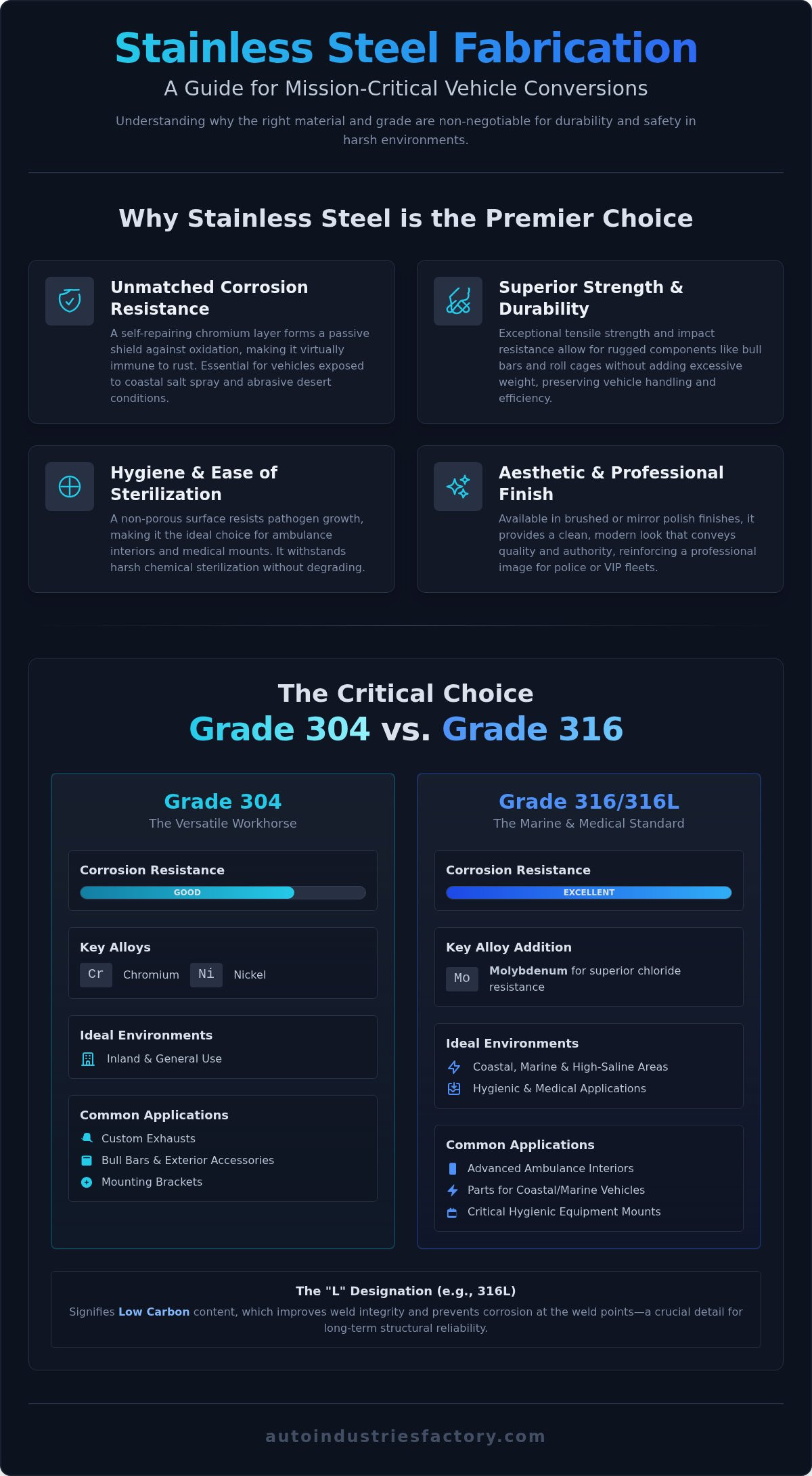
Unmatched Corrosion Resistance
The key to stainless steel's longevity is its chromium content, which forms a passive, self-repairing layer on the surface that prevents oxidation. This makes it virtually immune to rust and corrosion. In a climate like Oman's, with its humid coastal regions and saline air, mild steel components can degrade rapidly. For safari vehicles exposed to both coastal salt spray and abrasive desert conditions, stainless steel ensures structural integrity and reliability year after year.
Superior Strength and Durability
Stainless steel boasts exceptional tensile strength and impact resistance, allowing for the construction of incredibly robust components. This strength-to-weight ratio means we can engineer heavy-duty protective parts like bull bars, roll cages, and underbody armour that are both rugged and relatively lightweight, preserving the vehicle's handling and fuel efficiency. This durability is non-negotiable for vehicles operating in harsh off-road or security environments.
Hygiene and Ease of Sterilization
For emergency and medical vehicles, hygiene is paramount. Stainless steel has a non-porous surface that resists the growth of bacteria and other pathogens. This makes it the ideal material for ambulance interiors, medical equipment mounts, and patient transport areas. It can be easily and repeatedly sterilized with harsh chemicals without degrading, ensuring it meets the stringent health and safety standards required for life-saving missions.
Aesthetic Finish and Professional Appearance
Beyond its functional superiority, the quality of stainless steel fabrication provides a clean, modern, and professional finish. Available in various finishes from a muted brushed look to a bright mirror polish, it conveys a sense of quality, precision, and authority. For fleets such as police patrol units or VIP transport vehicles, this flawless appearance reinforces a public image of reliability and professionalism.
Understanding Stainless Steel Grades: 304 vs. 316 for Vehicle Parts
Not all stainless steel is created equal. For mission-critical vehicle components, selecting the correct grade is a foundational step that dictates the longevity, performance, and value of your investment. Understanding the key differences between the most common grades demystifies the technical specifications and empowers you to make the right choice for your specific application. This knowledge is paramount to any successful stainless steel fabrication project, ensuring the final product is engineered to withstand its intended environment.
Grade 304: The Versatile Workhorse
Often considered the industry standard, Grade 304 stainless steel contains 18% chromium and 8% nickel. Its composition provides excellent corrosion resistance for most conditions, making it a highly versatile and cost-effective choice. Thanks to its superb formability and weldability, Grade 304 is ideal for fabricating general structural components, mounting brackets, custom exhausts, and rugged exterior accessories like bull bars for vehicles operating primarily in inland areas of Oman.
Grade 316/316L: The Marine & Medical Standard
Grade 316 takes durability to the next level with the addition of molybdenum. This key element dramatically enhances its resistance to corrosion, specifically against chlorides found in salt water and de-icing salts. This makes it the only viable choice for vehicles operating along Oman's extensive coastline. Furthermore, its superior resistance to sterilizing chemicals makes Grade 316 essential for hygienic applications, such as the interiors of our advanced ambulances. The 'L' designation signifies low carbon content, which improves weld integrity and prevents corrosion at the weld points.
| Feature | Grade 304 | Grade 316 |
|---|---|---|
| Corrosion Resistance | Good | Excellent (Marine Grade) |
| Key Alloy Addition | Chromium & Nickel | Molybdenum |
| Ideal Environment | Inland, General Use | Coastal, Marine, Hygienic |
How to Choose the Right Grade for Your Vehicle
Making the correct decision comes down to three critical factors. The right choice ensures your investment in custom stainless steel fabrication delivers maximum value and mission-ready performance.
- Operating Environment: Will the vehicle be used primarily inland, or will it face the corrosive salt spray of coastal cities like Muscat, Sohar, or Salalah? For coastal use, Grade 316 is non-negotiable.
- Application: Is the component a general bracket or a part that requires absolute hygiene and resistance to harsh chemicals, like in an ambulance conversion? The application dictates the required level of resistance.
- Budget vs. Long-Term Performance: While Grade 304 is more economical upfront, Grade 316 is a superior long-term investment for harsh environments, preventing premature failure and costly replacements.
The Core Processes of Precision Stainless Steel Fabrication
Transforming raw stainless steel into a rugged, high-performance vehicle component is a multi-stage process that demands advanced technology and master craftsmanship. At our facility in the UAE, every step is executed with military-grade precision to ensure the final product meets the highest standards of quality and durability required for operation in Oman and across the region. This is the foundation of our expert stainless steel fabrication service, turning complex designs into functional, reliable reality.
Cutting: The First Step to Precision
Every flawless component begins with an exact cut. Using state-of-the-art machinery, we guarantee that every piece is dimensionally perfect, ensuring seamless integration with your vehicle's chassis and body. This initial accuracy prevents fitment issues and structural weaknesses down the line.
- CNC Laser Cutting: Delivers unparalleled accuracy for intricate designs like custom grilles or badging, producing clean, burr-free edges that require minimal secondary finishing.
- Plasma Cutting: The ideal solution for rapidly cutting through thicker stainless steel plates, perfect for fabricating heavy-duty bumpers, skid plates, and structural mounts.
Forming: Shaping Steel with Force and Finesse
Once cut, flat steel is expertly shaped into three-dimensional forms. This critical stage dictates both the component's structural integrity and its aesthetic appeal. Our skilled operators manipulate steel with force and control to match design specifications perfectly.
- Press Brake Bending: Creates sharp, precise angles and channels essential for fabricating rugged bull bars, rock sliders, and mounting brackets that fit the vehicle's contours flawlessly.
- Plate Rolling: Forms smooth, consistent curves for components like custom auxiliary fuel tanks, rounded bumpers, or specialized cylindrical housings.
Welding: Fusing Components for Maximum Strength
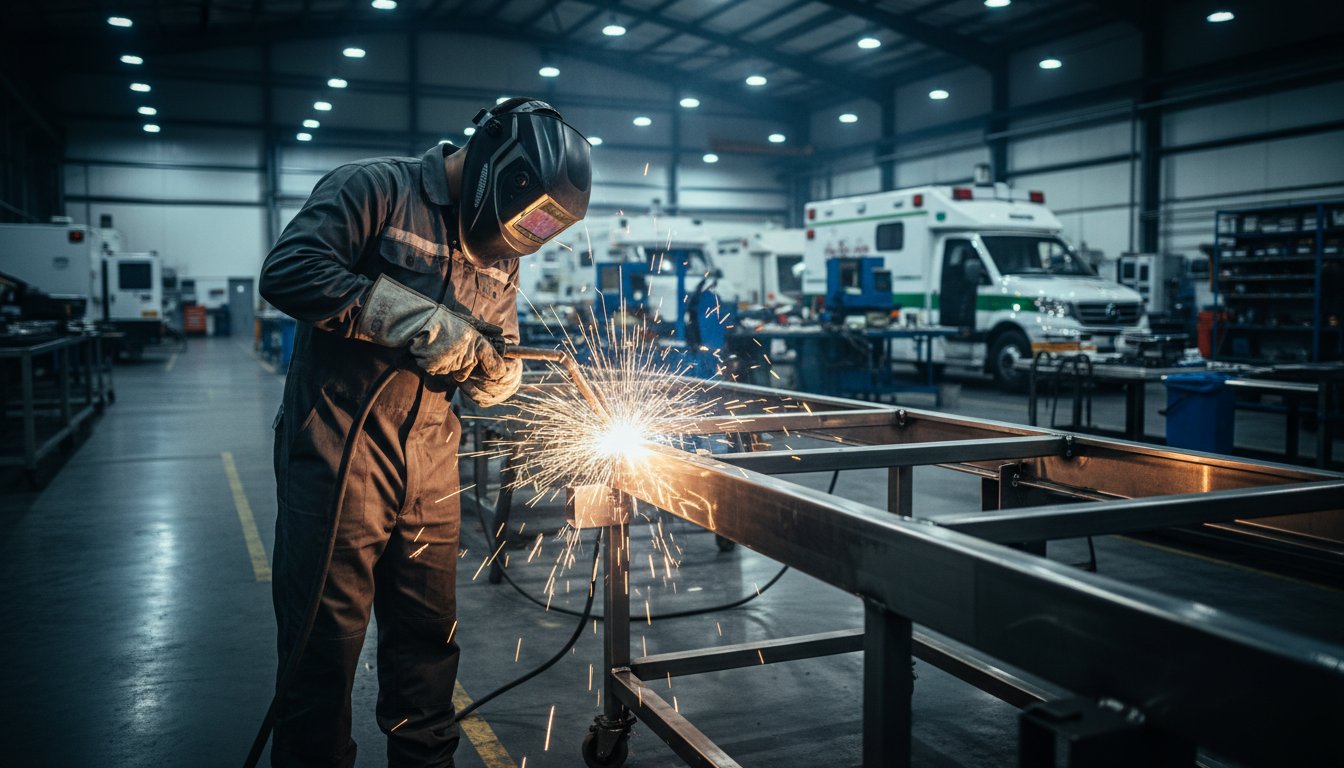
The true strength of any fabricated part lies in its welds. Our certified welders use specialized techniques to create joints that are often stronger than the base metal itself, ready to withstand the vibrations and stresses of Oman's toughest off-road terrains.
- TIG (Tungsten Inert Gas) Welding: Chosen for its clean, meticulous appearance, making it perfect for visible components like roof racks and exhaust systems where aesthetics are paramount.
- MIG (Metal Inert Gas) Welding: A rapid and efficient process used to create incredibly strong bonds for structural elements, chassis reinforcements, and internal supports where speed and strength are key.
Finishing: The Final Touch for Protection and Appearance
The final stage in our stainless steel fabrication process ensures long-term durability and a premium look. Proper finishing protects the component from environmental damage and integrates it seamlessly with the vehicle.
- Grinding and Polishing: Smooths all welds and surfaces to create a seamless, professional finish, whether for a brushed satin look or a mirror polish.
- Powder Coating: Applies a durable polymer finish that provides superior resistance to chipping, scratches, corrosion, and UV degradation from the intense sun.
Fabrication in Action: Stainless Steel in Specialized Vehicles
The theoretical advantages of corrosion resistance and high tensile strength are impressive, but their true value is proven in the field. Through expert stainless steel fabrication, we transform standard vehicles into specialized assets built for the most demanding environments. From emergency response to tactical operations and off-road exploration, this remarkable material provides the foundation for reliability, safety, and performance when it matters most.
Ambulance and Emergency Vehicles: Built for Life-Saving Reliability
In a medical environment, hygiene is paramount. Stainless steel’s non-porous surface is ideal for creating hygienic interior paneling and cabinetry that can be rigorously sterilized, preventing cross-contamination. Our precision fabrication process produces secure, custom-fit mounts for sensitive medical equipment, ensuring it remains stable on the move. We also engineer durable grab bars, flooring, and structural reinforcements that withstand constant, heavy use, guaranteeing the vehicle’s integrity for years of life-saving service.
Military, Police, and Armored Vehicles: Engineered for Mission Readiness
For military, police, and armored vehicles, failure is not an option. We utilize heavy-duty stainless steel to create interior components for troop carriers and mobile command centers that endure extreme operational stress. This includes:
- Custom brackets for securing vital communication equipment and weapon mounts.
- Reinforced door panels and interior linings for enhanced occupant protection.
- Robust, custom-built gear storage solutions designed for rapid access and maximum durability.
Off-Road and Safari Vehicles: Conquering Oman's Terrain
Oman’s rugged deserts, mountains, and wadis demand vehicles that are exceptionally tough. Our stainless steel fabrication services produce rugged bull bars and rear bumpers for maximum protection against impacts. We engineer heavy-duty roof racks and canopies to carry extreme loads without compromise. For extended expeditions, we fabricate custom-built water tanks and robust under-body protection plates to shield critical components from rock and debris. See examples of our expert vehicle conversions in action to understand how we prepare vehicles for any adventure. Every specialized build from Auto Industries Factory LLC demonstrates our commitment to turning premium materials into mission-ready solutions.
How to Choose the Right Stainless Steel Fabrication Partner
Selecting stainless steel is only the first step; unlocking its full potential for vehicle durability and performance depends entirely on the skill of your fabricator. The right partner ensures every cut, bend, and weld enhances your vehicle's structural integrity. Making an informed choice is as critical as selecting the premium material itself. Use this checklist to evaluate potential partners for your next project.
Verify In-House Capabilities and Technology
A premier fabrication partner invests in their own advanced equipment. Do they own and operate modern machinery like CNC lasers for precision cutting, press brakes for accurate bending, and professional-grade welding stations? Complete in-house services translate to superior quality control, faster turnaround times, and a single point of accountability. Don't hesitate to request a facility tour or a detailed list of their technology.
Demand Proven Experience in Your Sector
General metalworking is fundamentally different from specialized vehicle fabrication. An experienced partner understands the unique stresses, safety standards, and integration challenges specific to automotive applications. When vetting a company, ask for a portfolio of similar projects, whether for ambulances, military vehicles, or rugged off-road fleets. Their track record is the best indicator of their ability to deliver components that meet the demanding conditions in Oman.
- Have they completed projects for vehicles similar to yours?
- Do they understand chassis mounting points and weight distribution?
- Can they show examples of durable, corrosion-resistant finishes?
Inquire About Quality Control and Standards
For safety-critical components, a commitment to quality is non-negotiable. A professional stainless steel fabrication service will have a robust quality assurance process. Ask about their procedures for inspecting raw materials and validating finished welds. A partner like Auto Industries Factory demonstrates this commitment by combining advanced technology with rigorous, multi-stage quality control, ensuring every component is built for mission-critical reliability.
Your Partner for Mission-Critical Stainless Steel Fabrication
Ultimately, the decision to use stainless steel for heavy-duty vehicle components is a commitment to unparalleled durability, performance, and long-term value. Choosing the right grade and understanding the core manufacturing processes are crucial, but the most critical factor is partnering with a true specialist. Excellence in stainless steel fabrication is achieved when advanced technology is guided by deep, practical expertise.
As proven specialists in mission-critical vehicle conversions for the demanding UAE and GCC markets, we deliver rugged reliability. Our advanced in-house capabilities, including CNC laser cutting, precision bending, and expert welding, ensure every component is engineered to withstand the harshest conditions. We don't just build parts; we deliver solutions that enhance safety and operational readiness for your entire fleet.
Ready to equip your vehicles with components that are built to endure and designed to succeed? Discuss Your Custom Fabrication Project with Our Experts and let's forge a solution that meets your exact specifications.
Frequently Asked Questions
What is the main difference in cost between stainless steel and aluminum fabrication?
While the initial material cost for stainless steel is typically higher than aluminum in the Oman market, the total project cost is often more competitive. Aluminum requires specialized welding techniques that can increase labor expenses. The superior durability and corrosion resistance of stainless steel provide a greater long-term return on investment, especially for heavy-duty vehicle components, by reducing repair and replacement costs over the vehicle’s operational life. This makes it a sound financial choice for mission-critical applications.
How do you maintain and clean fabricated stainless steel parts on a vehicle?
Maintaining fabricated stainless steel is straightforward, even in Oman's demanding climate. Regular cleaning with mild soap and water is sufficient to remove road grime and dust, preserving its premium finish. For more stubborn contaminants, a non-abrasive cleaner can be used. It is critical to avoid harsh, chloride-based chemicals or abrasive tools like steel wool, as they can damage the protective surface layer. This simple routine ensures maximum corrosion resistance and longevity for your components.
Can stainless steel be repaired if it gets damaged in the field?
Absolutely. A key operational advantage of stainless steel components is their excellent field repairability. Damaged sections can be effectively cut, welded, and refinished by a skilled technician to restore full structural integrity and appearance. This is a crucial benefit for military, off-road, or commercial vehicles operating in remote areas where replacement parts are not readily available. Our expertise in stainless steel fabrication ensures repairs meet original heavy-duty specifications, maximizing vehicle uptime.
What is the typical lead time for a custom stainless steel fabrication project?
Lead time is determined by project complexity, material availability, and our current production schedule. A straightforward component like a custom bull bar may take 2-3 weeks from final design approval. More complex assemblies, such as a full vehicle canopy or specialized equipment mounts, can range from 4 to 7 weeks. We provide a precise and reliable project timeline after a thorough review of your technical specifications to ensure complete transparency with our clients.
Is stainless steel fabrication environmentally friendly?
Yes, stainless steel is a highly sustainable choice for vehicle components. It is 100% recyclable without any loss of quality, and a significant portion of new steel is produced from recycled materials. Furthermore, its exceptional durability and resistance to corrosion mean parts last significantly longer, reducing the need for replacements and minimizing waste over the vehicle's lifespan. This long-term performance makes it an environmentally responsible investment for any custom vehicle or fleet.
How does the weight of stainless steel components affect vehicle performance?
Stainless steel is denser than aluminum, which can impact a vehicle's payload capacity and fuel efficiency. However, its superior strength allows our engineers to often use thinner gauges of material while achieving the required durability, strategically mitigating the weight penalty. For applications where ruggedness, impact resistance, and extreme durability are the top priorities-such as on security or off-road vehicles-the calculated trade-off in weight is essential for achieving superior, reliable performance.


