
A life-saving medical unit is only as reliable as the engineering behind its conversion. When seconds count, you can't afford to worry about structural integrity or whether your fleet meets the latest EN 1789 standards. Many fleet managers find that identifying reliable ambulance conversion companies in UAE is challenging, especially when trying to balance rapid deployment with the rigorous demands of the new Federal Authority for Ambulance and Civil Defence. You need a partner that treats vehicle modification as a master craft, not just an assembly line.
We understand that your primary concern is protecting both patients and paramedics through uncompromising build quality. This comprehensive guide explores how precision engineering transforms standard GMC and Toyota platforms into specialized Type A, B, and C medical units. You'll discover the critical advantages of in-house laser cutting and CNC machining for structural reinforcement. We also preview the essential differences between a Box type ambulance and an Extended roof ambulance to help you identify the right solution for your specific mission requirements while ensuring total compliance with international safety standards.
Key Takeaways
- Learn how in-house fabrication, including precision laser cutting and CNC machining, ensures the structural integrity of every medical unit.
- Identify the most effective base platforms for your fleet, ranging from urban-ready Toyota Hiace models to rugged Toyota Land Cruisers for off-road access.
- Understand the critical safety requirements of EN 1789 and KKK-A-1822 standards to ensure your fleet meets international medical vehicle regulations.
- Evaluate leading ambulance conversion companies in UAE based on their ability to provide specialized Box type ambulances and extended roof configurations.
- Gain insight into the full-cycle manufacturing process, from initial structural reinforcement to final vehicle color changes and custom bull bar installations.
Understanding Ambulance Conversions in the UAE
Ambulance conversion is the precision process of transforming a standard civilian vehicle chassis into a specialized mobile medical unit. It’s a complex engineering task that requires stripping a vehicle to its frame and rebuilding it with reinforced structures, medical-grade interiors, and advanced life-support systems. For professional Ambulance overview, this isn't merely a cosmetic upgrade; it's a mission-critical modification that ensures the vehicle remains stable and functional during high-speed emergency responses. Every bracket and cabinet must be secured to withstand extreme forces, ensuring the safety of both the patient and the medical crew.
Leading ambulance conversion companies in UAE must now adhere to the strict regulations set by the Federal Authority for Ambulance and Civil Defence, established in late 2025. Standard "off-the-shelf" vehicles often lack the structural reinforcement needed to house heavy medical equipment or withstand the 10G crash impact tests required by EN 1789 standards. Professional conversion isn't an option; it's a legal and safety requirement. When a vehicle undergoes a major weight redistribution, the suspension and braking systems must be recalibrated. Expert vehicle fabrication services provide this level of mechanical oversight, ensuring the unit performs safely under the extreme stresses of emergency driving.
To better understand the precision involved in these builds, watch this helpful video:
Basic Life Support (BLS) vs. Advanced Life Support (ALS)
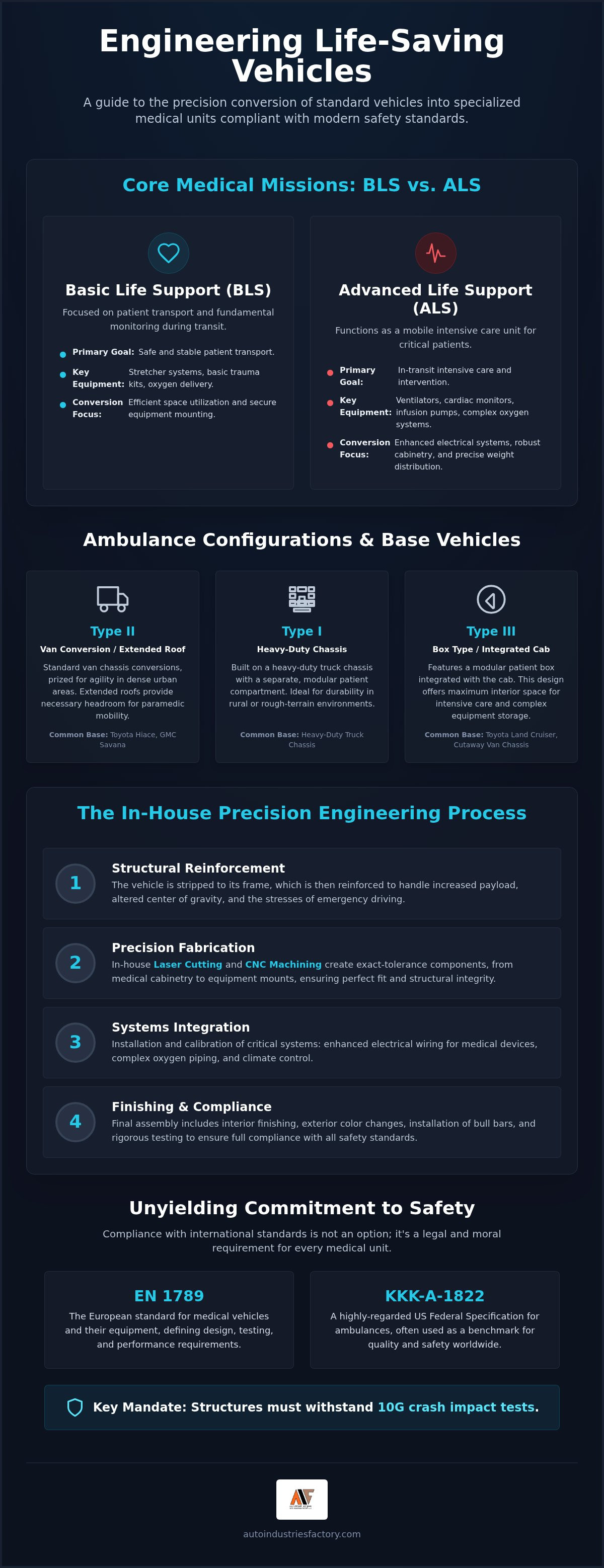
The conversion strategy depends entirely on the intended level of care. BLS units focus on patient transport and basic monitoring; their structural needs are centered on efficient space for a stretcher and essential trauma kits. ALS units, however, are mobile intensive care units. These require enhanced electrical systems to power ventilators and monitors, plus complex oxygen piping. The fabrication layout must account for the weight and placement of this gear to maintain vehicle balance. Choosing the right equipment early in the design phase is crucial, as it dictates the internal fabrication layout and electrical load requirements.
The Three Main Types of Ambulance Conversions
Selecting the right configuration is vital for fleet performance across the UAE's diverse terrain. Specialized ambulance conversion companies in UAE typically categorize builds into three distinct types:
- Type I: These utilize a heavy-duty truck chassis with a separate modular body. They're ideal for rural areas or rough terrain where durability is the priority.
- Type II: These are standard van conversions. They're agile and efficient for urban environments. This category often includes the Extended roof ambulance on GMC or Toyota platforms, providing essential headroom for paramedics.
- Type III: Similar to Type I but with a modular body integrated into the cab. This is frequently built as a Box type ambulance, offering maximum modular space for intensive care and complex medical storage.
The Engineering Process: Fabrication and Structural Integrity
True reliability in emergency vehicles starts with the foundation. Unlike many ambulance conversion companies in UAE that rely on outsourced fabrication, we utilize in-house laser cutting and CNC machining to ensure every component meets exact tolerances. Precision is mandatory. When you install heavy medical cabinetry, oxygen manifolds, and specialized seating, the original vehicle's center of gravity shifts. We address this through comprehensive structural reinforcement. This process strengthens the chassis to support the increased payload while maintaining the vehicle's handling and safety during high-speed maneuvers.
Precision Metalwork in Medical Vehicles
Our engineering team uses high-speed laser cutting to fabricate medical cabinetry from lightweight yet durable alloys. This reduces the overall vehicle weight without sacrificing structural strength. CNC bending technology allows us to create ergonomic interior layouts that maximize usable space in a Box type ambulance. Every weld is inspected for durability, ensuring that internal fixtures don't rattle or fail during years of intense service. This level of detail aligns with the WHO operational guidance for ambulance systems, which emphasizes the importance of vehicle reliability and safety in emergency care.
Electrical and Oxygen System Integration
A medical unit's electrical system must be robust. We install heavy-duty, color-coded wiring looms designed to power high-draw equipment like defibrillators and ventilators. Every circuit is protected and isolated to ensure electromagnetic compatibility (EMC), preventing interference with sensitive medical electronics. Our oxygen systems feature precision-engineered piping and manifold systems that are leak-tested under high pressure. These systems are integrated directly into the vehicle's reinforced frame for maximum security.
The final stage involves in-house painting and finishing. We provide custom fleet branding using high-durability automotive paints that protect the metalwork from the UAE's harsh environmental conditions. Professional finishing isn't just about aesthetics; it's about long-term corrosion resistance and professional representation. If you're looking for a partner with these specialized capabilities, you can explore our full range of vehicle fabrication services to see how we handle complex fleet requirements. Our masters of craft ensure that every Extended roof ambulance or specialized unit is built to perform under the most demanding conditions.
Selecting the Right Base Vehicle for Your Fleet
Selecting a base chassis is the foundation of any mission-critical medical fleet. Experienced ambulance conversion companies in UAE recognize that a vehicle's performance depends on matching the platform to its specific operational environment. You don't choose a van for desert rescue, just as you don't use a heavy truck for narrow urban corridors. The decision impacts everything from response times to the safety of the medical crew on board. For organizations looking to source these base platforms internationally, AutoDream provides a smart car marketplace that connects buyers and sellers across 15 different countries.
The Toyota Hiace remains the industry standard for urban emergency response. Its tight turning radius and efficient footprint allow it to navigate dense traffic and narrow hospital bays with ease. For remote site support or desert operations, the Toyota Land Cruiser is the gold standard. Its rugged 4x4 system and proven reliability in high-heat environments make it the only choice for off-road medical access. When building Advanced Life Support (ALS) units, GMC and Chevrolet platforms offer the high payload capacity required for heavy medical electronics and oxygen systems. These are often the preferred choice for an Extended roof ambulance where internal volume is the priority.
Payload capacity isn't just a technical spec; it's a safety limit. Every conversion must account for the weight of the medical crew, the patient, and the full suite of life-saving equipment. Exceeding this limit compromises braking and suspension performance. This is why we focus on structural reinforcement for every unit, ensuring the chassis is engineered to handle its specific mission profile without compromising vehicle longevity.
City-based fleets prioritize maneuverability and rapid acceleration to reach patients quickly in congested traffic. In contrast, desert-based units require specialized 4x4 capabilities and heavy-duty suspension upgrades to maintain stability. We reinforce these vehicles to handle the constant vibration and stress of rough terrain. This ensures that the medical interior remains secure and the vehicle stays operational in the most demanding conditions across the UAE.
Extended Roof vs. Standard Roof Configurations
The choice between roof heights often comes down to ergonomics and medical complexity. An Extended roof ambulance provides the internal height necessary for paramedics to stand upright and perform complex procedures during transport. This design philosophy aligns with the European standard EN 1789, which specifies minimum space requirements for medical personnel to work effectively. While standard roofs offer better aerodynamics for high-speed highway response, extended configurations are essential for units serving as mobile intensive care units or a Box type ambulance where maximum modular space is required.
Compliance with International Ambulance Standards
Compliance isn't just a paperwork exercise; it's the difference between a secure medical cabin and a hazardous environment during a collision. Professional ambulance conversion companies in UAE must build to the EN 1789 standard. This European benchmark includes the rigorous "Sledge Test," which requires all interior medical equipment and cabinetry to withstand a 10G crash impact. This ensures that heavy life-saving gear, like ventilators and monitors, doesn't become a projectile if the vehicle stops suddenly. For fleets requiring high-performance specifications, we also look to the KKK-A-1822 federal standard, which dictates everything from electrical system load capacity to the specific decibel levels of sirens.
Sanitization and hygiene are equally critical in the conversion process. We select medical-grade, non-porous materials for every interior surface to meet strict infection control protocols. Our builds feature seamless, anti-bacterial flooring and antimicrobial surfaces that resist blood-borne pathogens and simplify deep cleaning between calls. By using advanced fabrication techniques, we eliminate gaps where bacteria can thrive, ensuring the unit remains a sterile environment for patient care.
Quality Management and ISO Certifications
We maintain a strict quality management system to ensure every conversion follows a standardized, documented lifecycle. This process reduces the risk of mechanical or electrical failure by enforcing inspection checkpoints during laser cutting, structural welding, and system integration. Each Box type ambulance or specialized unit has a traceable build history. This documentation provides fleet managers with long-term accountability and ensures that every modification meets the high standards required by the Federal Authority for Ambulance and Civil Defence.
Safety and Ergonomics for Medical Professionals
Paramedic safety is as vital as patient care. We install industrial-grade anti-slip flooring and rounded interior corners to prevent injuries while the vehicle is in motion. Lighting systems are engineered to provide surgical-level clarity, allowing for precise medical procedures during transport. We optimize the placement of monitors and controls so paramedics can reach essential equipment while remaining safely seated and belted. This ergonomic approach reduces physical strain and enhances the crew's ability to focus on the patient during critical high-speed responses.
Ensuring your fleet is fully compliant requires an engineering partner that understands the technical nuances of international safety law. If you need a fleet built to these exacting standards, contact us today for a technical consultation on your ambulance conversion project. Our master engineers are ready to build a solution that protects your crew and your patients.
Why Choose Auto Industries Factory LLC for Your Conversion?
Reliability in mission-critical applications isn't a luxury; it's an engineering requirement. While many ambulance conversion companies in UAE act as mere assemblers, Auto Industries Factory LLC operates as a master engineering partner. We don't just install equipment; we rebuild vehicles from the chassis up. We specialize in transforming high-performance GMC and Toyota platforms into robust medical units designed for the most demanding environments across the region. Our focus on ruggedness ensures that every unit we deliver remains operational long after standard conversions have failed.
We address the specific needs of UAE fleets by offering two primary configurations. The Box type ambulance provides a modular, wide-body compartment that maximizes interior volume for advanced life support equipment and intensive care storage. Conversely, our Extended roof ambulance conversions involve precision metalwork to raise the roofline of standard vans, providing the necessary vertical clearance for paramedics to work standing up. Both designs utilize our in-house structural reinforcement to maintain vehicle stability and safety during high-speed maneuvers.
The In-House Advantage: Design to Delivery
Our expertise extends beyond medical fleets. We provide comprehensive Police Vehicle Modifications and military upfitting, focusing on protection and tactical utility. This includes fabricating custom bull bars, brush guards, and heavy-duty roof racks that shield the vehicle in high-risk zones. For a deeper look at our technical process, you can explore our Ambulance Conversion Guide. Whether you need a mobile clinic or a rugged desert rescue unit, our master craftsmen deliver solutions built to perform under pressure. We provide a comprehensive vehicle color change and bulk bull bar manufacturing to ensure your entire fleet maintains a unified, professional appearance. We position ourselves as a partner for government and military fleets that demand extreme dependability.
Engineering Your Fleet for Mission-Critical Reliability
Building a medical fleet that withstands the rigors of emergency response requires more than just interior outfitting. It demands a foundation of precision engineering and a deep understanding of international safety protocols. We've explored how in-house CNC machining and laser cutting technology eliminate the risks associated with outsourced fabrication, providing the structural integrity required for EN 1789 compliance. Whether you're deploying a Box type ambulance for intensive care or an Extended roof ambulance for urban response, your choice of partner determines the long-term durability of your investment.
Identifying the right partner among ambulance conversion companies in UAE ensures your vehicles meet the strict standards of the Federal Authority for Ambulance and Civil Defence while protecting your crew and patients. As a specialist in high-performance vehicle platforms, Auto Industries Factory LLC provides comprehensive fabrication and modification services tailored to your specific operational needs. Take the next step in securing your fleet's future. Request a Technical Consultation for Your Fleet. Your mission depends on equipment that won't fail; we're here to build it.
Frequently Asked Questions
What are the main types of ambulance conversions available in the UAE?
The three main types are Type I (truck-chassis with modular body), Type II (standard van conversion), and Type III (integrated modular body on van-chassis). In the local market, ambulance conversion companies in UAE frequently specialize in Type II and Type III configurations. These include the Extended roof ambulance for better paramedic headroom and the Box type ambulance for maximum medical storage. Each type is engineered for specific response environments, from urban streets to desert rescue.
How long does a standard ambulance conversion take to complete?
Conversion timelines vary based on the complexity of the medical systems and the extent of structural reinforcement required. A standard Type II conversion typically takes several weeks to ensure all in-house laser cutting and electrical integration meet safety standards. Specialized builds, such as a mobile intensive care unit, may require more time for precision fabrication. We prioritize an efficient, in-house workflow to eliminate third-party delays and maintain a strict delivery schedule for fleet managers.
Which base vehicles are most commonly used for UAE ambulances?
The Toyota Hiace and Toyota Land Cruiser are the most prevalent platforms for urban and off-road response, respectively. GMC Savana and Chevrolet Express models are also widely used for heavy-duty Advanced Life Support builds due to their high payload capacities. These high-performance platforms allow ambulance conversion companies in UAE to perform necessary modifications, such as raising the roofline or installing a Box type ambulance body, without compromising the vehicle's mechanical integrity.
Does a converted ambulance meet international safety standards like EN 1789?
Yes, professional conversions are engineered to meet or exceed international standards like EN 1789 and KKK-A-1822. This includes the "Sledge Test" for equipment securement and specific requirements for interior lighting, ventilation, and electrical load. Our fabrication process utilizes CNC machining to ensure every bracket and cabinet can withstand 10G impact forces. This rigorous compliance protects the medical crew and ensures the unit is legally eligible for registration with UAE health authorities.
Can you convert a standard van into an Advanced Life Support (ALS) unit?
We can transform a standard van into a fully equipped ALS unit through comprehensive structural and electrical upgrades. This process involves installing high-capacity wiring looms to power ventilators and monitors, along with reinforced oxygen piping. Most ALS conversions require an Extended roof ambulance configuration to provide paramedics with the vertical space needed for complex medical interventions. We use in-house laser cutting to fabricate custom mounts for all life-saving electronics and heavy medical gear.
What is the difference between a box type ambulance and a van conversion?
A Box type ambulance utilizes a custom-built modular body mounted on a chassis, offering a wider, square interior for maximum workspace. A van conversion, or Type II ambulance, utilizes the original vehicle's body, which is then reinforced and outfitted with medical interiors. While van conversions are more aerodynamic and maneuverable in city traffic, box types provide the superior modular space required for mobile clinics or complex intensive care transport units.
Do you provide structural reinforcement for heavy medical equipment?
Structural reinforcement is a mandatory part of our fabrication process for every medical unit we build. We use in-house laser cutting and CNC machining to strengthen the chassis and interior walls, ensuring they can support the weight of oxygen cylinders, stretchers, and cabinetry. This reinforcement prevents structural fatigue and keeps the vehicle stable during high-speed maneuvers. Our master engineers ensure that every mounting point is tested for durability and safety under extreme operational stress.
Are custom fabrication services for internal cabinetry included?
We provide complete in-house fabrication for all internal cabinetry, brackets, and medical equipment mounts. Using precision CNC bending and laser cutting, we create custom ergonomic layouts that maximize every inch of usable space. Our cabinetry is built from high-durability, medical-grade materials that are easy to sanitize and resistant to the harsh UAE environment. This in-house capability allows for direct communication between our engineers and fleet managers to ensure a perfect fit for the entire fleet.


