
A standard van is nothing more than a metal shell until it meets the brutal reality of a 45°C UAE summer and the high-stakes demands of a life-saving mission. Achieving a compliant Type 2 ambulance conversion UAE requires more than just basic medical shelving. It demands a total engineering overhaul to survive the region's environmental and regulatory stresses. You already know that passing a Department of Health (DoH) inspection isn't just about ticking boxes. It's about ensuring your fleet doesn't suffer structural failure or cooling collapse when lives are on the line.
In this guide, you'll learn how precision fabrication transforms standard high-roof chassis into mission-ready units that exceed EN 1789:2020 standards and GSO 1794 requirements. We'll explore the technical essentials of structural reinforcement, heavy-duty cooling systems, and ergonomic space optimization. This article previews the engineering milestones required to build a fleet that passes every health authority inspection while maximizing medical equipment capacity and long-term vehicle durability in extreme heat.
Key Takeaways
- Understand why van-based units are the definitive choice for urban rapid response across the UAE due to their superior maneuverability.
- Master the technical benchmarks of GSO 1794 and EN 1789:2020 to guarantee full regulatory compliance for your emergency fleet.
- Discover how advanced 3D modeling and precision fabrication optimize a Type 2 ambulance conversion UAE for maximum medical equipment capacity.
- Learn how CNC-machined lightweight materials and in-house metalwork ensure vehicle durability and structural integrity in extreme desert heat.
- Identify the essential engineering capabilities and documentation required to select a reliable partner for mission-critical fleet modifications.
The Strategic Role of Type 2 Ambulance Conversions in UAE Fleets
A Type 2 ambulance conversion UAE is a precision-engineered medical unit built within a standard van chassis. It's not just a transport vehicle. These units utilize the original vehicle body, often featuring an extended roof to allow medical staff to stand and work effectively. While some view van-based units as secondary, advanced engineering allows them to serve as high-performance platforms for both Basic Life Support (BLS) and Advanced Life Support (ALS). This versatility makes them the backbone of modern emergency response.
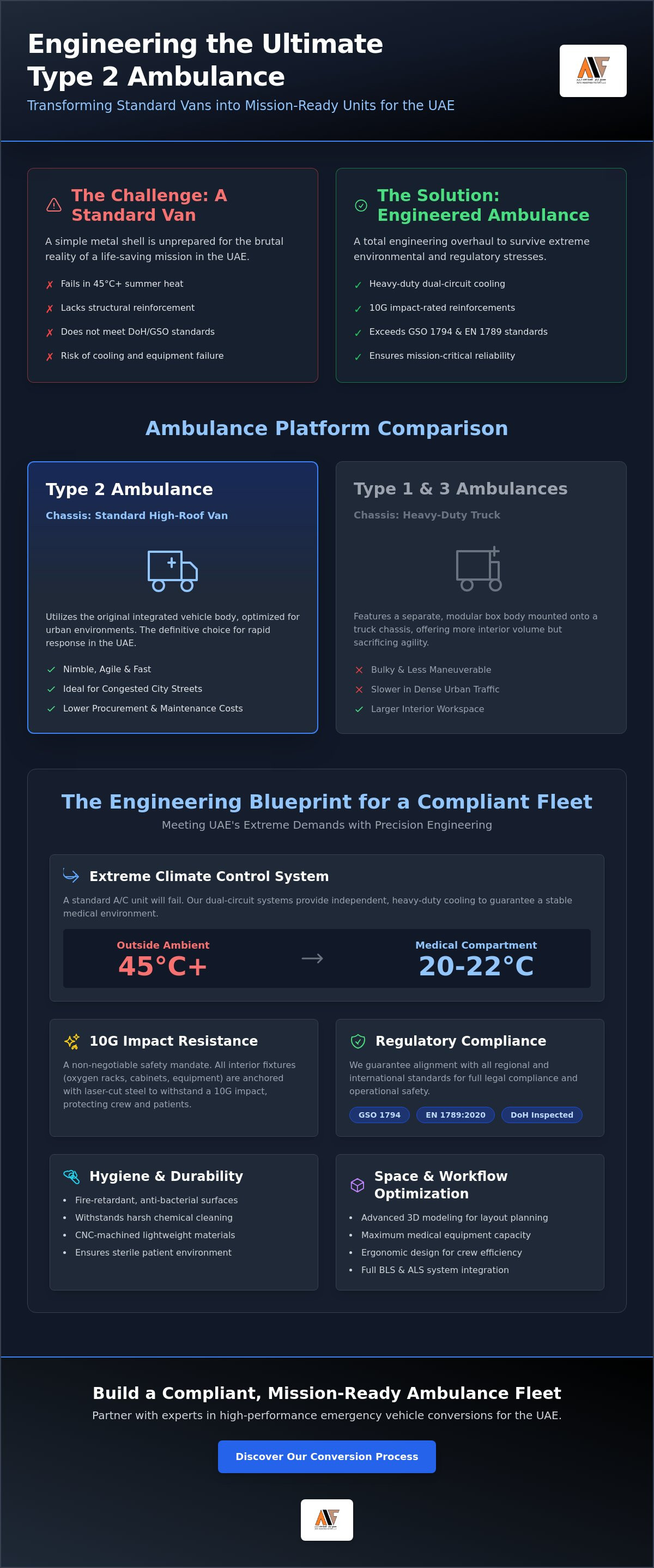
Urban density in cities like Dubai and Abu Dhabi demands speed and agility. Type 2 units excel in these environments. Their narrow profile and shorter wheelbase allow them to navigate congested city streets and narrow residential areas much faster than bulky truck-based alternatives. This agility is critical for reaching patients within the "Golden Hour," where every second directly impacts survival rates. Beyond speed, these units offer superior fuel efficiency and lower procurement costs for growing fleets.
To better understand the practical application of these units, watch this helpful reveal of a converted unit:
Type 2 vs. Type 1 and Type 3 Ambulances
The primary distinction lies in the chassis. To understand the full landscape of Ambulance Types and Standards, one must look at structural integration. Type 1 and Type 3 ambulances use heavy-duty truck chassis with a separate modular box body. While those offer more interior volume, the Type 2 conversion provides a more nimble, integrated solution. Many competitors claim Type 2 is limited to basic transport. We disagree. Through custom internal fabrication and CNC-machined cabinetry, these vans can be equipped with full ALS telemetry and life-support systems, providing a balanced cost-benefit ratio for private healthcare providers and government EMS organizations alike.
Why UAE Regulations Favor Type 2 for Rapid Response
Technical Benchmarks: Aligning GSO 1794 and EN 1789 Standards
Engineering a Type 2 ambulance conversion UAE isn't a matter of simple modification. It's a rigorous process of alignment with international and regional safety mandates. GSO 1794 acts as the unified GCC technical regulation, governing the structural integrity and safety features of every emergency unit. We pair this with EN 1789:2020, the European standard for medical vehicles. These benchmarks ensure your fleet is legally compliant and operationally safe. Our engineering department utilizes a standardized protocol to ensure every unit meets these regional mandates without compromise.
Safety hinges on the "10G requirement." This standard mandates that all interior fixtures, from oxygen racks to medical cabinets, must remain securely anchored during a 10G impact. It's a non-negotiable engineering hurdle. We use laser-cut steel reinforcements and precision metalwork to meet these loads. For hygiene, we select fire-retardant, anti-bacterial materials that withstand harsh cleaning chemicals. This ensures a sterile environment for every patient and protects your crew from cross-contamination during back-to-back missions.
High-Capacity Cooling and HVAC Systems
Standard van air conditioning can't handle a UAE summer. When outside temperatures exceed 45°C, a standard unit will fail to keep the medical compartment at the required 20-22°C. We solve this with dual-circuit cooling systems. These systems provide independent climate control for the patient area, ensuring medical supplies remain stable. By using multi-layer thermal insulation and specialized sealants, we create a thermal barrier that blocks the desert heat from penetrating the metal chassis. If you're looking for technical excellence in your fleet, explore our specialized vehicle conversion solutions designed for the GCC market.
Electrical Load Management for Medical Equipment
Reliable power is the lifeblood of an ambulance. We integrate heavy-duty alternators and auxiliary battery banks to support 24/7 mission readiness. This setup ensures that ventilators and monitors never lose power, even when the engine is idling at a scene. Pure sine wave inverters are utilized to protect sensitive medical electronics from voltage spikes or "dirty" power. Redundant electrical paths are essential to ensure that a single component failure never compromises life-sustaining equipment during transport. This no-nonsense approach to electrical engineering prevents mission-critical failures when the stakes are highest.
Optimizing the Medical Compartment: Space Management and Ergonomics
Space is the primary constraint in any van-based unit. Overcoming this requires a move away from standardized layouts toward custom-engineered solutions. A Type 2 ambulance conversion UAE demands precision cabinetry built from CNC-machined lightweight materials. Unlike competitors who rely on bulky, off-the-shelf cabinets, we utilize in-house fabrication to shave millimeters off dimensions while increasing storage volume. This approach ensures every piece of life-saving equipment has a dedicated, secure home without encroaching on the paramedic's workspace. Weight savings from these composite materials also translate to better vehicle handling and reduced wear on the braking system.
Ergonomics isn't just about comfort. It's about survival. We design seating layouts that allow paramedics to access the patient's airway and IV sites while remaining safely belted. This is achieved through strategic placement of the "Action Area," where all critical oxygen delivery controls, suction units, and medical supplies are within an arm's reach. To maximize versatility, we install modular floor tracks. These tracks allow for rapid reconfiguration of the stretcher mount or the addition of extra medical equipment based on the specific mission profile. It's a flexible solution that adapts to the evolving needs of UAE emergency fleets.
Fabrication Standards for Interior Durability
Durability in a high-tempo environment depends on the materials chosen. We've shifted away from traditional wood-based interiors, which absorb moisture and harbor bacteria, in favor of composite and metal fabrication. These materials offer superior longevity and are much easier to disinfect. Our ambulance conversion standards include seamless, medical-grade flooring that wraps up the walls to prevent fluid ingress. This creates a truly sterile environment that meets the highest UAE health authority requirements. If you require specialized fabrication for your fleet, our vehicle modification services provide the rugged reliability needed for the region's toughest conditions.
Paramedic Workflow and Safety
Mounting points are reinforced with laser-cut steel plates to ensure heavy equipment like defibrillators and oxygen tanks stay put during sudden maneuvers. We also integrate high-intensity LED lighting systems that provide shadow-free, surgical-level visibility. These systems are essential for performing complex procedures during high-speed transport. Every aspect of the interior is a result of calculated engineering for a Type 2 ambulance conversion UAE. This ensures the vehicle remains a high-performance medical environment throughout its service life. This meticulous focus on the paramedic's environment reduces fatigue and improves patient outcomes during critical minutes.
The Engineering Process: From Standard Van to Mission-Ready Unit
The engineering behind a Type 2 ambulance conversion UAE begins long before the first piece of metal is cut. We start with advanced 3D modeling to simulate every component's placement within the van's interior. This phase is critical for ensuring optimal weight distribution and vehicle balance. An unbalanced ambulance isn't just difficult to drive; it's a safety hazard during high-speed emergency maneuvers. By calculating the center of gravity during the design phase, we ensure the van remains stable even when fully loaded with oxygen tanks, medical monitors, and crew members.
Precision metalwork follows the digital design. We utilize in-house laser cutting and CNC machining to create components that fit the specific contours of the van chassis perfectly. This isn't about forcing generic kits into a vehicle shell. It's about engineering custom solutions that reinforce the structural integrity of the base vehicle. We add targeted reinforcements to the body to handle increased medical payloads safely, ensuring the roof and walls can support the dynamic loads of heavy medical equipment during rapid transit. This meticulous approach to fabrication ensures that every Type 2 ambulance conversion UAE we deliver is built to last.
In-House Fabrication Advantages
Relying on in-house fabrication gives us a definitive edge over providers who use outsourced assembly kits. By controlling the entire process from raw metal to the final assembly, we guarantee superior structural integrity. This allows us to tailor the interior to specific hospital or EMS protocols, meeting specialized needs that off-the-shelf solutions ignore. From custom welding to the final application of specialized automotive paint, every step remains under total quality control. If you need a fleet built to these exact technical standards, request a quote for our custom vehicle modification solutions today.
Rigorous Testing for UAE Roads
Before any unit is deployed, it undergoes a battery of tests to prove its mission readiness. We conduct weight bridge testing to verify the vehicle stays within its safe Gross Vehicle Weight (GVW) limits. This prevents premature wear on suspension and braking systems. Electrical system stress tests are performed under simulated peak loads and high ambient temperatures to ensure the dual-circuit cooling and life-support systems never falter in 50°C heat. Precision fabrication reduces long-term maintenance costs for fleets by eliminating the structural rattles and component failures common in lower-quality conversions. Our commitment to rigorous testing ensures that every unit is prepared for years of high-tempo service in the Emirates.
Selecting Your Conversion Partner for High-Performance Emergency Fleets
Choosing a partner for a Type 2 ambulance conversion UAE is a decision that impacts fleet reliability for years. It's not enough to select a workshop that simply installs equipment. You must evaluate the technical infrastructure of the facility. A professional partner should demonstrate in-house engineering capabilities, including laser cutting and CNC machining. These technologies ensure that every bracket and cabinet is built to exact tolerances, preventing the structural rattles and failures that plague lower-quality builds. When lives are at stake, the precision of the manufacturing process is your primary safeguard.
Compliance verification is the next critical hurdle. Your partner must provide comprehensive documentation proving adherence to GSO 1794 and EN 1789:2020 standards. Without this, your vehicles may fail health authority inspections, leading to costly delays and fleet grounding. Beyond the initial build, consider long-term post-conversion support. The harsh UAE climate accelerates wear on even the best components. A reliable partner ensures a steady supply of spare parts and maintains a dedicated service team to keep your mission-critical units on the road. This local presence is vital for minimizing downtime and ensuring 24/7 readiness. For broader supply chain and shipment consolidation needs, INAS EXIM LLC provides essential B2B trade support.
Why Auto Industries Factory LLC?
Auto Industries Factory LLC positions itself as the premier national specialist for specialized vehicle conversions in the Emirates. With decades of expertise, we've refined a comprehensive approach that covers everything from initial 3D design to final automotive painting. Our commitment to engineering for resilience means we don't take shortcuts on structural integrity or electrical safety. We treat every Type 2 ambulance conversion UAE as a high-stakes engineering challenge. This focus on mission-critical performance has made us a trusted partner for government agencies and private healthcare providers who demand the most robust emergency units available in the region.
Get Started with Your Fleet Conversion
Scaling an emergency fleet requires a partner who understands both the technical requirements and the logistical challenges. Our engineering team is ready to consult with you on custom Type 2 requirements, ensuring your specific medical protocols are integrated into the final design. The path from your initial estimate to the mission-ready delivery of your specialized vehicles is transparent and efficient. We manage the complex systems integration so you can focus on patient care. Contact Auto Industries Factory LLC today for a professional ambulance conversion consultation and secure a fleet built for extreme durability and total compliance.
Deploying a Future-Ready Emergency Fleet
Precision engineering is the defining factor that separates a standard transport van from a high-performance medical environment. We've analyzed how a compliant Type 2 ambulance conversion UAE must integrate agility with rigorous GSO and EN 1789:2020 standards to survive the region's extreme operational demands. From initial 3D modeling to laser-cut structural reinforcements, every modification serves a single purpose: mission-critical reliability. Choosing a partner with the right technical infrastructure is essential for long-term fleet durability and crew safety.
Utilizing in-house CNC and laser cutting capabilities ensures that your vehicles aren't just compliant, but structurally superior. As specialists in high-performance specialized vehicles, we provide the engineering depth required to pass every health authority inspection while maximizing paramedic efficiency in the field. This no-nonsense approach to fabrication prevents the structural failures and electrical collapses that compromise patient care during peak loads. Don't leave your fleet's integrity to chance when technical excellence is within reach.
Ready to upgrade your emergency response capabilities with rugged, reliable units? Request a Technical Consultation for Your Ambulance Fleet with Auto Industries Factory LLC and partner with a regional leader in specialized vehicle engineering. Your fleet is the lifeline of your medical service; ensure it's built to endure the toughest conditions in the Emirates.
Frequently Asked Questions
What is a Type 2 ambulance conversion?
A Type 2 ambulance is a van-based emergency vehicle where the medical compartment is integrated directly into the original vehicle chassis. These units often feature an extended roof to provide medical staff with the necessary head height to work effectively. Unlike modular truck bodies, these integrated units offer superior maneuverability and are the standard choice for urban rapid-response and patient transport missions.
Does a Type 2 ambulance meet UAE health authority regulations?
Yes, a Type 2 ambulance meets all local mandates if it complies with the latest standards published by the Abu Dhabi Department of Health and MOHAP. A professional Type 2 ambulance conversion UAE must adhere to international benchmarks like EN 1789:2020 or KKK-A-1822. Certification from these authorities is mandatory before any emergency vehicle can be legally registered and operated within the Emirates.
What are the best base vehicles for Type 2 ambulance conversion in the UAE?
The Toyota Hiace and GMC Savana are currently the most reliable platforms for a Type 2 ambulance conversion UAE due to their robust chassis and engine performance. These vehicles are engineered to handle the additional weight of medical equipment and reinforced cooling systems. Their popularity in the region ensures that spare parts are readily available, which is critical for maintaining fleet uptime.
How long does a professional Type 2 ambulance conversion take?
The conversion timeline typically spans several weeks depending on the level of customization and medical equipment integration required. This period includes the initial 3D modeling phase, structural reinforcement, and the installation of custom cabinetry. Every unit must also undergo rigorous quality control and electrical stress testing before it is cleared for final delivery to the fleet operator.
What is the difference between GSO 1794 and EN 1789 standards?
GSO 1794 is the unified GCC technical regulation for ambulance construction, while EN 1789:2020 is the European safety standard for medical vehicles and their equipment. While GSO standards focus on regional safety and environmental requirements, EN 1789 provides specific benchmarks for crash testing and equipment mounting. High-performance conversions in the UAE are engineered to align with both sets of regulations simultaneously.
Can a Type 2 ambulance be used for Advanced Life Support (ALS)?
Yes, Type 2 units can be effectively equipped for ALS missions through advanced space management and custom fabrication. While often used for Basic Life Support, precision engineering allows these vans to house complex monitors, ventilators, and telemetry systems. This transformation enables the vehicle to function as a mobile intensive care unit while retaining the agility needed for congested city streets.
Why is heavy-duty air conditioning essential for UAE ambulances?
Heavy-duty HVAC systems are critical for maintaining a stable clinical environment when ambient temperatures exceed 45°C. Standard automotive air conditioning cannot maintain the required 20-22°C inside a medical compartment filled with heat-generating electronics. Dual-circuit cooling systems ensure that patients remain stable and temperature-sensitive medications do not lose their efficacy during long transports in the desert heat.
How does in-house fabrication improve ambulance safety?
In-house fabrication ensures that every structural reinforcement and mounting bracket is built to the exact tolerances of the specific van chassis. By utilizing laser cutting and CNC machining, engineers can create high-strength components that meet the 10G impact requirement. This level of precision eliminates the rattles and structural weaknesses often found in generic, outsourced assembly kits, significantly increasing crew and patient safety.


