
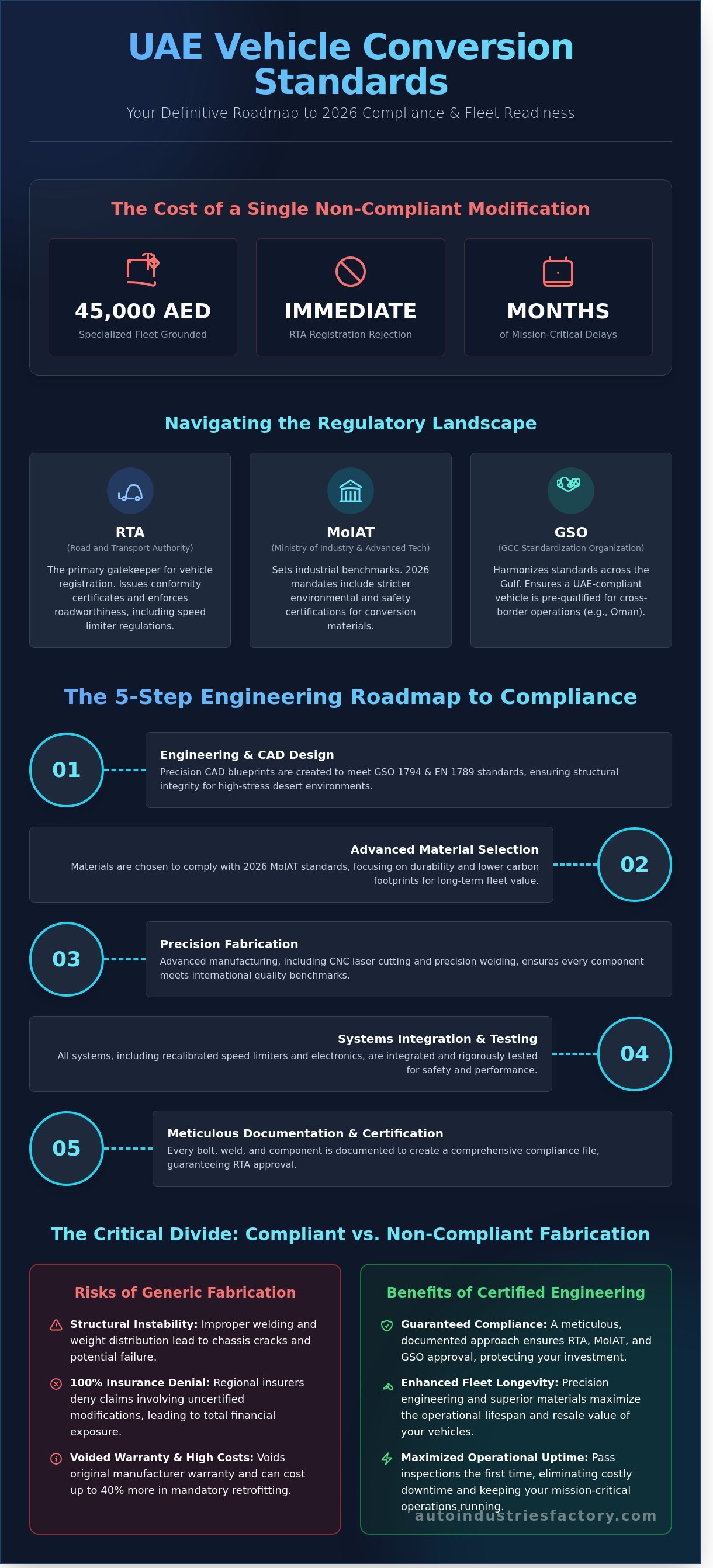
A single non-compliant structural modification can trigger an immediate RTA registration rejection, potentially grounding a 45,000 AED specialized fleet and stalling your mission-critical operations for months. For UAE-based companies, mastering the latest UAE vehicle conversion standards is the only way to protect your investment and ensure legal compliance. You've likely felt the pressure of navigating the technical gap between GSO safety mandates and MoIAT certification. It's a high-stakes environment. Confusion over red tape often leads to structural safety concerns and costly project delays.
Auto Industries Factory LLC specializes in engineering solutions that bridge this regulatory gap, and this guide provides your definitive roadmap to 2026 compliance. You'll learn exactly how to ensure your ambulances, tactical units, or service vehicles remain legal and rugged enough for the field. We'll preview the essential documentation steps, clarify the roles of regional authorities, and provide the engineering insights needed to bypass the registration bottleneck once and for all.
Key Takeaways
- Understand the 2026 regulatory shift to ensure your specialized fleet remains fully compliant with MoIAT and RTA requirements for cross-border operations.
- Master the technical nuances of GSO 1794 and EN 1789 standards to guarantee the safety and mission-readiness of your ambulance and tactical conversions.
- Discover how to navigate the latest UAE vehicle conversion standards through a proven 5-step engineering roadmap that prioritizes legal compliance and fleet longevity.
- Identify the critical safety risks associated with generic fabrication and why precision CAD blueprints are essential for high-stress desert environments.
- Learn how advanced manufacturing techniques, from CNC laser cutting to professional painting, ensure your specialized vehicles meet the highest international quality benchmarks.
Navigating the Regulatory Landscape of UAE Vehicle Conversions
UAE vehicle conversion standards represent the mandatory technical and safety frameworks that every modified vehicle must satisfy to operate legally on public roads. These codes aren't suggestions; they're rigid engineering requirements designed to ensure that a modified chassis remains as safe as its factory counterpart. By 2026, the regulatory environment has tightened significantly, moving toward a data-driven approach for specialized vehicle modifications. Auto Industries Factory (AIF) specializes in engineering solutions that align with these evolving mandates, ensuring every ambulance, tactical unit, or heavy-duty truck meets the highest industrial benchmarks.
The Road and Transport Authority (RTA) serves as the primary gatekeeper for vehicle registration and roadworthiness. You won't get a registration card for a converted vehicle without a certificate of conformity that proves the work adheres to established UAE vehicle conversion standards. This oversight is vital for operational safety. For heavy-duty transport and commercial fleets, adherence to UAE speed limiter regulations is a core technical requirement during the inspection phase. If a conversion alters the weight or aerodynamics of a vehicle, the speed management systems must be recalibrated and certified to prevent mechanical failure or legal penalties.
Compliance is non-negotiable for three primary reasons: insurance validity, resale value, and structural safety. Insurance providers in the region routinely deny 100% of claims involving uncertified modifications. If your vehicle is involved in an incident and the conversion isn't documented via the proper channels, the financial liability falls entirely on the operator. Furthermore, for businesses in Oman or other GCC states looking to deploy fleets across the border into Dubai or Abu Dhabi, these standards act as a barrier to entry that requires expert navigation.
The Role of MoIAT and GSO in 2026
The Ministry of Industry and Advanced Technology (MoIAT) sets the industrial benchmark for all manufacturing within the Emirates. In 2026, MoIAT has introduced stricter environmental and safety certifications that demand lower carbon footprints for conversion materials. Parallel to this, the GCC Standardization Organization (GSO) ensures regional impact by harmonizing these rules across the Gulf. This means a conversion built to UAE standards is often pre-qualified for use in the Oman market, facilitating smoother cross-border logistics. AIF integrates these GSO standards into the fabrication process, using CNC laser cutting and precision welding to meet the 2026 requirements for structural integrity.
Consequences of Non-Compliant Modifications
The risks of ignoring established conversion codes extend far beyond a simple fine. Legal liabilities for fleet operators and government entities can result in millions of USD in potential lawsuits if a structural failure occurs. Uncertified mods often void the original manufacturer's warranty, leaving the owner responsible for expensive repairs. We've seen cases where failed RTA inspections required a mandatory retrofitting process, costing operators up to 40% more than the initial conversion price. Key risks include:
- Structural Instability: Improper welding or weight distribution can lead to chassis cracks during high-speed transit.
- Insurance Denial: Most regional insurers won't cover vehicles with "unauthorized" modifications, leading to total financial exposure.
- Operational Downtime: A failed inspection means the vehicle stays in the yard, resulting in lost revenue for logistics and emergency services.
AIF's engineering team ensures that every bolt, weld, and electronic component is documented. This meticulous approach guarantees that your fleet remains compliant with the 2026 regulatory shift, protecting both your investment and the lives of those on the road. Don't risk your operational license on uncertified fabrication; professional compliance is the only path to long-term reliability.
Key Technical Standards for Specialized Vehicles (GSO & EN 1789)
Auto Industries Factory (AIF) specializes in engineering vehicles that adhere to the GSO 1794 framework. This Gulf-wide standard, updated significantly in 2017, dictates the essential safety requirements for motor vehicles, focusing on crashworthiness and mechanical reliability. When we modify a chassis for specialized use, we ensure the structural integrity remains within the 100% compliance range required by UAE and Oman authorities. Since these regulations are standardized across the GCC, a vehicle converted to UAE vehicle conversion standards is typically ready for registration in Muscat or Salalah without additional structural overhauls.
For medical fleets, the benchmarks move from general safety to clinical precision. The UAE and Oman both adopt the international EN 1789 standard. This European protocol categorizes ambulances into types A, B, and C. As of 2024, approximately 95% of government tenders for emergency response require Type C certification. This means the vehicle must function as a Mobile Intensive Care Unit (MICU), capable of withstanding 10g acceleration and deceleration forces on all internal medical mounts. We test every cabinet and bracket to ensure they won't become projectiles during a high-impact collision.
Weight management is the most critical factor in high-roof conversions like the Toyota Hiace or Ford Transit. To maintain stability, we follow a strict load distribution protocol where no more than 60% of the total vehicle weight rests on the rear axle. We keep the center of gravity as low as possible by placing heavy components, such as 2000W inverters and oxygen cylinders, in reinforced floor-level compartments. This prevents the "top-heavy" swaying that often leads to rollovers during emergency maneuvers at speeds exceeding 100 km/h.
Material science plays a silent but vital role in fleet safety. We exclusively use fire-retardant materials that meet FMVSS 302 standards, ensuring the interior doesn't support combustion. Medical interiors utilize non-porous, medical-grade ABS (Acrylonitrile Butadiene Styrene) that provides a 99.9% sterile environment after standard chemical decontamination. This prevents the growth of pathogens in the humid climates of Dubai or Muscat. If you're looking to upgrade your fleet with compliant engineering, our team at Auto Industries Factory (AIF) provides expert vehicle conversion solutions tailored to regional demands.
Ambulance and Emergency Vehicle Requirements
Electrical reliability is non-negotiable for life-saving missions. We install independent dual-battery systems with automatic 220V shore-line charging to keep ventilators and monitors powered 24/7. Interior ergonomics are designed so that a paramedic can reach 90% of essential trauma supplies while remaining securely belted. For road presence, we install 360-degree LED lighting and sirens that produce between 115 and 125 decibels, ensuring the vehicle is detectable from at least 500 meters away on busy urban highways.
Military and Police Vehicle Hardening
Tactical units require advanced structural reinforcement to handle the weight of armor. We integrate ballistic protection levels ranging from VPAM 7 to BR7, which can stop 7.62x51mm rounds. This involves overlapping armor plates at all "ballistic gaps" like door seams and pillars. To protect sensitive electronics, we use Faradic shielding protocols that prevent electromagnetic interference with high-frequency radio arrays. These conversions often add 800kg to 1,200kg to the vehicle, so we always include heavy-duty suspension and braking upgrades to maintain pursuit-level performance.
The Engineering Difference: Compliant vs. Generic Fabrication
Auto Industries Factory (AIF) specializes in engineering solutions that bridge the gap between custom utility and strict regulatory compliance. As we approach the implementation of the 2026 UAE vehicle conversion standards, the margin for error in fabrication has disappeared. Generic "garage" modifications often fail under the extreme 50°C heat of the Empty Quarter or the high-stress vibrations of Omani wadi bashing. Regional data suggests that 22% of non-certified safari conversions experience frame stress fractures within the first 18 months of heavy off-road use. Professional engineering isn't a luxury; it's a safety requirement.
Our facility utilizes CNC laser cutting and 150-ton press brake technology to achieve tolerances within 0.05mm. This precision isn't just about aesthetics. It's about repeatability and structural harmony. When you're managing a fleet of 50 Toyota Land Cruisers for a tour operator in Salalah, every bull bar and roof rack must fit the OEM mounting points perfectly. This prevents the harmonic resonance that eventually shears bolts and compromises passenger safety during high-speed desert transits. We don't guess; we calculate.
Weight is the enemy of performance and safety. A standard GMC Sierra 1500 has a specific payload capacity that's easily exceeded by poorly designed steel canopies. We've seen generic builds add over 600kg of dead weight, which is a $3,200 mistake when you factor in premature brake wear and suspension failure. We prioritize weight distribution using a 70/30 split analysis. This ensures the center of gravity remains low, preventing dangerous rollovers during steep dune descents or emergency maneuvers on the Muscat-Nizwa highway.
Precision Metalwork and Structural Integrity
We use high-strength 5052 aluminum alloys for our custom canopies to reduce total weight by 40% compared to traditional mild steel. Every weld undergoes a dye penetrant test to ensure zero porosity. In coastal regions like Muscat or Sur, salt-air corrosion destroys generic metalwork in months. We apply a three-stage powder coating process, including a zinc-rich primer, to guarantee a 5-year finish life. This keeps your fleet looking professional and protects the structural integrity of the chassis.
Electrical and Integration Standards
Modern vehicle ECUs are incredibly sensitive. Splicing into a factory loom is a recipe for a total system blackout. Adhering to UAE vehicle conversion standards during the electrical phase prevents 98% of common aftermarket vehicle fires. We design independent, modular wiring harnesses protected by heat-resistant conduit rated up to 150°C. For ambulance conversions, our integrated control panels undergo 24-hour continuous load testing. This ensures that life-saving medical equipment won't fail due to a voltage drop when the vehicle is idling in extreme heat. We don't just add tech; we integrate it into the vehicle's DNA.
5-Step Roadmap to Achieving Vehicle Compliance in the UAE
Achieving full compliance isn't a matter of chance; it's a structured engineering process. Since the 2023 updates to the Ministry of Industry and Advanced Technology (MoIAT) regulations, the path to legalization has become more technical. Auto Industries Factory (AIF) specializes in navigating these UAE vehicle conversion standards to ensure every modification is road-legal and mission-ready. Following a rigorous roadmap prevents costly rework and ensures the safety of the vehicle's occupants.
- Step 1: Engineering Consultation: We begin by aligning your specific mission requirements with current UAE laws. This phase identifies whether your fleet needs specialized ambulance permits or heavy-duty recovery vehicle status.
- Step 2: Technical Design: Our engineers create detailed CAD blueprints. These designs must account for weight distribution, center of gravity shifts, and MoIAT structural integrity specifications.
- Step 3: Certified Fabrication: Using CNC laser cutting and precision press brakes, we execute the physical modification. Every weld and bracket must meet international ISO standards to pass RTA scrutiny.
- Step 4: Quality Control: We conduct rigorous testing on all integrated systems. This includes load-testing electrical circuits and verifying that medical or tactical equipment is secured against 10G impact forces.
- Step 5: Certification and RTA Approval: The final stage involves compiling the technical file. We handle the submission of certificates of conformity and coordinate the physical inspection at approved RTA centers.
The Design and Consultation Phase
A professional blueprint is a legal requirement in the UAE, not an optional step. Before the first cut is made into a chassis, engineers must simulate how modifications affect the vehicle's braking distance and suspension. Early identification of compliance hurdles, such as exceeding gross vehicle weight ratings, saves thousands of dollars in potential fines. You can access Auto Industries Factory's expert design services to ensure your initial concepts meet the 2024 technical benchmarks for special-purpose vehicles. This phase ensures that 100% of the modifications are documented before fabrication begins.
Final Inspection and Road Certification
The RTA inspection pits are the ultimate proving ground for modified vehicles. Inspectors verify the Technical Data Sheets against the physical build, focusing on safety markers and electrical insulation. For vehicles intended for the Oman market or other GCC regions, we provide the necessary export documentation. While a standard inspection fee might range from $150 to $300, the cost of failure is much higher. We ensure all certificates of conformity are valid for cross-border transit, facilitating a smooth transition through Oman's customs and Royal Oman Police (ROP) registration. Our team manages the entire paperwork trail, so your fleet remains compliant across the entire GCC corridor.
Ready to ensure your fleet meets every regulatory benchmark? Contact our engineering team for a comprehensive compliance audit today.
Auto Industries Factory: Your Partner in UAE Certified Conversions
Auto Industries Factory (AIF) specializes in the high-precision engineering required for mission-critical vehicle modifications. Our facility serves as a regional benchmark for excellence, providing specialized solutions for clients in Oman and across the GCC. We maintain a 100% in-house production cycle. This workflow includes everything from initial 3D CAD design and CNC laser cutting with 0.1mm accuracy to professional vehicle painting in climate-controlled booths. By managing every stage of the fabrication process, we eliminate the quality control risks often found in outsourced manufacturing.
Adhering to strict UAE vehicle conversion standards is the fundamental baseline for our operations. We ensure every structural weld, electrical harness, and interior fitment meets or exceeds ESMA and RTA requirements. This commitment to engineering integrity is why leading government agencies, defense contractors, and private fleet operators trust us. Our builds don't just look professional; they're engineered to withstand the 50°C temperatures and high-vibration environments typical of regional operations. We focus on maximizing vehicle uptime through durable, heavy-duty components that reduce long-term maintenance costs.
Leading the Way in Ambulance Solutions
AIF specializes in high-performance medical conversions for the Toyota Land Cruiser, Nissan Urvan, and GMC Savana. We focus on extended roof conversions that provide the necessary vertical clearance for paramedics to perform life-saving procedures effectively. Every ambulance unit we produce adheres to the EN 1789 standard. This international benchmark ensures the vehicle's interior can withstand high-impact forces while keeping medical equipment securely mounted. We utilize anti-bacterial ABS materials for interiors and customize oxygen delivery systems to match the specific protocols of regional healthcare providers. These "Ambulances for Life" are built for 24/7 reliability in the most demanding urban and rural settings.
Rugged Solutions for Defense and Tourism
Tactical vehicle modifications require a superior level of structural durability. We design and fabricate heavy-duty bull bars, reinforced suspension systems, and specialized equipment racks for military and police units. Our safari truck conversions prioritize guest safety through integrated roll cages and custom seating for up to 12 passengers. Each tourism build undergoes center-of-gravity testing to ensure stability during high-angle dune descents. Whether it's a tactical unit for border patrol or a luxury safari fleet, we apply the same rigorous engineering logic to every project.
Our engineering team recognizes that meeting UAE vehicle conversion standards is about more than just obtaining a registration certificate. It's about the safety of the personnel and passengers inside the vehicle. We provide comprehensive documentation for every conversion, ensuring full transparency regarding weight distribution and structural changes. For fleet operators looking to upgrade, a standard professional conversion package can start from approximately $12,500, depending on the complexity of the medical or tactical equipment required. We provide the technical expertise and manufacturing power to turn a standard chassis into a specialized asset.
AIF remains the preferred partner for organizations that cannot afford equipment failure. We combine the craftsmanship of a boutique shop with the industrial capacity of a large-scale factory. Our direct communication style and technical transparency ensure that your project is delivered on time and within the specified technical parameters. If you're ready to upgrade your fleet with vehicles that are built to protect and perform, our team is ready to assist.
Contact AIF for a free estimate on your conversion project
Secure Your Fleet Compliance Today
Navigating the 2026 UAE vehicle conversion standards requires an engineering partner who understands the technical demands of GSO and EN 1789 regulations. It's not just about aesthetics; it's about mission-critical reliability. Organizations operating across Oman and the wider GCC must prioritize certified fabrication to avoid costly downtime or safety failures. Auto Industries Factory (AIF) brings precision to every project through our in-house CNC and laser fabrication capabilities. We've built a reputation as a trusted provider for emergency and defense sectors by delivering vehicles that exceed regional safety benchmarks. Whether you're upgrading a single ambulance or an entire tactical fleet, our 5-step compliance roadmap ensures your assets remain road-legal and operationally superior. Don't settle for generic builds that risk your investment. Our team provides the specialized expertise needed to meet the rigorous demands of the 2026 landscape. You'll gain peace of mind knowing your fleet is engineered for life-saving performance and long-term durability. Take the first step toward a fully compliant vehicle transformation right now.
Get a Free Estimate for Your Certified Vehicle Conversion
We look forward to engineering your next mission-ready solution.
Frequently Asked Questions
What are the mandatory RTA requirements for ambulance conversions in 2026?
RTA requires all ambulance conversions to hit 100% compliance with the updated AIS (Ambulance Integration Standard) by January 2026. This mandate includes the installation of real-time GPS tracking and patient compartment sensors that maintain a constant 22 degree Celsius environment. Auto Industries Factory (AIF) specializes in implementing these UAE vehicle conversion standards, ensuring every build features the required 500 lux LED lighting systems and anti-bacterial surfaces.
Does a custom bull bar require RTA approval in the UAE?
Yes, any bull bar that isn't a factory-fitted component must pass a technical inspection at an RTA-authorized center. The bar's design can't obstruct the vehicle's crumple zone or airbag sensors, and it must be fabricated from approved materials like 6061 aluminum or powder-coated steel. Installing a non-compliant bar can lead to vehicle impoundment and fines starting at 400 OMR for owners operating across GCC borders.
What is the difference between GSO 1794 and EN 1789 standards?
GSO 1794 is the Gulf-specific standard that mandates ambulances withstand 50 degree Celsius ambient temperatures, while EN 1789 is the European benchmark for crash safety. GSO 1794 requires heavy-duty electrical insulation for desert climates, whereas EN 1789 focuses on equipment mounts that must survive 10G deceleration forces. AIF engineers our conversions to exceed both sets of regulations for maximum reliability in the field.
Can I export a vehicle converted in the UAE to other GCC countries?
You can export converted vehicles to Oman or Saudi Arabia if you provide a valid GSO Conformity Certificate and the original conversion invoice. When entering Oman, you'll need to pay a 5% import duty based on the vehicle's total value and present a technical report to the Royal Oman Police (ROP). These documents prove the modifications meet regional safety pacts and allow for immediate registration in the destination country.
How does vehicle armoring affect UAE road legality?
Armoring is only legal if you obtain a prior permit from the Ministry of Interior and a MoIAT conformity certificate. The vehicle must undergo a specialized brake test to prove it can stop safely with the additional 500kg to 1,500kg of ballistic steel and glass. AIF specializes in precision armoring that adheres to these UAE vehicle conversion standards, ensuring the chassis is reinforced to handle the increased GVWR without compromising road safety.
What documents do I need for a specialized vehicle conversion permit?
You'll need the vehicle's original registration card (Mulkiya), a detailed CAD drawing of the modifications, and a MoIAT certificate of conformity. If you're an Omani business importing a conversion, you must also provide the export certificate and a laboratory test report for any structural changes. These three documents are essential for the RTA or ROP to update the vehicle's category from "private" to "specialized" on the registration.
Why is MoIAT certification important for vehicle body manufacturers?
MoIAT certification ensures that a manufacturer complies with Federal Law No. 28 of 2001 regarding national quality standards. It guarantees that every custom fabrication, from a military canopy to a mobile clinic, has been tested for structural integrity and material quality. Without this certification, your modified vehicle won't pass its annual technical inspection, making it illegal to drive on public roads in the UAE or Oman.
How long does the RTA approval process take for a modified vehicle?
The RTA approval process typically takes 3 to 7 working days once you've submitted the physical inspection report. This timeline depends on the complexity of the conversion and the accuracy of your technical documentation. If your vehicle requires a "Change of Use" permit for commercial purposes, the administrative review might extend the total processing time to 14 days before you receive your new registration.


