

A single electronic failure in 50°C heat isn't just a technical glitch; it's a mission-critical breakdown that can cost lives. You understand that maintaining an emergency fleet in the UAE requires engineering that goes far beyond standard automotive specifications. As the new Federal Authority for Ambulance and Civil Defense takes control in 2026, the pressure for upgrading emergency vehicle electronics UAE wide has reached a tipping point for fleet managers. You're likely dealing with the headache of integrating AI-powered traffic cameras and mandatory eCall systems while fighting the constant threat of thermal hardware degradation. This guide promises to help you master these technical requirements, ensure 100% regulatory compliance, and implement integration strategies that extend your vehicle's lifecycle. We will analyze the transition to Euro 6b standards, the latest digital system protocols, and the specific hardware modifications needed to achieve zero-failure reliability in the harshest environments on earth.
Key Takeaways
- Understand why 2026 response standards demand a shift from basic lighting to high-speed telematics and integrated data systems.
- Master the technical specifications for upgrading emergency vehicle electronics UAE to ensure zero-failure performance in extreme thermal environments.
- Learn strategic engineering methods to integrate modern digital hardware with legacy platforms without risking electrical overload or parasitic drain.
- Navigate the specific regulatory landscapes of SIRA and UAE Civil Defence to ensure every modification meets mandatory security and safety standards.
- Discover a systematic, factory-led approach to electronics upfitting that includes comprehensive electrical audits and custom-engineered wiring solutions.
The Necessity of Upgrading Emergency Vehicle Electronics in the UAE
Upfitting is more than a cosmetic exercise. It's the complete engineering of a vehicle's nervous system. For fleet managers, upgrading emergency vehicle electronics UAE is now a survival requirement rather than a luxury upgrade. As the Federal Authority for Ambulance and Civil Defense begins its oversight in 2026, the standard for mission-critical reliability has shifted. Modern response times depend on high-speed data transmission and integrated telematics that allow for real-time fleet coordination. High-traffic zones in Dubai and Abu Dhabi present unique challenges where outdated systems lead to communication lag and signal interference, compromising safety during the "golden hour" of emergency response.
Effective integration requires a deep understanding of emergency vehicle equipment standards. This includes everything from high-intensity warning lights to AI-powered cameras capable of recording traffic violations automatically. Failing to clear traffic isn't just a safety risk; it carries heavy legal weight. UAE authorities now enforce a 3,000 AED fine and six black points for motorists who block emergency lanes. Your electronics must facilitate this enforcement through smart technology that identifies these offenses in real-time. As urban expansion pushes response zones further into the desert, the demand for extended communication range and 5G LTE integration becomes undeniable.
Watch this overview of new specialized vehicle capabilities in the region to better understand the scale of technological integration:
Combatting the UAE Thermal Challenge
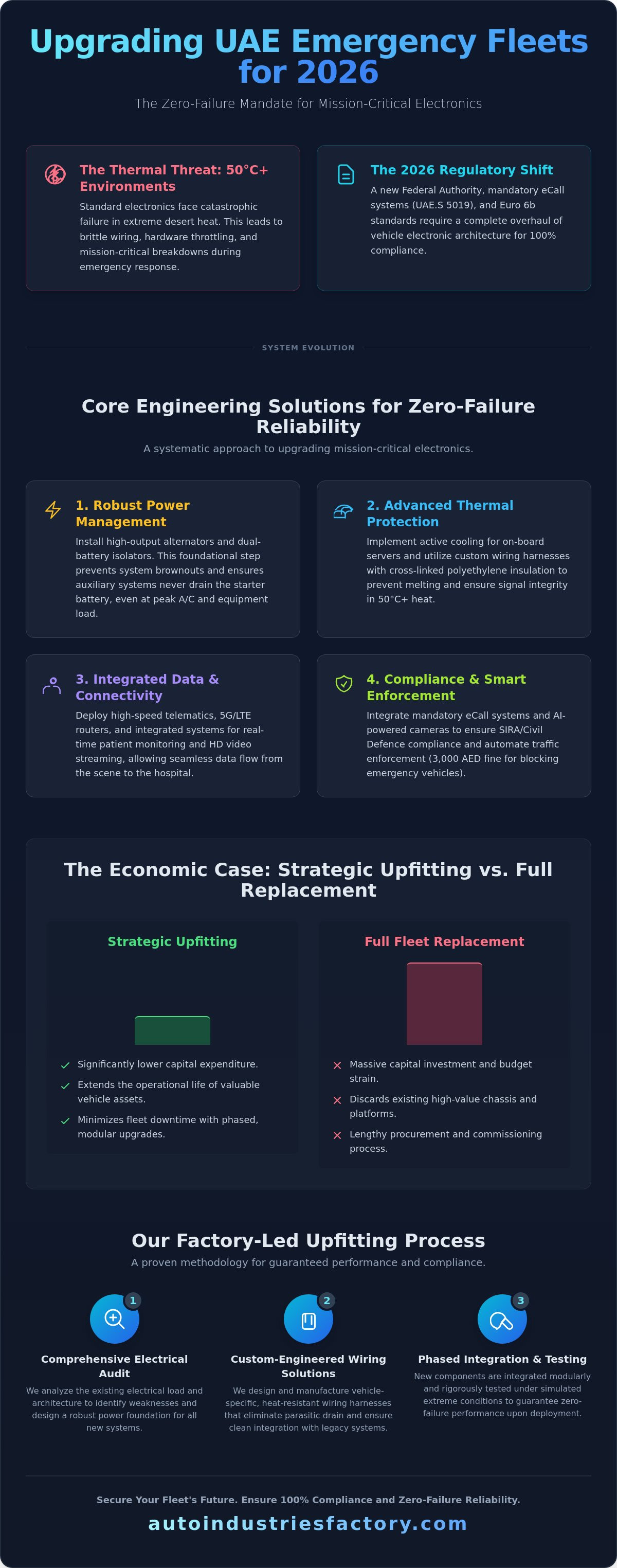
The desert environment is a brutal laboratory for electronics. Standard wiring often becomes brittle and fails under the 50°C+ ambient temperatures common in the summer months. We've seen passive cooling fail when vehicles idle at emergency scenes. Upgrading emergency vehicle electronics UAE involves a shift toward active cooling for server racks and the selection of components with extreme operating temperature thresholds. Professional upfitting focuses on custom wiring harnesses that utilize cross-linked polyethylene insulation to prevent melting. These high-performance modifications ensure that your mission-critical hardware doesn't throttle or shut down when the heat is at its peak.
The Economic Case for Upfitting vs. Replacement
Replacing an entire fleet of specialized vehicles is a massive capital expenditure that many budgets can't support. However, high-value platforms like the Toyota Land Cruiser or GMC Sierra chassis are built to last. By modernizing internal systems through our specialized vehicle modification services, you extend the operational life of these assets. Modular upgrades allow for the phased introduction of new tech, such as the mandatory eCall systems required by UAE.S 5019: 2024. This strategy minimizes fleet downtime and ensures compliance with the 2026 Euro 6b emission standards without the immediate need for total fleet turnover.
Core Systems: Essential Electronic Components for Modern Fleets
Precision engineering dictates that a vehicle's electronic architecture is only as reliable as its power source. When you're upgrading emergency vehicle electronics UAE, the first priority is the electrical foundation. Modern ambulances and police units carry an immense load, from high-draw medical refrigerators to AI-processing units. We install high-output alternators and dual-battery isolators to ensure that mission-critical systems never drain the primary starter battery. This robust power management is the only way to prevent system brownouts during peak summer temperatures when air conditioning and electronic loads are at their absolute maximum.
Beyond power, the integration of tactical and medical data has become a standard requirement for 2026 fleets. Real-time patient monitoring and high-definition video streaming allow hospital staff to prepare for arrivals before the ambulance even leaves the scene. These systems must adhere to comprehensive UAE vehicle regulations, ensuring that radio frequencies and data transmission protocols don't interfere with existing national security networks. It's a complex balancing act that requires specialized hardware designed for high-vibration and high-heat environments.
Communication and Navigation Integration
Seconds matter in emergency response. Integrating GPS with local UAE mapping systems like Dubai's "Makani" ensures that dispatchers can guide drivers through the most efficient routes, even in rapidly developing urban areas. For remote desert operations, we utilize low-profile satellite antennas that maintain connectivity where 5G signals fade. It's vital to ensure your communication systems are integrated tactical vehicle equipment, allowing for seamless handovers between cellular and satellite networks without data loss. This level of connectivity is essential for maintaining a unified command structure during large-scale incidents.
Visual and Auditory Warning Upgrades
Visibility is your first line of defense on the road. We've moved beyond simple flashing lights to low-draw, high-visibility LED systems that offer superior battery life and piercing clarity in the bright UAE sun. These lightbars are engineered with specialized heat sinks to prevent the internal circuitry from "cooking" during long shifts. Digital siren controllers now offer customizable tones and integrated PA systems for crowd control. These controllers allow operators to change patterns based on traffic density, providing a more effective warning in the high-decibel environments of city centers. If you're looking to enhance your fleet's capability, our specialized vehicle modification solutions provide the ruggedized hardware needed for these demanding roles.
Tactical data management isn't just about communication; it's about situational awareness. Modern upgrading emergency vehicle electronics UAE projects now include 360-degree camera arrays and onboard DVR systems. These tools provide a legal record of every intervention and assist drivers in navigating tight spaces. By choosing hardware with high operating temperature thresholds, you ensure these recording systems remain online when they're needed most. Every component we select is vetted for its ability to withstand the unique environmental stressors of the region while maintaining 100% operational uptime.
Strategic Engineering: Integrating New Tech with Legacy Platforms
Engineering a bridge between legacy chassis and modern digital suites requires more than basic electrical knowledge. When upgrading emergency vehicle electronics UAE fleets, we first perform a rigorous audit of the existing electrical load capacity. Older platforms weren't designed for the 2026 digital requirements, including high-bandwidth telematics and AI-powered enforcement cameras. To prevent parasitic drain, a common cause of fleet downtime, we fabricate custom wiring harnesses that bypass non-essential circuits while maintaining clean power delivery to mission-critical hardware. This ensures that the vehicle's "brain" and its tactical equipment operate in perfect synchronization without compromising the battery's health.
Interfacing new electronics with the original vehicle CAN-bus system is a delicate task. This digital handshake allows for seamless communication between vehicle sensors and tactical equipment, such as linking siren triggers to onboard camera recording. We use modular equipment racks to house these components. This design philosophy ensures that if a single module requires maintenance, it can be swapped without dismantling the entire electronic suite. It's about future-proofing the vehicle so it can adapt as UAE response standards evolve over the next decade. By keeping the architecture modular, we reduce the time vehicles spend in the workshop and maximize their time on the road.
Chassis-Specific Electronic Considerations
The Toyota Hilux and Land Cruiser are regional workhorses, but their off-road electronic stability can be compromised by improperly installed heavy electronic suites. We focus on precise weight distribution to maintain handling during high-speed responses. For GMC ambulance conversions, the electrical requirements are even more demanding due to the intensive medical equipment involved. These conversions require dedicated power management systems that isolate medical life-support from the vehicle’s primary engine electronics, ensuring 100% uptime regardless of the operational environment.
In-House Fabrication for Electronic Housing
Precision housing is where our metalwork expertise meets electronic engineering. We use CNC machining to create custom dashboard and console mounts that fit the specific ergonomics of each vehicle type, ensuring that controls are always within the driver's reach. Laser-cut brackets provide secure, vibration-resistant mounting for sensitive communication hardware, protecting it from the shocks of off-road desert travel. Additionally, our custom metal canopies are engineered with integrated ventilation paths. This ensures that when upgrading emergency vehicle electronics UAE in a closed environment, the heat generated by high-processing servers is efficiently dissipated, preventing thermal throttling during critical desert missions.
Successful integration isn't just about making the tech work; it's about making it last. By combining custom metal fabrication with advanced electrical engineering, we create a ruggedized environment where sensitive electronics can thrive. This holistic approach is what separates a standard upfit from a professional conversion designed to meet the 2026 federal standards.
Navigating UAE Regulations and Technical Standards
Regulatory compliance in the UAE isn't just about passing an annual inspection. It's a fundamental requirement for mission legality. As the Federal Authority for Ambulance and Civil Defense assumes its full mandate on January 1, 2026, the criteria for upgrading emergency vehicle electronics UAE have become significantly more stringent. Fleet managers must now account for a unified set of federal standards that govern everything from radio frequency interference to the luminosity of emergency lightbars. Navigating this landscape requires a partner who understands the intersection of GSO safety protocols and local municipality requirements. Failure to meet these technical standards doesn't just risk a fine; it can result in the immediate grounding of a critical response asset.
Certified installers in regions like Ajman and Dubai play a vital role in this process. Every modification, from a simple siren controller to a complex AI-powered surveillance suite, must be documented for RTA approval. This documentation proves that the vehicle's structural integrity and electrical safety remain intact after the upfit. We ensure that every component, including high-output alternators and custom wiring harnesses, meets GSO standards for modified vehicle electrical safety. This meticulous approach prevents the common "red-flag" issues that often stall the registration of converted emergency units.
SIRA and Security Compliance
For security and surveillance fleets, the Security Industry Regulatory Agency (SIRA) sets the benchmark. Mandatory specifications for onboard cameras and DVR systems are non-negotiable. These systems must support specific frame rates, storage capacities, and secure data transmission protocols to assist law enforcement in real-time. When you're managing a police car conversion, ensuring the hardware meets SIRA's data retention standards is critical. We integrate these systems using ruggedized housings that protect sensitive data drives from the vibrations of high-speed pursuit and the extreme external temperatures of the Emirates.
International Standards in a Local Context
While local regulations are primary, we often apply international benchmarks like EN 1789 to UAE medical fleets to ensure world-class safety. This European standard for ambulance electrical systems provides a robust framework for patient-area lighting and medical equipment power supply. However, these must be adapted to GSO 1794 standards to account for the UAE's extreme climate. Standard European wiring doesn't always survive the thermal stress of a Middle Eastern summer. We modify these international designs with high-heat insulation and active cooling to ensure they perform reliably at 50°C. Before you begin a fleet-wide rollout, verify the specific 2026 RTA modification permit requirements, as these have been updated to reflect the new federal oversight.
Staying compliant requires constant vigilance as technology and laws evolve. If you're unsure about the current standing of your fleet's electronic suite, our specialized vehicle conversion services include a full regulatory audit to ensure your vehicles meet all 2026 UAE standards. Professional upfitting is the only way to guarantee that your investment remains operational and legally protected in an increasingly regulated environment.
The Auto Industries Factory LLC Approach to Electronics Upfitting
Precision execution is the hallmark of a professional conversion. When upgrading emergency vehicle electronics UAE fleets, Auto Industries Factory LLC follows a rigorous five-step engineering process designed for mission-critical reliability. It begins with a comprehensive electrical audit and mission-profile analysis. We don't just install hardware; we evaluate how the vehicle will be used, whether it's a police interceptor in high-speed urban pursuits or a box-type ambulance idling for hours in the midday sun. This data allows our engineers in Ajman to design a custom system architecture that balances power consumption with operational necessity, ensuring that critical systems never fail when they're needed most.
Our process moves from design to precision installation using in-house fabricated components. By controlling the manufacturing of brackets, mounts, and consoles, we eliminate the weak points found in "off-the-shelf" solutions. Once installed, every vehicle undergoes rigorous stress testing in high-temperature environments. We simulate the extreme thermal loads of a UAE summer to verify that active cooling systems and wiring harnesses perform without degradation. Finally, we provide full certification and compliance documentation, ensuring your fleet meets all RTA, SIRA, and Civil Defence standards for 2026. This systematic approach guarantees that your investment is both legally protected and operationally superior.
Why In-House Fabrication Matters for Electronics
Off-road desert travel and high-speed urban responses create immense vibration that can rattle standard electronic mounts to pieces. We eliminate these vibration-induced failures through custom CNC-machined and laser-cut mounting solutions. This level of precision ensures perfect fitment for specialized medical or tactical gear, preventing hardware from shifting or losing connectivity during critical maneuvers. Our ability to integrate metalwork with electrical engineering allows for superior ventilation paths that passive systems lack. You can learn more about our special purpose vehicle manufacturer expertise and how our master craftsmen build for the toughest environments in the region.
Ready to Modernise Your Fleet?
The transition to the 2026 federal standards requires more than just new equipment; it requires a strategic engineering partner. We provide technical consultations for police, ambulance, and military fleet upgrades across Dubai, Abu Dhabi, and the Northern Emirates. Whether you're managing a small specialized unit or a large-scale municipal fleet, our team is ready to deliver a technical assessment of your current vehicle electronics. Don't wait for a system failure to reveal the weaknesses in your fleet's architecture. Contact us today to discuss our specialized vehicle modification services and secure the reliability your mission demands.
Engineering excellence isn't just about the technology you add; it's about how that technology is integrated into the vehicle's core. By choosing a factory-led approach to upgrading emergency vehicle electronics UAE, you ensure that every wire, bracket, and sensor is part of a unified, ruggedized system. We build for the long haul, ensuring your fleet remains compliant, efficient, and ready for any emergency response scenario.
Securing the Future of Your Mission-Critical Fleet
The landscape for emergency services in the Emirates is transforming. With the 2026 federal oversight and new technical mandates now in effect, maintaining operational readiness requires more than just routine maintenance. It demands a strategic approach to upgrading emergency vehicle electronics UAE wide. You've seen how precision engineering and custom fabrication solve the thermal challenges of the desert while ensuring your systems meet the latest SIRA and Civil Defence requirements. Our facility provides ISO-certified in-house fabrication and expert engineering specifically designed for UAE extreme heat conditions. We bridge the gap between legacy platforms and modern digital standards, ensuring your fleet remains a reliable asset in every high-stakes scenario. Don't let outdated electronics compromise your response times or regulatory standing. Take the next step toward a modernized, compliant fleet today. Get an Expert Consultation for Your Fleet Upgrade. We're ready to engineer your mission success.
Frequently Asked Questions
What are the main benefits of upgrading emergency vehicle electronics instead of buying new?
Upgrading allows you to modernize your fleet's capabilities while retaining high-value chassis like the Toyota Land Cruiser or GMC Sierra. It's a cost-efficient strategy to meet 2026 federal standards without the massive capital expenditure of total vehicle replacement. This modular approach minimizes fleet downtime and ensures your existing assets remain operationally superior for several more years.
How does the UAE climate affect emergency vehicle electronic systems?
Extreme ambient temperatures reaching 50°C+ cause standard wiring to become brittle and lead to thermal throttling in digital processors. Professional upgrading emergency vehicle electronics UAE includes installing active cooling for server racks and using high-heat insulation. These ruggedized modifications prevent system shutdowns during critical summer operations when vehicles must idle for extended periods at emergency scenes.
What specific SIRA regulations apply to security vehicle electronics in Dubai?
SIRA mandates specific high-definition camera resolutions and secure DVR storage capacities for all security and surveillance fleets. These systems must support real-time data transmission and adhere to strict data retention protocols to assist law enforcement agencies. Every installation requires certified hardware and documented proof of compliance to pass the agency's rigorous security inspections.
Can any vehicle conversion specialist handle advanced communication integration?
Advanced integration requires specialized engineering knowledge of vehicle CAN-bus systems and radio frequency interference. Most general shops lack the CNC machinery and technical expertise needed to fabricate vibration-resistant mounts for 5G LTE and satellite hardware. You should verify a specialist's experience with complex digital handovers before trusting them with your mission-critical communication suites.
How long does a typical electronics upfitting take for an ambulance?
The duration of an electronics upfit depends on the complexity of the mission profile and the current state of the vehicle's electrical architecture. A comprehensive upgrade typically follows a multi-stage process involving an electrical audit, custom harness fabrication, and rigorous stress testing. You should consult with an expert engineer to establish a realistic timeline based on your specific equipment requirements.
Are custom wiring harnesses necessary for emergency vehicle upgrades?
Custom wiring harnesses are essential because they're engineered to handle the significantly higher electrical loads of modern digital systems. They prevent parasitic drain and utilize specialized insulation to survive the UAE's harsh desert environment. Standard harnesses often fail under the combined stress of high-draw medical equipment and the extreme external heat common in the region.
What is the role of an auxiliary battery system in upfitted vehicles?
An auxiliary battery system acts as a dedicated power reservoir for tactical and medical gear, isolating these loads from the vehicle's primary starter battery. This setup ensures that devices like medical refrigerators or AI cameras don't drain the power needed to crank the engine. Dual-battery isolators manage the charging cycle to maintain 100% operational uptime during long shifts.
How do I ensure my upgraded vehicle remains compliant with RTA and GSO standards?
Compliance is ensured by using certified installers who provide comprehensive documentation of all modifications for RTA and GSO inspections. This includes verifying that upgrading emergency vehicle electronics UAE doesn't compromise structural integrity or exceed the vehicle's gross weight limits. Adhering to the mandatory 2024 technical regulations for eCall systems is also a critical part of the certification process.


