
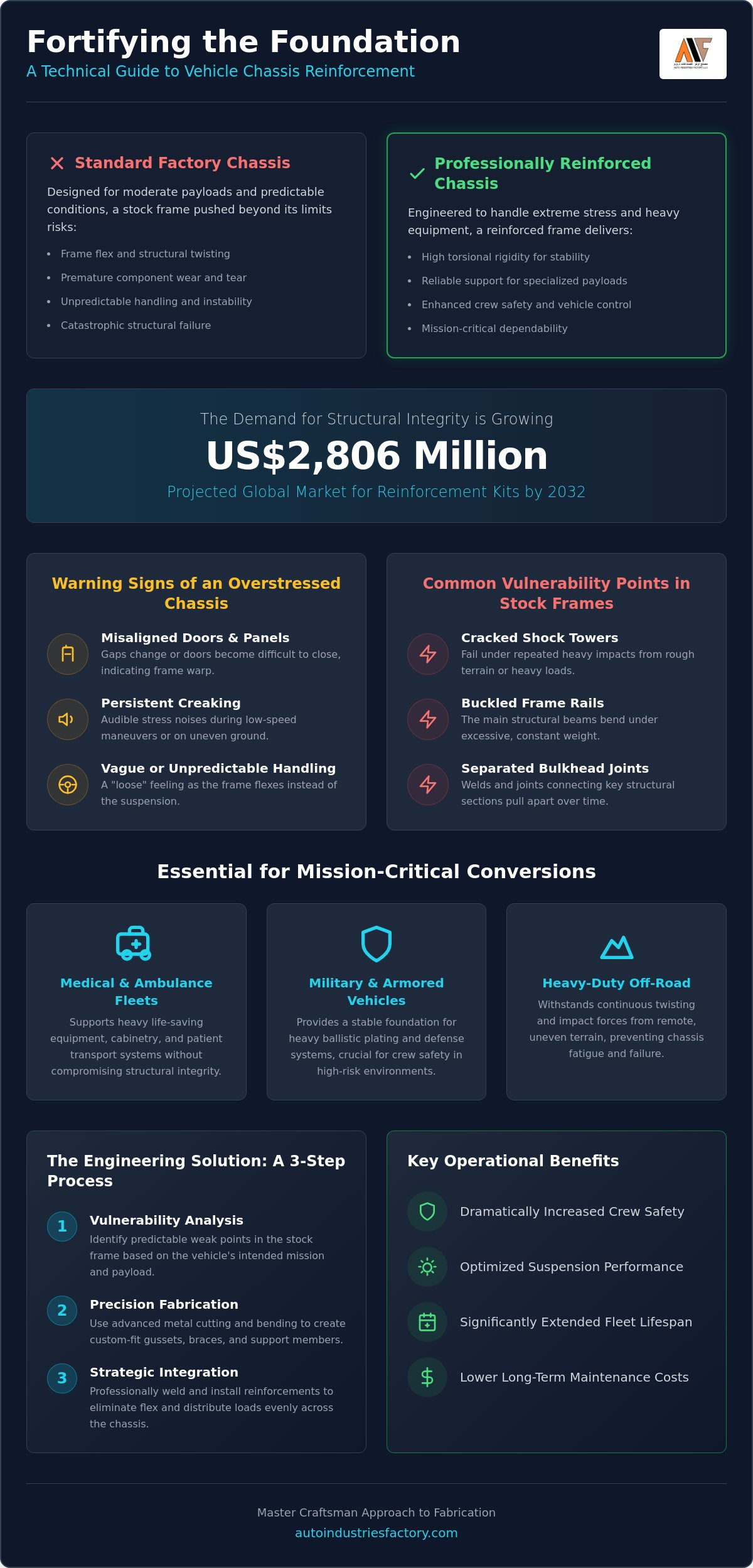
A standard vehicle frame is not built to withstand the relentless stress of a fully equipped ambulance or a military-grade conversion operating in remote terrain. When you push a factory chassis beyond its original engineering limits, you risk catastrophic structural failure and unpredictable handling that compromises crew safety. Professional vehicle chassis reinforcement is the technical bridge between a standard commercial truck and a reliable, mission-critical asset. With the global market for reinforcement kits projected to reach US$2,806 million by 2032, it's clear that industry leaders are prioritizing structural integrity over basic modifications.
You understand that a vehicle is only as dependable as its foundation. If the frame flexes under heavy loads, every other component suffers from premature wear and decreased performance. This article explains how expert engineering transforms standard frames into high-performance platforms capable of supporting specialized equipment without compromise. You'll discover the specific fabrication techniques used to extend vehicle lifespan and ensure safety compliance for heavy-duty conversions. We provide a technical breakdown of the structural enhancements required for the most demanding off-road and professional environments.
Key Takeaways
- Master the science of torsional rigidity and learn how it fundamentally dictates vehicle handling and safety under extreme loads.
- Discover why mission-critical fleets, such as ambulances and armored personnel carriers, rely on professional vehicle chassis reinforcement to support heavy ballistic plating and life-saving equipment.
- Learn how precision metal cutting and bending techniques create custom gussets and braces that eliminate structural weak points in factory frames.
- Identify the operational advantages of a rigid frame, including optimized suspension performance and significantly lower long-term fleet maintenance costs.
- Explore the benefits of a master craftsman approach to fabrication, where in-house engineering ensures every conversion is built for maximum durability and safety.
Understanding Vehicle Chassis Reinforcement: The Science of Rigidity
Vehicle chassis reinforcement is the strategic process of strengthening a Vehicle frame to handle loads and stresses far beyond its original factory design. It isn't just about adding weight; it's about engineering structural integrity into the core of a machine. When a standard vehicle is converted into a mission-critical asset, such as an ambulance or a military transport, the added weight of equipment and armor creates forces that standard frames weren't built to survive. Torsional rigidity is the resistance of a chassis to twisting forces. High rigidity ensures that the suspension does its job instead of the frame bending to absorb road impact.
To better understand this concept, watch this helpful video:
The engineering requirements differ significantly between chassis types. Ladder-frame vehicles, common in platforms like the Toyota Land Cruiser, provide a robust foundation but are prone to longitudinal twisting under heavy off-road use. Unibody vehicles, such as modern vans used for medical conversions, integrate the body and frame into a single unit. These require specialized reinforcement to prevent the entire shell from warping. Failure to address these needs leads to visible signs of chassis stress. You'll notice doors that no longer align perfectly, persistent creaking during low-speed maneuvers, and a "vague" feeling in the handling as the frame flexes during cornering.
The Physics of Chassis Flex and Stress
Every movement creates a force. Vertical loads from heavy medical gear or lateral loads from high-speed evasive maneuvers put immense pressure on the structural joints. When you apply heavy acceleration or carry maximum payloads, torque attempts to twist the chassis like a wet towel. Standard factory frames are designed for comfort and moderate weight, not the grueling demands of specialized fleets. Professional vehicle chassis reinforcement uses advanced metal cutting and bending to counteract these forces, ensuring the platform remains stable under extreme conditions.
Identifying Vulnerability Points in Stock Vehicles
Stock vehicles have predictable failure points when pushed to the limit. Shock towers often crack under repeated heavy impacts; frame rails can buckle under excessive weight; and bulkhead joints may separate over time. In the UAE, these issues are accelerated. High ambient temperatures and corrosive sand environments speed up structural fatigue in the metal. Torsional rigidity is the resistance of a chassis to twisting forces. Without it, the vehicle's lifespan is drastically shortened. We identify these vulnerabilities early to apply precision-engineered braces and gussets before the metal reaches its breaking point.
Why Mission-Critical Conversions Demand Structural Reinforcement
A factory-spec chassis is designed for predictable urban environments and moderate payloads. It isn't engineered to carry the literal weight of life-saving interventions or ballistic defense systems. When a vehicle is repurposed for specialized duty, the baseline structural integrity must be elevated to match the new mission. Professional vehicle chassis reinforcement ensures that the frame becomes a permanent, reliable partner to the high-tech equipment it carries, rather than a point of failure. Without this foundation, the added mass of specialized conversions will inevitably lead to frame fatigue, compromised safety, and shortened fleet life.
Heavy-Duty Payloads in Medical Fleets
Professional ambulance conversions involve much more than interior cabinetry. They require the integration of heavy medical oxygen cylinders, hydraulic stretchers, auxiliary battery banks, and complex electrical systems. This concentrated weight places constant stress on specific sections of the frame. Over years of 24/7 operation, an unreinforced chassis will begin "sagging," which throws off wheel alignment and puts dangerous stress on the braking system. Reinforcing the base prevents this degradation and maintains the stability of high-roof ambulance configurations during high-speed emergency maneuvers.
The stakes are even higher for security applications. Integrating ballistic plating into armored personnel carriers adds thousands of kilograms to the gross vehicle weight. This mass doesn't just affect the suspension; it creates immense torsional stress every time the vehicle turns or hits a bump. We use targeted structural enhancements to distribute this ballistic load across the entire frame, ensuring the vehicle remains agile and safe under fire. For organizations managing these high-stakes assets, consulting with an expert in specialized vehicle fabrication is a critical step in the design process.
The Rigors of Off-Road and Safari Operations
In the demanding desert environments of the UAE, safari vehicle conversions face "corrugation fatigue." This occurs when high-frequency vibrations from unpaved tracks literally shake a standard chassis apart. Platforms like the Toyota Land Cruiser LC70 and Hilux are the gold standard for these roles, but even they require reinforcement to handle custom roof racks and heavy metal canopies over long-term use. By strengthening the bulkhead joints and frame rails, we protect the vehicle from the structural cracking that often plagues stock off-roaders.
Beyond performance, reinforcement is a matter of safety compliance. Specialized fleets must meet rigorous national standards for load-bearing capacity and occupant protection. A reinforced chassis ensures that the vehicle remains predictable in an emergency, keeping tires in contact with the ground and maintaining the integrity of the passenger cabin. It's the difference between a vehicle that merely survives the job and one that excels in it for years.
Engineering Methods: How Professional Fabricators Strengthen a Frame
Professional vehicle chassis reinforcement is a high-precision discipline that combines advanced metallurgy with master-level fabrication. It moves beyond simple bolt-on parts to create a permanent, integrated solution for structural integrity. The process begins with specialized metal cutting and bending to produce components that match the exact geometry of the donor vehicle. By using in-house laser cutting and CNC machining, we ensure that every reinforcement plate and brace fits with zero tolerance for error, preventing the stress risers that lead to cracks in lower-quality modifications.
Plate Reinforcement and Strategic Gusseting
Strategic plating is the most effective way to increase a frame's section modulus without adding excessive weight. This often involves "boxing" a frame rail, which means welding a fourth side onto a standard C-channel rail to create a rigid, rectangular tube. This modification exponentially increases the frame's load-bearing capacity and resistance to twisting. Laser-cut gussets provide 30% more precision in stress distribution than manual fabrication. We place these gussets at high-stress intersection points, such as where the crossmembers meet the main rails, to ensure the chassis remains rigid during heavy acceleration or while carrying maximum medical or security payloads.
Seam Welding and Structural Bracing
Standard factory chassis rely on spot welds designed for cost-efficiency and passenger comfort. For mission-critical vehicles, these spot welds are a liability. Professional fabricators utilize full seam welding along the entire length of the chassis joints to create a unified, indestructible bond. This technique eliminates the microscopic movements between metal sheets that eventually lead to structural fatigue. We also integrate internal bracing and external armor as part of a holistic chassis ecosystem. This includes the installation of custom bull bars and bumpers, which serve as the first line of defense for the frontal chassis structure.
- CNC Machined Mounts: Custom-engineered suspension and accessory mounts ensure that heavy equipment is secured to the strongest points of the frame.
- High-Grade Welding: Utilizing TIG and MIG welding processes to maintain the metallurgical properties of high-strength steel.
- Corrosion Protection: Every reinforced section is treated to withstand the harsh environmental conditions of the UAE, preventing rust from compromising the new welds.
The result of these engineering methods is a platform that feels fundamentally different from a stock vehicle. It's a foundation built for the long-term survival of specialized fleets, ensuring that ambulances, police units, and safari trucks can perform their duties without the risk of frame failure. Our solution-oriented approach means we don't just add metal; we engineer reliability into every millimeter of the chassis.
Operational Benefits: Safety, Durability, and Fleet Longevity
The technical superiority of professional vehicle chassis reinforcement translates directly into measurable operational advantages. While the engineering process is complex, the goal is simple: ensuring the vehicle performs reliably under pressure. A reinforced frame provides a stable platform that maintains precise suspension geometry. When the chassis resists twisting, the suspension components can operate within their intended range of motion. This results in consistent tire contact patches, which are vital for braking and cornering stability in heavy-duty applications. To keep these systems performing at their peak, specialized Car Suspension Repair is essential for maintaining shock absorbers and alignment in the long term.
Beyond performance, structural integrity is a primary driver of fleet safety. In high-impact or rollover scenarios, a reinforced chassis acts as a protective cage for both the occupants and the expensive equipment inside. For national organizations managing large-scale operations, this reliability is non-negotiable. A rigid foundation prevents the frame fatigue that leads to body cracking and mounting point failures, significantly extending the vehicle's operational lifecycle.
Enhanced Handling and Driver Control
High-profile vehicles, such as box-type ambulances, are inherently susceptible to body roll due to their high center of gravity. Reinforcing the chassis minimizes this lateral sway, giving the driver more confidence during urgent maneuvers. In emergency response situations, every millisecond of steering response matters. A rigid frame ensures that driver inputs are transmitted directly to the road without being absorbed by a flexing chassis. For safari trucks, we engineer a specific balance of stiffness and controlled flex. This allows the vehicle to maintain optimal traction on uneven desert terrain while protecting the frame from the long-term damage caused by constant vibration.
Maximizing the ROI of Specialized Conversions
Specialized vehicle conversions represent a significant capital investment. Without vehicle chassis reinforcement, that investment is at risk. Frame cracks in heavy-use environments often lead to "total loss" scenarios because the cost of repairing a compromised foundation frequently exceeds the vehicle's value. Structural integrity also protects the interior. Medical monitors, electrical inverters, and communication arrays are sensitive to the high-frequency vibrations of a flexing frame. By stabilizing the foundation, you reduce the failure rate of these expensive onboard systems.
- Reduced Maintenance Costs: Fewer alignment issues and less wear on bushings and joints.
- Extended Lifecycle: Vehicles remain in service for a full 5-10 year fleet cycle without structural degradation.
- Higher Resale Value: A documented, professionally reinforced chassis is a mark of quality for secondary buyers.
Investing in a reinforced foundation is a strategic cost-saving measure that pays for itself through reduced downtime and lower repair bills. To ensure your fleet is built on a foundation of engineering excellence, request a technical consultation with our fabrication team today.
The Auto Industries Factory Standard: Precision Fabrication
Auto Industries Factory LLC operates as a specialized engineering partner for organizations that cannot afford structural failure. We approach every project with the mindset of a master craftsman, combining decades of technical expertise with the latest in manufacturing technology. Our facility manages the entire lifecycle of a modification, providing a seamless transition from design to painting. This end-to-end control ensures that every stage of vehicle chassis reinforcement meets our uncompromising standards for ruggedness and reliability.
We specialize in high-performance vehicle platforms that are proven to withstand the harshest environments. Whether working with the GMC Sierra or the Toyota Land Cruiser and Hilux, we understand the unique metallurgical properties and frame geometries of these vehicles. This specific knowledge allows us to apply reinforcements that complement the original engineering while providing the additional strength required for specialized duty. Our solutions are built in the UAE, for the UAE, ensuring they can handle the high-heat and high-stress conditions of the region.
Custom Solutions for Diverse Industries
The requirements for a high-speed police patrol unit differ fundamentally from those of a heavy-duty troop carrier. We tailor our reinforcement strategies to the specific operational profile of the fleet. For security and law enforcement, we focus on maintaining agility and high-speed stability. For military applications, we prioritize the load-bearing capacity needed for ballistic protection and heavy equipment. Our facility is equipped to handle bulk quantities of accessories, including custom bull bars and brush guards, ensuring that even large fleets receive consistent, high-quality fabrication. We also integrate these structural changes with professional vehicle color change services, delivering a mission-ready asset that looks as professional as it performs.
Commitment to Quality and Reliability
Reliability is engineered into every weld and every bracket. We employ rigorous testing protocols to verify that our structural modifications perform as intended under maximum stress. As a regional leader in specialized vehicle fabrication, our reputation is built on the durability of the machines we produce. We don't just provide products; we deliver comprehensive engineering solutions that solve complex modification challenges. Our no-nonsense approach to manufacturing means you get direct, efficient communication and a product that is ready for immediate deployment.
- In-House Capabilities: Laser cutting, CNC machining, and high-precision welding all happen under one roof.
- Platform Expertise: Specialized knowledge of Toyota, GMC, and other high-stakes vehicle frames.
- Mission-Ready Focus: Every modification is designed for protection, safety, and trust.
A vehicle is only as strong as its foundation. If your fleet requires the highest level of structural integrity for specialized operations, contact our engineering team to discuss your project. You can request a custom fabrication estimate today and secure the future of your mission-critical assets.
Secure the Structural Future of Your Specialized Fleet
Standard factory frames aren't built for the relentless demands of specialized service. Professional vehicle chassis reinforcement is the essential bridge between a standard commercial platform and a mission-ready asset capable of surviving the most extreme conditions. By utilizing our in-house CNC and laser cutting technology, we create precise, high-strength solutions that eliminate frame flex and prevent structural fatigue. This engineering focus ensures that your ambulances, military vehicles, and safari trucks remain stable under heavy payloads and high-stress maneuvers.
Choosing UAE-engineered fabrication means prioritizing the safety of your crew and the longevity of your investment. We specialize in transforming high-performance platforms into rugged foundations for the most critical industries. Don't compromise on structural integrity when the stakes are at their highest. Our master craftsman approach ensures every weld and brace meets the highest technical standards for mission-critical ambulance and military conversions.
Request a Technical Estimate for Your Fleet Conversion to begin building your foundation of reliability. We're ready to engineer the durability your mission requires.
Frequently Asked Questions
Does vehicle chassis reinforcement affect the manufacturer warranty?
Yes, structural modifications typically void the manufacturer’s warranty on the chassis and related suspension components. For mission-critical fleets like ambulances or military units, the operational necessity for structural integrity often takes precedence over standard warranties. Fleet managers usually rely on the engineering expertise and fabrication standards of the specialist converter to ensure the vehicle remains reliable throughout its service life.
How much weight does professional chassis reinforcement add to the vehicle?
Professional reinforcement typically adds between 2% and 5% to the vehicle's original curb weight. By utilizing in-house laser cutting and high-strength steel, we maximize the strength-to-weight ratio of every component. This precision ensures that the frame is robust enough for heavy ballistic plating or medical gear without significantly compromising the vehicle's acceleration or fuel efficiency in the field.
Is chassis reinforcement necessary for standard 4x4 vehicles used on-road?
No, standard 4x4 vehicles driven primarily on paved roads do not require vehicle chassis reinforcement. This technical process is specifically engineered for high-stakes environments where vehicles carry extreme payloads or face relentless off-road vibrations. For standard daily commuters, the factory-engineered frame is more than sufficient to handle everyday stresses and meet all standard safety requirements without additional strengthening.
What is the difference between a strut bar and full chassis reinforcement?
A strut bar is a basic bolt-on accessory that connects shock towers, whereas full reinforcement involves permanent structural modifications like seam welding and frame boxing. While a strut bar offers a minor reduction in front-end flex during cornering, full reinforcement strengthens the entire backbone of the vehicle. This deeper engineering is required to support mission-critical equipment and prevent frame cracking in remote environments.
Can a reinforced chassis improve the towing capacity of my truck?
How long does the chassis reinforcement process take for a fleet vehicle?
The timeframe for reinforcement usually ranges from five to fifteen working days depending on the specific modification requirements. This period covers the in-house design phase, precision laser cutting of custom plates, and the application of high-grade seam welds. For large-scale fleet orders, we utilize a streamlined fabrication workflow to maintain consistent quality and delivery schedules across multiple specialized units.
What materials are best for heavy-duty vehicle frame strengthening?
High-strength, low-alloy (HSLA) steel is the preferred material for reinforcing heavy-duty frames due to its excellent weldability and high tensile strength. We select steel grades that match the metallurgical properties of the original chassis. This ensures that the reinforcement plates and the factory rails expand and contract at similar rates, even under the intense ambient temperatures common in the UAE.
Is it possible to reinforce a chassis after the conversion is already complete?
It is possible to reinforce a completed vehicle, but performing vehicle chassis reinforcement during the initial build phase is significantly more efficient. Reinforcing a finished conversion often requires the labor-intensive removal of interior medical systems or external armor to reach critical weld points. Setting the foundation first ensures the structural integrity is locked in before any expensive mission-ready equipment is installed.


