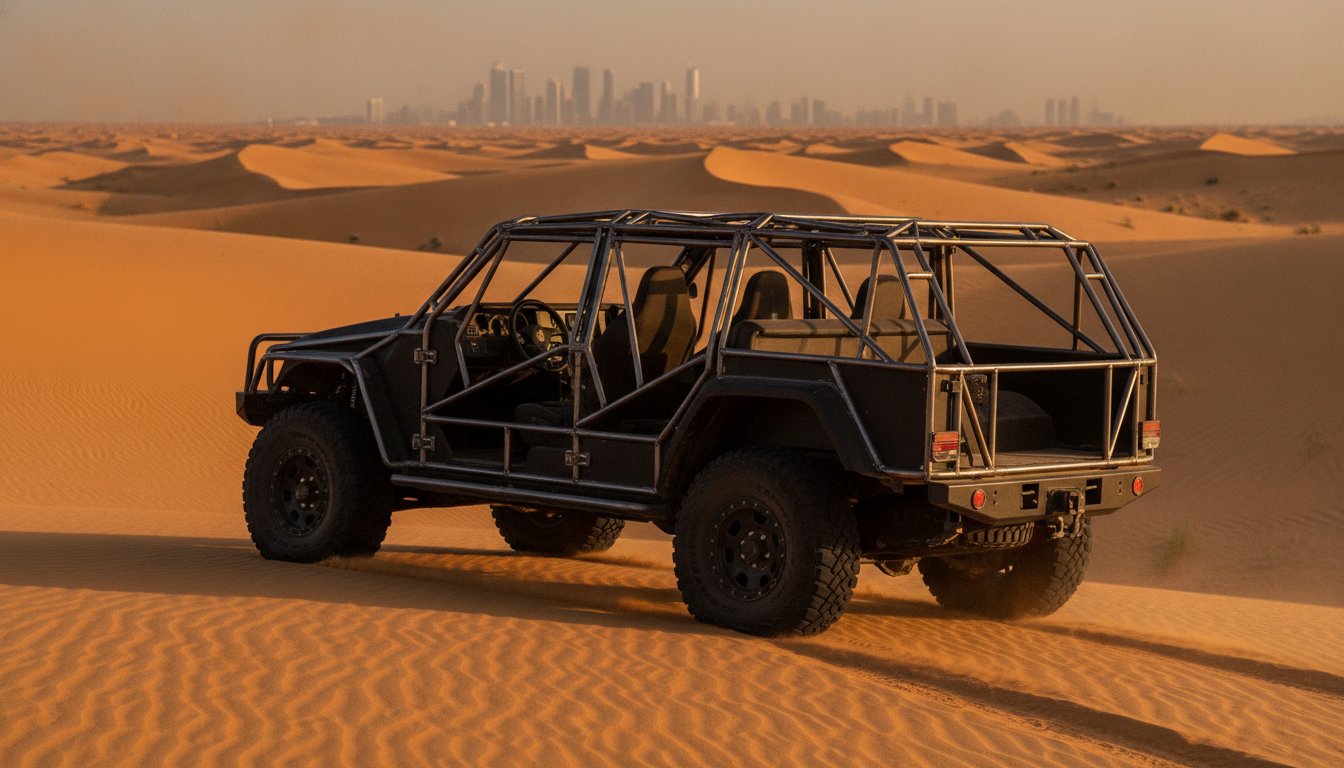
In the UAE's most unforgiving terrains, a roll cage isn't just a metal frame; it's the thin line between a controlled recovery and a mission-critical failure. For organizations relying on professional vehicle roll cage fabrication UAE, the stakes go far beyond simple aesthetics. You already know that extreme desert heat and high-impact off-road conditions demand more than just standard welding. Inconsistent quality from non-certified shops doesn't just risk a failed RTA inspection; it puts lives at stake when the environment turns hostile.
This guide breaks down the engineering precision and material standards required for industrial-grade fabrication in the region's most demanding environments. You'll learn how to ensure your fleet meets strict EMSO and MoIAT standards while maintaining long-term durability against material fatigue. From CNC pipe bending to certified structural safety, we provide the technical clarity needed to keep your mission-critical vehicles operational, compliant, and rugged enough for any challenge.
Key Takeaways
- Identify the structural engineering requirements necessary to protect occupants during high-speed emergency response and desert safari operations.
- Understand why mandrel bending is the only acceptable method for maintaining uniform wall thickness and preventing structural weak points in a roll cage.
- Compare high-performance materials like Cold Drawn Seamless (CDS) tubing and Chromoly to find the right balance for your vehicle roll cage fabrication UAE project.
- Explore custom fabrication solutions for mission-critical fleets, including specialized internal cages for military units and external exoskeletons for safari trucks.
- Learn how advanced CNC machining and 3D scanning ensure precision and consistency across bulk fleet orders for government and private sectors.
Industrial Roll Cage Fabrication in the UAE: Engineering for Mission-Critical Fleets
A roll cage is a specialized structural frame designed to prevent cabin collapse and protect occupants during a rollover event. In the UAE, the demand for professional vehicle roll cage fabrication UAE is driven by extreme environmental factors. High-speed highway transit, soft desert dunes, and heavy-duty off-road stress create a unique set of engineering challenges. For mission-critical fleets, a standard vehicle's roof pillars often lack the structural integrity to support the full weight of a loaded vehicle in a high-impact flip.
The industry has seen a massive shift from cosmetic, bolt-on accessories to fully integrated, engineered structural reinforcements. These Roll-Over Protection Systems (ROPS) are now considered essential for specialized vehicle conversions. Rather than being an afterthought, these cages are designed as part of the vehicle's core safety architecture. They distribute impact forces across the entire chassis, ensuring the survival cell remains intact under the most severe conditions.
To see the precision required in modern fabrication, watch this demonstration of a high-quality fitment:
Roll Cages for Emergency and Mission-Critical Vehicles
In a professional ambulance conversion, the roll cage serves a dual purpose. It must protect the medical personnel and patients while also securing heavy life-saving equipment that can become lethal projectiles during a crash. Engineering these units requires a master craftsman's touch to integrate the steel structure into the original vehicle chassis without compromising the interior medical space. We focus on low-profile, high-strength designs that ensure the vehicle remains agile during high-speed emergency responses while providing a rigid safety shell.
The Role of Fabrication in Fleet Safety
Off-the-shelf solutions frequently fail in heavy-duty UAE fleet applications because they don't account for the specific weight distributions of modified trucks. A functional safety cage is vastly different from a cosmetic bar. True vehicle roll cage fabrication UAE involves calculating the impact on the vehicle's center of gravity. If a cage is too heavy or poorly placed, it can actually increase the risk of a rollover by making the vehicle top-heavy. Our approach prioritizes:
- Structural Integration: Welding points that reinforce the factory chassis.
- Material Efficiency: Using high-tensile steel to maximize strength while minimizing weight.
- Handling Neutrality: Ensuring the added weight doesn't degrade the vehicle's off-road performance or braking distance.
For government and private fleets, consistent quality is non-negotiable. Every weld and every bend must meet industrial standards to ensure that when a rollover occurs, the equipment performs exactly as engineered. This level of reliability is what separates a certified safety solution from a generic workshop modification.
Essential Bending Techniques: The Mandrel Advantage for Structural Integrity
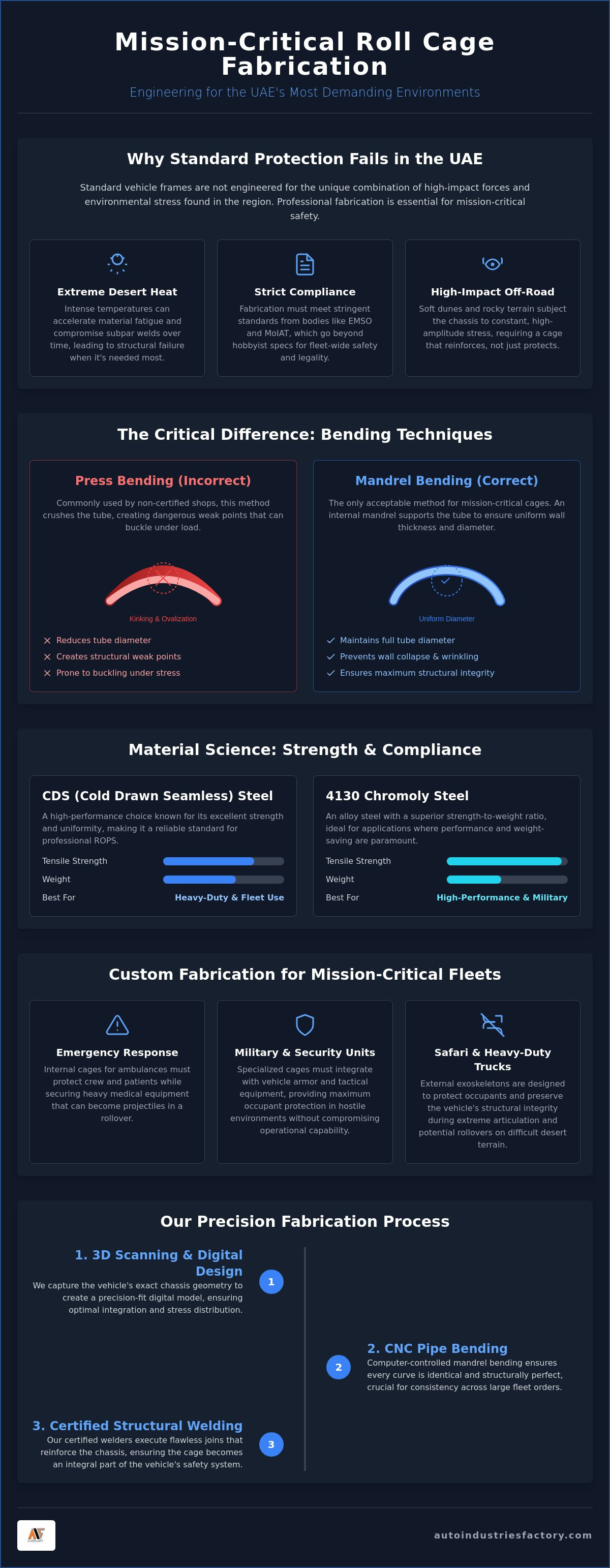
A roll cage is only as strong as its weakest bend. In the specialized field of vehicle roll cage fabrication UAE, the method used to shape steel tubing determines the ultimate safety of the vehicle. Most generic workshops use press bending, which effectively crushes the pipe to achieve a curve. This creates "ovalization" and kinking, reducing the tube's diameter and making it prone to buckling under stress. For mission-critical applications, we utilize mandrel bending to maintain the tube's original diameter and wall thickness throughout every curve.
Mandrel bending involves inserting a solid steel rod, or mandrel, inside the tube during the bending process. This internal support prevents the walls from collapsing or wrinkling. Adhering to these Official Engineering Standards ensures that every bend maintains its calculated load-bearing capacity. When a vehicle undergoes a rollover, the energy must be distributed evenly. A kinked bend acts as a pre-stressed failure point, whereas a mandrel-bent curve retains the structural integrity required to withstand massive impact forces. If you require high-precision components, our specialized bending services provide the technical foundation for these safety systems.
Maintaining Wall Thickness in High-Stress Curves
The physics of tube bending are unforgiving. As a tube curves, the material on the outside of the bend stretches while the inside compresses. Without precision control, the outer wall becomes dangerously thin and vulnerable to snapping. Mandrel bending is the industrial standard for preventing material thinning during fabrication. This is particularly vital in safari vehicle conversions where heavy roof loads and external exoskeletons place constant stress on the upper frame. By maintaining uniform wall thickness, we ensure the cage can support the vehicle's weight multiple times over without fracturing.
CNC Precision for National Fleet Scalability
For government and commercial entities, consistency across a fleet is a regulatory requirement. We use CNC pipe bending technology to translate digital CAD designs into physical reality with sub-millimeter precision. This eliminates the "trial and error" approach of manual fabrication. Every vehicle in a 100-unit fleet receives an identical cage that fits perfectly around specialized interiors and medical equipment. This digital-first approach reduces installation time on the factory floor and ensures that every driver in your fleet is protected by the exact same verified safety specification. There's no room for "close enough" when engineering for lives.
Material Science and UAE Compliance: Beyond FIA Standards
Choosing the right alloy is a critical engineering decision that dictates a vehicle's survival capacity. While international racing standards provide a baseline, vehicle roll cage fabrication UAE must account for thermal expansion and high-humidity oxidation unique to the Arabian Peninsula. Cold Drawn Seamless (CDS) tubing is our primary recommendation for mission-critical fleets. Unlike ERW (Electric Resistance Welded) pipes, CDS lacks a longitudinal seam, offering a uniform grain structure that resists splitting under extreme torsional stress. This material choice aligns with industrial ROPS Construction and Safety principles, ensuring the cage absorbs energy rather than fracturing.
The debate between Chromoly (4130) and Mild Steel often comes down to the specific mission profile. Chromoly offers a superior strength-to-weight ratio, allowing us to build lighter cages that don't compromise vehicle agility. However, it requires precise TIG welding and expert heat management to prevent brittleness. Mild steel remains a robust alternative for heavy-duty support vehicles where field repairability is a priority. Regardless of the alloy, the structural certification hinges on ASN-accredited welding. Every joint must be executed by certified professionals to ensure the cage functions as a single, unified safety cell during a rollover event.
Corrosion and Heat Resistance in the UAE
The UAE's environment is notoriously harsh on metalwork. Ambient temperatures frequently exceed 50°C, causing significant thermal cycling that can stress weld molecular structures over time. In the UAE's coastal regions, salt-laden humidity accelerates internal tube corrosion, which can weaken a cage from the inside out. We mitigate these risks through specialized post-fabrication treatments. For safari and off-road units, we utilize industrial powder coating or zinc-rich primers to create an impermeable barrier against the elements. These coatings are essential for maintaining structural integrity over a fleet's multi-year service life.
Certification and Technical Passports
Navigating the regulatory landscape is mandatory for road-legal operation in the Emirates. Obtaining an EMSO (Emirates Motorsports Organization) compliance sticker or a Technical Passport requires a transparent fabrication trail. This is especially critical for police vehicle modifications and government contracts where procurement standards demand verified material mill certificates. We provide full documentation for every build, including:
- Material Traceability: Verification of steel grade and origin.
- Weld Inspection Reports: Documentation of structural integrity.
- Design Compliance: Engineering drawings that meet RTA and MoIAT requirements.
Custom Applications: Safari Trucks, Military Units, and Heavy-Duty Support
Engineering for specialized fleets requires a departure from one-size-fits-all safety solutions. In the UAE, the diverse operational needs of safari operators, law enforcement, and military units demand a tailored approach to vehicle roll cage fabrication UAE. We don't just build frames; we engineer integrated protection systems that account for specific vehicle platforms like the Toyota Land Cruiser 70 series and heavy-duty Hilux variants. These platforms serve as the backbone for the region's most demanding industries, and their safety systems must be equally robust.
A unified safety frame often extends beyond the cabin. By connecting front-end bull bars and rear support racks directly to the main roll cage, we create a rigid exoskeleton that protects the vehicle's vital components. This holistic design ensures that impact energy from a front-end collision or a roof-load shift is distributed across the entire reinforced structure. This level of integration is essential for heavy-duty support vehicles that carry specialized equipment across high-stress desert environments.
Exoskeletons for Off-Road Safari Tours
Safari tour trucks require a unique balance of extreme safety and passenger visibility. For these applications, we favor external cages, or exoskeletons, which preserve interior cabin volume while providing a massive safety margin. We prioritize chassis-mounted roll cages over body-mounted versions for these fleets. Mounting directly to the chassis provides superior rigidity and prevents the bodywork from shearing off during a high-energy rollover. These structures are designed to incorporate custom canvas tops and reinforced seating, ensuring that the entire passenger environment is a secure, engineered cell.
Internal Cages for Tactical and Emergency Use
Tactical and emergency vehicles face a different set of constraints. Police patrol units and armored personnel carriers require low-profile internal cages that maximize interior volume for communication arrays, tactical gear, and medical equipment. We focus on reinforcing the pillars and roof lines without obstructing the driver's field of vision or the rapid deployment of personnel. These cages are often designed to support heavy roof-mounted arrays, ensuring the vehicle's structural integrity isn't compromised by its mission-critical payload. Explore our specialized vehicle conversion services to see how we integrate these safety systems into high-performance fleets.
Whether you are managing a fleet of desert safari trucks or tactical response units, your safety infrastructure must meet industrial engineering standards. Contact our team today to request a technical consultation for your next fleet modification project.
The Auto Industries Factory Process: Precision Fabrication in the UAE
At Auto Industries Factory LLC, we approach vehicle roll cage fabrication UAE as a discipline of high-level engineering rather than a mere mechanical task. Our process begins with high-fidelity 3D scanning of the vehicle's architecture. This digital data allows our engineers to create CAD models that account for every millimeter of space. By mapping the chassis in a virtual environment, we ensure that the finished roll cage integrates seamlessly with factory mounting points and interior equipment. This digital-first approach eliminates the guesswork and manual adjustments often found in smaller, non-certified workshops.
We embrace a "Master Craftsman" philosophy that bridges the gap between advanced technology and human expertise. While our CNC pipe bending machinery handles the repeatability required for bulk fleet orders, every critical joint is finished with expert hand-welding. Our certified welders specialize in high-tensile alloys, ensuring that each weld bead provides maximum penetration and structural strength. This combination of robotic accuracy and manual oversight is what defines our capability to deliver mission-critical safety solutions for the region's most demanding industries.
Quality control is integrated into every stage of the fabrication cycle. We don't rely solely on visual checks. For our most high-stakes military and medical projects, we employ ultrasonic testing to verify the internal integrity of our welds. This non-destructive testing ensures there are no hidden inclusions or weak points that could fail under the stress of a high-speed rollover. Every joint is a promise of protection. Our comprehensive service model covers the entire lifecycle of the build, from the initial laser cut to final industrial painting and vehicle integration.
From Design to Deployment
The journey starts with a technical consultation to define your mission-specific safety requirements. Whether it's an ambulance needing internal reinforcement or a safari truck requiring an exoskeleton, we tailor the design to the vehicle's specific operational profile. Our Ajman-based facility houses precision laser cutting and CNC bending equipment to maintain zero-tolerance fitment across every component. After assembly, each unit undergoes a multi-stage painting process using industrial-grade coatings designed to withstand the UAE's high-UV environment. This end-to-end control ensures the final product is ready for immediate deployment into active service.
National Fleet Support and Reliability
Scale is a core part of our operational identity. We're equipped to handle large-scale fleet conversions for both government and private sectors without compromising individual unit quality. Our facility is designed for high-volume throughput, ensuring your 50th vehicle is as structurally sound as the first. Learn more about our team and commitment to quality to understand why we're the trusted partner for regional fleet safety. Our engineers are available for direct technical consultations to provide custom fabrication quotes that meet your specific regulatory and operational needs. We don't just provide products; we deliver engineered safety solutions built for the long haul.
Secure Your Fleet with Engineered Structural Integrity
Engineering a roll cage for a professional fleet is a high-stakes investment in occupant survival. You've seen how mandrel bending preserves structural integrity and why material selection must account for the UAE's extreme thermal stress. From 3D scanning to certified welding, every step in the process ensures your vehicles meet strict EMSO and MoIAT standards. Relying on specialized vehicle roll cage fabrication UAE is the only way to guarantee that your safari trucks, ambulances, and tactical units perform exactly as engineered when they're needed most. For fleet owners who are also managing property assets in the region, Credit Link provides the financial expertise needed to secure mortgages in Dubai efficiently.
Auto Industries Factory LLC brings master craftsmanship to every project. We utilize advanced in-house CNC bending and laser cutting technology to achieve zero-tolerance fitment on high-performance platforms like Toyota and GMC. Our full-service approach includes everything from precision fabrication and certified welding to industrial painting. Don't leave your fleet's safety to chance. Choose a partner that prioritizes engineering precision over cosmetic additions.
Request a Technical Consultation for Your Fleet Fabrication Project today. We're ready to help you build a safer, more resilient fleet for the toughest environments in the Emirates.
Frequently Asked Questions
What is the difference between a roll bar and a full roll cage?
A roll bar consists of a single structural hoop behind the front seats, providing basic protection against roof collapse. A full roll cage is a comprehensive, interconnected frame that reinforces the entire cabin, including the pillars and roof line. For mission-critical fleets, we recommend full cages because they create a complete safety cell that protects occupants from side-impact intrusion and multi-point rollovers.
Does fitting a roll cage make a vehicle road-legal in the UAE?
Road legality depends on receiving approval from the Ministry of Industry and Advanced Technology (MoIAT) and the RTA. In the UAE, full roll cages are typically permitted for commercial safari vehicles, emergency units, and military fleets with a valid technical passport. Standard passenger cars may require a "half cage" configuration to pass inspection unless they have specific commercial or motorsport exemptions.
Why is Mandrel bending preferred over press bending for roll cages?
Mandrel bending uses an internal support to maintain the tube's diameter and wall thickness throughout the curve, preventing the pipe from crushing or kinking. Press bending often creates structural weak points by thinning the outer wall of the bend. When performing vehicle roll cage fabrication UAE, we use mandrel bending to ensure every curve retains its full engineered strength to withstand high-impact forces.
What materials are best for heavy-duty safari vehicle roll cages?
Cold Drawn Seamless (CDS) tubing and Chromoly (4130) are the superior choices for safari applications due to their high strength-to-weight ratios. CDS is valued for its uniform grain structure and resistance to splitting under stress. Chromoly is often used for high-performance builds because it provides extreme durability while keeping the vehicle's center of gravity low, which is vital for top-heavy safari trucks.
How much weight does a typical roll cage add to a specialized vehicle?
A professionally fabricated roll cage typically adds between 40kg and 100kg to the vehicle's total mass, depending on the design complexity and material choice. We prioritize high-tensile alloys to keep this weight as low as possible. Our engineers calculate the impact of this added mass to ensure the vehicle's braking, handling, and suspension performance remain within safe operational limits for off-road use.
Can a roll cage be integrated into an existing ambulance conversion?
Yes, we can integrate roll cages into existing conversions using 3D scanning to map the interior medical space precisely. This allows us to design a low-profile reinforcement that fits around oxygen tanks and medical cabinets without obstructing the paramedics. This integration is a vital safety upgrade for ambulances that frequently operate at high speeds or in challenging regional terrains.
What is EMSO certification and why does my fleet need it?
EMSO certification is a technical validation from the Emirates Motorsport Organisation proving the cage meets international safety and engineering standards. For specialized fleets, this certification is often a prerequisite for obtaining a Technical Passport and final RTA registration. It guarantees that your vehicle roll cage fabrication UAE was executed by a certified facility using verified materials and welding protocols.
How do you ensure weld integrity in high-vibration off-road environments?
We ensure integrity through certified welding and non-destructive ultrasonic testing to identify internal flaws that visual inspections might miss. In high-vibration environments, we utilize precision gusseting at every joint to distribute stress across a larger surface area. This prevents the fatigue cracking that often occurs in inferior, non-certified cages when subjected to the constant rattling of desert dunes.


