
A true APC vehicle conversion is far more than just bolting steel plates to a chassis. It is a total structural re-engineering project that transforms a vehicle's DNA for survival. You already understand that mission success depends on a precise balance between impenetrable protection and operational mobility. Choosing between BR6 and BR7 standards or worrying about how 1,500 pounds of ballistic steel will affect your suspension are critical concerns when lives are on the line. You need a vehicle that doesn't just stop a round but remains agile enough to exit the kill zone.
This guide provides a professional deep dive into the engineering, ballistic standards, and advanced fabrication processes required to convert standard platforms into mission-ready Armoured Personnel Carriers. We will explore the technical differences in ballistic materials, the necessity of reinforced powertrains, and how to identify a fabrication partner in the UAE capable of delivering elite-tier protection. Whether you're managing a private security fleet or specialized government units, you'll gain the clarity needed to ensure your fleet is built for the highest stakes.
Key Takeaways
- Learn the technical distinctions between basic armoring and a full-scale APC vehicle conversion designed for high-risk troop transport and medical evacuation.
- Understand how high-grade ballistic steel and advanced composite materials are integrated using overlapping techniques to eliminate vulnerable gaps in the armor.
- Identify why the Toyota Land Cruiser and GMC platforms are the preferred chassis for rugged UAE environments and mission-critical reliability.
- Explore the precision fabrication process, from complete vehicle teardown to 3D digital templating, ensuring structural integrity under extreme stress.
- Discover how to customize your fleet for specialized roles such as mobile command centers or riot control units with reinforced bull bars and brush guards.
Defining Professional APC Vehicle Conversion Standards
Professional APC vehicle conversion is an exhaustive re-engineering process that separates a tactical asset from a basic armoured civilian vehicle. While a standard armoured car focuses on low-profile protection for urban environments, an Armoured Personnel Carrier (APC) is engineered for high-intensity mission profiles. These include front-line troop transport, rapid medical evacuation, and mobile command centers. Unlike aftermarket bolt-on kits that merely add weight, a professional conversion integrates the armour into the vehicle's structural skeleton for maximum tactical longevity.
Relying on a master craftsman is essential for ensuring ballistic integrity. Every weld point and seam represents a potential vulnerability if not handled by experts. Our factory utilizes in-house CNC machining and laser cutting to ensure that ballistic plates fit with zero-tolerance precision. This meticulous fabrication creates a continuous protective capsule. It prevents ballistic gaps, which are common in lower-quality modifications where plates don't properly overlap at pillars and door frames.
Tactical Requirements for Modern APCs
Modern tactical units demand more than just bullet resistance. High-stakes environments require specific engineering choices to ensure occupant survival and mission efficiency. We focus on these core tactical pillars:
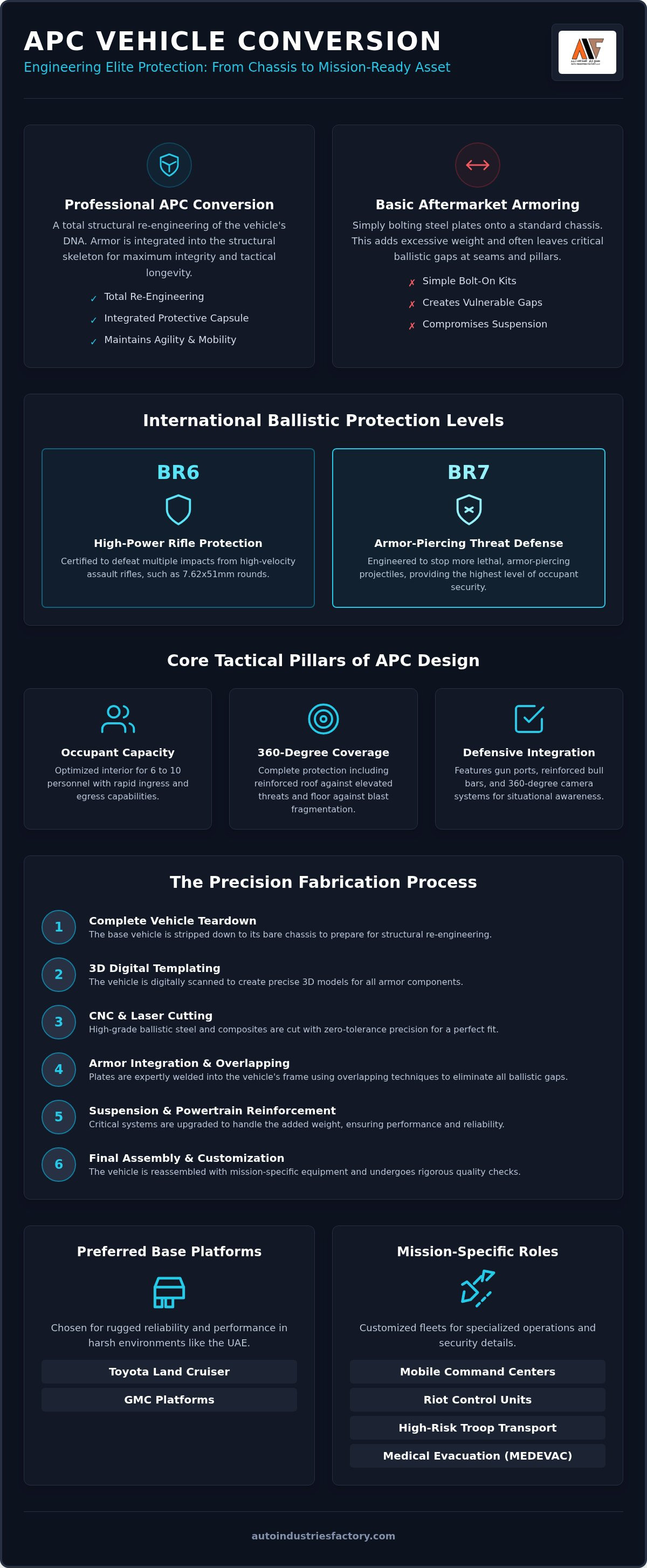
- Occupant Capacity: Converting platforms like the Toyota Land Cruiser or GMC requires optimizing the interior for 6 to 10 personnel without compromising ingress or egress speeds.
- 360-Degree Coverage: Protection isn't limited to the sides. It must include the roof against elevated threats and the floor against fragmentation.
- Defensive Integration: Effective units feature gun ports, heavy-duty brush guards, and advanced situational awareness tools like 360-degree camera systems.
International Protection Standards
In the UAE, security fleets typically operate under rigorous international ballistic standards. Professional APC vehicle conversion usually targets BR6 or BR7 levels. BR6 provides protection against 7.62x51mm rifle rounds. BR7 is designed to stop more lethal armor-piercing threats. We ensure every build meets these specific requirements through structural reinforcement and high-grade materials.
Blast protection is equally critical. A mission-ready vehicle must withstand floor-level threats from grenades or light explosives. We prioritize the use of certified ballistic steel and transparent armour. Certification isn't just paperwork; it's the guarantee that every plate and glass panel has been tested to survive the specific threats your team faces. Using unverified materials is a risk no professional organization can afford to take.
Engineering Ballistic Protection: Materials and Armouring Levels
Engineering a superior APC vehicle conversion requires a deep understanding of material science. We utilize high-grade ballistic steel that offers extreme hardness and energy absorption. For high-threat environments, we integrate advanced composite materials like aramid or ceramic tiles. These materials provide equivalent protection to steel at a fraction of the weight. This weight reduction is vital for maintaining vehicle performance during pursuit or extraction.
Ballistic integrity fails if there's a single gap. We employ a sophisticated 'overlapping' technique to eliminate these risks. This involves installing ballistic steel splash guards behind every door seam, pillar, and window frame. If a projectile strikes a seam, the overlap catches the round or fragmentation. It ensures no direct line of sight exists into the cabin, maintaining a sealed protective environment.
Visibility is as critical as protection. Transparent armour consists of multi-layered ballistic glass bonded with specialized polycarbonate interlayers. This construction prevents spalling, where glass shards fly inward upon impact. We ensure optical clarity remains high so drivers can navigate safely under duress. Protection also extends below the vehicle. Our floor strategies involve specialized plating designed to deflect blasts from grenades and anti-personnel mines, creating a survival cell that shields occupants from upward-moving fragmentation.
High-Precision Fabrication Techniques
Precision is non-negotiable in armoured builds. Our factory uses in-house laser cutting to produce seamless armour plates that fit perfectly within the vehicle's original frame. CNC machining allows us to manufacture custom, heavy-duty hinges that support the immense weight of armoured doors without sagging over time. Crucially, our welding protocols follow strict heat-management standards. This prevents the ballistic steel from losing its temper, which would otherwise create soft spots in the protection.
Weight Management and Structural Integrity
Adding thousands of kilograms of armour changes a vehicle's physics. We precisely calculate the impact on the center of gravity to prevent rollover risks during high-speed maneuvers. Over-armouring a chassis without proper engineering leads to catastrophic mechanical failure of the axles and brakes. To combat this, we implement specialized vehicle conversion solutions that balance lightweight composites with heavy plating. This ensures the unit remains agile enough for tactical roles while maintaining its full ballistic rating.
Selecting the Right Base Platform for APC Conversion
The foundation of any successful APC vehicle conversion starts with the chassis. Selecting a platform that can sustain the massive weight of ballistic steel without sacrificing reliability is the first engineering challenge. The Toyota Land Cruiser, specifically the LC70 and LC300 series, remains the undisputed industry gold standard. These platforms offer unparalleled durability and a global parts network that ensures mission continuity even in remote regions. Their robust frames allow for significant structural reinforcement without compromising the vehicle's core integrity.
For patrol and light transport roles, the Toyota Hilux and GMC platforms provide necessary versatility. These vehicles offer high payload capacities and excellent off-road performance. When evaluating a base unit, torque is the most critical metric. An armoured vehicle is significantly heavier than its civilian counterpart. High low-end torque is required to move the ballistic mass from a standstill efficiently. Additionally, we assess factory cooling systems. Standard radiators often fail under the combined stress of high weight and the extreme heat found across the UAE national landscape.
Utilizing commercially available base units offers significant advantages for fleet commonality. It reduces long-term maintenance costs because parts are easily sourced through standard supply chains. This approach allows security and defense agencies to maintain their fleets without relying on proprietary, military-only components. Our specialized vehicle modification services ensure these commercial platforms are ruggedized to meet the most demanding mission profiles.
Chassis and Suspension Reinforcement
A standard factory suspension will collapse under a ballistic payload. We replace every component with heavy-duty systems specifically rated for the increased Gross Vehicle Weight (GVW). This includes reinforced coil springs, heavy-duty shock absorbers, and strengthened axle housings. Braking systems also require a total overhaul. We install high-performance rotors and calipers to ensure the vehicle can stop reliably during tactical driving. Mission continuity is further secured by run-flat tire systems, allowing the unit to travel up to 50km after a total pressure loss.
Mechanical Upgrades for Harsh Environments
National climate conditions demand enhanced cooling kits to prevent engine overheating during prolonged stationary idling or high-speed extractions. We also integrate heavy-duty electrical systems. Modern tactical units require significant power for communication arrays and situational awareness tools. Finally, we reinforce the structural pillars. Since a professional APC vehicle conversion results in doors weighing over 100kg, we fabricate custom, oversized hinges. These prevent the door from dropping, ensuring it always closes and seals perfectly against the ballistic frame.
The Fabrication Process: From Standard Chassis to Armoured Unit
Transforming a civilian platform into a tactical asset is a multi-phase engineering undertaking. A professional APC vehicle conversion begins with a complete vehicle teardown. Every interior component, window, and trim piece is removed until only the bare chassis remains. We perform a baseline structural assessment to ensure the frame is free of defects before adding ballistic weight. This ensures the foundation is strong enough to support the upcoming modifications.
Once the chassis is cleared, we move to 3D design and digital templating. Our engineers create a digital armour capsule that fits perfectly within the vehicle's body lines. This precision allows for the in-house cutting and shaping of ballistic materials using CNC laser technology. We then integrate this armour capsule, welding it directly to the reinforced structure to create a unified survival cell. The final phase involves assembly, where we upfit the interior for mission-specific roles and apply high-durability tactical painting designed for national desert environments.
In-House Design and Engineering
Precision is the hallmark of a master craftsman. We use advanced CAD/CAM software to ensure every ballistic plate fits with zero tolerance. This level of detail prevents the shingling effect where plates are forced to fit, which compromises protection. Our design process allows us to customize the interior layout based on your mission profile. We can configure the cabin for specialized troop seating or integrate life-saving medical equipment for ambulance roles. Learn more about our conversion process to see how we maintain structural integrity during these modifications.
Quality Control and Testing
Adding armour significantly impacts the base vehicle's mechanical integrity. We address this through rigorous quality control that goes beyond visual checks. Every weld joint undergoes inspection, including ultrasonic testing to detect internal flaws that might fail under ballistic impact. We also perform mechanical stress testing on the upgraded drivetrain. This ensures the engine, transmission, and axles can handle the increased payload in high-stress environments. Our goal is to deliver a build that meets your specific mission-critical requirements without the risk of mechanical breakdown. If you need a reliable fleet, request a technical consultation for your next armoured project.
Mission-Specific Customization for Defense and Security Fleets
A successful APC vehicle conversion doesn't end with ballistic plating. The final stage involves integrating secondary systems that define the vehicle's operational role. For riot control applications, this includes installing high-intensity tactical lighting, sirens, and specialized mesh guards for windows. Mobile command centers require a different approach, focusing on internal power management for communication arrays and satellite links. We ensure these systems are integrated without compromising the armour capsule's integrity.
Physical durability is enhanced through custom-fabricated hardware. We manufacture heavy-duty bull bars and brush guards designed for obstacle clearance and ramming capability. These components are welded directly to the reinforced chassis to withstand extreme impacts. For logistical support and border patrol, we provide external storage solutions like heavy-duty roof racks and bespoke metal canopies. These additions allow teams to carry mission-essential gear while keeping the internal cabin clear for personnel.
Medical and Rescue APC Conversions
In high-risk extraction scenarios, a standard ambulance is a liability. We engineer armoured ambulances that function as a protected ballistic shell for both medical staff and patients. This process involves more than just interior padding. We integrate oxygen supply systems, defibrillator mounts, and trauma lighting into the reinforced walls. These Professional ambulance conversion solutions ensure that life-support remains functional even under direct fire, providing a mobile sanctuary for emergency medical teams.
Off-Road and Tactical Mobility
Rugged terrain requires specific modifications to maintain the mobility established during the initial APC vehicle conversion. Border patrol and safari roles often demand extreme off-road capability. We equip these units with snorkels for deep-water fording, heavy-duty winches for self-recovery, and comprehensive underbody protection to shield the drivetrain from rocks and debris. The Toyota LC70 remains the preferred platform for these roles due to its mechanical simplicity and legendary durability in national desert conditions. For more on preparing vehicles for harsh environments, see the ultimate guide to safari vehicle conversions.
Engineering Your Mission-Ready Fleet
Professional armouring is a complete structural re-engineering project. You now understand that success depends on a precise balance between impenetrable protection and mechanical mobility. By selecting robust platforms like the Land Cruiser and utilizing in-house CNC machining, you ensure your tactical assets can withstand extreme stress. Every overlap and weld point is a critical link in the chain of survival. These engineering choices determine whether a vehicle merely carries armour or truly protects its occupants.
Achieving a professional APC vehicle conversion requires the hands of a master craftsman. Our factory provides full structural and ballistic engineering, supported by high-precision laser cutting and specialized military expertise. We focus on delivering rugged, UAE-engineered builds that empower your team to operate with total confidence in high-risk zones. Whether you're managing a security fleet or specialized police units, we provide the technical capability to meet your most demanding mission profiles.
Request a Technical Consultation for Your APC Conversion Project to begin your build. We're here to help you deploy a fleet that never compromises on safety or performance.
Frequently Asked Questions
What is the difference between a standard armoured car and an APC conversion?
An APC conversion focuses on tactical troop transport and high-intensity mission profiles. While a standard armoured car is often a low-profile VIP vehicle, an APC requires structural survival cells, higher occupant capacity, and integrated defensive systems like gun ports. These units are engineered for tactical longevity in combat or riot control environments. They prioritize structural integrity and specialized utility over the aesthetics common in executive armoured vehicles.
Which base vehicles are best suited for APC conversion?
The Toyota Land Cruiser LC70 and LC300 series are the industry gold standards for APC builds. Their robust frames allow for significant structural reinforcement while maintaining mechanical reliability. Other high-performance platforms include the Toyota Hilux and GMC trucks, which offer the high torque and payload capacity necessary for heavy ballistic loads. We select these platforms specifically for their durability in the harsh UAE national climate and their global parts availability.
How does the added weight of armour affect vehicle performance?
Adding 600 to 1,500 pounds of ballistic steel shifts the center of gravity and increases stress on the drivetrain. Without professional engineering, this leads to slower acceleration and longer braking distances. We mitigate these effects by installing heavy-duty suspension systems, reinforced axle housings, and high-performance braking kits. This ensures the unit remains agile and safe during high-speed extractions or tactical maneuvers, preventing the mechanical failure often seen in under-engineered conversions.
What ballistic protection levels are available for professional conversions?
Professional conversions typically target BR6 or BR7 ballistic standards. BR6 protection is engineered to stop 7.62x51mm rifle rounds, while BR7 is designed for armor-piercing threats. Every APC vehicle conversion we perform utilizes certified ballistic steel and multi-layered transparent armour. We also implement floor protection strategies to shield occupants from fragmentation caused by grenades or light anti-personnel mines, ensuring a complete survival cell for high-risk operations.
Can an existing fleet vehicle be retrofitted into an APC?
Existing fleet vehicles can be retrofitted if the chassis is structurally sound and capable of supporting the increased Gross Vehicle Weight. We perform a complete teardown and baseline structural assessment before any modification begins. If the platform meets our engineering requirements, we integrate a custom-designed armour capsule and upgrade the mechanical systems. This process ensures the older unit meets modern tactical requirements and provides the same level of protection as a new build.
What maintenance is required for a converted armoured personnel carrier?
Maintenance for a converted unit is more intensive than for a standard vehicle because it constantly operates at its maximum weight limit. Regular inspections of the heavy-duty suspension, brake pads, and door hinges are mandatory to prevent wear-related failures. We recommend frequent checks of the cooling system and drivetrain components, as they operate under higher thermal stress. Using commercially available base units helps keep these specialized maintenance costs manageable for large fleets.
Are run-flat tires mandatory for APC vehicle conversions?
Run-flat tire systems are essential for mission continuity and occupant safety in tactical environments. These systems allow the vehicle to travel up to 50km at reduced speeds even after a total loss of tire pressure from ballistic impact. In high-risk zones, the ability to exit a kill zone without stopping for a tire change is critical. We integrate these systems as a standard requirement for units operating in hostile or remote areas.
How long does a typical professional APC conversion take?
The timeline for a professional APC vehicle conversion varies based on the level of protection and mission-specific customization required. A standard build involving teardown, 3D templating, laser cutting, and final assembly usually takes several weeks to complete. Complex customizations for armoured ambulances or mobile command centers may extend this duration. We provide specific lead times after a technical consultation and a baseline assessment of your specific fleet requirements.


