Did you know that the European EN 1789 standard requires ambulance interiors to survive a "Sledge Test" where medical equipment must withstand a 10G crash impact? In the high-stakes world of emergency response, you already know that a vehicle's structural integrity is just as critical as the life-saving gear it carries. Choosing between various ambulance conversion companies in UAE becomes a matter of engineering precision when you consider the harsh regional climate and the rigorous demands of 24/7 operations.
We'll help you navigate the complexities of specialized vehicle fabrication to ensure your fleet remains mission-ready and fully compliant with the latest UAE regulations. You'll discover the engineering benchmarks required for rugged performance, from the new Federal Authority for Ambulance and Civil Defense policies to specific GCC GSO 963 standards. We provide a clear breakdown of the most reliable vehicle platforms, including the Toyota Hiace and GMC Savana, alongside the critical selection criteria for choosing a manufacturing partner that offers long-term technical support. This guide ensures your investment results in a durable, high-performance ambulance fleet that protects both patients and providers.
Key Takeaways
- Master the technical benchmarks of EN 1789 and GSO 963 standards to ensure your medical fleet meets critical structural integrity and crash-safety requirements.
- Compare the performance profiles of the Toyota Hiace, GMC Savana, and custom box-type conversions to select the ideal platform for your specific mission requirements.
- Identify essential criteria for vetting ambulance conversion companies in UAE, focusing on in-house fabrication capabilities and technical compliance with local health authorities.
- Understand why in-house CNC machining and precision metalwork are non-negotiable for long-term vehicle durability and reducing costly fleet downtime.
- Navigate the evolving regulatory landscape, including new federal policies and emirate-specific standards for ambulance licensing and specialized equipment.
The Landscape of Ambulance Manufacturing Companies in the UAE
Local manufacturing serves as the backbone of the United Arab Emirates' rapidly expanding healthcare infrastructure. It's no longer enough to import generic medical vehicles; the regional demand for rapid response requires a sophisticated transition from standard commercial vans to specialized, life-saving units. Leading ambulance conversion companies in UAE provide the technical expertise necessary to strip a base vehicle to its chassis and rebuild it with the structural integrity required for high-intensity emergency work.
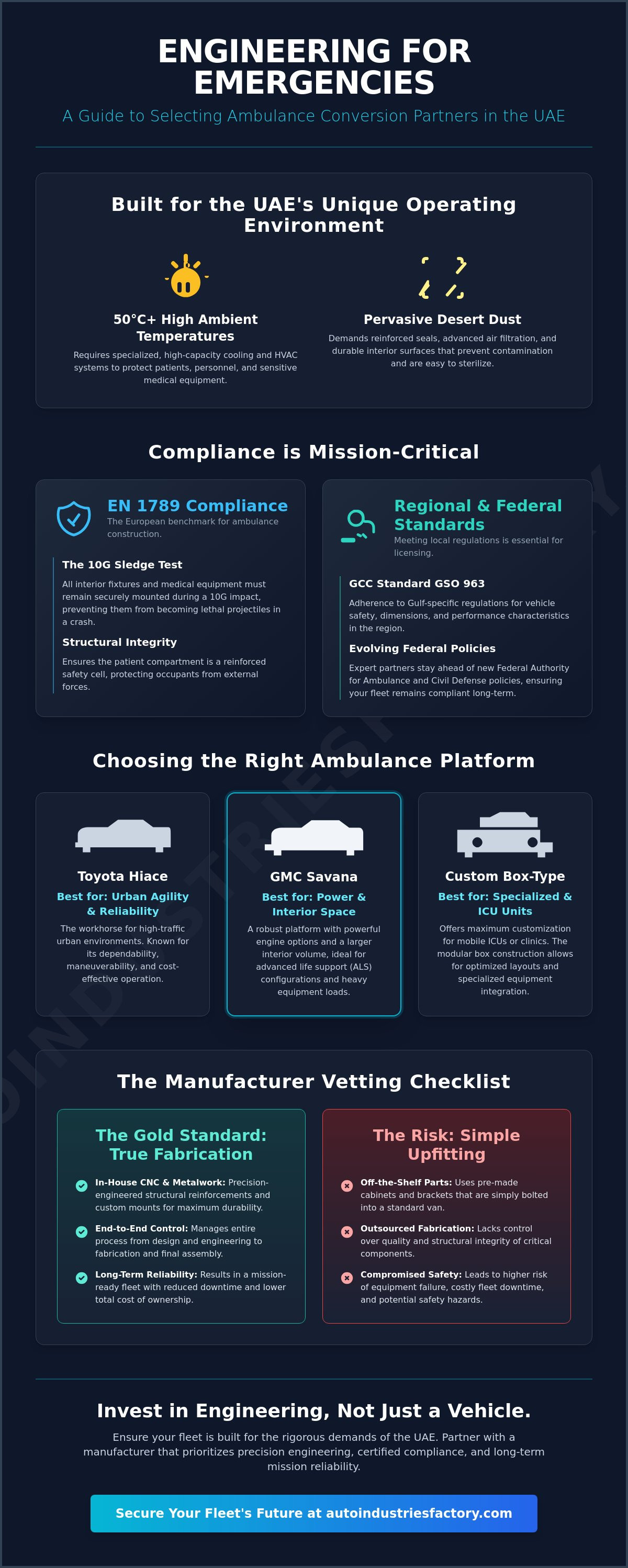
National expertise is vital for meeting the UAE’s unique environmental and regulatory demands. High ambient temperatures exceeding 50°C and pervasive desert dust require specialized cooling systems and reinforced seals that standard international models often lack. Local manufacturers understand these variables. They ensure every build complies with the specific requirements of regional health authorities and regulatory bodies, while preparing for the centralized standards of the upcoming Federal Authority for Ambulance and Civil Defense.
To better understand the level of detail involved in these transformations, watch this helpful video:
There is a sharp distinction between simple upfitting and comprehensive vehicle fabrication. Upfitting involves installing pre-made cabinets and brackets into a van. True manufacturing involves structural metalwork, CNC precision cutting, and custom electrical engineering. When you partner with experienced ambulance conversion companies in UAE, you aren't just buying a vehicle; you're investing in a mobile medical environment engineered for durability and hygiene.
Defining Excellence in UAE Vehicle Conversion
A top-tier manufacturing partner manages the entire lifecycle of the build in-house. This end-to-end control starts with the initial engineering design and continues through metal fabrication, medical-grade cabinetry installation, and final automotive paint. Adherence to EN 1789 Compliance ensures that every interior component is crash-tested and ergonomically optimized for paramedic workflows. Ambulance manufacturing is a fusion of automotive engineering and medical compliance.
Mission-Critical Reliability in Emergency Response
Fabrication quality isn't just a technical metric; it directly impacts patient outcomes. A poorly secured oxygen rack or a failing electrical inverter can have catastrophic consequences during a high-speed transport. High-utilization emergency fleets require ruggedness that only expert metalwork can provide. By utilizing specialized services, fleet managers secure mission-specific solutions ranging from box-type ICU units to extended-roof Toyota and GMC platforms. This level of precision ensures that your vehicles stay on the road, minimizing downtime and maximizing life-saving potential.
Technical Standards and EN 1789 Compliance in Vehicle Conversion
Emergency response demands more than a fast engine. It requires a vehicle that acts as a fortress for both patients and staff. Elite ambulance conversion companies in UAE treat the EN 1789 standard as the baseline, not the ceiling. This European benchmark dictates every technical aspect of the build, from the rate of air exchange in the patient cabin to the exact force a cabinet latch must withstand during a collision. Without these certifications, a vehicle is simply a van with lights; with them, it's a mobile life-support environment.
Structural integrity is the most critical pillar of EN 1789. The "Sledge Test" requires that all interior fixtures and medical equipment remain secured during a 10G impact. This means the metalwork behind the medical-grade cabinetry must be reinforced with precision-engineered mounting points. Hygiene is equally vital. Surfaces must be non-porous and resistant to aggressive disinfectants. We use seamless interior lining and antimicrobial materials to prevent bio-contamination in hard-to-reach corners, ensuring the vehicle remains a sterile environment for every mission.
Electrical system integrity is another non-negotiable factor. Modern ambulances are mobile power plants that run ventilators, monitors, and suction units simultaneously. Specialized wiring looms, separate from the original manufacturer's harness, are essential to prevent electrical interference and ensure 100% uptime. Failure to meet these technical specifications results in more than just mechanical risk. National health authorities, including the Abu Dhabi Department of Health (DoH) standards, mandate verified compliance before any vehicle is licensed for operation. To ensure your fleet meets these rigorous benchmarks, you can explore our comprehensive conversion services designed for maximum reliability.
Ambulance Categories: Type I, II, and III
Understanding vehicle categories helps fleet managers match the right tool to the mission. Type I ambulances utilize a truck-based chassis, such as a Ford F-350, with a modular box body to provide maximum space for bariatric or complex ICU equipment. Type II ambulances are the agile workhorses of urban response, built on standard van platforms like the Toyota Hiace for rapid navigation through traffic. Type III ambulances offer a specialty hybrid, featuring integrated modular bodies on a cutaway van chassis that allows for a seamless walk-through from the driver’s cabin to the patient area.
Advanced Medical System Integration
Workflow efficiency is the product of smart engineering. Oxygen delivery systems and suction units must be positioned within the paramedic's primary reach to ensure they never have to unbuckle their harness during transit. Mounting systems for heavy monitors and stretchers must be precision-milled to lock instantly and release without friction. For a deeper look at the engineering behind these specialized builds, read our Ambulance Conversion Guide for more details on professional medical vehicle fabrication.
Comparing Base Platforms: Toyota, GMC, and Custom Box-Type Solutions
Selecting the right vehicle chassis is the first critical decision in the engineering process. The base platform determines the vehicle's payload capacity, interior volume, and long-term mechanical reliability under the UAE's extreme operating conditions. Leading ambulance conversion companies in UAE prioritize high-performance platforms that can withstand the weight of medical-grade cabinetry, oxygen systems, and advanced life support equipment without compromising road stability or response times.
The Toyota Hiace remains the undisputed workhorse for urban ambulance fleets. Its reputation for mechanical simplicity and low maintenance makes it ideal for high-mileage city response. For missions requiring more interior workspace, the GMC Savana and Chevrolet Express platforms offer superior torque and a wider footprint. These American-made chassis are the preferred choice for extended roof ambulance builds, providing paramedics with the vertical clearance necessary to perform life-saving procedures while standing.
Remote area response and off-road industrial sites require a different engineering approach. The Toyota Land Cruiser LC78 and Hilux are the gold standard for desert-ready medical units. These platforms undergo significant suspension and cooling system upgrades to handle the rugged terrain and high heat of the UAE's oil and gas fields or rural regions. Every chassis must meet the GCC Technical Benchmarks to ensure it meets regional safety and performance standards before the conversion process begins.
Extended Roof and Box Type Configurations
Extended roof ambulances on GMC or Toyota platforms are specifically engineered for critical care. By increasing the roof height, we create an ergonomic environment where paramedics can move freely. In contrast, the box type ambulance utilizes a modular body mounted on a cutaway chassis. This configuration offers maximum interior square footage and perfectly square walls, making it the superior choice for long-distance patient transport and mobile intensive care units that require heavy diagnostic equipment.
Platform Selection for Diverse UAE Terrains
Matching vehicle power to the environment is essential for fleet longevity. Urban units focus on agility and braking performance for stop-and-go traffic. Desert units require reinforced underbodies and specialized filtration to prevent sand ingestion. We apply the same rugged engineering principles used in our Safari Vehicle Conversions to ensure ambulance chassis can handle extreme heat and shifting dunes. This level of durability ensures your medical fleet remains operational regardless of the geographical challenges.
Evaluating Fabrication Capabilities: In-House vs. Outsourced Manufacturing
Many ambulance conversion companies in UAE operate as simple assembly points for imported kits, but true engineering excellence requires a master craftsman approach where every component is produced on-site. Controlling the fabrication process from raw structural steel, often sourced from reliable regional suppliers like JABAL AL NOOR Steel, to final medical-grade cabinetry ensures the vehicle’s interior is physically integrated with the chassis. When manufacturing is outsourced, you lose the ability to verify the quality of hidden welds and the structural integrity of internal mounting points.
In-house laser cutting and CNC machining provide the precision that manual cutting simply can't replicate. When mounting heavy medical equipment, the fitment must be perfect to eliminate vibration and structural fatigue over years of high-intensity service. Precision welding and structural reinforcement are critical for heavy-duty units operating in high-stress environments, ensuring the cabin remains a rigid, safe shell during emergency maneuvers.
Controlling the supply chain also allows for the selection of superior materials specifically for the UAE's high humidity and salinity. Professional vehicle painting and specialized protective coatings are applied in-house to safeguard against premature corrosion. This comprehensive control over the manufacturing cycle directly impacts fleet longevity. If you're looking for a partner that prioritizes technical precision, contact us for expert vehicle conversion solutions today.
The Engineering Advantage of Custom Fabrication
Custom fabrication provides a distinct edge for specialized medical units. CNC machining ensures that custom medical racks fit the unique contours of the vehicle perfectly, maximizing every square centimeter of cabin space. Laser cutting allows us to create interior components that are both lightweight and exceptionally strong, improving the vehicle's power-to-weight ratio. Because the entire design process is handled by Auto Industries Factory LLC, we eliminate third-party delays, leading to faster turnaround times for complex custom orders.
Quality Control and Durability Testing
Durability testing is a non-negotiable phase of our manufacturing cycle. Every electrical harness and mechanical latch undergoes stress testing to ensure it survives the relentless duty cycle of an emergency vehicle. We implement strict protocols for material selection, focusing on corrosion resistance to combat the national climate. Learn more about Auto Industries Factory LLC and our commitment to maintaining the highest fabrication standards in the region. This focus on quality ensures your fleet remains mission-ready for years to come.
Specialized Medical Fleet Solutions by Auto Industries Factory LLC
Auto Industries Factory LLC delivers mission-critical fleet solutions that go beyond the capabilities of standard ambulance conversion companies in UAE. We provide a full spectrum of medical vehicle modifications for private healthcare providers, police departments, and military units. Whether you require a high-volume patient transport fleet or a single, highly specialized mobile intensive care unit, our engineering team manages the entire conversion lifecycle. We don't rely on third-party fabricators; by keeping design, metalwork, and final finishing in-house, we guarantee that every weld and electrical circuit meets our rigorous internal standards.
Initiating a project with Auto Industries Factory LLC is a streamlined process focused on technical clarity. We begin with a comprehensive analysis of your mission requirements, assessing payload needs, medical equipment configurations, and expected terrain. Our master craftsmen then translate these requirements into a digital blueprint for CNC and laser-cut production. This level of vertical integration ensures that your specialized vehicles are delivered on time and built to survive the harshest regional duty cycles. For organizations looking to expand their capabilities, our comprehensive conversion services provide the rugged reliability needed for 24/7 operations.
Beyond Standard Ambulances: Specialized Units
Our expertise extends to large-scale healthcare operations through the manufacturing of mobile clinics and medical troop carriers. These units are designed for mass-casualty response and remote community health initiatives where standard vehicles fail. We also manufacture custom hardware to protect your fleet, including heavy-duty bull bars and reinforced roof racks. These components provide essential protection during off-road missions or high-impact urban environments. For more information on multi-agency fleet solutions, see our guide on Police Vehicle Modifications.
Partnering for Long-Term Fleet Performance
Choosing a national manufacturer like Auto Industries Factory LLC provides significant advantages for ongoing fleet management and technical support. We offer dedicated maintenance guidance and comprehensive structural warranties that international importers simply can't match. As your operational needs evolve, our facility is equipped to handle rapid fleet updates, from medical equipment mounting upgrades to full vehicle color changes. This proximity ensures minimal downtime and a direct line to the engineers who built your vehicles. We invite you to contact our technical team today to request a detailed estimate for your next custom conversion project.
Securing the Future of Emergency Medical Response
High-performance medical response depends on the synergy between automotive engineering and medical compliance. As we've explored, moving beyond generic upfitting to specialized in-house fabrication is what distinguishes the leading ambulance conversion companies in UAE from those offering basic modifications. By prioritizing structural integrity through CNC precision and adhering to the rigorous benchmarks of EN 1789, fleet managers ensure their vehicles are prepared for the high-stakes reality of emergency transport in the region's extreme climate.
The choice of a manufacturing partner directly influences the life-saving capacity and long-term durability of your fleet. Whether you're deploying agile urban units on Toyota platforms or high-acuity ICU vehicles on GMC chassis, your investment must be backed by expert craftsmanship and local technical support. It's time to elevate your operational standards with a partner dedicated to protection and mission-critical reliability. Contact Auto Industries Factory LLC for Professional Ambulance Conversions and request a technical estimate for your specialized fleet requirements. Your mission deserves the highest standard of engineering excellence.
Frequently Asked Questions
What are the primary types of ambulances manufactured in the UAE?
Ambulances in the UAE are primarily classified into three categories based on international standards. Type A units focus on basic patient transport; Type B units serve as emergency ambulances for treatment on-site; and Type C units act as mobile intensive care units (MICUs). Each type requires specific engineering for medical equipment mounting and cabin space. These classifications ensure every vehicle matches the acuity level of the mission it serves.
Which base vehicles are most commonly used for ambulance conversions in the UAE?
The most common base vehicles include the Toyota Hiace for urban response and the GMC Savana for extended roof builds. For off-road and industrial sites, the Toyota Land Cruiser LC78 and Hilux are the standard choices. These platforms are selected for their mechanical durability and the availability of spare parts across the region. Choosing a robust chassis is the first step in ensuring long-term fleet reliability.
What is the EN 1789 standard, and why is it important for ambulance manufacturers?
EN 1789 is the European standard governing the design, testing, and performance of medical vehicles. It's critical because it mandates the 10G "Sledge Test" to ensure all interior equipment stays secured during a crash. Adhering to these benchmarks is essential for securing licensing from the Abu Dhabi Department of Health (DoH) or the Dubai Health Authority (DHA). It guarantees a safe environment for both patients and paramedics.
Can a standard commercial van be converted into a high-acuity ambulance?
Yes, a standard commercial van can be converted, but it requires comprehensive engineering. Leading ambulance conversion companies in UAE don't just add equipment; they strip the van to its frame to add structural reinforcements. This process includes installing dedicated electrical looms and medical-grade cabinetry that can handle high-acuity diagnostic tools. Professional fabrication ensures the vehicle remains stable even with the added weight of life-support systems.
How long does the ambulance conversion process typically take for a fleet?
A basic conversion typically takes between one to two weeks per vehicle. For more complex ICU units or box-type ambulances, the timeline extends to four to six weeks. Large fleet orders are managed through staged production cycles to ensure consistent quality across every unit. Factors like custom cabinetry fabrication and specialized medical system integration will influence the final delivery schedule for your organization's specific requirements.
What is the difference between a Type II and a Type III ambulance?
The primary difference lies in the chassis and body configuration. A Type II ambulance is a standard van conversion where the medical cabin is built within the original vehicle body. A Type III ambulance uses a cutaway van chassis with an integrated modular box body. This Type III design provides significantly more interior workspace and allows for a seamless walk-through from the driver’s cabin to the patient area for advanced care.
Does Auto Industries Factory LLC provide custom interiors for specialized medical vehicles?
We provide fully customized interiors tailored to the specific mission of each vehicle. This includes specialized medical cabinetry, oxygen delivery systems, and mounting solutions for high-acuity monitors. Our team handles everything from basic patient transport layouts to complex mobile intensive care units for military and police applications. Every interior is designed using in-house CNC and laser cutting to ensure a perfect fit and maximum durability in the field.
Are locally manufactured ambulances as safe as imported European or American models?
Locally manufactured ambulances are often superior to imports because they're engineered for the UAE's extreme environment. While meeting the same EN 1789 and GSO 963 safety standards as European models, local builds feature reinforced cooling systems and dust-proof seals. This ensures the vehicle can operate in 50°C heat without mechanical failure. Top ambulance conversion companies in UAE also provide faster access to technical support compared to international suppliers.


