
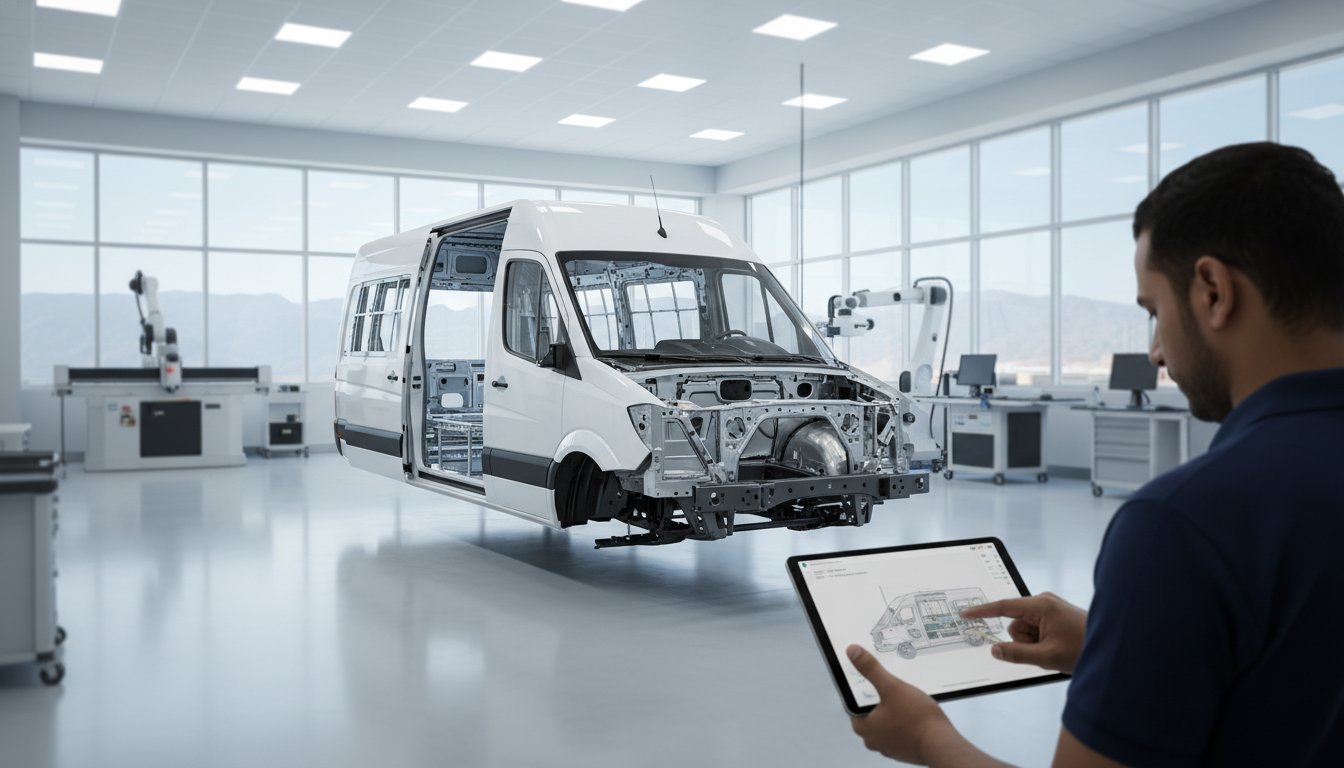
A chassis failure isn't just a mechanical setback. In the emergency sector, it's a mission-critical failure that puts lives at risk. You've likely felt the frustration of vehicle downtime or the struggle to fit heavy Advanced Life Support equipment into a frame that can't handle the load. Selecting the best base vehicle for ambulance conversion 2026 requires more than just looking at a price tag. It demands an engineering perspective that prioritizes structural integrity, precision metalwork, and payload capacity.
We know you're under pressure to meet the rigorous NFPA 1900 standards and the CAAS Version 4.0 requirements released in February 2025. This guide identifies the top vehicle platforms for the upcoming year, from the versatile Ford Transit to rugged GMC and Toyota extended roof options. You'll learn how to select a chassis that maximizes operational lifespan and provides the foundation for a highly functional medical interior. We'll examine the technical specs that matter most for box type conversions and specialized medical fabrications to ensure your fleet remains reliable under the most demanding conditions.
Key Takeaways
- Understand the critical balance between Gross Vehicle Weight and advanced medical technology to prevent premature chassis fatigue.
- Compare top-performing chassis to find the best base vehicle for ambulance conversion 2026 suited for your specific terrain and mission profile.
- See how precision CNC machining and structural reinforcement provide the durability needed for high-intensity emergency response.
- Ensure long-term fleet compliance by aligning your vehicle selection with the latest GSO 1794 and EN 1789 safety standards.
- Learn to integrate custom bull bars and bumpers to protect your medical interior and vehicle assets in high-risk zones.
Core Selection Criteria for Ambulance Base Vehicles in 2026
Identifying the best base vehicle for ambulance conversion 2026 isn't about finding the cheapest van on the market. It's a technical calculation. You need a platform that balances Gross Vehicle Weight (GVW), a stable wheelbase, and proven engine reliability. Modern Ambulance design and types vary significantly, but the chassis remains the backbone of the entire operation. If the foundation is weak, the most advanced medical interior becomes a liability.
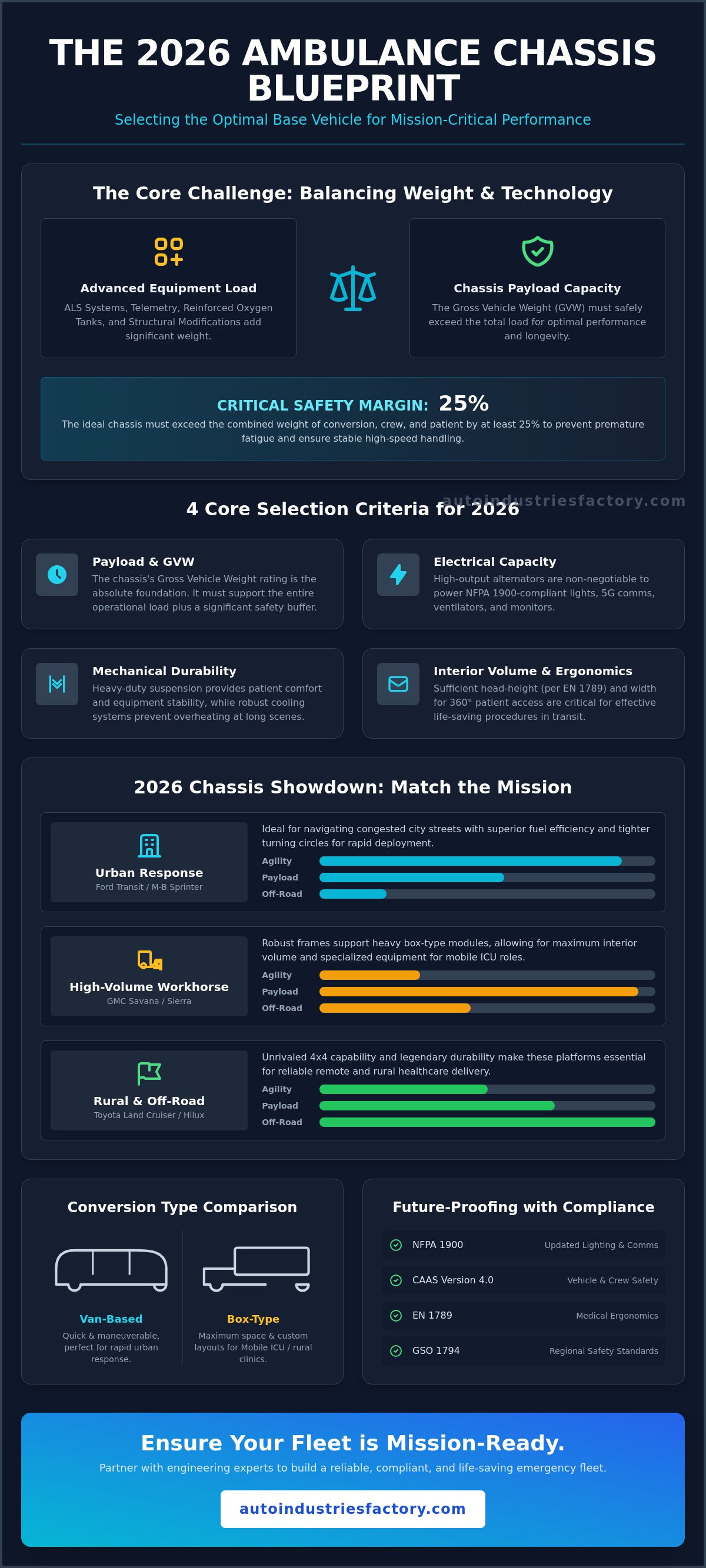
The 2026 payload challenge is a primary concern for fleet managers. Advanced Life Support (ALS) equipment, integrated telemetry, and reinforced oxygen systems add hundreds of kilograms before the crew even steps inside. The ideal 2026 chassis is one that exceeds the combined weight of the conversion, crew, and patient by at least 25%. This weight buffer prevents premature suspension fatigue and ensures the vehicle handles predictably during high-speed emergency maneuvers.
Electrical system capacity must match the demands of the new NFPA 1900 standards. These standards include updated requirements for warning lights and integrated communication technology. High-output alternators are now non-negotiable for modern ALS units that require constant power for monitors, ventilators, and 5G-enabled data transmission. To better understand how different chassis hold up over time, watch this helpful video:
Mechanical Durability and Chassis Integrity
Durability starts with the suspension. We evaluate systems based on their ability to provide patient comfort while maintaining stability for sensitive medical equipment. In high-ambient temperature regions, standard engine cooling often falls short. You must specify chassis with heavy-duty cooling packages to prevent overheating during long idle periods at emergency scenes.
Space Utilization and Interior Volume
Space is a functional requirement, not a luxury. Meeting EN 1789 compliance requires specific minimum head-height to allow paramedics to work standing up. We also prioritize width to ensure 360-degree patient access. This allows the medical team to perform life-saving procedures from any side of the stretcher during transit. For more details on how we engineer these spaces, explore our ambulance conversion services.
Top Performing Chassis: Comparative Analysis for 2026
Selecting the best base vehicle for ambulance conversion 2026 depends entirely on your operational environment. Urban EMS providers often favor the Mercedes-Benz Sprinter or Ford Transit. These platforms offer superior fuel efficiency and tighter turning circles; they're ideal for navigating congested city streets. They provide the agility needed for rapid response while maintaining a professional medical workspace. When evaluating the best base vehicle for ambulance conversion 2026, our engineers prioritize the power-to-weight ratio to ensure the engine isn't overstressed by the medical conversion.
For high-volume requirements, the GMC Savana and Sierra remain the American workhorses. Their robust frames support heavy box-type ambulance modules, allowing for maximum interior volume and specialized equipment storage. When deciding between these platforms, consider the mission type. Our engineering team often helps clients with Choosing a Chassis: GMC vs. Toyota for Ambulances to ensure the powertrain matches the expected load and terrain.
Van-Based vs. Box-Type Conversions
Panel vans like the Ford Transit are perfect for rapid urban response. They're quick and easy to maneuver in traffic. However, if your mission involves mobile ICU roles or extended rural clinics, a custom box-type fabrication is superior. These modules offer square walls and increased width, providing the space needed for complex medical interventions. All our builds are designed to meet the CAAS Ground Vehicle Standard for safety and durability.
4X4 Capability vs. Highway Performance
Rural and remote healthcare requires a different approach. The Toyota Land Cruiser 70 Series and the Toyota Hilux are unrivaled for off-road rescue. Their mechanical simplicity and 4x4 capability allow them to reach patients in areas where standard vans would fail. Conversely, highway-oriented vans dominate patient transport services where speed and smoothness on paved roads are the priority. If your fleet operates in diverse terrains, you might need a mix of both. You can view our full range of ambulance conversion solutions to see how we adapt these chassis for specific environments.
Engineering the Conversion: The Fabrication Advantage
Precision fabrication is what separates a standard van from a mission-ready medical unit. Even the best base vehicle for ambulance conversion 2026 requires expert modification to survive the stress of emergency response. At Auto Industries Factory LLC, we don't just add equipment; we re-engineer the platform. Our in-house CNC machining and laser cutting technologies ensure every structural reinforcement meets exact tolerances. This engineering precision is vital for maintaining chassis integrity over a ten-year operational lifespan.
Protection is paramount in high-risk zones. We integrate custom bull bars and heavy-duty rear bumpers directly into the vehicle's frame. These aren't cosmetic additions. They're functional armor designed to protect the engine's cooling system and the sensitive medical interior during impacts. Specialized welding techniques further ensure that internal medical cabinetry remains rattle-free and secure. This level of craftsmanship prevents the structural fatigue often seen in lower-quality conversions using the best base vehicle for ambulance conversion 2026.
Structural Reinforcement and Safety
Safety standards are constantly evolving. Staying current with Ambulance Standard Revisions is critical for fleet compliance. We reinforce vehicle roofs to support heavy lightbars and multi-point medical equipment mounting. Similarly, floors receive structural bracing to securely house stretchers and high-capacity oxygen cylinders. This prevents dangerous equipment shifts during sudden deceleration or high-speed maneuvers.
Advanced Systems Integration
Modern conversions require sophisticated climate and power management. We install medical-grade HVAC systems capable of maintaining stable temperatures in extreme climates. Digital control systems manage everything from sirens to power distribution; they provide paramedics with a streamlined interface for all vehicle functions. If you need a chassis built to these exact specifications, explore our ambulance conversion solutions to start your project.
Compliance, Standards, and Future-Proofing Your Fleet
Compliance isn't just a legal hurdle; it's a safety guarantee for your crew and patients. Selecting the best base vehicle for ambulance conversion 2026 involves anticipating regulatory shifts across different regions. In the Middle East, meeting GSO 1794 standards is mandatory for operational legality. Globally, Understanding EN 1789 Ambulance Standards is essential for buyers who need to navigate complex crash-test requirements and interior ergonomic mandates. We ensure every conversion aligns with these rigorous benchmarks to provide maximum protection during high-speed transit.
Future-proofing for 2026 requires a focus on digital integration. Modern fleets now demand 5G-enabled telemetry and integrated communication systems that allow real-time data sharing between the vehicle and the hospital. While the shift toward electric vehicles (BEVs) is accelerating, current battery technology still presents limitations for long-range missions or high-ambient heat environments. For 2026, we recommend evaluating BEVs for urban patient transport while maintaining traditional internal combustion engines for heavy-duty, long-distance emergency response.
Mission-Specific Configurations
The best base vehicle for ambulance conversion 2026 must be adaptable to specific medical roles. Basic Life Support (BLS) units focus on efficient transport and fundamental care. Conversely, Advanced Life Support (ALS) units require more complex electrical grids and storage for ventilators and cardiac monitors. We also engineer specialized configurations for neonatal transport and infectious disease isolation, ensuring each unit has the dedicated filtration and mounting systems required for these sensitive missions.
Maintenance and Long-Term Reliability
Reliability depends on the availability of spare parts. When planning your 2026 fleet, prioritize chassis with a strong regional service presence. A grounded ambulance is a wasted asset. Selecting a converter that offers comprehensive after-sales support ensures your fleet stays operational. We focus on using globally recognized platforms like GMC, Toyota, and Ford to guarantee that mechanical components are always accessible, reducing your vehicle downtime and extending the operational lifespan of your medical investment.
Securing the Future of Your Medical Fleet
Building a reliable emergency response fleet starts with a foundation of engineering precision. You've seen that the best base vehicle for ambulance conversion 2026 isn't just a simple purchase. It's a strategic decision based on payload capacity, specific terrain requirements, and rigorous safety standards. Whether you choose a high-volume GMC box type or a rugged Toyota 4x4, the structural integrity of the fabrication determines the vehicle's true operational lifespan. Precision matters when lives are on the line.
Reliability in the field depends on a partner who understands the high stakes of medical transport. Our ISO certified manufacturing facility utilizes expert in-house CNC and laser cutting to reinforce every chassis we modify. We are specialists in GSO and EN 1789 compliance; we ensure your vehicles meet international safety mandates without compromise. Don't leave your fleet's performance to chance or unproven converters.
Request a Custom Ambulance Conversion Quote for Your Fleet to ensure your mission-critical vehicles are built to endure the challenges of 2026. We look forward to engineering a solution that protects your patients and your personnel.
Frequently Asked Questions
What is the most reliable 4x4 base vehicle for rural ambulance conversion?
The Toyota Land Cruiser 70 Series remains the most reliable 4x4 platform for rural and off-road medical response. Its mechanical simplicity and rugged suspension allow it to operate in extreme environments where standard vans would suffer structural failure. It is frequently the best base vehicle for ambulance conversion 2026 for missions that require high-clearance and dependable 4WD performance in remote locations.
How much payload capacity does a Type II ambulance require?
A Type II ambulance typically requires a usable payload margin of at least 1,500 to 2,000 pounds after the conversion process is finished. This capacity is necessary to safely accommodate the crew, patient, and essential medical supplies without overstressing the chassis. We prioritize selecting van platforms with a high Gross Vehicle Weight Rating (GVWR) to ensure the vehicle remains stable during emergency maneuvers.
Can a Toyota Land Cruiser be converted into an ALS ambulance?
Yes, a Toyota Land Cruiser can be converted into an Advanced Life Support (ALS) unit when equipped with an extended roof or a custom box-type module. While the standard SUV body is compact, our specialized fabrication allows for the installation of ventilators, cardiac monitors, and oxygen systems. It stands as the best base vehicle for ambulance conversion 2026 when life-saving technology must reach patients in inaccessible terrain.
What are the main differences between GSO and EN 1789 ambulance standards?
GSO standards are specific to the Middle East and focus on high-ambient temperature performance and regional lighting requirements. EN 1789 is a European safety standard that mandates rigorous crash-testing for the medical compartment and its equipment mounting points. A professional conversion must balance these standards to ensure the vehicle is both legally compliant and structurally sound for its specific operating region.
Is the Mercedes Sprinter or Ford Transit better for high-roof ambulance conversions?
The Mercedes-Benz Sprinter often offers a slight advantage in total payload capacity for heavy medical builds. However, the Ford Transit is frequently selected for its extensive global service network and lower long-term maintenance costs. Both chassis are excellent for high-roof conversions; your choice should depend on local parts availability and the specific weight requirements of your medical interior.


