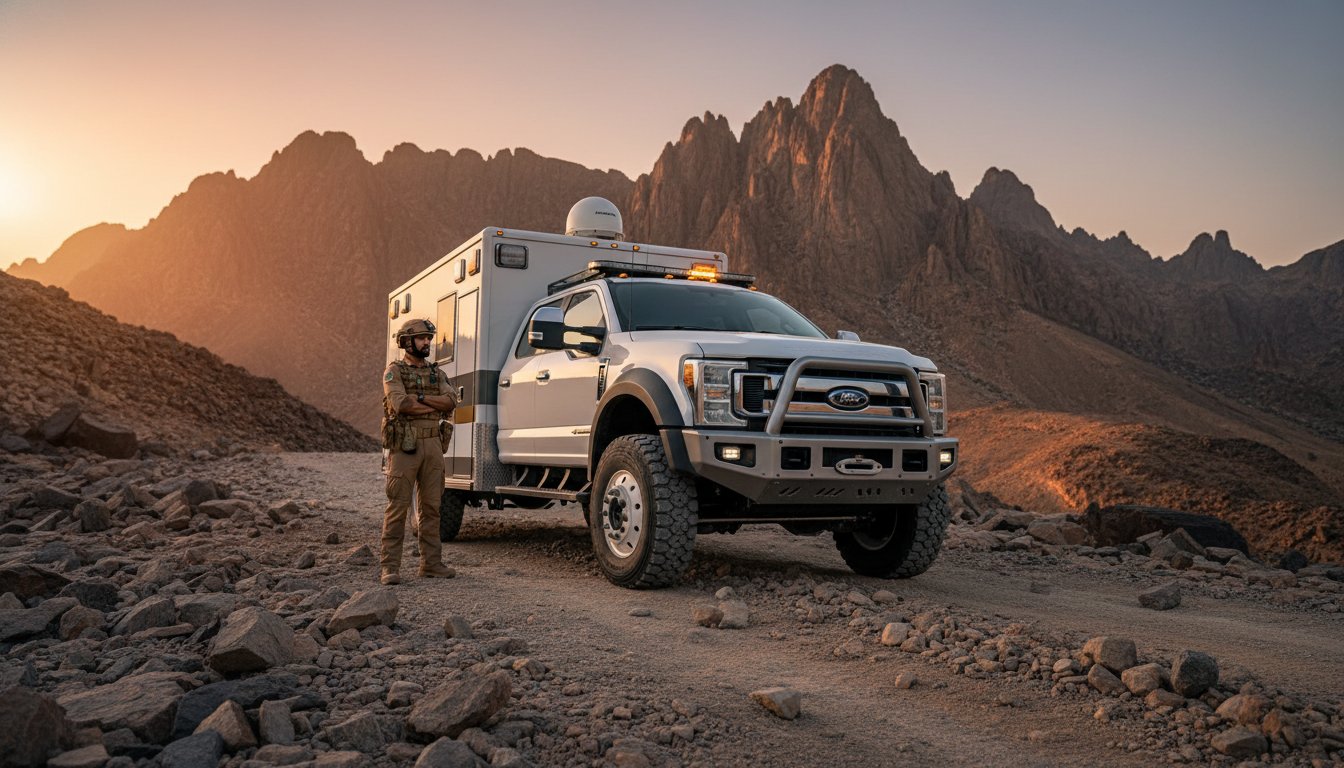
A standard 4x4 conversion isn't a rescue vehicle; it's a liability waiting to happen in the desert. When the pavement ends, the stakes for your crew and patients skyrocket. You've likely seen standard ambulances break down in rugged environments or watched expensive medical equipment fail due to high-vibration terrain. It's a frustrating reality where inadequate space in a basic conversion makes life-saving work nearly impossible. Specialized off-road ambulance fabrication isn't just about adding four-wheel drive. It's about engineering a platform that survives where others fail.
We understand that reliability is non-negotiable when lives are on the line. This article will help you master the technical requirements of off-road ambulance fabrication to ensure mission-critical reliability in the most demanding environments. You'll learn how to achieve a build that meets EN 1789 and the CAAS GVS V4.0 standards implemented in July 2025. We'll preview the structural engineering secrets that reduce maintenance downtime and keep your fleet operational in the world's harshest terrain.
Key Takeaways
- Identify the specific structural failures common in standard conversions and how to prevent them through purpose-built engineering.
- Explore the precision manufacturing techniques, including laser cutting and CNC bending, required to reinforce Toyota and GMC chassis for mission-critical durability.
- Master interior layout strategies that maximize medical staff efficiency while using anti-vibration systems to secure Advanced Life Support equipment.
- Learn how specialized off-road ambulance fabrication incorporates custom bull bars and roof racks to shield the vehicle from extreme environmental hazards.
- Gain insights into balancing EN 1789 compliance with the rugged demands of desert and mountain rescue operations to minimize vehicle downtime.
The Fundamentals of Off-Road Ambulance Fabrication
Off-road ambulance fabrication is the specialized engineering process of transforming a heavy-duty 4x4 chassis into a mission-ready medical unit. It's not a simple bolt-on kit. This discipline focuses on re-engineering vehicles like the Toyota Land Cruiser or GMC Sierra to withstand the brutal mechanical stresses of desert and mountain rescue. While many Ambulance types handle paved city streets, the off-road variant must serve as a mobile trauma center in environments where roads don't exist.
Standard conversions often fail because they treat the vehicle as a cargo van rather than a high-stress platform. In extreme heat or rocky terrain, standard frames experience fatigue from the weight of life-saving equipment. Following professional ambulance conversion standards ensures that the vehicle remains a reliable asset instead of a liability. This transition from a passenger vehicle to a specialized mission unit requires deep expertise in structural metalwork and weight distribution.
To better understand this concept, watch this helpful video:
Why Standard Chassis Require Professional Fabrication
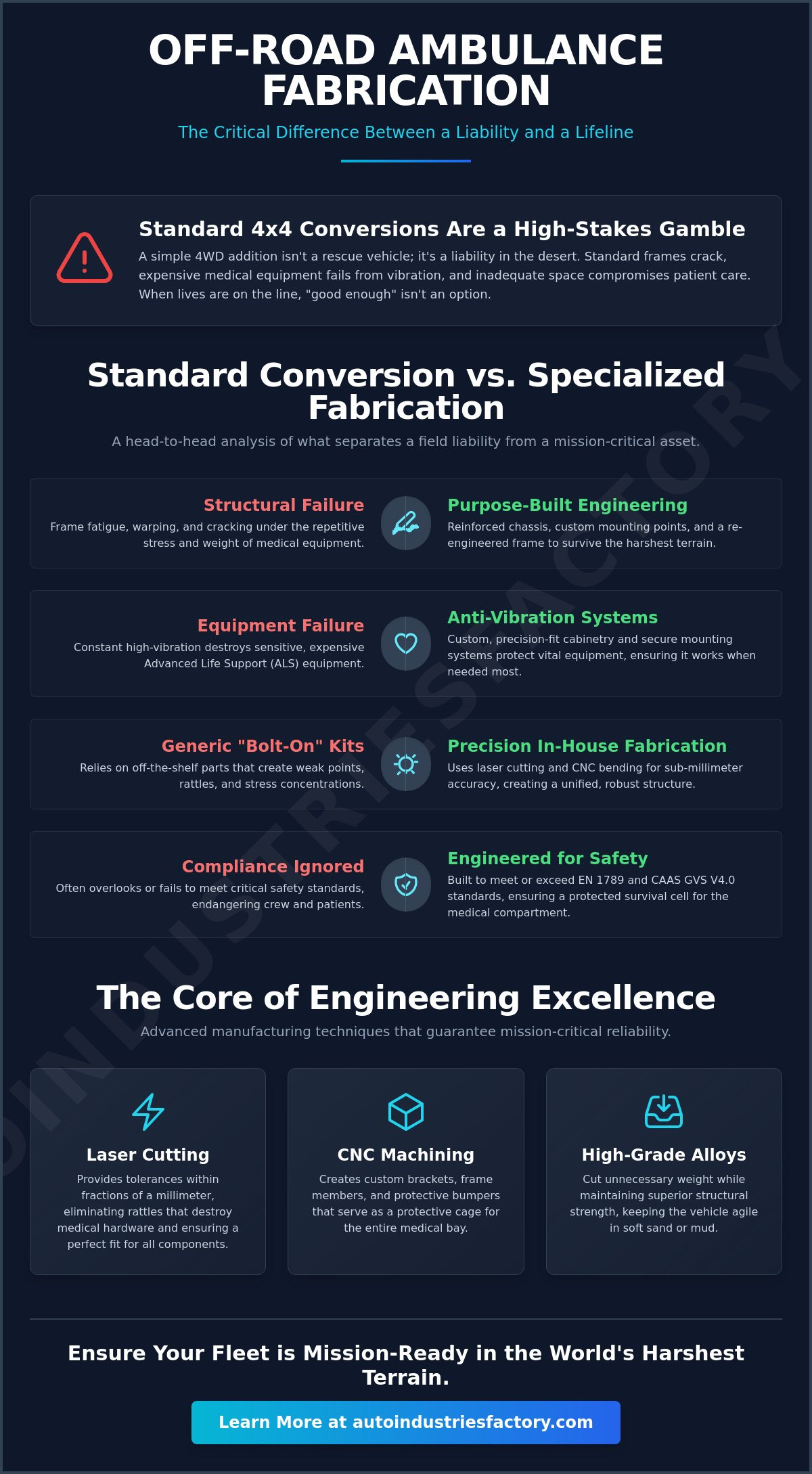
Off-road scenarios place immense stress on vehicle frames. Heavy medical monitors, oxygen cylinders, and cabinetry create a high center of gravity that standard suspensions can't manage. Professional off-road ambulance fabrication addresses these issues through structural reinforcement rather than just aesthetic changes. We distinguish between simple modifications and true engineering. Without reinforced mounting points and upgraded suspension geometry, a vehicle's frame can warp or crack under the repetitive impact of high-vibration terrain.
Defining the Off-Road Ambulance Standard in 2026
In 2026, the industry has shifted toward the CAAS Ground Vehicle Standard (GVS) V4.0, which was implemented on July 1, 2025. This standard prioritizes crash-tested safety and structural integrity. Successful builds must balance a high payload capacity for ALS equipment with the agility required for tight mountain trails. The EN 1789 standard ensures that the medical compartment functions as a protected survival cell, maintaining its integrity even during extreme off-road maneuvers or potential rollovers.
Engineering Excellence in Off-Road Ambulance Fabrication and Bodywork
True engineering separates a reliable rescue unit from a standard 4x4. Off-road ambulance fabrication demands industrial-grade precision. We don't rely on generic parts. Instead, we use advanced laser cutting and CNC machining to create every bracket and frame member in-house. This level of control ensures medical cabinetry and oxygen systems fit perfectly within the reinforced shell. By choosing high-grade alloys, we cut unnecessary weight while maintaining the structural strength needed for extreme rescue missions.
The engineering principles we apply often parallel our work in safari vehicle conversions. Both sectors require vehicles that can handle high-vibration terrain for extended periods. If a chassis can withstand the rigors of a safari, it's ready for the high-stakes environment of emergency medical services. This synergy ensures that our medical units are built on a foundation of proven, rugged durability.
Precision Metalwork: CNC and Laser Cutting in Vehicle Modification
In-house metalwork is vital for mission-critical reliability. Laser cutting provides tolerances within fractions of a millimeter. This precision stops the rattling that typically destroys medical hardware in basic conversions. We use these technologies to fabricate custom bumpers and internal frames that serve as a protective cage for the medical bay. These high-grade alloy components offer superior protection without overloading the chassis, keeping the vehicle agile in soft sand or mud.
Suspension and Chassis Reinforcement for Extreme Durability
Advanced Life Support (ALS) equipment adds massive weight to a 4x4 platform. We re-engineer the leaf and coil springs on Toyota and GMC chassis to maintain stability during high-speed off-road rescue. It's about damping and control, not just ground clearance. We reinforce every mounting point to stop frame fatigue before it starts. If your operations demand this level of durability, check our specialized vehicle modification services to see how we engineer for longevity.
Interior Systems Integration for Rugged Medical Environments
Interior ergonomics in a 4x4 environment aren't about comfort; they're about survival. Effective off-road ambulance fabrication must account for the violent lateral and vertical forces experienced during high-speed desert crossings. Standard medical equipment isn't designed for these G-forces. We integrate Advanced Life Support (ALS) layouts that keep life-saving tools within reach while ensuring every monitor and ventilator is secured through anti-vibration mounting systems. This prevents sensitive electronics from recalibrating or failing when you're miles from the nearest service center.
Our in-house metal fabrication allows us to build internal cabinetry that survives constant shocks and jolts. We replace standard plastic latches with heavy-duty locking mechanisms that won't fail under pressure. Electrical redundancy is equally critical in remote zones. We install high-output alternators and dual battery systems to power medical gear and communication tools without risking a dead engine in the middle of nowhere. This ensures that the vehicle remains a functional trauma room regardless of the external environment.
Secure Medical Equipment Mounting for Rough Terrain
We use specialized, CNC-machined brackets for oxygen cylinders and stretchers to ensure they remain locked during extreme maneuvers. Our internal fabrication processes create a reinforced environment where equipment cannot become a dangerous projectile during sudden impacts or steep mountain climbs. This level of security is vital for protecting both the patient and the medical crew during high-speed transit over uneven ground.
Power Management and Climate Control in 2026
Modern rescue operations in 2026 rely on digital diagnostic tools that demand stable, uninterrupted power. We utilize high-output alternators to maintain charge across dual battery systems, providing a failsafe for mission-critical electronics. To combat extreme external temperatures, we fabricate heavy-duty HVAC ducting designed to resist dust ingress. This ensures the patient compartment stays sterile and cool even in the harshest desert heat. If you need a vehicle engineered for these extremes, explore our specialized ambulance conversion solutions to see our technical capabilities in action.
Custom Fabrication Solutions for Specialized Mission Requirements
External protection is the first line of defense for any rescue unit operating in unpredictable terrain. While previous sections focused on structural and interior integrity, off-road ambulance fabrication must also address external armor. A mission-critical vehicle is useless if a minor collision with a rock or animal disables the radiator. We engineer custom bull bars and rear bumpers that provide 360-degree protection, ensuring the vehicle remains mobile in the most hostile environments.
Our comprehensive modification services offer a streamlined one-stop-shop for design, fabrication, and final painting. We don't view these vehicles as modified passenger cars. Instead, we deliver a fully integrated solution where every component, from the winch mounts to the heavy-duty HVAC, works in harmony. This holistic approach reduces maintenance downtime because every part is engineered to fit the specific chassis geometry of your fleet.
Custom Accessories: Bull Bars, Roof Racks, and Canopies
Custom-fabricated bull bars are superior to off-the-shelf options because they're designed for the exact weight and balance of an ALS-equipped ambulance. We integrate winch mounts and recovery points directly into the primary vehicle structure. This ensures that if a vehicle gets stuck in soft sand, the recovery forces are distributed across the reinforced frame rather than pulling on a cosmetic bumper. Heavy-duty roof racks further extend mission capability by providing secure storage for extra fuel, sand tracks, and specialized rescue gear that won't fit in the medical bay.
The Consultation and Design-to-Delivery Process
Our process begins with precise CAD modeling to ensure every modification aligns with your operational requirements. We move from digital design to precision metal cutting and bending, followed by rigorous quality control. Every build undergoes testing to verify that it meets national safety standards and your specific mission profiles. This transition from design to delivery ensures that the final vehicle is a rugged, dependable asset ready for immediate deployment in extreme desert or mountain operations.
Secure Your Mission-Critical Rescue Operations
Engineering excellence is the single factor that separates a successful rescue mission from a catastrophic vehicle failure in the field. This guide has highlighted how structural reinforcement and precision metalwork form the essential backbone of a reliable 4x4 medical unit. From anti-vibration mounting for sensitive ALS monitors to custom-fabricated external armor, every technical detail must be engineered to survive the world's harshest environments.
Mastering off-road ambulance fabrication requires a partner who understands the high stakes of extreme terrain. Our team provides specialized expertise in high-performance Toyota and GMC platforms, ensuring your fleet remains operational when standard vehicles fail. We utilize complete in-house CNC and laser cutting capabilities to deliver precision components that meet rigorous national standards for specialized vehicle conversions. Your crew deserves a vehicle that's as resilient as they are.
Request a technical consultation for your off-road ambulance project to begin engineering your custom solution. We're ready to help you build a fleet that never compromises on safety or performance.
Frequently Asked Questions
What is the best chassis for off-road ambulance fabrication?
The Toyota Land Cruiser and GMC Sierra are the most reliable platforms for high-stress rescue missions. These chassis provide the necessary torque and durability to carry Advanced Life Support equipment over soft sand or rocky trails. We focus on these platforms because they offer superior structural integrity and global parts availability, which is essential for remote operations where maintenance access is limited.
How does off-road fabrication differ from standard ambulance conversion?
Off-road ambulance fabrication differs from standard conversions by prioritizing structural reinforcement and vibration damping over simple interior outfitting. Standard ambulances are designed for paved urban streets and often suffer frame fatigue in rugged environments. Our specialized fabrication process involves re-engineering the chassis to handle extreme lateral forces and vertical impacts, ensuring the medical compartment remains a secure survival cell during off-road transit.
Are off-road ambulances compliant with EN 1789 standards?
Yes, specialized 4x4 builds are engineered to align with EN 1789 and the July 2025 CAAS GVS V4.0 standards. Achieving compliance requires balancing the strict safety requirements for medical compartments with the heavy-duty modifications needed for all-terrain mobility. We ensure that the interior layout meets crash-test safety protocols while the exterior remains rugged enough for desert or mountain rescue operations.
What custom accessories are essential for desert or mountain rescue?
Essential accessories include custom-fabricated bull bars, reinforced rear bumpers, and heavy-duty roof racks. These components protect the vehicle's cooling systems from environmental hazards and provide secure mounting points for winches and recovery gear. Integrating these accessories directly into the vehicle's primary structure ensures that they can withstand the mechanical stresses of high-speed off-road rescue missions without compromising vehicle balance.
How long does the fabrication process take for a specialized 4x4 ambulance?
The timeline for a specialized build depends on the level of customization and the specific chassis selected for the project. Professional fabrication is a comprehensive process that includes initial CAD design, precision metal cutting, and rigorous quality control testing. While schedules vary based on mission requirements, we prioritize engineering precision to ensure that every vehicle delivered is a dependable, long-lasting solution for extreme rescue operations.


