
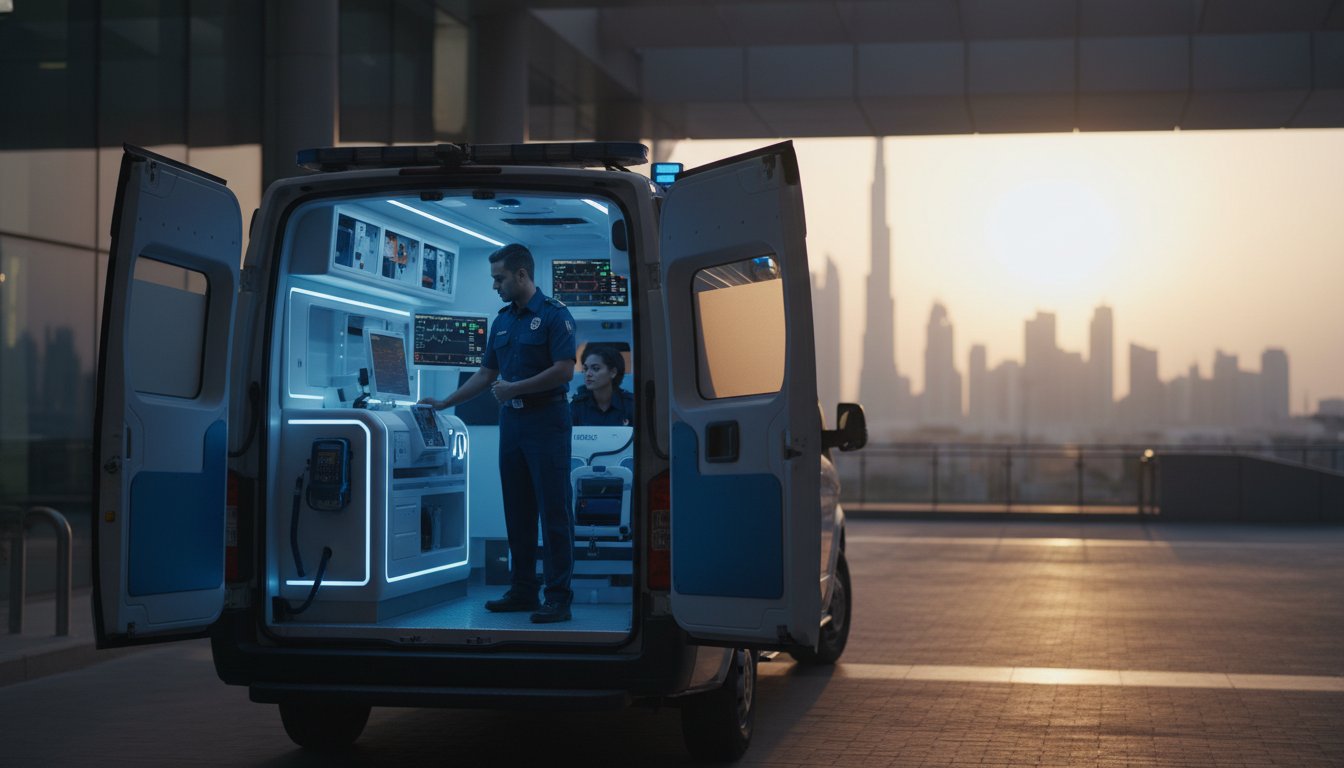
Can your fleet's electrical grid sustain a 3,000-watt load for life-saving cardiac equipment while idling in 50°C Dubai heat? You've likely realized that meeting DHA and MOHAP standards is a complex engineering hurdle that requires more than just a basic medical fit-out. To ensure patient safety during a critical transfer, a cardiac care unit ambulance conversion must be built on a foundation of heavy-duty fabrication and flawless electrical integration. It's a technical challenge where any compromise in component quality leads to mission failure.
Auto Industries Factory (AIF) specializes in designing these high-performance mobile intensive care units to withstand the most demanding UAE conditions. This 2026 guide reveals the technical precision and regulatory expertise required to guarantee 100% uptime for your emergency vehicles. We'll break down the specialized power systems, advanced thermal management, and equipment integration strategies that define the new standard for life-saving transport across the Emirates. Discover how to build a fleet that's mission-ready for every emergency through superior engineering and rugged construction.
Key Takeaways
- Learn the critical engineering differences that define a Type C Mobile Intensive Care Unit and its vital role in the UAE’s "Golden Hour" cardiac response strategy.
- Understand the specialized HVAC requirements and chassis reinforcements necessary to ensure medical equipment reliability in 50°C+ ambient temperatures across Sharjah and Ajman.
- Discover why a cardiac care unit ambulance conversion requires significantly higher equipment density and interior workspace compared to standard Type B ALS units.
- Gain insights into meeting GSO 1794 and EN 1789 standards while selecting the optimal chassis, such as the GMC Savana or Toyota Hiace, for UAE regulatory compliance.
- Explore the end-to-end precision fabrication process used by Auto Industries Factory in the UAE to deliver customized, life-saving CCU solutions for hospital fleets.
What is a Cardiac Care Unit (CCU) Ambulance Conversion?
Auto Industries Factory (AIF) specializes in the heavy-duty engineering required for a professional cardiac care unit ambulance conversion. These vehicles are categorized as Type C Mobile Intensive Care Units (MICU), designed specifically to bring the hospital's cardiac wing to the patient's doorstep. In the fast-paced environments of Dubai and Abu Dhabi, these units are vital components of the UAE’s "Golden Hour" strategy. This protocol dictates that patients suffering from heart failure or trauma must receive advanced intervention within 60 minutes to ensure the highest probability of survival.
For providers like the Dubai Health Authority (DHA) and SEHA, these conversions represent a mission-critical investment in public safety. Unlike basic transport, a CCU conversion integrates complex medical hardware into a rugged, high-performance chassis. To understand the baseline requirements for these vehicles, one can review the standard Ambulance Types and Functions used globally. AIF ensures every build meets or exceeds these international benchmarks while adhering to local UAE health regulations and the specific demands of the region's climate.
To better understand the technical complexity of these builds, watch this helpful video showing a high-level conversion update:
The Purpose of a Mobile Cardiac Suite
The primary goal of a CCU conversion is the immediate stabilization of patients with acute myocardial infarction (AMI). These vehicles provide a sterile, hospital-grade environment on wheels. They support Advanced Life Support (ALS) by integrating specialized cardiac monitoring, 12-lead ECG machines, and advanced defibrillators. This setup allows paramedics to perform intensive interventions while in transit. It effectively starts the treatment process before the patient even reaches the emergency department, which is crucial for long-term recovery outcomes.
CCU Conversion vs. Standard Ambulance
Standard ambulances often focus on basic patient transport, but a CCU conversion requires significantly more internal volume and specialized power systems. AIF engineers these cabins to accommodate larger medical teams, often including cardiologists and specialized nurses who need 360-degree access to the patient. The diagnostic capabilities are far more advanced, featuring integrated telemetry that transmits real-time data to hospital teams. While a standard vehicle might offer basic first aid, the CCU is a mobile intensive care intervention unit built for maximum reliability and precision performance.
Based in Ajman and Dubai, AIF understands that every second counts. That's why our cardiac care unit ambulance conversion process focuses on ergonomic layouts that minimize movement for the medical team while maximizing the availability of life-saving equipment. It's not just about adding equipment; it's about re-engineering the vehicle to serve as a flawless extension of the hospital's intensive care unit.
Engineering the CCU: Essential Specs for UAE Climate and Performance
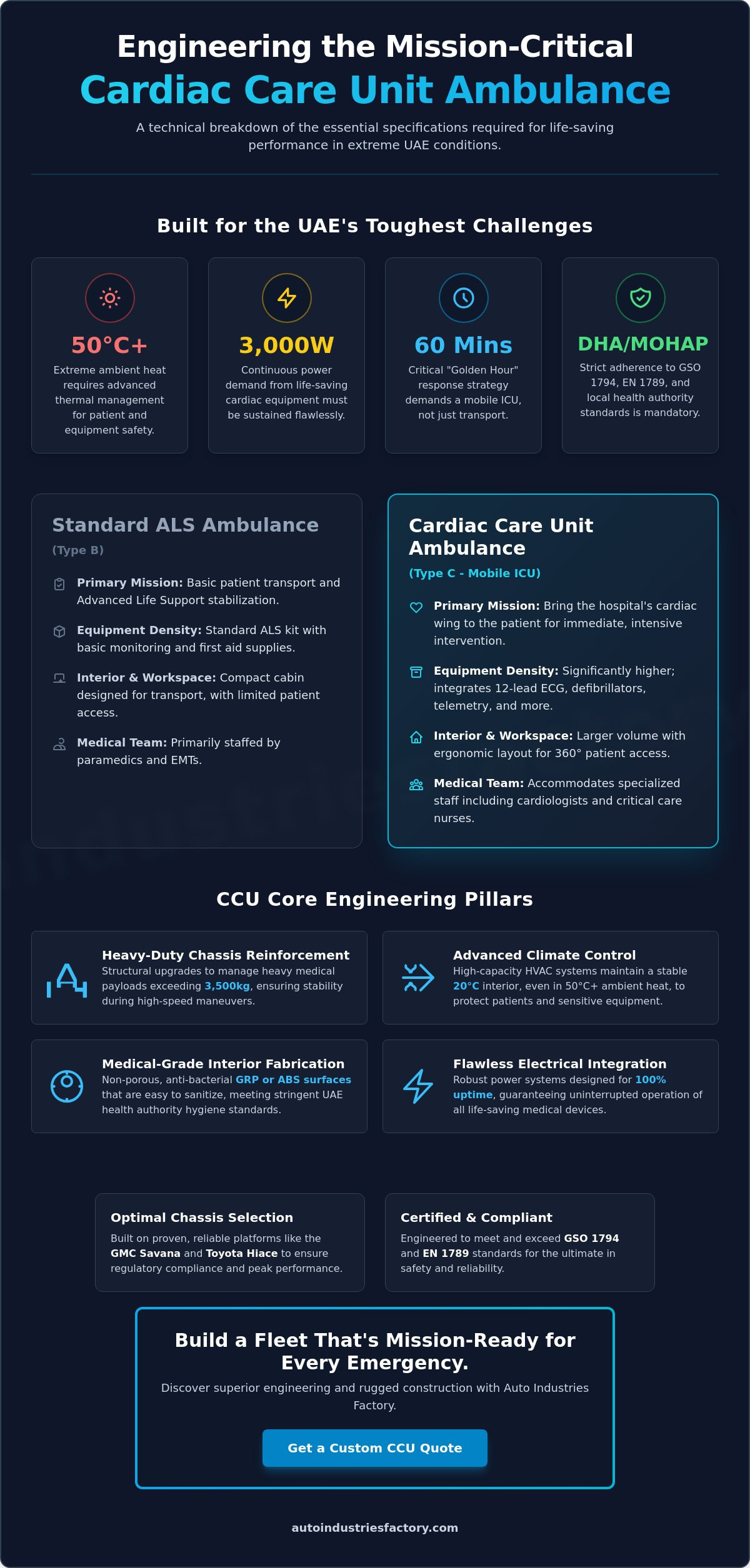
Building a high-performance cardiac care unit ambulance conversion requires more than just installing medical monitors. It starts with structural integrity. Auto Industries Factory (AIF) reinforces the vehicle chassis to manage heavy medical payloads that often exceed 3,500kg. This reinforcement prevents frame fatigue and ensures stability during emergency maneuvers on Dubai highways. To combat the extreme 50°C+ summer temperatures in Sharjah and Ajman, we integrate advanced HVAC systems. These units utilize high-capacity compressors to maintain a consistent 20°C environment, protecting both the patient and heat-sensitive medications. Interior fabrication uses medical-grade, anti-bacterial GRP or ABS materials. These surfaces are non-porous and easy to sanitize, meeting the strict hygiene standards of UAE health authorities. AIF utilizes precision laser cutting to create custom medical cabinetry and equipment mounts, ensuring a rattle-free environment where every tool stays secure.
Electrical Redundancy and Power Systems
Electrical failure isn't an option during cardiac transport. We install dual-battery systems equipped with intelligent split-charging. This setup ensures that medical electronics never drain the engine's starter battery. Pure sine wave inverters are used to provide clean, stable power, which is necessary to protect sensitive cardiac monitors and defibrillators from voltage spikes. For long-term readiness, external shore power connections allow paramedics to keep all onboard equipment fully charged while the vehicle is stationed at UAE hospitals. For specialized fleet requirements, explore our custom fabrication services to see how we handle complex vehicle builds.
Medical Gas and Oxygen Infrastructure
A cardiac care unit ambulance conversion must provide a reliable supply of life-sustaining gases. We design integrated oxygen manifolds that feature digital pressure monitoring for real-time status updates. To maximize interior workspace, we build custom recessed storage compartments for large-capacity oxygen cylinders. All gas delivery relies on safety-tested, medical-grade copper piping. This rigid piping system is far more durable than flexible hoses, reducing the risk of leaks or pressure drops during critical care procedures.
Thermal and Acoustic Insulation
Patient comfort and temperature stability are maintained through high-density polyurethane foam insulation. This material fills every wall cavity to block heat transfer from the desert sun. We also apply sound-dampening layers to the floor and side panels to keep road noise below 65 decibels. The R-value defines the thermal resistance of the insulation material, which is the primary metric for determining how effectively an ambulance can repel the intense solar radiation found in the UAE. This multi-layered approach ensures the cabin remains a quiet, cool sanctuary for patients in distress.
CCU (Type C) vs. Standard ALS (Type B): A Comparison
Transitioning from a standard Advanced Life Support (ALS) vehicle to a Mobile Intensive Care Unit (MICU) requires more than just adding extra monitors. It's a fundamental shift in engineering philosophy. While a Type B ALS ambulance focuses on patient stabilization and rapid transport, a Type C cardiac care unit ambulance conversion is designed for active, high-level clinical intervention during transit. In the UAE, where medical standards are governed by strict DHA and DOH regulations, the technical jump involves a 40% increase in equipment density compared to standard units.
Type B vehicles typically accommodate two paramedics and a single patient. In contrast, a CCU must provide enough cubic volume for a three or four-person specialist team, including a cardiologist or a critical care nurse. This necessitates a complete reconfiguration of the interior layout to ensure that life-saving interventions don't stall due to cramped quarters. For a broader look at how these vehicles are built from the ground up, refer to our Ambulance Conversion guide.
Mandatory Cardiac Equipment Integration
The core of a cardiac care unit ambulance conversion is the telemetry suite. Unlike ALS units that might carry a basic monitor, a CCU requires a high-end 12-lead ECG system capable of real-time data transmission to receiving hospitals like Rashid Hospital or Cleveland Clinic Abu Dhabi. This allows specialists at the destination to prep the cath lab before the patient arrives. Engineering these vehicles involves installing:
- Advanced biphasic defibrillators with external pacing and synchronized cardioversion capabilities.
- Multi-channel infusion pumps for precise titration of vasopressors and anti-arrhythmics.
- Specialized transport ventilators that offer pressure-regulated volume control (PRVC) for complex cardiac cases.
- Automated External Defibrillators (AED) as redundant safety backups for the primary crew.
Workspace and Ergonomics
Space is the most valuable commodity in a CCU. We engineer the interior to provide 360-degree patient access; this means the medical team can reach the patient’s head, torso, and extremities without obstructing each other. This layout is vital during high-stress procedures like emergency intubation or central line placement. Our designs at Auto Industries Factory focus on heavy-duty, reinforced floor tracks that allow for modular seating adjustments.
Ergonomics play a massive role in crew performance during long shifts. We install specialized paramedic seating with four-point harnesses that allow the medic to remain restrained while reaching critical controls. Overhead storage is replaced with recessed, shatter-proof cabinets to maximize headroom. High-intensity LED lighting systems are calibrated to eliminate shadows during delicate procedures, ensuring the environment mimics a stationary hospital ICU as closely as possible.
Chassis Selection and UAE Regulatory Compliance
Auto Industries Factory (AIF) specializes in the technical engineering required for high-stakes medical vehicle modifications. Choosing the right chassis is the primary decision in any cardiac care unit ambulance conversion. In the UAE, the environment demands vehicles that handle 50°C ambient temperatures while supporting the heavy electrical draw of life-support systems. The choice between a van-based or a box-type chassis determines the unit's capacity and urban mobility.
The Case for GMC and Toyota in the UAE
The GMC Savana is the preferred choice for heavy-duty, box-type CCU conversions. Its robust frame handles the 4,500kg gross vehicle weight (GVW) typical of a fully equipped mobile intensive care unit. For rapid response in congested areas like Downtown Dubai, the Toyota Hiace high-roof model is the industry standard. It offers unmatched reliability and easier navigation through narrow urban corridors. Every cardiac care unit ambulance conversion we execute includes critical suspension upgrades. We replace factory components with heavy-duty air suspension or reinforced shock absorbers. This stabilizes the vehicle during high-speed transit on the E11, protecting cardiac patients from sudden G-force shifts.
Regulatory Standards and Safety
Compliance ensures both patient safety and legal operation within the Emirates. All vehicles must meet RMA and GSO standards to receive certification. GSO 1794 is the specific mandate for ambulance safety in the GCC, while EN 1789 governs the crash-test requirements for interior medical furniture. Every equipment mount for a defibrillator or ventilator must withstand a 10g deceleration force. This prevents medical devices from becoming projectiles during an emergency stop.
Dubai Health Authority (DHA) and the Sharjah Health Authority have specific vehicle specifications that must be met before a license is issued. These include:
- Dual-compressor air conditioning systems capable of maintaining 20°C in peak summer heat.
- Anti-bacterial, seamless interior flooring for infection control.
- Specific lumen counts for interior trauma lighting.
- Integrated 360-degree LED warning lights and high-decibel sirens per UAE traffic law.
AIF's engineering team manages the entire inspection process with UAE traffic authorities and the RTA. We provide the technical documentation and certificates of conformity required for registration. It's vital to remember that a cardiac care unit ambulance conversion isn't just a vehicle; it's a mobile hospital wing that must pass rigorous 2026 safety benchmarks. We ensure your fleet stays on the road and remains fully compliant with every local regulation.
Ready to upgrade your fleet? Contact our engineering team for a CCU conversion estimate.
Precision CCU Fabrication by Auto Industries Factory in the UAE
Auto Industries Factory (AIF) specializes in the engineering and manufacturing of high-performance medical vehicles. Our facilities in Ajman and Dubai provide a comprehensive, end-to-end solution for a cardiac care unit ambulance conversion. We understand that in the UAE, medical vehicles must perform under extreme environmental conditions while maintaining the highest levels of clinical safety. We don't outsource our engineering. Every structural modification and system integration happens within our own factory walls to guarantee life-saving reliability.
Our commitment to excellence is reflected in our "Built for Life-Saving Reliability" philosophy. We work closely with both government health authorities and private hospital fleets to deliver vehicles that function as mobile intensive care units. Whether you need a single specialized unit or a full fleet of CCUs, our team ensures every vehicle meets the rigorous standards required for emergency cardiac interventions in the Emirates.
The AIF In-House Advantage
Precision is the foundation of our fabrication process. We utilize advanced CNC machining and laser cutting technology to create medical cabinetry that fits perfectly within the vehicle's interior. This eliminates gaps where bacteria could thrive and ensures that life-saving equipment remains secure during high-speed transit. Our structural team performs expert welding and reinforcement to support the weight of heavy oxygen cylinders and advanced cardiac monitors. We prioritize mission-critical safety above all else.
- CNC Laser Cutting: Flawless fabrication of medical-grade cabinetry and storage solutions.
- Structural Reinforcement: Heavy-duty modifications to handle specialized CCU equipment and high-capacity electrical loads.
- Professional Livery: High-visibility paint and hospital branding applied in our dedicated climate-controlled booths.
- UAE Climate Engineering: Advanced insulation and heavy-duty HVAC systems designed for 50°C+ temperatures.
Getting Started with Your Fleet Conversion
AIF simplifies the complex process of a cardiac care unit ambulance conversion. We begin with a detailed consultation to understand your specific medical protocols and equipment requirements. Our engineers then develop a bespoke specification that optimizes the internal layout for paramedic efficiency. We maintain transparent lead times for all projects, ensuring your fleet is operational without unnecessary delays. Our support doesn't end at delivery; we provide comprehensive post-conversion maintenance to keep your units in peak condition.
You can learn more about our engineering capabilities on our about us page or explore our full range of vehicle conversion services. If you're ready to upgrade your healthcare fleet, contact us directly for a free project estimate.
Contact Auto Industries Factory (AIF):
📞 Phone/WhatsApp: +971 54 430 8487
📍 Location: Ajman & Dubai, UAE
SECURE YOUR ELITE EMERGENCY RESPONSE FLEET
Auto Industries Factory (AIF) specializes in high-performance vehicle modifications across the UAE. Choosing a professional cardiac care unit ambulance conversion ensures your fleet meets the rigorous EN 1789 and GSO standards required for Type C emergency vehicles. Our factory in Ajman uses advanced in-house laser cutting and CNC fabrication to build units that withstand the 50°C summer temperatures typical of the region. We've optimized every chassis selection to prioritize patient stability and medical team efficiency. You're not just buying a vehicle; you're investing in a life-saving solution engineered for the most demanding environments in Dubai and beyond. Our team handles the entire technical process from precision metalwork to regulatory compliance. We don't just assemble parts; we engineer reliability into every weld and electrical circuit. It's time to elevate your medical response capabilities with technology built for local conditions. Let's build a mobile intensive care unit that sets the standard for 2026 and beyond.
Get a Free Estimate for Your CCU Ambulance Conversion
Your mission-critical fleet deserves the precision of a leading UAE manufacturer.
Frequently Asked Questions
What is the main difference between a standard ambulance and a CCU ambulance?
A cardiac care unit ambulance conversion differs from a standard ambulance by providing a mobile intensive care environment equipped for advanced life support. While standard units focus on basic patient transport, a CCU conversion includes high-end medical technology like 12-lead ECG monitors, transport ventilators, and infusion pumps. Auto Industries Factory engineers these units with reinforced interior structures to support heavy life-saving equipment that isn't typically found in basic emergency vehicles.
Which chassis is best for a Cardiac Care Unit ambulance in the UAE?
The Mercedes-Benz Sprinter and Ford Transit are currently the top-rated chassis for a cardiac care unit ambulance conversion in the UAE due to their high payload capacities. These models provide the 3.5 to 5.0-tonne gross vehicle weight needed to carry heavy medical machinery and specialized cabinetry. AIF experts often recommend the Sprinter for its superior stability and the Toyota Hiace for its proven durability in the 50-degree Celsius summer heat common in Dubai and Ajman.
How does Auto Industries Factory ensure HVAC reliability in extreme UAE heat?
AIF ensures HVAC reliability by installing independent dual-circuit cooling systems that maintain an internal temperature of 20 to 22 degrees Celsius even when external temperatures hit 52 degrees. We use high-density polyurethane insulation panels and heavy-duty compressors that operate separately from the engine's primary AC. This redundant engineering prevents equipment overheating and ensures patient safety during long-distance transfers between Emirates. It's a critical feature for maintaining the integrity of temperature-sensitive cardiac medications.
Are AIF cardiac care unit conversions compliant with DHA and MOHAP standards?
Every AIF cardiac care unit conversion is fully compliant with Dubai Health Authority (DHA) and Ministry of Health and Prevention (MOHAP) technical standards. We follow the KKK-A-1822F and EN 1789:2020 international benchmarks required by UAE regulators for licensing. Our engineering team handles the rigorous documentation and inspection readiness needed for 100% approval from the Licensing and Accreditation Department. We don't compromise on regulatory safety protocols.
Can an existing van be converted into a Cardiac Care Unit ambulance?
You can convert an existing van into a CCU ambulance if the vehicle meets specific age and payload requirements. The chassis must typically be less than 2 years old and possess a high-roof configuration to allow paramedics to stand while performing CPR. AIF performs a 25-point structural assessment on donor vehicles to ensure they can handle the 800kg to 1,200kg of additional weight required for a full cardiac suite.
What is the typical timeline for a custom CCU ambulance conversion in Dubai?
A custom CCU ambulance conversion in Dubai typically takes between 45 and 60 working days from the date of chassis delivery. This timeline includes the 15-day fabrication of medical-grade cabinetry and the 10-day installation of complex electrical systems. We provide a detailed project schedule at the start of every build. This ensures fleet managers can plan their operational deployment without delays or unexpected downtime.
Does AIF provide the medical equipment for the CCU conversion?
AIF provides complete turn-key solutions including the supply and integration of world-class medical equipment like Zoll or Stryker systems. We source 12-lead defibrillators, portable ventilators, and automated external defibrillators that meet UAE medical board specifications. Clients can also opt for an installation-only service where we prepare the mounting points and power supply for their existing medical hardware. It's a flexible approach tailored to specific fleet requirements.
What electrical safeguards are installed in a CCU ambulance?
Every CCU ambulance includes a pure sine wave inverter and a dual-battery isolation system to protect sensitive cardiac monitors from power surges. We install 220V and 12V outlets with dedicated circuit breakers and shore-line power connections for external charging. These safeguards ensure that critical life-support machines never lose power, even if the vehicle's primary engine fails during a mission. We use fire-retardant wiring looms to exceed standard safety industrial norms.


