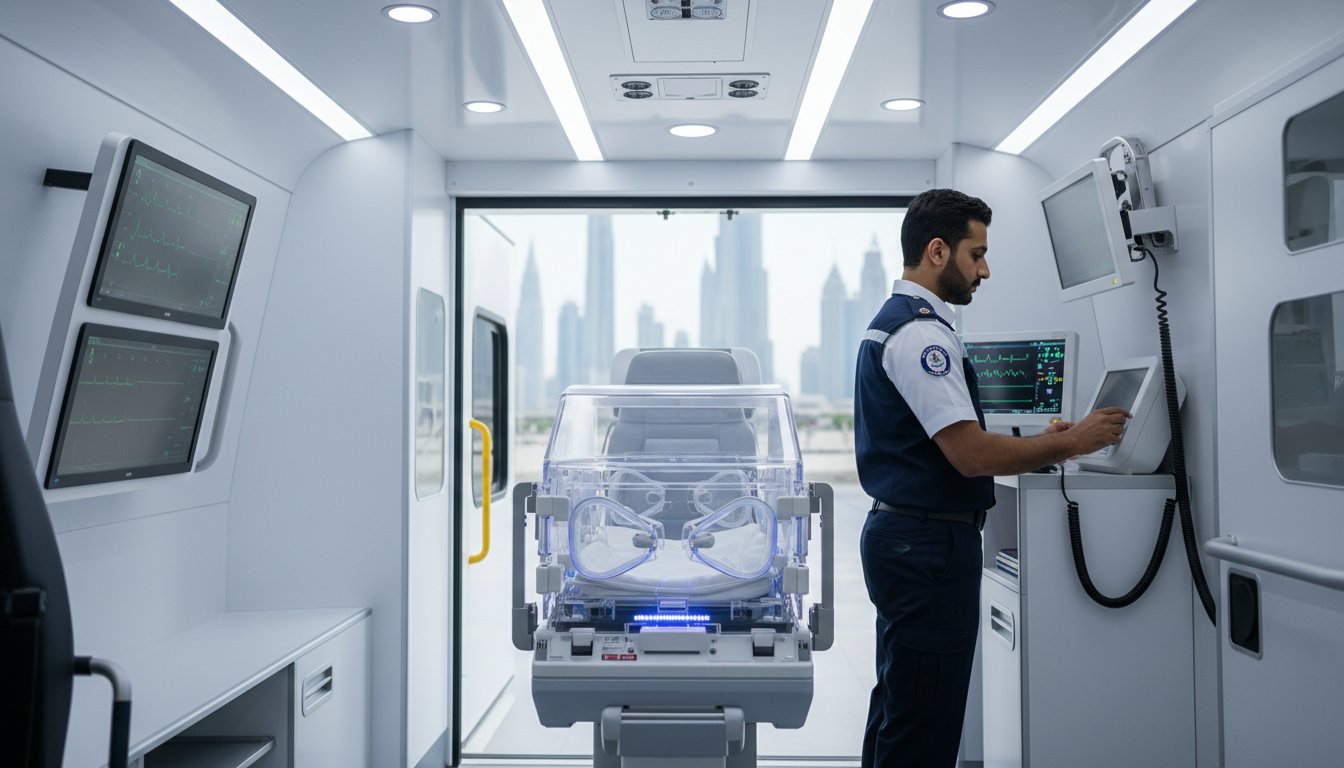
In the peak of a 50°C Dubai summer, a standard ambulance conversion isn't just insufficient; it's a critical risk to a newborn's life. You understand that transporting a fragile neonate requires more than just a siren and a stretcher. It demands a controlled environment where temperature, vibration, and medical precision are managed to the smallest degree. Partnering with a specialized neonatal ambulance fabricator is the only way to ensure these delicate patients remain stable during high-stakes transfers across the Emirates.
You'll discover the rigorous technical engineering standards required to combat extreme Gulf heat and the advanced fabrication processes that eliminate harmful road vibrations. We'll outline the specific RTA and UAE health authority regulations you must navigate to ensure your fleet is fully compliant and mission-ready. This guide previews the precision engineering involved in our process, covering everything from redundant cooling systems to in-house CNC-machined custom medical mounts designed for maximum stability.
Key Takeaways
- Understand why standard ALS vehicles are insufficient for newborn transport and how specialized mobile NICUs provide life-saving stability for the most fragile patients.
- Learn how a leading neonatal ambulance fabricator uses precision CNC machining and laser-cut reinforcements to secure heavy medical equipment in a sterile, easy-to-sanitize environment.
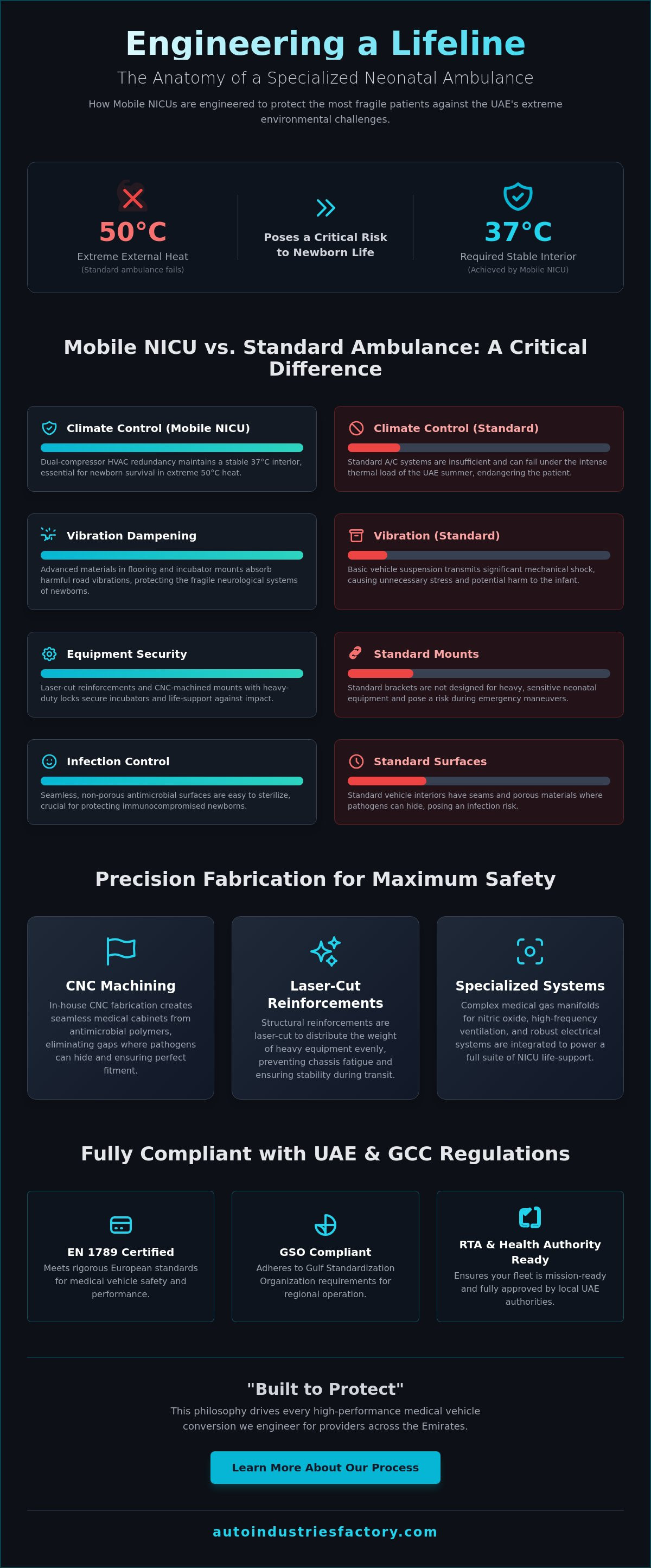
- Discover the engineering required to maintain a stable 37°C internal climate despite the UAE’s extreme 50°C external heat through dual-compressor HVAC redundancy.
- Identify the essential EN 1789 and GSO safety standards required to ensure your specialized medical fleet is fully compliant with UAE and GCC regulations.
- Explore the "Built to Protect" philosophy that drives high-performance medical vehicle conversions for healthcare providers in Dubai, Abu Dhabi, and across the Emirates.
The Critical Role of a Neonatal Ambulance Fabricator in the UAE
Auto Industries Factory (AIF) specializes in engineering high-precision vehicle conversions that transform standard chassis into life-saving mobile environments. A neonatal ambulance is far more than a transport vehicle; it is a mobile Intensive Care Unit (NICU) specifically designed for the most fragile patients. These units are built to sustain newborns who require critical care during the transition between medical facilities. Selecting an expert neonatal ambulance fabricator ensures that every component, from the oxygen supply to the vibration-dampening floor, meets rigorous international medical standards.
Standard Advanced Life Support (ALS) ambulances often lack the specialized infrastructure required for specialized neonatal transport. In cities like Dubai and Abu Dhabi, where specialized pediatric centers are often miles apart, the stability of the transport environment is non-negotiable. Precision fabrication directly impacts mortality rates by maintaining a thermal neutral environment and providing uninterrupted mechanical ventilation. As the UAE’s healthcare sector expands, there is a growing demand for these specialized pediatric emergency services to support the country's world-class medical network.
To better understand the complexity of these mobile units and their impact on patient outcomes, watch this helpful video:
Neonatal vs. Standard Ambulance Conversions
A specialized conversion requires a complete overhaul of the vehicle’s internal architecture. Medical gas requirements are far more complex than in standard units; we install dedicated manifold systems designed for nitric oxide and high-frequency ventilation. Precision mounting points are also essential. Transport incubators must be secured with heavy-duty locking mechanisms that withstand sudden braking or impact. Additionally, the electrical systems must handle a massive load to power incubators, infusion pumps, and life-support monitors simultaneously without any risk of power failure.
Why Local UAE Fabrication Matters
Operating from our facilities in the Emirates allows us to design vehicles that handle the unique environmental challenges of the region. From the high humidity of Fujairah to the high-speed transit routes in Sharjah, our engineering accounts for local road conditions and extreme ambient temperatures. A local neonatal ambulance fabricator provides immediate response times for custom modifications and fleet maintenance. You can explore our about us page to see how our UAE-based expertise and rugged engineering support the nation’s critical healthcare infrastructure.
Engineering the Mobile NICU: Precision Fabrication Techniques
Turning a standard vehicle into a life-saving environment requires an engineering mindset that prioritizes precision over everything else. As a specialized neonatal ambulance fabricator, Auto Industries Factory (AIF) utilizes in-house CNC machining to create medical cabinetry with seamless joints. These smooth surfaces are critical for infection control; they leave no gaps where pathogens can hide. We use high-grade antimicrobial polymers and non-porous materials that withstand the aggressive sterilization protocols required in UAE hospitals and clinics.
Mounting heavy medical equipment like high-frequency ventilators and nitric oxide delivery systems demands more than just standard bolts. Our engineers use laser-cut structural reinforcements to distribute weight evenly across the chassis. This prevents metal fatigue and ensures that life-support systems remain anchored during emergency maneuvers. Because premature infants are extremely sensitive to environmental stress, we integrate advanced vibration dampening materials into the floor and incubator mounts. This specialized technology reduces mechanical shock significantly compared to standard ambulance builds, protecting the fragile neurological systems of neonates during transit across Dubai's urban infrastructure.
Advanced Medical Cabinetry and Ergonomics
AIF designs every interior layout to maximize the efficiency of the medical team. We utilize ergonomic mapping to ensure doctors and nurses can reach oxygen controls, suction units, and specialized neonatal medications without leaving their belted seats. The cabinetry includes dedicated, secure storage for compressed air and oxygen cylinders, meeting strict safety protocols for high-pressure gas. While European ambulance standards provide a baseline for general patient transport, neonatal units require customized fabrication to handle the unique dimensions and power requirements of transport incubators.
Structural Integrity and Patient Safety
The additional weight of a full neonatal life support suite often exceeds 200kg. We reinforce the vehicle chassis and suspension to maintain handling stability and braking performance under these specific loads. Every incubator securement point undergoes rigorous testing to ensure patient safety during transit. For a deeper look at our technical process, you can explore our ambulance conversion guide which details our commitment to structural excellence.
Our custom electrical looms are built with zero-fail redundancy. We install independent circuits for the incubator and ventilator to prevent power interruptions that could jeopardize a fragile life. If you're looking to upgrade your medical fleet with specialized vehicles, you can view our full range of conversion services to see how we handle complex engineering challenges for the UAE healthcare sector.
Climate Control and Redundancy: Surviving UAE Extremes
In the UAE, external ambient temperatures frequently peak at 50°C during the peak summer months. For a premature infant, even a 2-degree fluctuation in body temperature can lead to metabolic distress or respiratory failure. Auto Industries Factory (AIF) specializes in engineering thermal solutions that maintain a constant 37°C internal environment regardless of the desert heat outside. As a specialized neonatal ambulance fabricator, we prioritize 100% redundancy in every build. This involves installing dual-compressor HVAC systems where each unit is capable of cooling the entire patient compartment independently. If one compressor fails, the secondary system engages immediately to prevent thermal spikes.
We use high-performance, multi-layer thermal insulation with a high R-value to line the vehicle walls, floor, and ceiling. This creates a thermal vault that resists the intense solar radiation typical of Dubai and the Northern Emirates. Our engineering team calculates the heat load for every square centimeter of the cabin to ensure the cooling capacity exceeds the harshest local conditions by at least 30%.
HVAC Engineering for the Middle East
Airflow management is a critical safety factor. Traditional vents can create localized cold spots or drafts that cause neonatal hypothermia. Our custom ducting systems distribute air evenly through perforated ceiling panels. This ensures the ambient temperature remains stable without blowing directly on the incubator. Each unit features independent rear climate controls with digital sensors accurate to 0.1°C. To handle the unique environment of the UAE, we integrate heavy-duty dust and sand filtration systems. These filters prevent desert particulates from clogging the cooling coils during long-distance transfers between medical facilities.
Electrical System Reliability
Neonatal transport requires massive, stable power for life-critical equipment. A standard vehicle alternator can't handle the simultaneous draw of ventilators, infusion pumps, and nitric oxide delivery systems. We install high-output alternators and dedicated medical-grade inverters to manage these loads. Backup battery banks provide up to 4 hours of autonomous power if the engine is shut off. Shore power integration allows the medical team to pre-cool the cabin and charge all equipment while parked at the hospital bay. Every neonatal ambulance fabricator project we undertake follows a strict testing phase to ensure the electrical grid remains stable under maximum load.
The 'Zero-Failure' electrical protocol ensures that every critical life-support component has three independent power paths to guarantee uninterrupted operation during transit.
Compliance and Standards for UAE Medical Fleets
Operating a specialized medical unit in the Emirates requires strict adherence to international and local safety benchmarks. A professional neonatal ambulance fabricator must integrate EN 1789 standards into the vehicle's structural DNA. This European regulation governs medical vehicles and their equipment, ensuring that every cabinet, bracket, and medical mount survives a 10G crash test. In the GCC, the GSO (GCC Standardization Organization) mandates additional climate-specific requirements. These protocols ensure that heavy-duty HVAC systems maintain a steady internal temperature of 22°C even when external desert temperatures exceed 50°C during peak summer months.
Local licensing adds a final layer of scrutiny. The Dubai Health Authority (DHA) and the Department of Health (DOH) Abu Dhabi inspect clinical layouts to confirm they meet neonatal intensive care benchmarks. Once medical approval is secured, the RTA (Roads and Transport Authority) conducts a technical inspection at centers like Tasjeel or Shamil. They verify weight distribution, axle loads, and emergency lighting before issuing a specialized vehicle license. Since 2021, 100% of new medical fleet additions in the UAE must meet these unified safety codes to operate on public roads.
The Certification Process
Success in fleet deployment starts with rigorous third-party testing. We subject every conversion to quality control protocols, including electrical load analysis for high-draw neonatal incubators and oxygen manifold pressure tests. You'll need a comprehensive documentation pack for health authority approval. This includes technical drawings, material safety data sheets, and structural integrity certificates. Auto Industries Factory (AIF) offers expert compliance consulting to navigate these bureaucratic hurdles. We ensure your documentation is flawless before submission to the Ministry of Health or the RTA.
Choosing the Right Chassis for Neonatal Use
The chassis selection determines the stability of the fragile life-support environment. We often compare the Toyota Land Cruiser and GMC Savana based on your specific operational area. The Land Cruiser is the gold standard for rugged stability and 4x4 capability in rural areas like Ras Al Khaimah or the Hatta region. However, the GMC Savana provides a wider interior for dual-incubator setups. As a specialized neonatal ambulance fabricator, we frequently implement extended roof modifications. This creates a vertical workspace of at least 1.8 meters, allowing clinicians to stand fully while attending to the infant. We also install advanced air suspension systems. These upgrades reduce road-induced vibrations by 35%, which is critical for protecting the fragile central nervous systems of premature babies during transit.
Auto Industries Factory: The Leading UAE Neonatal Ambulance Fabricator
Auto Industries Factory (AIF) specializes in high-precision medical vehicle conversions that exceed standard emergency specifications. With over 15 years of engineering excellence across Dubai and Ajman, we've established ourselves as a premier neonatal ambulance fabricator. Our "Built to Protect" philosophy isn't just a slogan; it's a rigorous engineering standard applied to every weld and electrical circuit. We understand that neonatal transport requires a vibration-free environment and 100% power redundancy for life-support systems. Whether we're upfitting a fleet for government health authorities or specialized private clinics, our team ensures every vehicle meets stringent UAE safety regulations and international healthcare standards.
Our approach combines heavy-duty durability with the delicate requirements of infant care. We don't just install equipment; we re-engineer the vehicle's DNA. This includes specialized suspension tuning to minimize road shock and the integration of medical-grade interior finishes that are 100% seamless for superior infection control. By maintaining total control over the supply chain, we deliver solutions that are both technically advanced and built to withstand the unique climate challenges of the Middle East.
Our Fabrication Capability
Our 25,000 square foot facility in Ajman houses advanced machinery that keeps the entire manufacturing process in-house. We utilize CNC laser cutting for precision brackets and press brakes for heavy-duty structural reinforcement. This vertical integration allows us to maintain strict quality control while offering shorter lead times than competitors who outsource their metalwork. Our expertise isn't limited to medical units. You can see our diverse engineering skills in our police vehicle modifications, where we apply the same rugged durability required for law enforcement to our life-saving neonatal units. From the initial chassis reinforcement to the final anti-bacterial paint finish, every step happens under our direct supervision.
Get a Technical Consultation
Starting your neonatal fleet project with AIF is a collaborative process. We begin with a technical consultation to map out your specific requirements, such as incubator dimensions, oxygen storage capacity, and onboard telemetry systems. Our engineers design layouts that maximize ergonomic efficiency for paramedics while ensuring the infant remains in a stable, climate-controlled zone. Once the design is finalized, our fabrication team begins the conversion with millimetric precision. We provide comprehensive support throughout the UAE, ensuring your fleet remains operational with dedicated maintenance services and rapid spare parts availability. Ready to upgrade your emergency response capabilities? Contact Auto Industries Factory for a specialized quote and let our engineers build a solution that protects your most vulnerable patients.
Secure the Future of Neonatal Care with Precision Engineering
The stakes for neonatal transport in the UAE couldn't be higher. Every second counts when moving fragile lives across Dubai or the Northern Emirates. It's why precision engineering isn't just a luxury; it's a life-saving necessity. Auto Industries Factory (AIF) delivers this through advanced in-house CNC and laser precision technology. We ensure every mobile NICU meets rigorous GSO and EN standards to guarantee safety under the harshest environmental conditions. Our conversions provide the reliability that medical teams need during critical transit windows.
Choosing a specialized neonatal ambulance fabricator means you're investing in redundant climate control systems that withstand 50-degree Celsius heat without failure. Our team focuses on rugged durability and flawless execution for every custom conversion. We're proud to be a trusted UAE-based manufacturer supporting the region's expanding healthcare infrastructure. You'll find that our commitment to mission-critical reliability transforms standard vehicles into specialized medical environments. Let's discuss how we can customize your fleet to meet the highest international medical specifications today.
Request a Technical Consultation for Your Neonatal Fleet
We look forward to helping you build a fleet that protects the UAE's most vulnerable patients with world-class engineering and dependable performance.
Frequently Asked Questions
What makes a neonatal ambulance different from a standard ambulance?
A neonatal ambulance functions as a mobile Level III Neonatal Intensive Care Unit (NICU). It differs from a standard ambulance by incorporating advanced vibration isolation systems and dedicated gas manifolds for medical air and oxygen. As a specialized neonatal ambulance fabricator, AIF ensures these units include 220V power inverters with 4-hour battery backups to keep incubators and ventilators running during transit.
How do you ensure the cooling system doesn't fail in the UAE summer?
We install reinforced 18,000 BTU dual-evaporator cooling systems to combat the 50°C UAE summer heat. These units utilize high-performance thermal insulation in the wall panels to guarantee a stable 22°C internal temperature. We also include an external shore power connection. This allows the climate control to run while the vehicle is parked at the hospital without idling the engine.
Which vehicle chassis is best for a neonatal conversion in the UAE?
The Mercedes-Benz Sprinter and Ford Transit 350 HD are the most reliable chassis for neonatal conversions. These models offer the necessary 1.9-meter internal height and a wheelbase exceeding 3,600mm. This size provides enough floor space for the incubator, two medical seats, and life-support equipment. Their electronic stability programs are essential for the smooth transport of fragile infants on high-speed roads.
Are your neonatal ambulances compliant with DHA and DOH Abu Dhabi standards?
Every vehicle we fabricate complies with DHA and DOH Abu Dhabi technical specifications. We follow the EN 1789:2020 standard for medical vehicles and their equipment. Our engineering team manages the entire certification process. This includes the final inspection and registration with the Ministry of Health and Prevention (MOHAP) to ensure the vehicle is road-legal and mission-ready for any UAE hospital.
Can you integrate existing hospital incubators into a new conversion?
We can definitely integrate your existing hospital incubators into a new conversion. Our workshop uses CNC laser cutting to create custom mounting brackets and rail systems compatible with brands like Dräger or GE. These mounts are tested to withstand 10g centrifugal force. This ensures the equipment remains stationary during emergency maneuvers or sudden braking on UAE highways, protecting the infant inside.
What is the typical lead time for a custom neonatal ambulance fabrication?
The fabrication of a custom neonatal ambulance generally requires 45 to 60 working days. This period begins once the base vehicle arrives at our Ajman factory. The timeline covers precision metalwork, electrical wiring for medical gases, and the installation of anti-bacterial interior surfaces. We provide a detailed project schedule at the start of every build to keep hospital administrators and fleet managers informed.
Do you provide maintenance services for specialized medical vehicles in Sharjah and Ajman?
Auto Industries Factory (AIF) specializes in providing comprehensive maintenance for medical fleets across Sharjah, Ajman, and Dubai. We offer 24/7 technical support for both the vehicle mechanicals and the specialized medical interior. Our service contracts include quarterly inspections of the oxygen delivery systems and electrical inverters. This proactive approach prevents equipment failure during critical patient transfers between Emirates.
Is it possible to armor a neonatal ambulance for high-risk environments?
It's possible to armor these units to BR6 or BR7 standards for high-risk zones. We reinforce the suspension and braking systems to manage the extra 1,200kg of ballistic protection required for safety. As a premier neonatal ambulance fabricator, we ensure the armoring doesn't compromise the medical cabin's functionality. The design maintains all necessary ports for medical gases while providing 360-degree ballistic protection.


