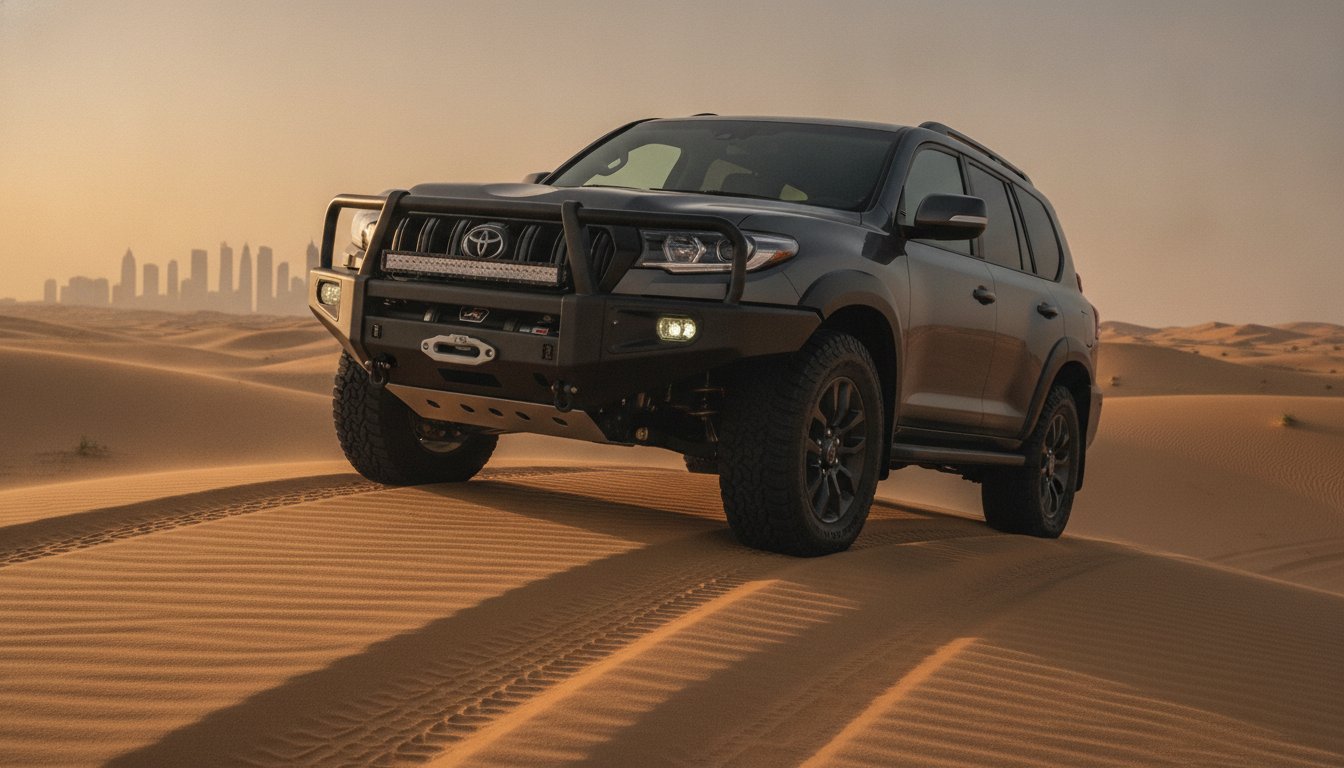
A standard retail bull bar might look the part on a showroom floor, but it often becomes a liability when pushed to its limits in the bush or on a tactical mission. You already know that extreme off-road conditions demand more than just a bolt-on accessory; they require a component that integrates with your vehicle's specific DNA. When you invest in a custom bull bar design for 4x4, you're not just buying a piece of metal. You're addressing the common failures of generic equipment, such as compromised cooling, blocked specialized sensors, or structural fatigue under heavy winch loads.
It's frustrating when mass-produced gear forces you to choose between protection and vehicle performance. We'll show you how professional engineering balances structural integrity with mission-ready functionality. You'll discover the precise process behind fabricating bars that improve approach angles and maintain safety compliance without overloading your suspension. This article breaks down the transition from CAD modeling to high-precision laser cutting, ensuring your vehicle remains a reliable, high-performance asset in the field.
Key Takeaways
- Learn why 3D scanning and CAD modeling are essential for simulating impact zones and ensuring a perfect chassis fit.
- Discover how a professional custom bull bar design for 4x4 prioritizes structural integrity over simple aesthetics for maximum protection.
- Evaluate the trade-offs between high-tensile steel and T6 aluminium to balance vehicle weight with heavy-duty durability.
- Understand how to integrate high-capacity winches and LED lighting while maintaining optimal engine cooling.
- Explore the specialist engineering required to adapt bull bars for mission-critical platforms like safari and ambulance conversions.
What is Custom Bull Bar Design for 4x4 Vehicles?
Custom bull bar design for 4x4 vehicles isn't about adding a decorative accessory. It's a rigorous engineering discipline focused on creating a protective shell that integrates directly with a vehicle’s chassis. Understanding the Bull bar design and history reveals that these components evolved from simple wooden rails into complex, high-tensile steel structures designed to absorb massive kinetic energy. Unlike mass-market alternatives, a custom build is tailored to the specific weight, geometry, and cooling requirements of your vehicle platform.
Many retail options are mere "brush guards." These are often lightweight, thin-walled tubes that fold under impact, potentially causing more damage to the radiator or headlights than the obstacle itself. A professional structural bar is designed to protect both the occupants and the critical engine components during high-speed animal strikes or low-speed technical maneuvers. For military and safari fleets, off-the-shelf products usually lack the durability required for continuous operation in punishing environments.
To better understand this concept, watch this helpful video:
The Primary Functions of a Professional Bull Bar
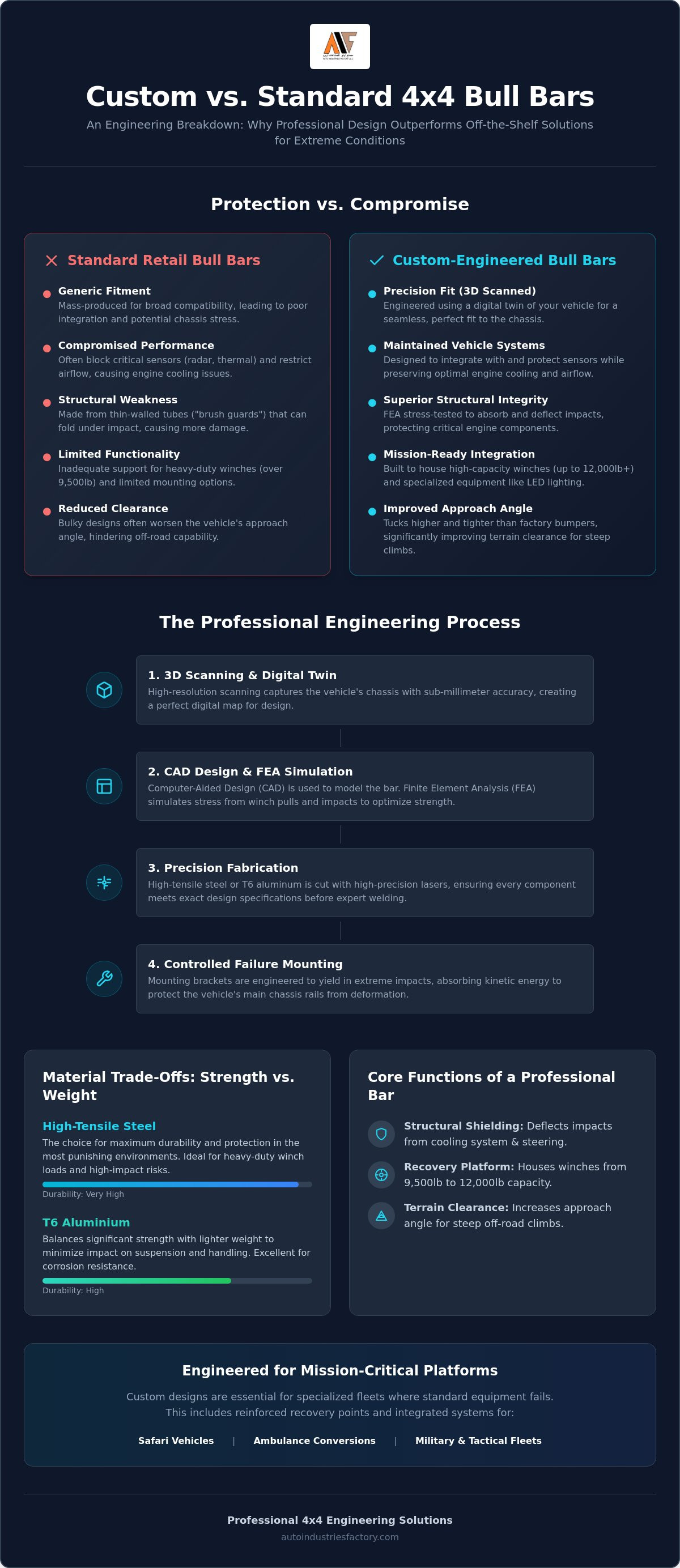
Professional bars serve three critical roles. First, they provide structural shielding, deflecting impacts away from the cooling system and steering components. Second, they act as a recovery platform, housing winches with 9,500lb to 12,000lb capacities. Finally, they improve terrain clearance. Custom designs often tuck higher and tighter than factory bumpers, which significantly increases the vehicle’s approach angle for steep off-road climbs. This ensures the bar doesn't snag on rocks or sand dunes during technical driving.
When to Choose Custom Over Commercial Off-The-Shelf (COTS)
Retail bars are built for the average user, but specialized operations have unique requirements. If your vehicle uses advanced radar for adaptive cruise control or specialized thermal imaging sensors, standard bars often block their field of view. Custom fabrication allows for the relocation of these sensors into protected housings. This is particularly vital for safari vehicle conversions. Operators in remote areas need reinforced recovery points and specialized mounting for sand tracks or additional lighting that retail catalogs don't provide. Precision engineering ensures these additions don't compromise the vehicle's cooling or airflow.
The Engineering Phase: CAD and Precision Design
Precision engineering starts long before the first piece of metal is cut. Modern custom bull bar design for 4x4 vehicles relies on high-resolution 3D scanning to create a digital twin of the vehicle's chassis and front-end geometry. This process captures every bolt hole, sensor location, and cooling duct with sub-millimeter accuracy. By starting with a perfect digital map, engineers ensure the final product integrates seamlessly with the vehicle's lines without requiring invasive modifications or forced fitment. This level of detail is what separates a professional build from a generic accessory.
Once the scan is complete, the design moves into Computer-Aided Design (CAD) software. We use this environment to simulate stress points and impact zones using Finite Element Analysis (FEA). This allows us to predict how the bar will react under the strain of a 12,000lb winch pull or a high-speed frontal collision. Engineering for maximum protection means balancing structural rigidity with weight distribution. Excessive weight on the front axle leads to premature suspension wear and compromised handling, so every millimeter of material is optimized for strength-to-weight efficiency. If you require this level of technical precision for your fleet, explore our professional modification services.
Chassis Mounting and Structural Integrity
A common misconception is that a bull bar should be as rigid as possible. In reality, the mounting system must be engineered as the "weakest link" in a controlled hierarchy of failure. During an extreme impact, the mounting brackets are designed to yield slightly, absorbing kinetic energy before it can deform the vehicle’s main chassis rails. This preserves the structural integrity of the frame and aligns with modern crumple zone technology. We prioritize bolt-on designs over welding directly to the frame, as this allows for easier replacement and maintains the metallurgical properties of the factory chassis. Adhering to Australian bull bar safety standards ensures these mounting systems are both robust and legally compliant.
Airbag and Sensor Compatibility
Modern 4x4s are packed with sophisticated safety tech that a poorly designed bar can easily disable. We utilize "crush cans" within the mounting brackets, which are precisely tuned components that allow the vehicle’s SRS sensors to detect a collision and trigger airbags only when necessary. Airbag-safe mounting brackets are essential to ensure the vehicle's safety systems deploy exactly as the manufacturer intended during a collision. Additionally, our custom bull bar design for 4x4 platforms includes dedicated housings for Adaptive Cruise Control (ACC) radar and parking sensors. These are positioned to maintain a clear field of view, preventing "ghost" obstacles or signal loss while ensuring the engine receives optimal airflow through engineered apertures.
Materials and Fabrication: Building for Durability
The transition from a digital model to a physical asset requires uncompromising precision and a deep understanding of metallurgy. In our facility, we bridge this gap using in-house laser cutting and CNC machining to ensure every component meets exacting tolerances. Custom bull bar design for 4x4 platforms demands this level of accuracy to ensure that complex geometric shapes wrap tightly around the vehicle's bodywork while maintaining structural rigidity. This physical fabrication process eliminates the weak points often found in manual, hand-cut alternatives, ensuring the protective shell remains resilient under extreme stress.
Material selection is the most critical decision in the fabrication phase. As of early 2026, global market shifts have seen steel mill products rise by over 20%, yet high-tensile steel remains the industry standard for maximum impact protection. We utilize CNC bending to create seamless curves, which increases the bar's inherent strength by maintaining the metal's grain structure. When it's time to join these components, our master craftsmen employ TIG and MIG welding techniques. These professional welds provide the mission-critical strength required for vehicles operating in the harshest environments on the planet, such as remote safari trails or military zones.
Steel vs. Aluminium: The Professional Verdict
Choosing the right material depends entirely on the vehicle's mission profile. High-tensile steel is the gold standard for custom bull bars and bumpers intended for high-impact environments. While carbon steel costs approximately $0.80 to $1.20 per kg, its durability is unmatched for heavy-duty recovery. Conversely, T6 aluminium is the preferred choice for desert reconnaissance or light-duty patrol. It offers a weight saving of 25 to 35 kg compared to steel, though it comes at a higher material cost of $3.20 to $4.50 per kg. For specialized fleets, hybrid designs that pair steel mounting brackets with aluminium outer shells often provide the best balance of protection and payload management.
Finishing and Corrosion Resistance
A bull bar is only as good as its defense against the elements. Every custom bull bar design for 4x4 vehicles must undergo a rigorous finishing process to prevent oxidation and structural degradation. We start with industrial sandblasting to clear the surface, followed by a zinc-rich priming stage. For the final coat, we offer both high-durability powder coating and industrial-grade painting. Powder coating provides a thick, resilient barrier against stone chips and abrasions, while our painting facility allows for exact custom colour matching. This is essential for police vehicle modifications, where the bar must integrate seamlessly with official fleet liveries without compromising its protective properties.
Performance Features: Winches, Lighting, and Airflow
Mission-ready 4x4s require more than just impact protection. They need a functional platform that supports recovery operations and auxiliary lighting while preserving the vehicle's mechanical health. A professional custom bull bar design for 4x4 platforms integrates these features into the core architecture rather than treating them as bolt-on afterthoughts. This approach ensures that adding a 50kg winch or a bank of LED spot lamps doesn't degrade the vehicle's approach angle or its ability to shed heat in high-ambient temperatures. By optimizing the bar's profile, we can actually improve terrain clearance for steep climbs and technical maneuvers compared to factory bumpers.
Winch Integration and Recovery Points
Standard retail bumpers often lack the internal bracing required to handle the extreme torsional forces of a heavy recovery. We design winch cradles specifically for 9,500lb to 12,000lb capacities, using reinforced steel plates that distribute the load evenly across both chassis rails. Accessibility is a priority in our engineering process. We include dedicated ports for clutch handles and remote control cables so operators don't have to reach into dangerous pinch points during a recovery. Our structural designs prioritize the following features:
- Chassis-Mounted Recovery Points: Rated points are integrated directly into the mounting brackets to transfer force to the strongest part of the vehicle.
- Recessed Lighting Mounts: Protected housings for LED light bars and spot lamps prevent damage from low-hanging branches or debris.
- High-Lift Jack Points: Reinforced T-slots or circular ports allow for stable vehicle lifting during tyre changes in soft sand or mud.
Thermal Management and Airflow Design
One of the most overlooked aspects of front-end protection is its impact on the cooling system. A bar that blocks the radiator or intercooler will lead to rapid heat soak and engine derating, especially in desert environments or during heavy towing. We address this by utilizing expanded metal mesh and precision CNC-cut vents that facilitate maximum airflow. The height and profile of the bar are carefully calculated to prevent air from tumbling over the bonnet, which can reduce cooling efficiency at high speeds. The total open area of the bull bar vents must be mathematically balanced against the radiator’s surface area to ensure that engine operating temperatures remain stable during high-stress off-road operations.
Don't compromise your vehicle's mechanical health for the sake of protection. Get a technical consultation for your fleet's custom fabrication needs to ensure your vehicles remain cool and capable in the field.
The Specialist Advantage: Mission-Ready 4x4 Solutions
Standardized equipment rarely meets the rigorous demands of specialized vehicle fleets. When lives or high-value assets are at stake, a generic accessory is a point of failure you can't afford. A custom bull bar design for 4x4 platforms allows for the integration of role-specific hardware that mass-produced bars simply ignore. By utilizing our "one-roof" solution, which spans from initial CAD modeling to final industrial painting, we ensure that every protective component is optimized for the vehicle's specific mission profile. This is especially critical for high-performance platforms like the Toyota Land Cruiser and Hilux, where structural synergy is paramount.
In a remote ambulance conversion, the bull bar serves as a primary insurance policy against immobilization. Medical vehicles operating in rugged, unpaved environments face a constant risk of animal strikes or terrain impacts that could disable the engine. Our custom fabrication ensures these vehicles remain operational in the field, protecting both the medical crew and the patients. For large-scale operators, our in-house laser cutting and CNC machining capabilities allow for rapid fleet deployment without the lead times associated with third-party suppliers.
Safari and Tour Operator Requirements
Safari operators require a unique blend of protection and utility. We design heavy-duty bars for the Toyota Land Cruiser 70 series that feature reinforced top hoops to deflect thick brush and branches away from the windscreen and snorkel. These bars often incorporate integrated step treads, providing guides or mechanics with easy engine bay access for field maintenance. Our custom bull bar design for 4x4 safari builds is engineered to work seamlessly with heavy-duty roof racks and high-mount snorkel systems, ensuring the vehicle's intake remains clear even in dusty or flooded conditions.
Military and Security Fleet Standards
Tactical and security vehicles demand a different set of engineering priorities. We specialize in non-reflective, matte finishes that minimize the vehicle's visual signature during night operations. These builds often include mounting points for blackout lighting and thermal sensors that must remain unobstructed. For high-threat environments, our bars are reinforced for "ramming" capabilities, allowing security patrol vehicles to clear obstacles or push disabled vehicles without sustaining radiator damage. For specialized fleet requirements, contact Auto Industries Factory LLC to discuss your specific fabrication needs.
Secure Your Fleet with Engineered Protection
Mission success in the field depends on equipment that withstands the most punishing environments on earth. As we've explored, a professional custom bull bar design for 4x4 vehicles is an engineering solution that integrates CAD precision with high-tensile materials. By prioritizing structural synergy over simple aesthetics, you ensure that your vehicle's cooling, safety sensors, and approach angles remain optimized for peak performance. Whether you're managing a tactical security fleet or a remote safari operation, the right front-end protection prevents immobilization and protects your most valuable assets.
Auto Industries Factory LLC brings master craftsmanship to every build, utilizing in-house laser cutting and CNC machining to meet mission-critical standards. We specialize in robust conversions for Toyota Land Cruiser and Hilux platforms, delivering a one-roof solution from initial design to industrial finish. Don't leave your protection to chance with generic retail accessories. Request a Consultation for Your Custom Fleet Accessories today. Your team deserves the dependability that only expert engineering can provide.
Frequently Asked Questions
Do custom bull bars affect the vehicle’s airbag deployment?
Correct engineering ensures airbags deploy exactly as the manufacturer intended. We utilize precisely tuned crush cans within the mounting brackets to simulate factory crumple zones. This prevents the bar from being too rigid, which could otherwise interfere with SRS sensors during a collision. Professional fabrication always prioritizes these safety systems to maintain occupant protection.
What is the best material for a 4x4 bull bar: steel or aluminium?
The best material depends entirely on your specific mission profile. Steel is the gold standard for high-impact protection in rugged environments, while aluminium is preferred for weight savings in desert or light-duty roles. A professional custom bull bar design for 4x4 vehicles often involves selecting the material that balances your payload requirements with the terrain you'll face.
Will a custom bull bar cause my engine to overheat?
Overheating is prevented through calculated airflow apertures and precision venting. We use CNC-cut vents and expanded metal mesh to ensure the radiator and intercooler receive the necessary volume of air. This is critical for vehicles operating in high-ambient temperatures or under heavy towing loads where maintaining cooling efficiency is a top engineering priority.
Can I mount a winch to any custom bull bar design?
No, a winch must be mounted to a dedicated, reinforced cradle that is integrated into the bar’s structural frame. A professional custom bull bar design for 4x4 platforms includes a heavy-duty winch plate that ties directly into the chassis mounts. This ensures the bar doesn't twist or fail under the extreme torsional forces generated during a 12,000lb recovery operation.
Do I need to upgrade my suspension after installing a custom bull bar?
Generally, a suspension upgrade is recommended to account for the additional front-end weight. Adding a steel bar and a winch increases the load on the front axle, which can lead to nose-diving during braking and reduced suspension travel. Fitting heavy-duty springs or adjustable struts helps maintain the vehicle's factory handling, ground clearance, and overall stability.
Are custom bull bars legal for road use?
Legality depends on your local regulations and the bar's specific safety features. In regions like Australia, bars must comply with ADR standards, ensuring they lack sharp edges and don't block headlights or indicators. In the United States, rules vary by state. Engineering a bar that follows these safety guidelines is essential for maintaining road legality and insurance coverage.
How much does a custom bull bar design and fabrication cost?
The total cost is determined by the complexity of the engineering and the materials selected. High-tensile steel and T6 aluminium have different market rates, and the inclusion of specialized sensor mounts or winch cradles will influence the final price. We provide detailed estimates based on the specific mission requirements and the vehicle platform of your fleet.
Can a custom bull bar be colour-matched to my vehicle?
Exact colour matching is achieved through our industrial painting process. While powder coating is the standard for maximum durability against stone chips, we can apply automotive-grade paint to match your vehicle's factory finish or specific fleet livery. This ensures the protective hardware integrates seamlessly with the vehicle's appearance without sacrificing its long-term corrosion resistance.


