
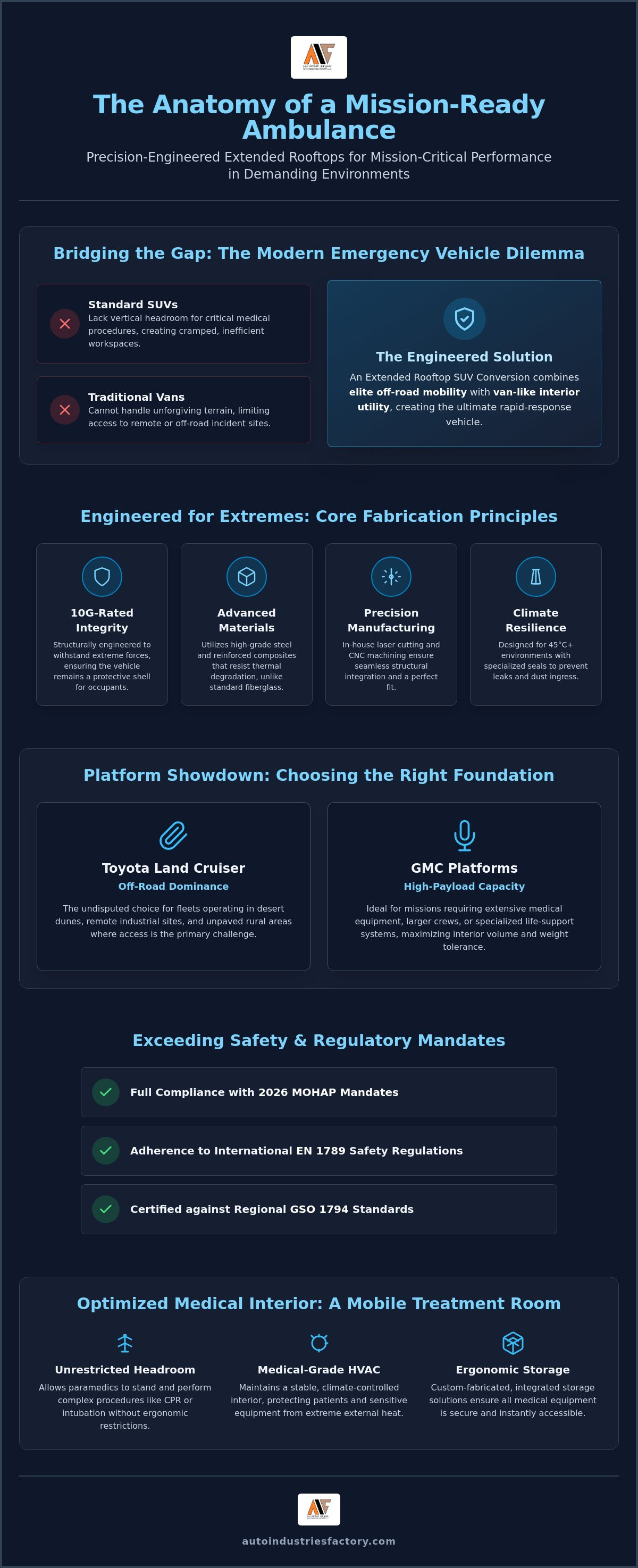
An extended rooftop is not just a height modification; it's a precision structural redesign that bridges the gap between SUV mobility and van-like utility. You shouldn't have to choose between a vehicle that can reach a remote desert site and one that provides enough vertical space for life-saving medical procedures. Many fleet managers find that standard SUVs lack the necessary headroom for complex interventions, while traditional high-roof vans simply cannot handle the unforgiving UAE terrain.
We understand that maintaining structural integrity while expanding interior volume is a mission-critical challenge. This guide shows you how to achieve 10G-rated durability and full compliance with GSO 1794 and EN 1789 standards. By integrating advanced laser cutting and CNC machining, a professional patient transport vehicle conversion UAE specialists provide ensures your fleet meets the 2026 mandates from MOHAP and national and local health authorities. We will explore how these engineering solutions protect your crew and patients in extreme 45°C environments while securing the long-term reliability of your Toyota or GMC platforms. Discover how to build a fleet that remains robust, compliant, and ready for the most demanding emergency response missions.
Key Takeaways
- Understand the critical engineering differences between standard factory roofs and custom-fabricated extensions for maximum medical headroom.
- Learn how in-house laser cutting and CNC machining provide the 10G-rated structural integrity required for mission-critical emergency response.
- Identify the optimal platform for your fleet by comparing the off-road dominance of the Toyota Land Cruiser with the high-payload capacity of GMC conversions.
- Discover how a professional patient transport vehicle conversion UAE ensures full compliance with 2026 MOHAP standards and EN 1789 safety regulations.
- Master interior optimization techniques that integrate medical-grade HVAC systems and ergonomic storage without sacrificing mobility in extreme desert conditions.
What is an Extended Rooftop Ambulance: Space, Safety, and Specialised Utility
An extended rooftop ambulance represents a significant shift from traditional emergency vehicle design. It isn't just a vehicle with a taller shell; it's a precision-engineered unit where the roof is structurally modified to increase head clearance. In the UAE market, the difference between a factory high-roof and a professional aftermarket extension is stark. Factory roofs often prioritize cargo volume. In contrast, a high-quality patient transport vehicle conversion UAE focuses on medical utility and crew safety, ensuring every millimeter of added height serves a functional purpose.
Vertical space is a non-negotiable requirement for paramedics. Performing complex procedures like CPR or intubation requires the medic to stand or move without restriction. Standard SUVs often force crew members into cramped, ergonomic nightmares. A professional patient transport vehicle conversion UAE build creates a mobile treatment room that meets the high standards of EMS, military, and remote industrial operators. Understanding Ambulance Types and Modification helps fleet managers recognize why these specialized builds are the preferred choice for mission-critical applications.
To better understand this concept, watch this helpful video:
The Evolution of High-Clearance Medical Vehicles
The transition from basic hardtops to modern extended designs reflects a deeper commitment to engineering. Modern 2026 standards have revolutionized vehicle stability. We don't just add height; we manage the center of gravity. Modern extensions now feature aerodynamic profiles. These shapes are designed to reduce fuel consumption and minimize drag, which is vital for long-distance transfers across the Emirates. This evolution ensures that vehicles remain stable at high speeds while providing the interior volume of a much larger van.
Key Advantages Over Standard Van Conversions
SUV-based extended roof units offer superior off-road capabilities compared to heavy, traditional vans. This is a critical factor for fleets operating in desert dunes or unpaved rural areas. At Auto Industries Factory LLC, we prioritize structural rigidity. Many market options use fiberglass inserts that can fail under the UAE's intense heat. Our approach utilizes fully integrated fabrication that maintains the vehicle's safety cage. This results in better manoeuvrability in tight urban environments and greater durability on the open road. These engineering choices provide the ruggedness required for national emergency services operating in the most demanding environments.
Precision Engineering: How Extended Roofs are Fabricated for Mission-Critical Performance
Precision engineering transforms a standard chassis into a life-saving asset. While the previous section defined the utility of these vehicles, the fabrication process determines their survival in the field. A high-quality patient transport vehicle conversion UAE depends on the use of high-grade steel and reinforced composites. We avoid standard plastics because they lack the thermal stability required for the Arabian Peninsula. To achieve the 10G-rated structural integrity demanded by 2026 safety mandates, every joint is engineered to withstand extreme stresses; this ensures the vehicle remains a protective shell during high-speed maneuvers or off-road transit.
Fabrication must also solve the environmental challenges of the region. In temperatures that regularly exceed 45°C, standard automotive seals can degrade and leak. We utilize specialized sealing and waterproofing techniques that are specifically tested for extreme thermal expansion and contraction. This protects the sensitive medical electronics and maintains the efficiency of the medical-grade HVAC system. By focusing on these technical details, we ensure the roof extension doesn't just add space; it adds a layer of rugged dependability that standard factory builds can't provide.
The Role of CNC and Laser Cutting in Fabrication
The manufacturing process at Auto Industries Factory LLC begins with high-fidelity computer-aided design (CAD). We use in-house laser cutting and CNC machining to achieve tolerances measured in microns. This level of accuracy ensures the new roof extension aligns perfectly with the base vehicle's original pillars for a seamless, factory-finish look. Adhering to Ambulance Safety and Design Standards, our automated fabrication reduces human error in critical welding zones. This precision is why our specialized vehicle conversion solutions are trusted by national emergency services. It’s about creating a repeatable, high-strength bond that lasts the entire lifecycle of the fleet.
Structural Integrity and Reinforcement
Adding vertical volume significantly shifts a vehicle's center of gravity. To counter this, we reinforce the B and C pillars with high-tensile steel to support the added weight of the roof and overhead medical gear. This reinforcement is vital for maintaining vehicle integrity during a rollover. Our engineers apply advanced weight distribution strategies to ensure the vehicle doesn't become top-heavy, keeping high-speed handling predictable on UAE highways. For fleets operating in high-risk zones, we integrate techniques from our car armouring expertise. This specialized knowledge allows us to strengthen the vehicle’s safety cage without adding unnecessary bulk, ensuring the patient transport vehicle conversion UAE remains agile and mission-ready.
Comparing Platforms: Toyota Land Cruiser vs. GMC Extended Roof Conversions
Selecting the right chassis is the foundation of any successful patient transport vehicle conversion UAE project. While many fleet managers focus on the medical equipment, the engine and frame determine a unit's operational lifespan in the field. In the Emirates, two platforms dominate the market: the legendary Toyota Land Cruiser 78 and the heavy-duty GMC series. Each serves a distinct mission profile, and choosing the wrong one can lead to increased maintenance costs or mission failure in extreme conditions.
The decision often comes down to the primary operating environment. Desert dunes require mechanical simplicity and high ground clearance. Urban-to-rural transitions, however, often prioritize highway stability and interior workspace for complex medical interventions. Both platforms benefit from our in-house laser cutting and CNC machining, ensuring that the roof extension integrates perfectly with the original manufacturer's frame without compromising the vehicle's inherent strengths.
Toyota LC78: The King of Off-Road EMS
The Toyota LC78 Hardtop remains the global standard for rugged, off-road emergency services. Its greatest asset is mechanical simplicity. In remote regions like Al Dhafra or the Empty Quarter, where temperatures regularly exceed 50°C, the LC78's cooling system and robust suspension are vital. This platform is specifically designed for durability in high-heat environments. Key features that favor an extended roof build on this chassis include:
- Mechanical Simplicity: Easier to maintain in remote areas with minimal electronic diagnostic tools.
- Narrow Body Profile: Exceptional agility on unpaved tracks and narrow desert passages.
- Parts Availability: Toyota's extensive network across the UAE ensures that replacement parts are always accessible, reducing fleet downtime.
GMC Platforms: Power and Interior Volume
GMC-based extended roof ambulances have seen a rise in popularity for Advanced Life Support (ALS) missions. These units offer a wider chassis, which is essential for patient-centric layouts. Paramedics gain more room to move around the stretcher, a critical factor during long-haul transfers between regional clinics and major hospitals in Abu Dhabi or Dubai. The GMC platform provides the high torque and power output necessary to carry heavy medical payloads and specialized ALS kits without sacrificing acceleration or highway speed.
While medical fleets focus on patient stability, organizations coordinating non-emergency executive travel between these hubs can explore Hourly and Flat-Rate Chauffeur Service Fees for premium transport solutions.
Optimising the Medical Interior: Ergonomics and Equipment in High-Roof Environments
An extended roof provides the physical volume, but strategic internal engineering provides the utility. A high-performance patient transport vehicle conversion UAE fleets rely on must balance equipment density with paramedic movement. We design overhead storage compartments that utilize the vertical space created by the roof extension without obstructing the crew. This allows for the storage of lightweight, high-frequency items like bandages, IV starts, and diagnostic tools within arm's reach. By clearing the floor and mid-level walls of clutter, we create a safer environment for medics to move around the patient during transit.
Lighting and oxygen placement are critical for mission success. We integrate shadowless LED arrays directly into the high-roof ceiling. These arrays provide surgical-level visibility, which is essential for procedures like suturing or starting difficult IV lines in a moving vehicle. Oxygen systems and suction units are recessed into the side walls at shoulder height. This ensures immediate paramedic access while the medic remains safely belted in their seat. Every component is positioned based on ergonomic studies to minimize reach distances and improve response times.
Advanced HVAC and Air Filtration
Cooling a large interior volume in the UAE climate is a significant engineering challenge. With outdoor temperatures often exceeding 45°C, a standard vehicle AC system isn't enough. Our conversions feature independent, medical-grade HVAC units installed directly within the roof structure. This provides essential redundancy; if the primary vehicle AC fails, the patient compartment remains cool. We also integrate HEPA filtration systems to provide isolation capabilities for infectious disease transport. This ensures that the patient transport vehicle conversion UAE standards require remains a sterile and safe environment for both the patient and the crew.
Paramedic Ergonomics and Safety
Medic fatigue is a major factor in long-distance transfers between regional clinics. The high-roof clearance allows even tall paramedics to stand upright, significantly reducing back strain and physical exhaustion. Our interior layouts prioritize safety and decontamination through specific features:
- Strategic Seating: Swivel seats with three-point harnesses allow the medic to face the patient while remaining securely belted.
- Industrial-Grade Surfaces: We use non-slip flooring and antibacterial composite walls for rapid decontamination between missions.
- Recessed Equipment: All heavy monitors and defibrillators are mounted on 10G-rated brackets to prevent them from becoming projectiles in a collision.
Designing a workspace that protects your team is just as important as the vehicle's exterior durability. If you're ready to upgrade your fleet's operational capacity, explore our custom ambulance interior solutions to see how we maximize every centimeter of space.
Custom Fabrication Solutions: Why Professional Conversion Matters for Emergency Fleets
Professionalism in vehicle modification separates a temporary fix from a permanent fleet asset. At Auto Industries Factory LLC, we address the inherent risks of "bolt-on" roof extensions that often lead to structural fatigue over time. A substandard patient transport vehicle conversion UAE providers might offer could compromise the vehicle’s safety cage during high-stress maneuvers. We deliver fully integrated fabrication where the extension becomes an inseparable part of the original chassis. This end-to-end engineering approach ensures that the vehicle maintains its integrity across its entire operational lifecycle, regardless of the terrain it encounters.
Quality control is maintained through every phase of the build. Beyond the precision cutting and structural reinforcement discussed previously, we ensure that every unit undergoes rigorous testing before deployment. This commitment to excellence ensures full compliance with EN 1789 and other international medical standards. By treating the vehicle as a singular, unified system, we provide national emergency services with a robust platform that is built to perform in the high-stakes environments of the Emirates.
The 7-Step Conversion Process
Our comprehensive workflow is designed to move a vehicle from a standard factory state to a mission-ready unit with surgical precision. As detailed in our ambulance conversion pillar, this process includes everything from initial CAD design to the final vehicle painting. We utilize industrial-grade protective coatings that are essential for preventing corrosion in the saline coastal air of the UAE. Every unit is subjected to commissioning tests that prove the vehicle’s stability and medical equipment functionality under real-world stress conditions.
Future-Proofing Your Fleet in 2026
Operating an emergency fleet in 2026 requires a forward-looking strategy. We utilize modular interior designs that allow your patient transport vehicle conversion UAE to adapt as medical technology evolves. This means your fleet can be upgraded with new monitoring systems or diagnostic tools without requiring a complete structural overhaul. Choosing a partner with dedicated after-sales support is vital for maintaining the readiness of specialized vehicle conversions. Our engineering team provides the ongoing technical expertise needed to keep your fleet at the forefront of emergency medical response.
Consult with our engineering experts for your custom ambulance fleet to discover how our integrated fabrication solutions can enhance your operational capabilities.
Building the Future of UAE Emergency Response
Emergency fleets in 2026 require more than just extra space; they demand a foundation of mission-critical engineering. By choosing a professional patient transport vehicle conversion UAE specialist, you ensure that every roof extension is a structural asset rather than a liability. We've explored how in-house CNC and laser cutting technologies create the 10G-rated durability necessary for the Emirates' harshest environments. Whether you deploy on the rugged Toyota LC78 or the high-payload GMC platforms, your vehicles must be built to withstand extreme heat and demanding operational cycles.
Achieving this level of precision requires a partner dedicated to international medical standards and robust fabrication techniques. Our team delivers end-to-end solutions that protect your crew and maximize patient outcomes. Don't leave your fleet's reliability to chance. Request a Technical Consultation for Your Ambulance Fleet today to secure the engineering excellence your mission deserves. We look forward to building a safer, more capable future for your emergency operations.
Frequently Asked Questions
What is the main benefit of an extended roof over a standard ambulance?
The primary advantage is the significant increase in vertical headspace, which allows paramedics to stand upright and perform life-saving procedures like CPR or intubation without physical restriction. Unlike standard vans, an extended roof on an SUV platform maintains high ground clearance and off-road mobility. This combination is essential for reaching remote UAE sites while providing a professional, high-utility medical workspace for the crew.
Is an extended rooftop ambulance stable during high-speed emergency driving?
Yes, stability is maintained through precision engineering and strategic weight distribution. We reinforce the B and C pillars to handle the added load and utilize computer-aided design to ensure the vehicle’s center of gravity remains within safe limits. This structural integrity prevents top-heaviness; it ensures predictable handling during high-speed emergency response on both paved highways and unpaved desert terrain.
Can any SUV be converted into an extended rooftop ambulance in the UAE?
While many vehicles can be modified, we specialize in Toyota and GMC platforms due to their proven durability in the UAE’s extreme climate. These chassis provide the necessary structural strength to support a high-roof modification without compromising long-term reliability. Choosing these established platforms ensures that your patient transport vehicle conversion UAE project meets the rigorous demands and safety standards of national emergency services.
How does the roof extension affect the vehicle’s fuel efficiency?
An extended roof increases aerodynamic drag, but our fabrication process uses streamlined, aerodynamic profiles to minimize this impact. By using precise laser cutting to create a smooth transition between the original body and the extension, we reduce air resistance. While there is a minor change in fuel consumption, the trade-off for increased medical utility and crew safety is a necessary requirement for modern EMS fleets.
What medical equipment can be installed in an extended roof unit?
The increased volume allows for a full suite of Advanced Life Support equipment, including ventilators, multi-parameter monitors, and heavy-duty oxygen cylinders. We also integrate shadowless LED arrays and specialized suction units directly into the ceiling and walls. This layout maximizes the available floor space; it ensures paramedics have immediate access to critical tools while the patient remains stabilized during transport.
Does the roof extension meet international safety standards like EN 1789?
Our conversions are engineered to meet and exceed international safety standards, including EN 1789 and GSO 1794. This includes achieving 10G-rated structural integrity, which ensures the medical compartment remains intact during a collision or rollover. Adhering to these standards is mandatory for all licensed EMS providers in the UAE to ensure the maximum safety of both patients and medical personnel.
How long does a typical extended roof ambulance conversion take?
A full customization for an extended roof ambulance typically takes between 20 and 30 working days. This timeline accounts for the precision fabrication of the roof, structural reinforcement, medical fit-out, and rigorous testing phases. While basic retrofits are faster, mission-critical builds require this dedicated timeframe to ensure every component meets our high engineering and safety benchmarks before the vehicle enters the field.
Is the roof extension made of metal or fiberglass at Auto Industries Factory LLC?
We prioritize high-grade steel and metal fabrication over standard fiberglass for our roof extensions. Metal provides superior structural rigidity and heat resistance, which is vital in the harsh Arabian sun. Fiberglass is prone to cracking and warping in extreme temperatures; however, our metal-reinforced structures offer the long-lasting durability required for heavy-duty emergency missions across the Emirates.


